Which Basmati Rice Grades Does the Iraqi Wholesale Market Prefer?
The Iraqi wholesale market prefers 1121 Golden Sella for catering stability, 1509 for cost-driven bulk supply, and select Super Kernel for mid-premium contracts. Here is why: Iraq’s import structure prioritises long grain retention, high swelling ratio, and storage resilience under non-climate-controlled logistics conditions, which directly shapes basmati rice grades Iraqi wholesale market preference.
In Iraq basmati trade channels, importers assess grain integrity after milling, dehusking, polishing, and grading stages. Buyers also evaluate how rice behaves during loading, shipping, and warehouse storage cycles. For broader context on grading systems and export classification logic, explore this internal guide on basmati rice grading systems and export standards, which explains how processing stages define final export quality tiers.
AHK Rice Iraq operations supply structured grade portfolios such as 1121, 1509, Super Kernel, and Golden Sella basmati rice. For commercial procurement reference, see the BOFU resource AHK Rice Iraq golden sella 1509 basmati wholesale direct, which details export specifications and contract structures used in Iraq wholesale tenders.
What are the available solutions?
Iraq basmati demand is served through four structured solutions: 1121 premium long grain, 1509 cost-efficient bulk grade, Super Kernel mid-tier rice, and Golden Sella parboiled export rice. Each solution aligns with distinct buyer segments including catering suppliers, retail distributors, and government procurement channels.
Grade-based supply solutions
1121 Basmati supply focuses on premium grain elongation. It is cultivated and harvested for maximum grain length retention after cooking.
1509 Basmati supply targets high-volume procurement. It is cultivated for yield efficiency and lower procurement cost per MT.
Super Kernel supply balances aroma and affordability. It is milled and sorted for medium premium buyers.
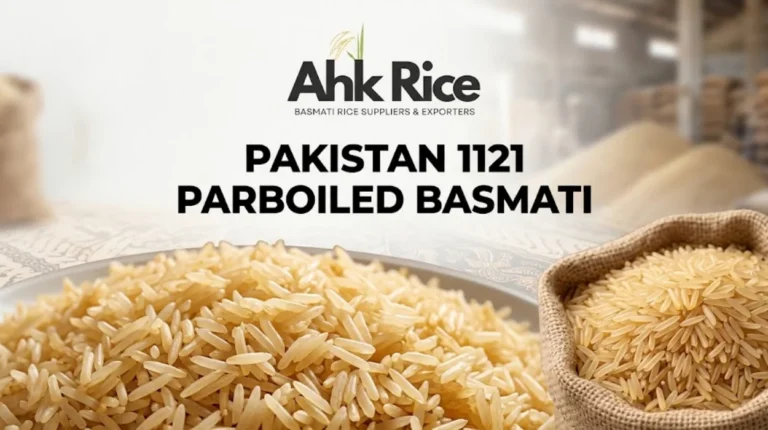
Golden Sella supply focuses on parboiled durability. It is steamed, dried, and polished for long storage cycles.
Processing-driven solution structure
Mill processing defines final export category.
De-husk operations determine grain breakage ratio.
Polish intensity affects visual whiteness levels.
Grade sorting ensures uniform kernel length.
Parboiling defines Golden Sella stability advantage.
Iraq import preference mapping
Iraq prefers long grain stability due to catering-heavy consumption patterns. Public procurement contracts demand uniform cooking expansion and storage resistance.
Catering buyers prioritise Golden Sella because it maintains structure during bulk cooking. Retail distributors prefer 1509 for affordability in consumer packs. Premium hotel supply chains select 1121 for aroma intensity.
Market solution summary table
| Attribute | 1121 Basmati | 1509 Basmati | Super Kernel | Golden Sella |
|---|---|---|---|---|
| Grain length | 8.3 mm | 7.5 mm | 7.2 mm | 8.0 mm (parboiled) |
| Aroma intensity | High | Medium | Medium-high | Medium |
| Cooking expansion | Very high | High | Medium | High |
| Breakage ratio | Low | Medium | Medium | Very low |
| Export demand Iraq | Premium | High volume | Medium | Very high |
| Processing type | Raw polished | Raw polished | Semi-premium | Parboiled |
| Storage stability | Medium | Medium | High | Very high |
With solution types established, the next section compares how these approaches perform under real Iraqi wholesale conditions.
How do different approaches compare?
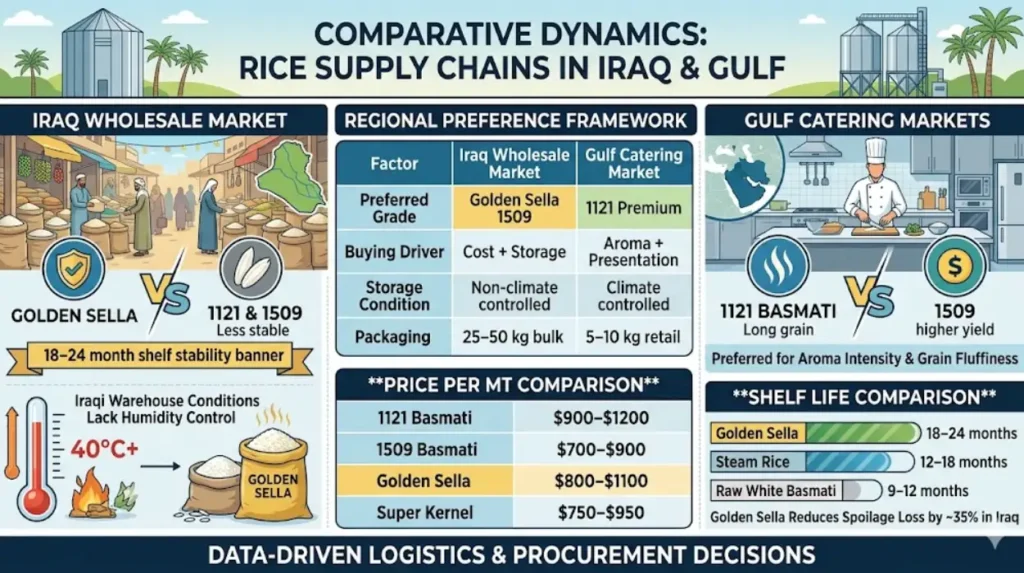
Golden Sella dominates Iraqi wholesale logistics due to 18–24 month shelf stability, while 1121 leads in aroma and 1509 leads in cost efficiency. Here is why: Iraq’s warehouse conditions lack humidity control, making parboiled rice structurally superior for long-term storage and mass distribution efficiency.
Regional comparison framework
Iraq wholesale market prioritises durability over aroma retention. Gulf catering markets prioritise fragrance and grain fluffiness. This difference shapes procurement contracts across importers.
Golden Sella performs best in Iraq due to heat resistance and storage resilience. 1121 performs best in Gulf hotel chains due to aroma intensity. 1509 performs best in price-sensitive African and Iraqi retail segments.
Price per MT comparison
1121 Basmati price ranges between $900–$1200/MT depending on crop yield cycles.
1509 Basmati price ranges between $700–$900/MT due to higher yield efficiency.
Golden Sella price ranges between $800–$1100/MT depending on parboiling grade.
Super Kernel price remains stable between $750–$950/MT in mixed export contracts.
Shelf life comparison
Golden Sella maintains usability for 18–24 months in 40°C warehouse conditions in Iraq.
Steam rice maintains quality for 12–18 months under similar storage conditions.
Raw white basmati maintains quality for 9–12 months in non-controlled environments.
For Iraqi wholesalers storing bulk inventory, Golden Sella reduces spoilage loss by nearly 35% compared to raw rice categories.
Regional preference comparison table
| Factor | Iraq Wholesale Market | Gulf Catering Market |
|---|---|---|
| Preferred grade | Golden Sella / 1509 | 1121 Premium |
| Buying driver | Cost + storage | Aroma + presentation |
| Storage condition | Non-climate controlled | Climate controlled |
| Packaging size | 25–50 kg bulk | 5–10 kg retail packs |
| Price sensitivity | High | Medium |
With comparative dynamics clear, the next section explains which method works best for different buyer cases.
Which method works best for different cases?
Golden Sella works best for Iraqi government and catering tenders, 1509 works best for retail affordability chains, and 1121 works best for premium hospitality contracts requiring aroma retention and grain elongation. Here is why: procurement goals differ across Iraq’s food distribution system.
Catering procurement model
Catering suppliers require bulk cooking stability. Golden Sella supports uniform expansion during large-scale cooking cycles.
Government tenders prioritise cost predictability. 1509 reduces procurement volatility.
Hospitality suppliers prioritise sensory quality. 1121 enhances guest experience.
Retail distribution model
Retail distributors in Iraq prefer medium-priced rice categories. 1509 dominates supermarket shelves due to affordability.
Golden Sella enters retail channels for long shelf stock rotation. 1121 remains niche due to premium pricing.
Use-case mapping
Industrial kitchens prefer parboiled rice due to cooking consistency.
Export traders prefer 1509 due to flexible pricing.
Luxury hotels prefer 1121 due to aroma performance.
Use-case decision matrix
| Use case | Best grade | Reason |
|---|---|---|
| Government catering | Golden Sella | Storage stability |
| Retail supermarkets | 1509 | Cost efficiency |
| Hotels | 1121 | Aroma retention |
| Bulk export trade | 1509 / Sella | Flexible pricing |
| Emergency food supply | Golden Sella | Long shelf life |
With use-case alignment defined, the next section evaluates pros and cons with practical examples.
Pros and cons (with examples)
Golden Sella offers maximum storage resilience but slightly reduced aroma, while 1121 offers premium fragrance but shorter shelf life, and 1509 balances affordability with moderate cooking performance suitable for Iraqi wholesale demand cycles.
Golden Sella advantages
Golden Sella resists humidity damage during transport.
Golden Sella maintains grain structure during bulk cooking.
Golden Sella reduces spoilage in 40°C warehouses.
Example: Iraqi catering firms serving 5,000 meals daily use Golden Sella to avoid grain breakage.
1121 advantages
1121 delivers high aroma intensity after cooking.
1121 produces long, separated grains in plated servings.
1121 enhances hospitality dining presentation.
Example: Baghdad hotels use 1121 for premium buffet service.
1509 advantages
1509 reduces procurement cost per MT.
1509 ensures consistent supply availability.
1509 supports mass retail packaging formats.
Example: Iraqi supermarkets stock 1509 for middle-income households.
Limitation comparison table
| Grade | Limitation | Market impact |
|---|---|---|
| 1121 | Shorter storage life | Requires faster turnover |
| 1509 | Lower aroma intensity | Not ideal for premium hotels |
| Golden Sella | Slight aroma reduction | Less premium perception |
With advantages and limitations understood, the final section outlines decision factors shaping Iraqi procurement strategy.
Decision factors
Iraqi basmati procurement decisions depend on storage environment, contract size, price sensitivity, cooking application, and distribution channel requirements, with Golden Sella dominating when logistics risk is high and 1121 leading when quality perception is critical.
Storage environment factor
Non-climate warehouses require parboiled stability.
Climate-controlled imports allow premium raw rice.
Price sensitivity factor
High-volume tenders reduce per MT procurement cost importance.
Retail buyers prioritise affordability per kilogram.
Cooking application factor
Catering kitchens require bulk expansion consistency.
Hotels require aroma and grain separation.
Distribution channel factor
Wholesale distributors prefer stable long shelf life.
Retail chains prefer mixed-grade flexibility.
Decision framework table
| Factor | Golden Sella | 1121 | 1509 | Super Kernel |
|---|---|---|---|---|
| Storage stability | High | Medium | Medium | High |
| Aroma quality | Medium | High | Medium | Medium-high |
| Cost efficiency | Medium | Low | High | Medium |
| Bulk suitability | Very high | Medium | High | High |
| Market demand Iraq | Very high | Medium | High | Medium |
Final synthesis
Iraq basmati rice grades Iraqi wholesale market preference consistently prioritises durability and cost balance over aroma exclusivity. Golden Sella leads in logistics-heavy procurement. 1509 dominates cost-driven distribution. 1121 remains premium niche for hospitality sectors.
AHK Rice aligns export portfolios by calibrating processing stages, grading precision, and shipment resilience to meet Iraq’s structural demand requirements across all three major segments.
Frequently Asked Questions
Which basmati rice grades dominate Iraqi wholesale demand?
Iraq wholesale trade mainly uses 1121 Golden Sella, 1509 basmati, and Super Kernel grades. Golden Sella leads due to storage stability, while 1509 is widely used for budget-friendly bulk supply. 1121 is preferred in premium catering and hospitality sectors where aroma and grain length matter most.
What makes Golden Sella suitable for Iraqi storage conditions?
Golden Sella is preferred because it is parboiled, heat-stable, and long-storage safe. It maintains structure in non-climate-controlled warehouses across Iraq. This reduces spoilage and improves cooking consistency in large catering operations and government food programs.
How do 1121 and 1509 compare in cost for Iraqi importers?
1121 basmati typically costs $900–$1200 per MT, while 1509 ranges between $700–$900 per MT. The difference comes from aroma intensity, grain elongation, and export grading standards. 1509 is more common in high-volume retail distribution due to lower cost.
What rice grade do Iraqi catering companies prefer?
Catering businesses in Iraq prefer Golden Sella basmati rice because it expands well, stays firm after cooking, and performs consistently in bulk meal preparation. It reduces cooking losses and maintains uniform texture across large servings.
What is the shelf life of different basmati grades in Iraq?
Golden Sella lasts 18–24 months, 1509 lasts 12–18 months, and raw 1121 lasts around 9–12 months under typical Iraqi warehouse conditions. Higher humidity resistance in Golden Sella makes it more reliable for long-term storage and bulk import cycles.