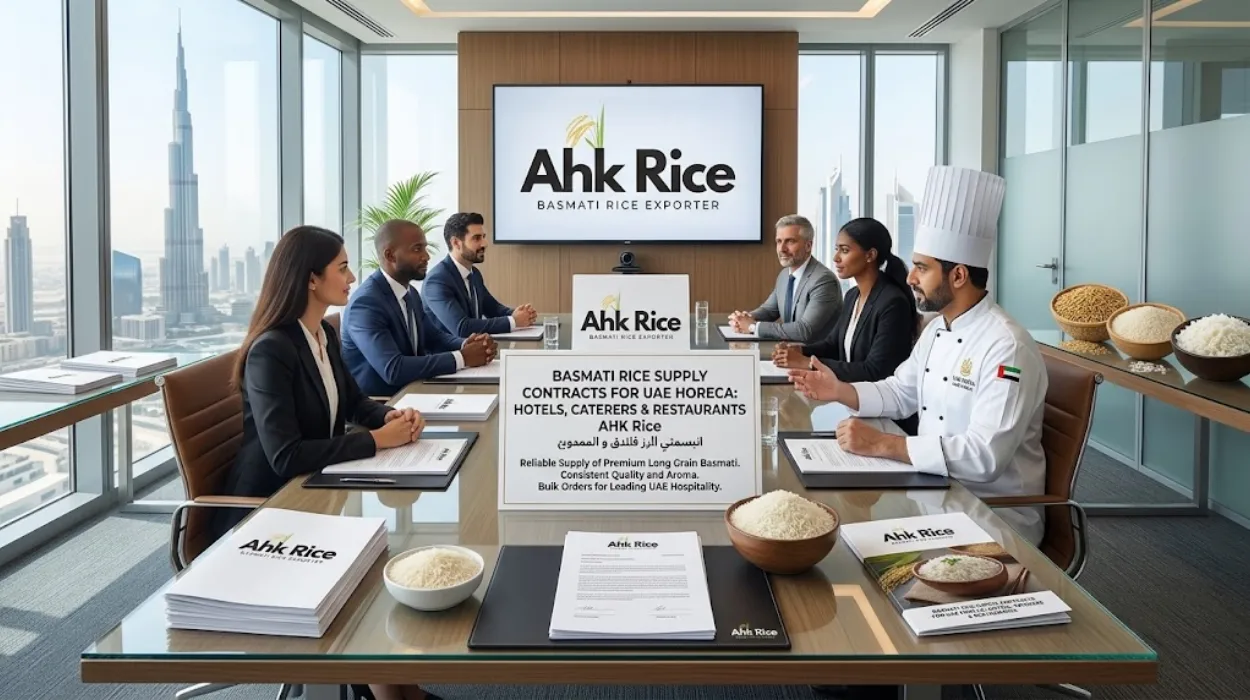
Basmati Rice Supply Contracts for UAE Hotels, Caterers and Restaurants from AHK Rice
UAE hotels, caterers and restaurants need consistent Basmati rice quality, dependable shipment planning and clearly defined commercial terms to maintain foodservice operations. AHK Rice supplies Pakistani Basmati rice for bulk procurement, with options including 1121, Super Kernel and 1509, allowing buyers to match grain characteristics, cooking performance and budget requirements to their menus.
For buyers researching what type of Basmati rice UAE hotels and restaurants use, the next step is to define the required grade, processing method, packing format, shipment volume and delivery terms before requesting a supply quotation. A documented contract helps align the approved sample with the commercial shipment and reduces specification misunderstandings.
What is the best solution for securing a reliable Basmati rice supply contract in the UAE?
The most practical solution is a written supply contract that defines rice variety, processing type, grain specifications, broken percentage, moisture limits, packaging, inspection requirements and delivery terms. Buyers should approve a representative sample before confirming bulk production and shipment.
UAE hospitality businesses face different purchasing requirements. A luxury hotel may prioritise long grains, aroma and consistent presentation, while a catering company may focus on cooking yield, holding performance and cost per serving. A restaurant group may need standardised results across several locations.
A supply contract should identify the product precisely rather than relying on the general term “Basmati rice.” Specify whether the order requires 1121 Steam, 1121 Golden Sella, Super Kernel or 1509. Record the agreed quality parameters and acceptance criteria in the contract or attached specification sheet.
Buyers comparing processing methods can review Basmati rice for UAE HoReCa: Sella vs Steam for bulk cooking and holding time. This comparison helps procurement teams select rice according to menu requirements, batch cooking and service conditions.
For large-volume procurement, AHK Rice can discuss product specifications, packaging options and shipment arrangements with buyers seeking Pakistani Basmati rice for UAE foodservice operations.
Why should UAE HoReCa buyers choose AHK Rice?
AHK Rice offers Pakistani Basmati sourcing with multiple varieties, export-oriented processing, custom packaging and coordinated shipment preparation. Buyers can discuss their required specifications and packaging format before approving a sample and confirming the commercial order.
AHK Rice operates from Punjab, Pakistan, and supplies Pakistani Basmati rice to international markets. Its product range includes 1121, Super Kernel, and 1509 Basmati rice varieties, supporting different procurement priorities across hospitality and food distribution.
The AHK Rice Basmati rice supply service provides a starting point for buyers evaluating products and export requirements. The purchasing discussion should establish the required grade, target volume, destination, packaging and Incoterm before the final quotation is issued.
The supply process should address four operational requirements:
- Product consistency: Define grain length, broken percentage, moisture and processing method against agreed specifications.
- Cooking suitability: Test aroma, elongation, texture and separation using the buyer’s own cooking procedure.
- Packaging control: Confirm bag material, net weight, printed branding and applicable UAE labelling requirements.
- Export coordination: Agree on shipment documentation, inspection arrangements, loading schedules and delivery responsibilities.
These controls matter because a sample that performs well in a kitchen does not automatically establish that a later shipment meets the same specifications. The contract should connect the approved sample, production requirements and inspection criteria.
AHK Rice buyers should also confirm the applicable food safety documentation, certificate requirements and destination-specific import procedures with their UAE importer before shipment.
Which Basmati rice variety should hotels, caterers and restaurants order?
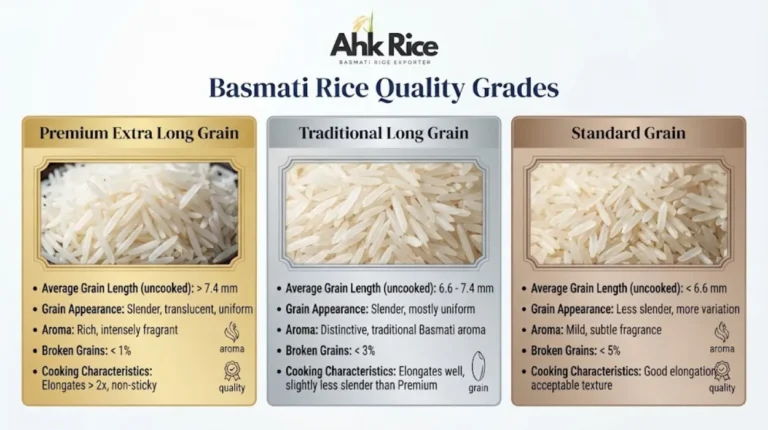
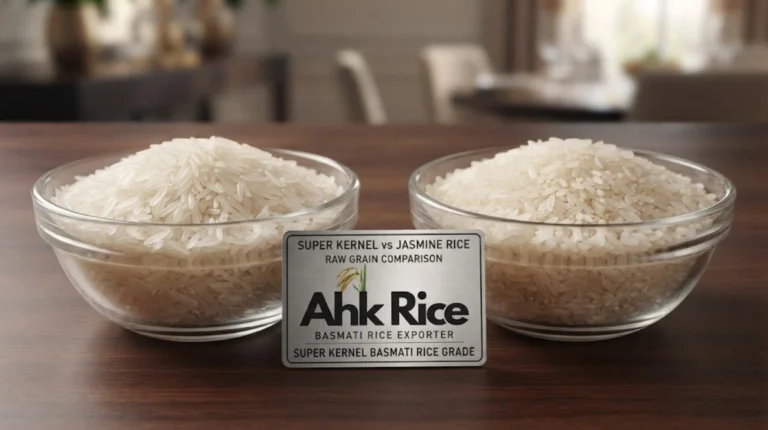
Choose 1121 for premium long-grain presentation, Super Kernel for traditional Basmati aroma and everyday foodservice applications, or 1509 for buyers evaluating yield efficiency and purchasing cost. Confirm the final selection through cooking trials and agreed specifications.
The appropriate variety depends on menu positioning, preparation methods and the expected holding period.
| Rice variety | Procurement priority | Typical application |
|---|---|---|
| 1121 Steam | Long-grain presentation and elongation | Premium hotel menus, biryani and rice platters |
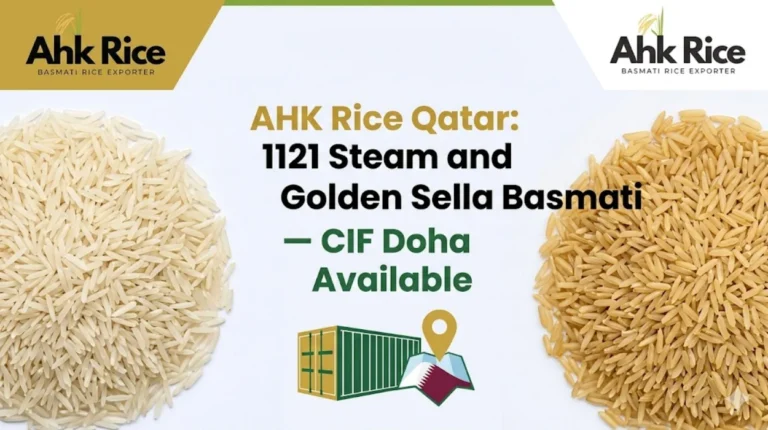
| 1121 Golden Sella | Parboiled grain structure and holding performance | Large-batch catering, buffets and banquet service |
| Super Kernel | Traditional Basmati aroma and familiar eating quality | Restaurants, South Asian menus and foodservice |
| 1509 Steam | Cost-conscious long-grain service | High-volume restaurant operations |
| 1509 Golden Sella | Bulk cooking and operational efficiency | Institutional kitchens and large catering orders |
These are selection guidelines, not guarantees of cooking results. Performance depends on the exact grade, crop, processing conditions, storage and preparation method.
Before awarding a contract, chefs should test the rice using the intended soaking time, water ratio, cooking equipment and holding conditions. A hotel serving individual plated meals may evaluate texture and presentation differently from a caterer holding several trays for a large event.
AHK Rice can discuss the variety and processing format that best matches the buyer’s specification. The contract should identify the selected product clearly and document any limits for broken grains, moisture and other quality parameters.
What results can UAE buyers expect from a properly defined supply contract?
A well-defined contract improves purchasing clarity, batch planning and quality verification by establishing measurable product requirements before shipment. It does not guarantee identical cooking results or a specific delivery date unless the relevant terms are agreed and fulfilled.
The first expected outcome is better specification control. Procurement staff, suppliers and kitchen teams can work from the same product description rather than interpreting quality requirements differently.
The second outcome is more reliable menu planning. When the buyer tests an approved sample and records its cooking performance, the kitchen has a reference for evaluating the delivered lot. This is particularly useful for hotel buffets, catering contracts and restaurant chains.
The third outcome is improved cost visibility. Buyers can calculate the estimated rice cost per serving using the quoted product price, actual cooked yield, portion size and preparation losses. A lower price per metric tonne does not necessarily mean a lower cost per serving if the rice performs poorly under the kitchen’s operating conditions.
For example, a catering company preparing several hundred biryani portions should test both the dry grain quality and the cooked output. The buyer can compare the number of acceptable portions produced from a standard quantity of rice, then use the results to evaluate competing specifications.
AHK Rice should be assessed against the buyer’s documented requirements, sample approval and contract terms. Any inspection, laboratory testing or shipment-specific certificate should be explicitly agreed rather than assumed to be included in every order.
How much does a Basmati rice supply contract from Pakistan to the UAE cost?
The contract price depends on rice variety, processing method, grade, order volume, packaging, inspection requirements, shipment costs and Incoterm. Request a shipment-specific quotation instead of relying on a generic market price or an unverified per-tonne estimate.
A commercial quotation should separate the factors that affect the landed cost.
| Cost factor | What the buyer should confirm |
|---|---|
| Rice grade | Variety, grain length, broken percentage and moisture |
| Processing | Steam, Golden Sella, White or another agreed specification |
| Order volume | Metric tonnes, minimum order and loading quantity |
| Packaging | Bulk bags, retail packs, printed bags and labelling |
| Freight | Sea freight, destination charges and agreed delivery basis |
| Inspection | Third-party inspection, testing and certificates |
| Trade terms | FOB, CFR or CIF, with responsibilities clearly defined |
FOB generally places the main sea freight and insurance arrangements with the buyer, while CIF includes cost, insurance and freight to the named destination port, subject to the agreed contract and applicable Incoterms. CIF does not automatically include every destination charge, customs duty or import clearance cost.
For UAE deliveries, buyers should also budget for applicable port handling, customs clearance, local transportation and any required inspection or regulatory charges. The final landed cost depends on the specific shipment and the importer’s arrangements.
AHK Rice should quote against the destination port, selected variety, packing format, quantity and requested shipment window. Buyers should compare quotations on the same specification and delivery basis to avoid misleading price comparisons.
How does the AHK Rice sample approval process work, and what does it cost?
The sample process starts with a defined product request, followed by sample preparation, dispatch, buyer testing and written approval. The buyer and supplier should agree on courier charges, any applicable certification costs and whether sample expenses are credited against the commercial order.
A practical sample-to-contract process follows six steps.
- Submit the specification. Identify the rice variety, processing type, preferred grain characteristics, packaging and intended kitchen application.
- Confirm sample availability. Agree on the sample quantity, preparation time and whether the sample represents the intended commercial specification.
- Confirm sample costs. Establish the sample price, courier charge, destination handling and any applicable phytosanitary or other documentation fees before dispatch.
- Arrange dispatch. Confirm the delivery address, courier service, required paperwork and responsibility for charges.
- Conduct kitchen trials. Evaluate aroma, grain elongation, texture, separation, cooking yield and holding performance using the intended preparation method.
- Approve the specification in writing. Record the selected product, agreed quality parameters, packaging, volume, price basis and shipment requirements before production or loading.
For eligible sampling requests, AHK Rice has offered up to 20 kg of Super Kernel Basmati rice without a charge for the rice itself, with the buyer covering courier shipping and applicable phytosanitary charges. Buyers must confirm current eligibility, destination restrictions, available quantity and all costs directly before placing a request. This offer should not be assumed to apply to every variety or shipment.
There is no single verified courier or documentation fee that applies to all UAE destinations. Costs vary with parcel weight, service level, route and the documents required. The sample request should therefore include a written cost breakdown.
Written approval is essential. If the buyer’s required grade or specifications change after approval, the contract should state how the revised requirements will be handled.
How many shipping days does Pakistani Basmati rice take to reach the UAE?
Sea freight from Pakistan to the UAE is generally planned in days to a few weeks, depending on the departure port, destination port, sailing schedule and transshipment. Buyers should obtain a current carrier schedule and a separate estimate for clearance and inland delivery.
For initial planning, buyers can use the following indicative windows, not guaranteed transit commitments.
| Shipment stage | Indicative planning allowance |
|---|---|
| Sample courier | Several business days to around two weeks, depending on route and clearance |
| Sea transit to a UAE port | Approximately 3–10 days for some direct or short-route sailings |
| Production and export preparation | Depends on stock availability, processing and packaging |
| UAE port clearance and delivery | Depends on documents, inspections, customs processing and local transport |
These ranges are planning estimates, not confirmed schedules for a particular AHK Rice shipment. Transshipment, vessel availability, port congestion, public holidays and customs checks can extend the overall timeline.
The purchase contract should distinguish production lead time, port cut-off, vessel departure, sea transit, estimated arrival and final delivery. It should also specify which party books freight, obtains insurance where applicable, submits import documentation and pays destination charges.
AHK Rice and the UAE importer should confirm the actual shipment plan before the buyer commits to a hotel opening, catering event or replenishment deadline.
What documents and packaging requirements should UAE importers confirm?
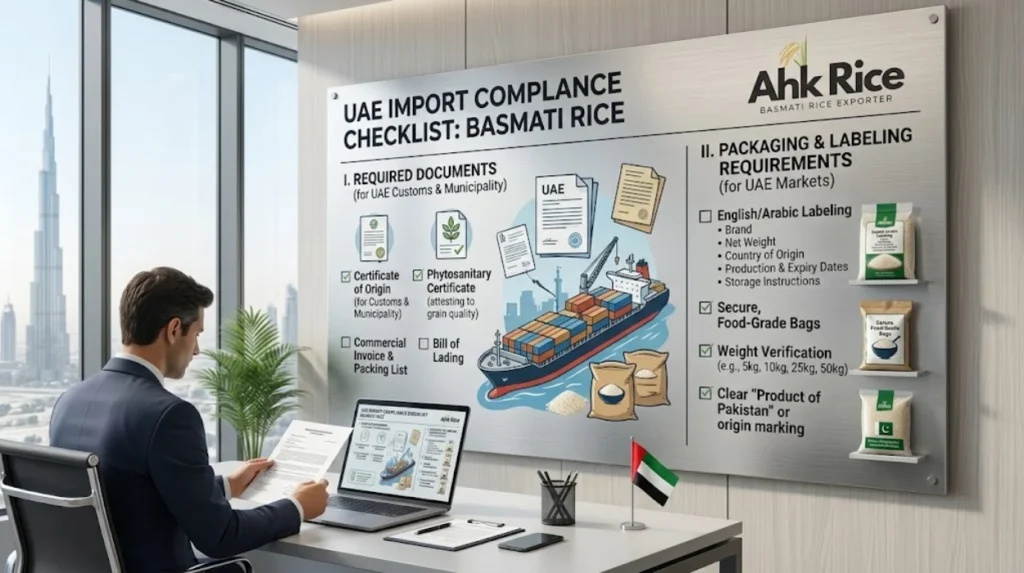
UAE importers should verify the applicable food registration, product labelling, customs documentation and shipment certificates before dispatch. Requirements depend on the product, packaging, importer and current regulations, so the final checklist must be confirmed with the relevant UAE authority.
The commercial file commonly includes the sales contract or purchase order, commercial invoice, packing list and transport document. A certificate of origin, phytosanitary certificate, health documentation or laboratory report may also be required depending on the product and applicable import rules.
For retail or foodservice bags, buyers should confirm the required language, product name, country of origin, net weight, date marking, storage instructions and other mandatory label particulars. UAE-specific requirements should be reviewed before printing large quantities of custom packaging.
Packaging should also suit the distribution channel. Retail buyers may need branded 5 kg or 10 kg packs, while wholesalers and larger foodservice operators may prefer 25 kg or 50 kg bags, subject to product suitability and handling requirements.
AHK Rice and the importer should approve the final artwork, bag specifications and document checklist before production. Any additional testing, certification, inspection or registration requirement should be confirmed early enough to avoid preventable dispatch delays.
How can a UAE hotel, caterer or restaurant start a supply contract with AHK Rice?
Start by submitting your required variety, processing method, monthly or shipment volume, packaging format, destination port and target delivery date. Request a written quotation, arrange a sample where needed and approve the specification before confirming the order.
The buyer should prepare a concise procurement brief covering the following:
- Required variety and processing type.
- Target volume in metric tonnes and expected repeat-order frequency.
- Grain length, broken percentage, moisture and other quality limits.
- Retail or foodservice packaging requirements.
- Destination port and preferred Incoterm.
- Sample quantity, testing requirements and acceptance criteria.
- Required documents, inspection arrangements and delivery deadline.
AHK Rice can then evaluate the requested specification and provide the relevant commercial details for discussion. Before signing, the buyer should check payment terms, production lead time, shipment schedule, quality remedies, inspection procedures and the process for handling discrepancies.
A supply contract works best when every critical requirement is measurable and agreed before shipment. For UAE HoReCa buyers, that means matching the rice to the menu, validating cooking performance, controlling packaging and documentation, and confirming the full cost of delivery.
To request a quotation for your UAE hotel, catering business or restaurant, contact AHK Rice.
Frequently Asked Questions
Which Basmati rice is suitable for UAE hotels?
1121 Steam suits menus prioritising long-grain presentation, while 1121 Golden Sella is often considered for bulk cooking and buffet service. Final selection should depend on cooking trials and the hotel’s specification.
Can UAE restaurants request Basmati rice samples from AHK Rice?
Yes, buyers can enquire about sample availability for product evaluation. Sample quantity, courier charges, documentation and any applicable phytosanitary costs should be confirmed before dispatch.
How long does shipping from Pakistan to the UAE take?
Some sea routes have transit times of approximately 3–10 days, but schedules vary. Production, vessel availability, port clearance and inland delivery must be considered separately.
What affects the price of bulk Basmati rice?
Price depends on variety, processing, grade, order quantity, packaging, inspection, freight and Incoterm. A shipment-specific quotation provides a more useful comparison than a generic price per tonne.
What should a Basmati rice supply contract include?
It should specify the variety, quality limits, packaging, approved sample, price, payment terms, inspection, documents, shipment schedule and responsibilities for delivery and discrepancies.