Cooking Quality Standards for Commercial Golden Sella Rice Buyers
Commercial buyers seeking consistent cooking performance should prioritize standardized quality specifications over price alone because grain uniformity, moisture control, processing quality, and export-grade testing determine yield, appearance, texture, and customer satisfaction far more than small differences in purchase cost.
Foodservice operators, wholesalers, restaurant chains, and private-label distributors evaluate Golden Sella Basmati rice based on measurable quality parameters rather than marketing claims. Buyers that understand these standards reduce complaints, improve inventory consistency, and achieve predictable cooking results across large-scale commercial kitchens. If you are exploring why distributors increasingly prefer this variety, read our guide explaining why many professional buyers select 1509 Golden Sella Basmati rice for foodservice applications before comparing technical specifications.
The first commercial-grade reference in this guide is:
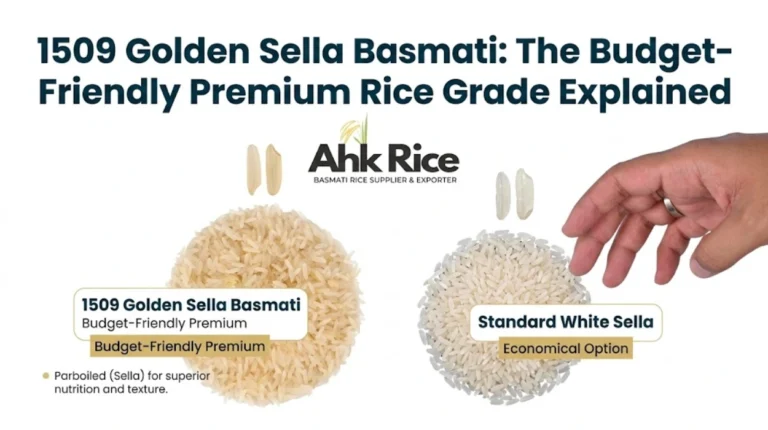
1509 Golden Sella Rice which represents one of the most widely traded premium parboiled Basmati categories exported from Pakistan. AHK Rice processes export-quality Golden Sella rice in Punjab through cleaning, grading, polishing, sorting, packaging, and container loading while complying with internationally accepted export quality standards for 2026.
What cooking quality standards define commercial Golden Sella rice?
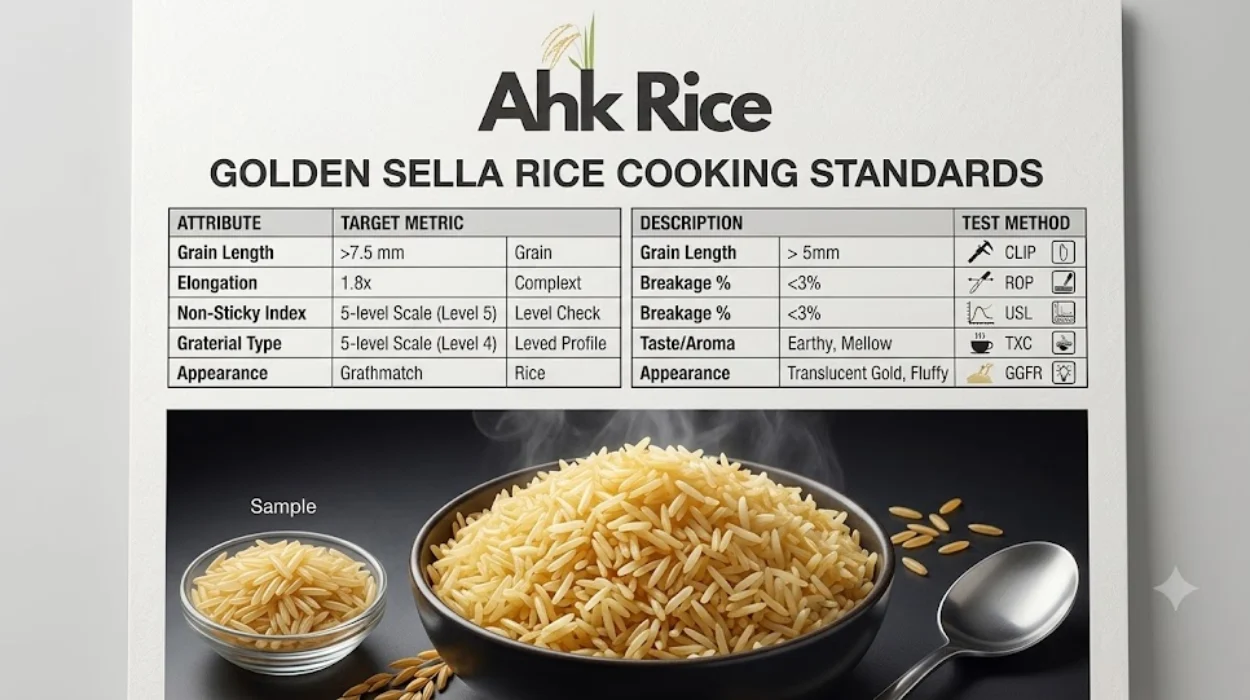
Commercial cooking quality depends on measurable grain specifications including moisture content, grain length, broken percentage, purity, aging, elongation ratio, and cooking consistency. Together, these factors determine restaurant yield, presentation quality, customer satisfaction, storage stability, and overall commercial value across international foodservice and retail markets.
Cooking quality refers to how rice performs after preparation rather than how it appears inside the bag. Professional buyers evaluate finished performance because restaurants, catering companies, hotels, and institutional kitchens purchase repeatability rather than appearance alone.
The most important commercial standards include:
| Specification | Commercial Standard (2026) | Why It Matters |
|---|---|---|
| Grain Length | Long extra-long grains | Premium presentation |
| Moisture | Approximately 12–13% | Better storage stability |
| Broken Grains | Low percentage | Uniform cooking |
| Purity | High varietal purity | Consistent texture |
| Grain Aging | Properly matured | Better aroma and elongation |
| Cooking Elongation | Strong elongation ratio | Attractive serving quality |
| Foreign Matter | Export-grade cleaned | Food safety and quality |
No single specification determines cooking quality. Every parameter influences final plate presentation.
Professional importers normally request laboratory reports before shipment approval.
How do different processing approaches affect cooking quality?
Processing techniques directly influence grain integrity, cooking yield, texture, and shelf stability. Modern automated processing preserves grain quality better than conventional methods because every production stage uses controlled cleaning, grading, sorting, moisture management, and packaging systems that reduce physical damage.
Commercial Golden Sella rice undergoes parboiling before milling.
The major production stages include:
- Paddy selection.
- Cleaning.
- Soaking.
- Steam treatment.
- Drying.
- Milling.
- Polishing.
- Color sorting.
- Length grading.
- Packaging.
Modern optical sorting removes discolored grains.
Length graders improve grain uniformity.
Controlled drying prevents internal stress cracks.
Metal detection improves food safety compliance.
Vacuum or moisture-resistant packaging helps preserve cooking quality during long export transit.
Facilities using automated quality control generally achieve higher consistency than facilities relying primarily on manual inspection.
How do commercial quality standards compare between different purchasing approaches?
Different procurement strategies emphasize different quality priorities. Restaurant distributors focus on cooking consistency, retail brands prioritize visual appearance, industrial food manufacturers value processing efficiency, while government procurement programs typically emphasize compliance, stability, and standardized quality documentation above premium presentation.
Commercial buyers usually compare suppliers using specification sheets instead of promotional brochures.
Specification Comparison Table
| Attribute | Standard Grade | Premium Commercial Grade |
|---|---|---|
| Grain Uniformity | Good | Excellent |
| Broken Percentage | Moderate | Low |
| Moisture Control | Standard | Strictly Controlled |
| Cooking Yield | Good | Higher |
| Grain Elongation | Good | Superior |
| Purity | High | Very High |
| Batch Consistency | Acceptable | Excellent |
Premium grades reduce operational variability.
Lower breakage improves serving appearance.
Uniform moisture reduces cooking adjustments.
Higher purity improves texture consistency.
Consistent batches simplify commercial kitchen operations.
Which cooking quality solution works best for different commercial buyers?
The most suitable quality standard depends on business requirements rather than product category. Foodservice distributors prioritize cooking consistency, retailers prioritize appearance, exporters prioritize compliance documentation, and manufacturers prioritize processing performance to maximize operational efficiency and customer satisfaction simultaneously.
Different buyers require different specifications.
Restaurants
Restaurants value:
- High elongation.
- Uniform texture.
- Low broken grains.
- Fast batch consistency.
Foodservice Distributors
Large distributors prioritize:
- Container consistency.
- Standardized grading.
- Reliable laboratory reports.
- Stable shelf life.
Retail Brands
Retail packaging companies emphasize:
- Attractive grain appearance.
- Uniform color.
- Consumer satisfaction.
- Premium visual presentation.
Industrial Food Manufacturers
Manufacturers often prioritize:
- Predictable hydration.
- Processing efficiency.
- Stable cooking time.
- Large-volume consistency.
Selecting specifications according to application reduces waste and increases customer satisfaction.
How do USA and Middle East markets compare in commercial quality expectations?
Regional markets purchase different commercial grades because customer preferences, foodservice applications, retail positioning, and price expectations differ. Understanding regional demand helps importers select the most appropriate specification rather than simply choosing the highest available grade regardless of application.
USA Market Preferences
The United States commercial market generally favors:
- Long extra-long grains.
- High elongation.
- Low broken percentage.
- Premium packaging.
- Consistent batch performance.
Restaurant distributors commonly prioritize serving appearance because presentation influences customer perception.
Private-label buyers often request customized packaging and multilingual labeling.
Gulf and Middle East Preferences
Many Gulf buyers emphasize:
- Bright Golden Sella appearance.
- Uniform grain size.
- Stable cooking performance.
- Competitive pricing.
- Bulk packaging.
Large catering operations focus heavily on cooking yield because they prepare thousands of servings daily.
Regional Comparison
| Market | Preferred Grade | Typical Priority |
|---|---|---|
| USA | Premium Golden Sella | Elongation and consistency |
| Gulf Region | Premium/Standard Export Grade | Yield and appearance |
Regional specifications influence procurement decisions more than geography alone.
How do prices and shelf life compare across commercial grades?
Premium commercial grades generally command higher prices because they deliver better grain uniformity, cooking performance, and consistency. However, higher purchase costs often reduce operational losses through improved cooking yield, lower waste, and stronger customer satisfaction over extended distribution periods.
Approximate 2026 export pricing varies according to harvest quality, destination, packaging, freight conditions, and order quantity.
Commercial Comparison
| Grade | Approximate FOB Price (USD/MT) | Typical Shelf Life |
|---|---|---|
| Standard Export Grade | 980–1,070 | Up to 24 months |
| Premium Commercial Grade | 1,080–1,220 | Up to 24 months under proper storage |
Shelf life depends on:
- Moisture control.
- Packaging quality.
- Warehouse conditions.
- Temperature.
- Humidity.
- Container handling.
Higher-quality packaging protects rice throughout international shipping.
What are the advantages and disadvantages of different quality strategies?
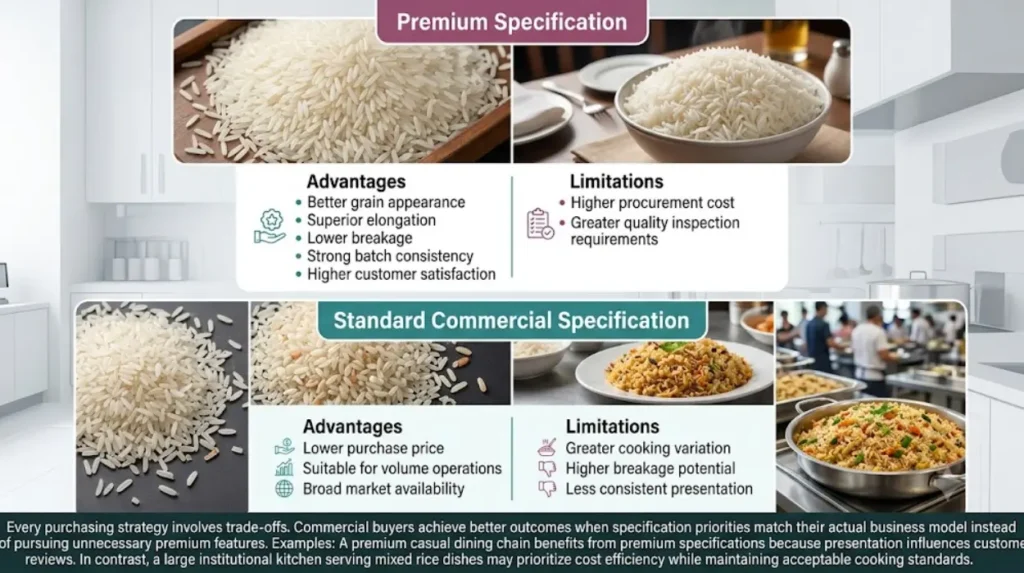
Every purchasing strategy involves trade-offs between acquisition cost, presentation quality, cooking consistency, operational efficiency, and long-term customer satisfaction. Commercial buyers achieve better outcomes when specification priorities match their actual business model instead of pursuing unnecessary premium features.
Premium Specification
Advantages
- Better grain appearance.
- Superior elongation.
- Lower breakage.
- Strong batch consistency.
- Higher customer satisfaction.
Limitations
- Higher procurement cost.
- Greater quality inspection requirements.
Standard Commercial Specification
Advantages
- Lower purchase price.
- Suitable for volume operations.
- Broad market availability.
Limitations
- Greater cooking variation.
- Higher breakage potential.
- Less consistent presentation.
For example, a premium casual dining chain benefits from premium specifications because presentation influences customer reviews. In contrast, a large institutional kitchen serving mixed rice dishes may prioritize cost efficiency while maintaining acceptable cooking standards.
Which decision factors should commercial buyers evaluate before purchasing?
Commercial purchasing decisions should balance measurable quality indicators, supplier capability, documentation, packaging, logistics, consistency, and regional market expectations because long-term supply performance depends on the complete procurement process rather than a single laboratory specification or price quotation.
Professional buyers commonly evaluate:
| Decision Factor | Importance |
|---|---|
| Grain Uniformity | Very High |
| Moisture Control | Very High |
| Export Documentation | High |
| Packaging Options | High |
| Batch Consistency | Very High |
Additional considerations include:
- Third-party inspection availability.
- Production capacity.
- Container loading standards.
- Traceability.
- Food safety documentation.
- Supply continuity.
Reliable suppliers provide repeatable specifications instead of varying quality between shipments.
How can buyers choose the most appropriate cooking quality standard?
The best commercial standard aligns with the intended market, customer expectations, operational requirements, and procurement budget. Buyers that compare measurable specifications instead of promotional claims achieve more consistent cooking performance, lower waste, and stronger long-term purchasing results.
The decision should begin with application rather than product name.
Restaurant distributors require different priorities than supermarket brands.
Institutional catering companies often emphasize cooking yield over luxury presentation.
Private-label retailers frequently prioritize appearance and packaging.
Importers should compare complete specification sheets before evaluating quotations. Read:
Buy 1509 Golden Sella Rice from Pakistan for USA Distribution.
Commercial Decision Framework
| Business Scenario | Recommended Priority | Best Grade | Main Benefit | Cost Focus |
|---|---|---|---|---|
| Premium Restaurants | Elongation | Premium | Plate presentation | Medium |
| Hotel Chains | Consistency | Premium | Uniform service | Medium |
| Retail Brands | Appearance | Premium | Consumer appeal | Medium |
| Institutional Catering | Yield | Standard/Premium | Lower serving cost | High |
| Food Manufacturers | Processing Stability | Standard Commercial | Production efficiency | High |
Understanding cooking quality standards enables buyers to compare suppliers objectively rather than relying on generalized product descriptions. Grain uniformity, moisture management, purity, elongation, and processing consistency collectively determine commercial performance and long-term procurement value. For buyers moving from evaluation to supplier selection, the decision-focused article should be placed after this guide to naturally continue the buying journey.
Frequently Asked Questions
How is Golden Sella Basmati rice different from White Basmati rice for commercial kitchens?
Golden Sella Basmati rice is parboiled before milling, making the grains stronger, less likely to break, and better suited for high-volume commercial cooking. It also offers excellent grain elongation and consistent texture after cooking.
What moisture level is recommended for export-quality Golden Sella rice?
Commercial export-grade Golden Sella rice is typically maintained at 12–13% moisture content. This range helps preserve grain quality during storage and international shipping while supporting consistent cooking performance.
Why is grain elongation important for foodservice buyers?
Grain elongation improves the visual presentation of cooked rice and increases customer satisfaction. Restaurants and catering businesses often prefer rice that becomes longer without becoming sticky after cooking.
How does broken grain percentage affect cooking quality?
A lower broken grain percentage produces a more uniform cooked product, improves presentation, reduces uneven cooking, and increases overall commercial value for restaurants and retail brands.
Which commercial buyers benefit most from premium Golden Sella rice?
Premium Golden Sella rice is ideal for restaurant chains, hotels, catering companies, premium retailers, and private-label brands that require consistent cooking results, attractive appearance, and high customer satisfaction.
What quality documents should importers request before placing an order?
Commercial buyers should request a specification sheet, moisture analysis report, purity report, packing list, phytosanitary certificate (where required), certificate of origin, and third-party inspection report if applicable.
What is the typical shelf life of commercial Golden Sella rice?
When stored in cool, dry conditions and packed in moisture-resistant packaging, commercial Golden Sella rice generally has a shelf life of up to 24 months while maintaining its quality.