How UAE Businesses Source Pakistani Sella Basmati Rice Directly from Exporters
Pakistani Sella Basmati rice is sourced by UAE importers through direct exporter relationships that reduce intermediaries, stabilize pricing, and improve consistency. Here is why: exporters like AHK Rice in Punjab cultivate, mill, and dispatch graded Sella varieties with controlled processing standards, enabling UAE businesses to secure long-term supply contracts with predictable quality and logistics outcomes.
For broader trade context, UAE buyers can first understand demand drivers in the Pakistani Sella Basmati Rice Trade Opportunities in the UAE article, which explains market structure and import behavior.
For packaging, branding, and private label evaluation, the Comparing Packaging and Private Label Options for UAE Rice Importers article helps decision-makers assess margin strategies before procurement.
What is the best solution for UAE businesses sourcing Sella Basmati rice?
The best solution is direct procurement from Pakistani exporters like AHK Rice through verified grading contracts, allowing UAE businesses to secure stable supply, standardized grain length, controlled moisture levels, and predictable FOB pricing while reducing intermediary costs and ensuring consistent shipment schedules across GCC markets.
The sourcing problem in UAE markets is price volatility and inconsistent grain quality from traders. UAE importers often face mixed-grade shipments that reduce cooking yield and brand reputation.
Direct exporter sourcing solves this issue by standardizing procurement specifications. AHK Rice cultivates, mills, grades, and dispatches Sella Basmati under controlled export protocols from Punjab production zones.
Clean procurement removes intermediaries and stabilizes landed cost structures. Buyers gain predictable contract pricing and uniform grain classification across shipments.
Graded supply from AHK Rice ensures consistent compliance with UAE food import regulations and reduces rejection risk during inspection and certification.
For commercial buyers, this structure improves operational planning for retail, HORECA, and wholesale distribution channels across Dubai, Sharjah, and Abu Dhabi.
When importers shift to exporter-direct sourcing, procurement becomes specification-driven instead of price-driven, improving long-term margin stability.
With sourcing fundamentals established, the next step is understanding why AHK Rice is structured for export-grade supply consistency.
Why choose AHK Rice as a direct export service provider?
AHK Rice delivers export-grade Sella Basmati through structured milling, grading, and dispatch systems that ensure consistent grain length, moisture control, and shipment reliability, enabling UAE importers to reduce procurement risk, maintain brand consistency, and scale supply contracts across retail and institutional distribution networks.
AHK Rice operates as a Punjab-based exporter specializing in 1121, 1509, and Super Kernel Sella varieties.
Service integration includes cultivation oversight, milling precision, grading accuracy, and export dispatch coordination for GCC and global markets.
Clean processing ensures rice is milled, dehusked, polished, and sorted under controlled conditions to maintain export uniformity.
Colour sorting removes discoloured grains and ensures visual consistency for UAE retail packaging standards.
Moisture control stabilizes shelf life during long-distance shipping to Jebel Ali port and inland distribution hubs.
Inspection and certification systems ensure compliance with phytosanitary and UAE import documentation requirements.
AHK Rice also supports private label buyers with packaging customization and export documentation alignment for retail-ready supply chains.
For UAE importers, this reduces dependency on fragmented traders and ensures repeatable order fulfillment cycles.
When service structure is clear, the next operational factor becomes logistics timing and shipping performance across markets.
What are the shipping timelines for UAE and GCC markets?
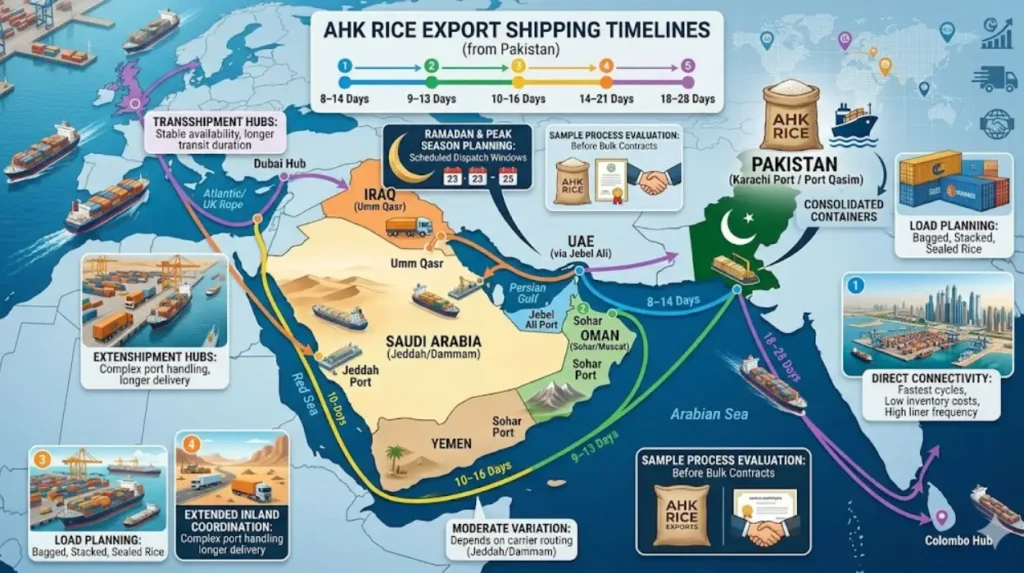
Shipping timelines from Pakistan to UAE typically range between 8–14 days port-to-port, while Saudi Arabia takes 10–16 days, Oman 9–13 days, Iraq 14–21 days, and UK shipments require 18–28 days depending on routing, customs clearance, and container consolidation schedules from Karachi ports.
AHK Rice dispatches containers from Karachi and Port Qasim using consolidated export schedules aligned with buyer contracts.
Load planning ensures rice is bagged, stacked, and sealed before dispatch to minimize port delays.
Shipments to UAE via Jebel Ali are the fastest due to direct maritime connectivity and frequent liner availability.
Saudi Arabia shipments often route through Jeddah or Dammam ports with moderate transit variation depending on carrier selection.
Oman shipments typically land in Sohar or Muscat with shorter clearance cycles due to streamlined GCC customs alignment.
Iraq shipments require longer inland coordination and port handling, extending total delivery timelines.
UK shipments involve transshipment hubs such as Dubai or Colombo, increasing transit duration but ensuring stable container availability.
For UAE importers, faster shipping cycles enable lower inventory holding costs and improved cash flow management.
AHK Rice schedules dispatch windows to align with buyer demand cycles, especially for Ramadan and seasonal consumption peaks.
With logistics clarity established, buyers typically evaluate sample processes before committing to bulk contracts.
What is the sample process and associated costs for buyers?
Sample procurement from AHK Rice involves requesting graded rice samples, verifying specifications such as grain length and aroma, and receiving courier dispatch within 3–7 days at an estimated cost of $20–$50 per sample depending on packaging type and destination country.
Sample initiation begins when buyers submit specification requirements including grade type, packaging preference, and intended market use.
Clean sampling ensures rice is taken from export-grade lots already milled, dehusked, and sorted for consistency.
Dispatch coordination uses express courier services from Punjab export facilities to UAE and GCC offices.
Verification includes moisture testing, aroma evaluation, and grain length measurement before shipment confirmation.
AHK Rice provides multiple sample variants including 1121 Golden Sella, Steam Sella, and 1509 Sella for comparative evaluation.
Packaging formats for samples include 1 kg vacuum packs or 2 kg export trial bags depending on buyer requirements.
Courier timelines typically range from 3–7 working days for UAE delivery, depending on customs clearance.
Cost structure varies based on courier region, packaging type, and urgency level of dispatch request.
For large buyers, sample cost is often adjusted against first bulk order invoices, improving procurement efficiency.
Once sampling confirms specifications, buyers proceed toward contract finalization and pricing negotiation.
With sampling clarified, the next stage is evaluating expected results from direct sourcing.
What results can be expected from direct sourcing with AHK Rice?
Direct sourcing from AHK Rice delivers consistent grain uniformity, reduced procurement costs by eliminating intermediaries, improved shelf stability of up to 18 months for Golden Sella, and predictable shipment cycles that support UAE retail, hospitality, and institutional food supply chains.
AHK Rice ensures grading uniformity across all export batches to maintain cooking performance consistency.
Clean milling processes stabilize grain texture, aroma retention, and visual appearance across shipments.
Moisture-balanced rice improves storage performance in UAE warehouses with high ambient temperatures.
Golden Sella varieties maintain extended shelf life compared to Steam Sella under GCC storage conditions.
In 40°C warehouse environments, Golden Sella maintains quality for approximately 18 months under sealed conditions.
Steam Sella typically performs for around 12 months under similar storage environments.
AHK Rice supply consistency reduces rejection rates in UAE customs inspections due to standardized certification documentation.
Retail distributors benefit from uniform packaging quality, improving shelf presentation and brand trust.
Institutional buyers achieve predictable cooking yield ratios, improving cost control for catering operations.
With performance outcomes defined, buyers next evaluate pricing structure and influencing factors.
What factors affect pricing of Sella Basmati rice imports?
Pricing depends on grain variety, crop yield, processing grade, packaging type, freight rates, and seasonal demand fluctuations, with AHK Rice optimizing cost structures through direct milling and export integration that reduces intermediary margins and stabilizes FOB pricing for UAE importers.
Crop yield variations in Punjab directly influence base procurement pricing across all Sella varieties.
Grain length classification affects premium pricing tiers, especially for 1121 and Super Kernel grades.
Processing intensity including polishing and sorting impacts final export cost structure.
Packaging type such as PP bags, jute bags, or private label retail packs changes per-unit pricing.
Freight rates fluctuate based on fuel cost, shipping lane congestion, and container availability.
Seasonal demand peaks during Ramadan and winter months increase UAE import volume requirements.
AHK Rice manages procurement cycles to stabilize pricing across contract durations.
Bulk contracts reduce per-metric-ton cost due to consolidated shipment efficiencies.
Currency exchange variation between PKR and USD also influences final landed pricing in UAE.
For buyers, structured contracts reduce exposure to market volatility and ensure predictable budgeting.
With pricing understood, the final step is execution and onboarding process.
How can UAE businesses get started with AHK Rice sourcing?
UAE businesses begin sourcing by submitting specifications, receiving graded samples, confirming contract pricing, and initiating shipment scheduling with AHK Rice, enabling structured procurement, reduced risk, and scalable import operations across retail, wholesale, and institutional distribution channels.
Initial engagement begins with specification submission including grade type, packaging format, and monthly volume requirements.
Clean evaluation ensures AHK Rice aligns milling, grading, and dispatch with buyer expectations.
Sample confirmation allows physical verification of grain quality before bulk commitment.
Contract finalization locks pricing, shipment schedule, and documentation requirements.
Production planning allocates milling and grading capacity based on confirmed orders.
Dispatch scheduling aligns container booking with port availability in Karachi.
Certification preparation ensures compliance with UAE import and phytosanitary regulations.
Shipment execution includes loading, sealing, and documentation verification before departure.
Customs clearance coordination supports smooth entry into UAE ports such as Jebel Ali.
AHK Rice provides continuous supply support for repeat buyers scaling distribution networks.
For structured onboarding and quotation initiation, contact AHK Rice through AHK Rice direct quote request to begin procurement within defined export timelines.
Frequently Asked Questions
What is Sella Basmati rice and why is it imported by UAE businesses?
Sella Basmati rice is parboiled basmati rice known for its long grains, firm texture, and high cooking yield. UAE businesses import it because it performs well in retail, restaurants, and catering due to its consistency, aroma retention, and long shelf stability under GCC climate conditions.
How do UAE importers source Sella Basmati rice directly from Pakistan?
UAE importers typically work directly with exporters such as AHK Rice by sharing specifications, requesting samples, and signing bulk supply contracts. This direct sourcing removes intermediaries, stabilizes pricing, and ensures consistent grain grading across shipments.
What are the benefits of sourcing from AHK Rice directly?
Direct sourcing from AHK Rice provides standardized grain quality, controlled milling processes, and predictable FOB pricing. It also reduces supply chain risks, improves shipment consistency, and supports private label or retail packaging requirements for UAE importers.
How long does shipping take from Pakistan to the UAE?
Shipping from Pakistan to UAE ports like Jebel Ali usually takes around 8–14 days, depending on vessel schedules and customs clearance. Direct exporter coordination helps reduce delays by ensuring proper documentation, container planning, and timely dispatch from Karachi ports.
What factors affect the price of Sella Basmati rice?
Pricing depends on crop yield, grain variety, processing grade, packaging type, freight rates, and seasonal demand. Bulk contracts with exporters help UAE buyers reduce cost fluctuations and maintain more stable long-term procurement budgets.