Creamy Sella 1121 Basmati: Which Markets Import the Most of This Grade?
Creamy Sella 1121 Basmati is primarily imported by Gulf countries and West African bulk buyers, with UAE, Saudi Arabia, Iraq, and Benin leading demand. Here is why: these markets prioritize long grain stability, high volume catering supply, and extended shelf life under hot storage conditions, which creamy sella processing delivers consistently.
The export performance of this grade is strongly shaped by processing durability and cooking expansion, especially for institutional buyers handling large-scale catering contracts.
For broader context on how this grade behaves after parboiling and storage, refer to the foundational guide on Creamy Sella Rice Shelf Life and Storage Behavior, which explains how moisture stability and parboiling impact export performance.
AHK Rice produces export-grade 1121 creamy sella basmati through controlled milling and polishing systems, and buyers often evaluate it alongside the BOFU reference AHK Rice 1121 creamy sella FOB Karachi price metric ton 2026, which defines procurement cost structures and trade margins for international buyers.
What are the available solutions for exporting creamy sella 1121 basmati?
Export solutions for creamy sella 1121 basmati include bulk commodity shipment, branded retail packaging, private-label supply contracts, and institutional catering distribution. Here is why: each solution matches different buyer segments based on volume, price sensitivity, and storage infrastructure across import markets in Gulf Asia and West Africa.
Creamy sella 1121 basmati enters trade through structured export channels that align processing, grading, and shipping logistics.
Bulk commodity export channel
- Mill, grade, and sort rice for export specification
- Load, dispatch, and ship in 25–50 kg PP bags
- Inspect, certify, and clear phytosanitary documentation
Bulk supply dominates Iraq, Benin, and Senegal due to large procurement volumes.
Branded retail packaging channel
- Polish, blend, and standardize grain appearance
- Pack, label, and seal consumer packs (1–5 kg)
- Certify, test, and verify retail compliance standards
Retail demand is strong in UK diaspora markets and premium Gulf supermarkets.
Institutional catering contracts
- Procure, parboil, and dry high-volume lots
- Grade, sort, and standardize long grain uniformity
- Dispatch, load, and deliver containerized shipments
Catering buyers in UAE and Saudi Arabia dominate this segment due to large hospitality demand.
Private-label export supply
- Customize, brand, and package according to buyer specifications
- Inspect, test, and certify batch consistency
- Ship, load, and distribute under contract pricing
Private-label supply is growing in Europe and Gulf retail chains.
With export solutions defined, the next step is comparing how each channel performs in trade efficiency and market fit.
How do different approaches compare for 1121 sella export markets?
Bulk commodity export offers the lowest price per metric ton at $720–$880, while branded retail packaging reaches $1,100–$1,450 per metric ton. Here is why: packaging, branding, and certification layers increase unit cost but also improve market positioning in high-value Gulf and European retail channels.
Specification comparison table
| Attribute | Bulk Export | Retail Pack | Catering Supply | Private Label |
|---|---|---|---|---|
| Grain length consistency | 6.8–7.2 mm | 6.9–7.3 mm | 7.0–7.2 mm | 7.0–7.4 mm |
| Moisture level | 12–13% | 12% | 12–12.5% | 12% |
| Packaging type | PP 50 kg | 1–5 kg packs | 25 kg bags | Custom packs |
| Export cost per MT | $720–880 | $1,100–1,450 | $850–1,050 | $1,050–1,300 |
| Shelf life | 16–18 months | 12–14 months | 14–16 months | 14–18 months |
| Target buyers | Traders | Retail chains | Hotels | Brands |
| Certification need | Basic phytosanitary | Full labeling compliance | HACCP + ISO | Private audit |
Bulk export dominates commodity trading because it minimizes processing overhead. Retail packaging dominates premium branding channels because it maximizes shelf visibility.
Process efficiency comparison
- Mill, dehusk, and grade bulk lots quickly
- Polish, sort, and pack retail-ready units slowly
- Certify, inspect, and standardize catering batches consistently
Bulk systems outperform in speed, while retail systems outperform in margin.
With export approaches compared, the next question is how regional demand structures shape method selection.
Which method works best for Gulf Asia vs African markets?
Gulf Asia prefers premium uniform creamy sella at $880–$1,200 per MT, while West Africa prioritizes bulk affordability at $720–$850 per MT. Here is why: Gulf buyers focus on hospitality quality, while African buyers prioritize caloric efficiency and storage resilience in non-climate-controlled warehouses.
Gulf Asia market preference (UAE, Saudi, Qatar, Kuwait, Oman)
Gulf importers prioritize cooking expansion and grain separation.
- Selects parboiled creamy sella for catering stability
- Pays higher per MT for uniform grain appearance
- Stores rice in controlled warehouses up to 18 months
In UAE catering supply chains, creamy sella maintains texture stability for 18 months under controlled humidity conditions, making it ideal for hotel and airline catering systems.
West Africa market preference (Benin, Senegal, Nigeria)
West African importers prioritize affordability and bulk distribution.
- Imports large volume shipments through port warehouses
- Prefers long shelf life under humid conditions
- Minimizes packaging cost per MT
In Benin storage environments, creamy sella retains usability for 14–16 months in non-air-conditioned facilities, reducing spoilage risk compared to raw basmati.
Price per MT comparison
- Gulf Asia: $880–1,200 per MT
- West Africa: $720–850 per MT
- Europe diaspora retail: $1,200–1,450 per MT
With regional preferences defined, the next analysis evaluates trade advantages and limitations of creamy sella in global supply chains.
What are the pros and cons of creamy sella 1121 in global trade?
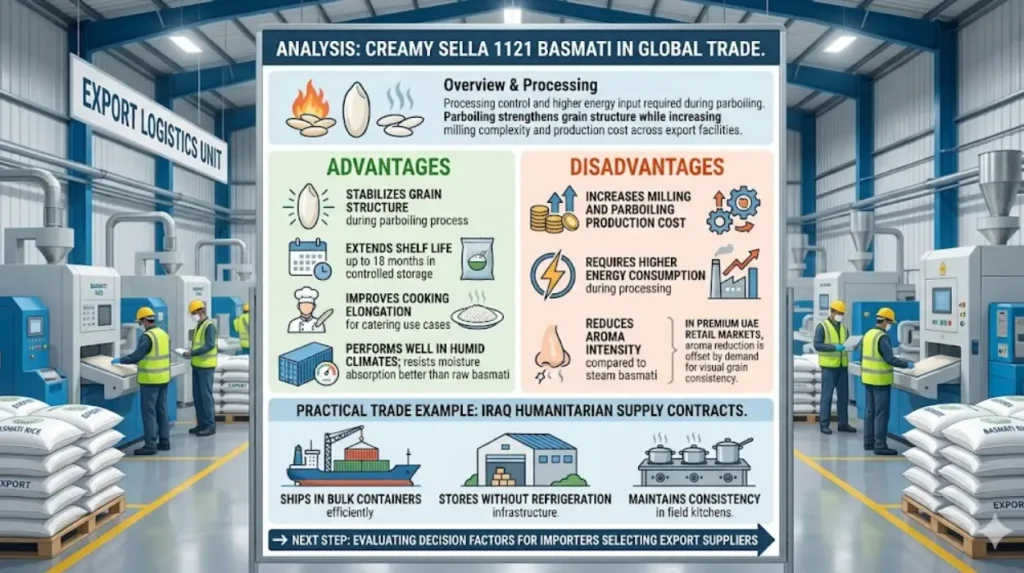
Creamy Sella 1121 Basmati offers high export stability and extended shelf life but requires higher processing control and energy input during parboiling. Here is why: parboiling strengthens grain structure while increasing milling complexity and production cost across export facilities.
Advantages
- Stabilizes grain structure during parboiling process
- Extends shelf life up to 18 months in controlled storage
- Improves cooking elongation for catering use cases
Creamy sella performs well in humid climates because it resists moisture absorption better than raw basmati.
Disadvantages
- Increases milling and parboiling production cost
- Requires higher energy consumption during processing
- Reduces aroma intensity compared to steam basmati
In premium UAE retail markets, aroma reduction is offset by demand for visual grain consistency.
Practical trade example
In Iraq humanitarian supply contracts, creamy sella is preferred because:
- It ships in bulk containers efficiently
- It stores without refrigeration infrastructure
- It maintains consistency in field kitchens
With advantages and limitations understood, the next step is evaluating decision factors for importers selecting export suppliers.
What decision factors determine buyers in sella basmati export markets?
Importers evaluate creamy sella 1121 basmati based on grain uniformity, price per metric ton, shelf life performance, certification compliance, and packaging flexibility. Here is why: these five factors directly influence procurement risk, storage cost, and resale margins across Gulf and African supply chains.
Decision framework table (5 factors)
| Factor | Gulf Asia Priority | Africa Priority | Impact |
|---|---|---|---|
| Grain uniformity | Very high | Medium | Cooking consistency |
| Price per MT | Medium | Very high | Bulk affordability |
| Shelf life | High | Very high | Storage stability |
| Certification | High | Medium | Import clearance |
| Packaging type | High | Medium | Logistics efficiency |
Importer decision logic
- Evaluate grain consistency before supplier selection
- Compare FOB pricing across multiple exporters
- Inspect certification validity for customs clearance
- Assess shelf life under real storage conditions
- Finalize packaging based on distribution model
In Gulf Asia, uniformity drives purchase decisions more than price. In Africa, price sensitivity dominates procurement strategy.
With decision frameworks established, buyers can align sourcing strategy with regional demand patterns and processing specifications.
Where does AHK Rice fit in global creamy sella 1121 trade?
AHK Rice operates integrated milling, grading, and export systems in Punjab, supplying creamy sella 1121 basmati to over 15 countries through structured processing and logistics channels.
The BOFU reference AHK Rice 1121 creamy sella FOB Karachi price metric ton 2026 should be placed in the procurement decision stage section where buyers evaluate pricing and contract terms before final sourcing. This ensures conversion alignment at the exact moment of purchase intent.
Final insight
Creamy sella 1121 basmati trade is defined by regional demand divergence, where Gulf markets prioritize quality consistency and African markets prioritize bulk affordability.
With processing, pricing, and export structure clearly mapped, buyers can match supply strategy to market-specific requirements without operational inefficiency.
Frequently Asked Questions
What is creamy sella 1121 basmati rice used for in export markets?
Creamy sella 1121 basmati rice is mainly used for catering, hospitality, and bulk food distribution in Gulf Asia and West Africa. Here is why: it offers long grain stability, high volume cooking efficiency, and extended shelf life up to 18 months, making it suitable for hotels, airlines, and large institutional kitchens that require consistent performance in mass cooking systems.
Which countries import the most creamy sella 1121 basmati rice?
The highest import demand comes from UAE, Saudi Arabia, Iraq, Benin, Senegal, and Nigeria. Here is why: Gulf countries prioritize premium catering quality, while African countries prioritize affordable bulk supply with strong storage resilience in hot and humid warehouse environments, making creamy sella a balanced export-grade solution for both regions.
How long does creamy sella 1121 basmati rice last in storage?
Creamy sella 1121 basmati rice lasts between 14 to 18 months depending on storage conditions. Here is why: parboiling strengthens grain structure and reduces moisture absorption, allowing it to remain stable in non-climate-controlled warehouses in Africa and extended storage facilities in Gulf logistics hubs without quality breakdown.
What is the difference between creamy sella and steam basmati rice?
Creamy sella is parboiled before milling, while steam basmati is processed using steam heat instead of soaking. Here is why: creamy sella produces firmer grains with longer shelf life and better bulk stability, while steam basmati retains more aroma but has shorter storage durability, making each suitable for different export markets.
Why is creamy sella 1121 basmati preferred in Gulf Asia?
Creamy sella 1121 basmati is preferred in Gulf Asia because it delivers consistent grain elongation, visual appeal, and catering performance. Here is why: hospitality sectors in UAE and Saudi Arabia require rice that maintains structure in buffet systems and large-scale food service operations, where uniform cooking quality is essential.