Creamy Sella Basmati Rice: What Every Importer Needs to Know
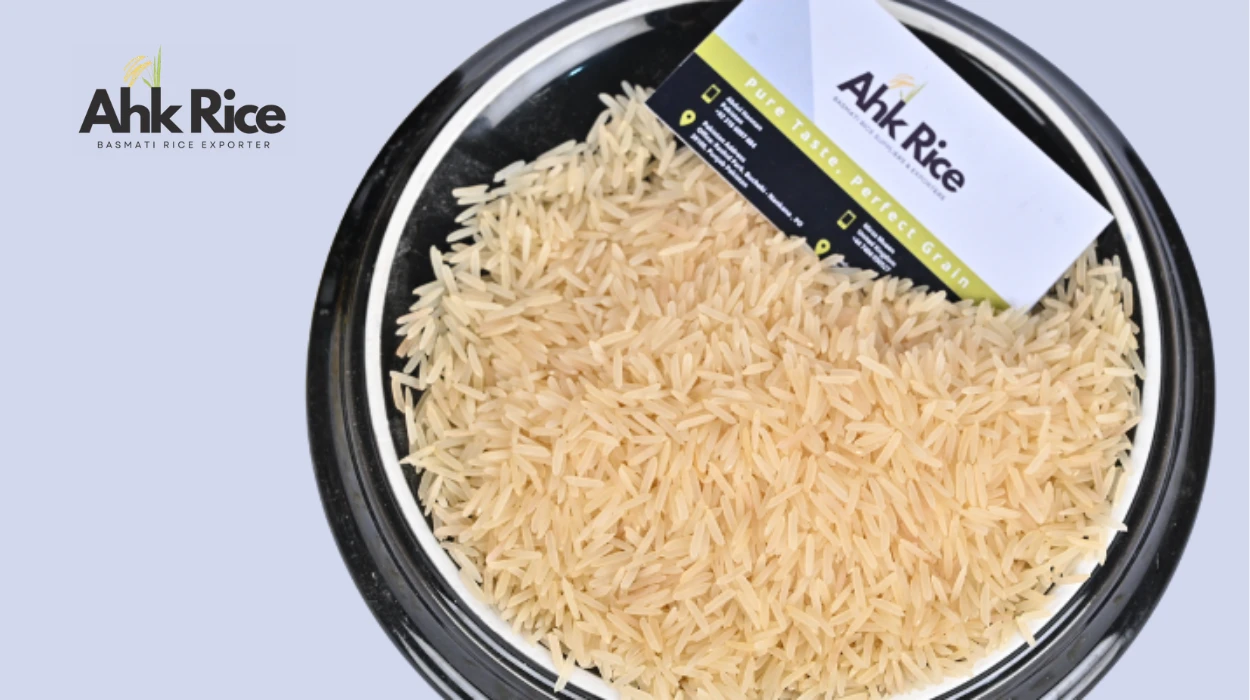
Creamy sella basmati rice is a lightly parboiled long-grain basmati with an off-white creamy tone, 7.8–8.3 mm grain length, and firm cooked texture. Here is why: controlled parboiling gelatinizes starch, strengthens grains, and preserves elongation during cooking.
Creamy sella basmati rice serves importers who need consistency, moderate pricing, and balanced appearance. The product sits between white rice and golden sella in both process intensity and market preference. Buyers in Africa, the Middle East, and Central Asia procure it for retail packs and bulk catering.
What is creamy sella basmati rice?
Creamy sella basmati rice is a lightly parboiled basmati with a creamy off-white color, 8.0±0.3 mm grain length, and low breakage tolerance below 2%. It combines white rice appearance with sella durability for export logistics.
Creamy sella basmati rice results from partial parboiling of paddy before milling. The process preserves the basmati aroma and long grain identity. The color remains creamy instead of golden because soaking temperature and steaming time remain controlled within defined limits.
White sella rice is another industry term for the same category. Importers use both terms interchangeably across markets such as Benin, Yemen, and Afghanistan. Lightly parboiled basmati defines the process level, not the variety.
Basmati varieties used include 1121, Super Kernel, and 1509. Each variety delivers a different elongation ratio and cooked texture. For example, 1121 expands up to 2.5 times its raw length, while 1509 cooks faster with slightly lower elongation.
With the definition established, the next question is how this controlled parboiling process works.
How does creamy sella basmati processing work?
Creamy sella processing uses 9 controlled steps: cleaning, soaking, steaming, drying, dehusking, polishing, grading, color sorting, and packing. Each step targets moisture 12–13%, uniform color, and grain strength for export handling.
Step-by-step process
- Clean the paddy to remove stones, dust, and immature grains
- Soak the paddy at controlled temperature below 65°C
- Steam the soaked paddy to gelatinize starch lightly
- Dry the paddy to reach 12–13% moisture
- Dehusk the grain to remove husk layers
- Polish the rice to achieve a creamy surface
- Grade by length using precision graders
- Sort by color using optical sorters
- Pack in PP or BOPP bags for export
Soaking defines the final color. Lower soaking temperature prevents deep golden tones. Steaming duration remains shorter than golden sella processing. This combination produces the creamy appearance and maintains grain flexibility.
Drying stabilizes the grain. Moisture above 14% causes fungal risk during shipping. Moisture below 11% increases breakage during milling. Export-grade rice maintains 12–13% moisture for optimal balance.
Processing explains the product behavior. The next step is to break down its core components and measurable specifications.
What are the key components and specifications?
Creamy sella basmati specifications include grain length 7.8–8.3 mm, moisture 12–13%, broken grains ≤2%, chalkiness minimal, and foreign matter ≤0.1%. These values define export grade quality.
Core specification components
- Grain length: 7.8–8.3 mm
- Grain width: 1.7–1.9 mm
- Moisture: 12–13%
- Broken grains: ≤2%
- Damage/discoloration: ≤1%
- Foreign matter: ≤0.1%
- Purity: ≥95% single variety
Grain length defines market classification. Premium buyers in Gulf markets require 8.2 mm average length. African retail buyers accept 7.9 mm averages with competitive pricing.
Broken percentage affects pricing directly. A 1% increase in broken grains reduces export value per metric ton. Importers specify maximum 2% broken for retail packs and 5% for bulk distribution.
Purity confirms variety consistency. Mixed varieties reduce cooking uniformity. Buyers request lab test reports before shipment to verify purity levels.
Specifications define measurable quality. The next question is why importers choose creamy sella over other types.
What are the benefits of creamy sella basmati rice?
Creamy sella basmati delivers higher yield after cooking, low breakage during transport, and balanced appearance between white and golden rice. These benefits reduce losses and improve retail acceptance across multiple markets.
Creamy sella basmati increases cooked volume by 1.8–2.2 times. This yield benefits catering businesses and institutional buyers. Restaurants in Saudi Arabia and Iraq prefer this range for portion control.
Grain strength improves due to partial gelatinization. Transport damage reduces significantly compared to raw white rice. Long-distance shipping to West Africa maintains quality without excessive breakage.
Color neutrality supports wider acceptance. Some markets reject golden tones due to local preferences. Creamy sella meets demand where consumers prefer lighter rice without losing durability.
Shelf life extends up to 18 months under proper storage. Temperature-controlled warehouses at 25–30°C maintain quality without discoloration. This duration supports bulk import cycles.
Benefits explain demand patterns. The next step is to identify where and how importers use this product.
Where is creamy sella basmati rice used?
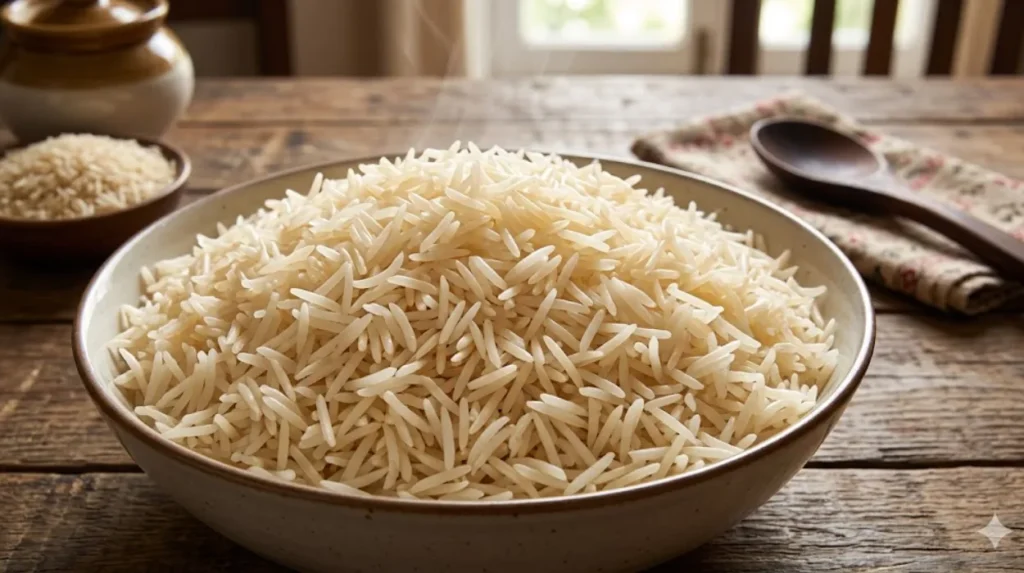
Creamy sella basmati is used in retail packaging, catering supply, and government tenders across Africa, the Middle East, and Central Asia. Its balanced profile fits both premium and mid-range segments.
Use cases by market
Retail packaging
Retail brands pack creamy sella in 5 kg, 10 kg, and 25 kg bags. Markets include Benin, Senegal, and Yemen. Consumers prefer its light color and long grain look.
Catering and food service
Hotels and restaurants use creamy sella for biryani, pulao, and plain rice dishes. The grain remains separate after cooking. Bulk buyers prefer 25 kg and 50 kg packaging.
Government tenders
Public procurement agencies import creamy sella for food distribution programs. The rice offers cost efficiency and storage stability. Countries include Afghanistan and Sudan.
Cooking performance defines these use cases. Creamy sella cooking maintains grain separation. Water absorption ratio ranges between 1:2 and 1:2.5 depending on soaking time.
Use cases clarify demand. The next section addresses common problems and misconceptions importers face.
What problems or misconceptions exist about creamy sella basmati?
Common misconceptions include confusing creamy sella with white rice, assuming lower quality due to lighter color, and ignoring moisture specifications, which leads to storage and cooking issues.
Misconception 1: Creamy sella equals white rice
White rice undergoes no parboiling. Creamy sella undergoes partial parboiling. The difference affects cooking strength and shelf life. Creamy sella resists breakage better.
Misconception 2: Lighter color means lower quality
Color reflects processing intensity, not quality. Controlled parboiling produces creamy color intentionally. Quality depends on grain length, purity, and moisture levels.
Misconception 3: Moisture does not affect imports
Moisture directly affects storage stability. Rice above 14% moisture develops mold during shipping. Rice below 11% breaks during milling. Importers must verify lab reports before shipment.
Misconception 4: All basmati behaves the same
Different varieties produce different results. 1121 delivers higher elongation. Super Kernel provides stronger aroma. 1509 cooks faster. Importers must match variety to market demand.
Misconception 5: Cooking method does not matter
Cooking method affects final texture. Soak the rice for 20–30 minutes. Use a 1:2 water ratio. Cook on controlled heat. These steps ensure proper elongation and separation.
Problems highlight decision risks. The next step is to connect creamy sella with comparative understanding for buyers.
How does creamy sella compare with other basmati types?
Creamy sella sits between white rice and golden sella in both processing intensity and price range. It offers moderate durability, lighter color, and balanced cooking performance compared to alternatives.
White rice offers the lightest color but lowest durability. It breaks more during transport. Golden sella offers maximum strength but darker color. Creamy sella balances both properties.
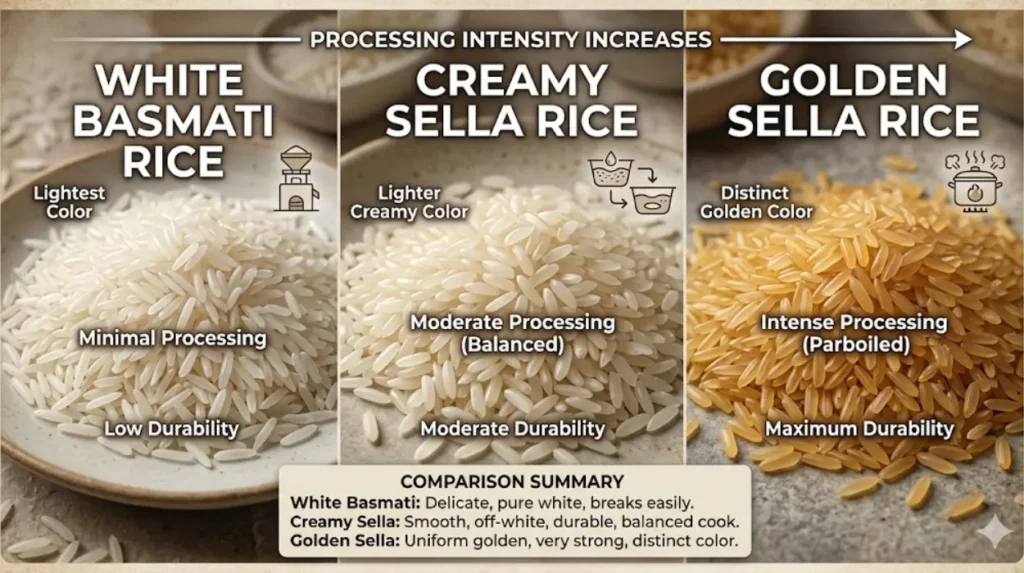
Price positioning reflects this balance. Creamy sella costs higher than white rice and lower than golden sella. Importers choose based on target consumer preference and logistics conditions.
Shelf life comparison shows variation. Golden sella lasts up to 24 months. Creamy sella maintains quality for 18 months. White rice requires consumption within 12 months under similar conditions.
For a detailed comparison of price and quality differences, refer to read the analysis:
1121 creamy sella vs golden sella price quality
With comparison established, the final step is understanding how importers should evaluate this product before procurement.
How should importers evaluate creamy sella basmati rice?
Importers must evaluate lab reports, physical inspection, cooking tests, and supplier certifications before procurement. These steps ensure compliance with specifications and reduce shipment risk.
Evaluation checklist
- Inspect grain length using calibrated measurement tools
- Test moisture content using digital moisture meters
- Verify broken percentage through sample analysis
- Conduct cooking test for elongation and texture
- Review purity through laboratory certification
Laboratory reports confirm compliance. Third-party inspection agencies verify shipment quality before loading. This step prevents disputes at destination ports.
Cooking tests provide practical validation. Importers cook 100 grams of rice under standard conditions. The test measures elongation ratio, aroma, and grain separation.
Documentation supports compliance. Required documents include phytosanitary certificate, certificate of origin, fumigation certificate, and quality inspection report.
Evaluation completes the buyer knowledge cycle. Importers now understand what creamy sella basmati rice is, how it works, and how to assess it.
Frequently Asked Questions
What is the difference between creamy sella and white sella rice?
Creamy sella rice is lightly parboiled, while white rice is not parboiled at all. This difference creates stronger grains, longer shelf life, and lower breakage in creamy sella compared to white rice. Creamy sella undergoes controlled soaking and steaming. This step strengthens the grain structure. White rice skips this process, so it breaks more during transport and cooking. Importers choose based on durability needs.
Which basmati variety is best for creamy sella processing?
1121 basmati is the preferred variety for creamy sella due to 8.2–8.4 mm grain length and high elongation up to 2.5x after cooking. Super Kernel and 1509 serve mid-range and fast-cooking segments. 1121 delivers premium appearance and cooking performance. Super Kernel provides stronger aroma. 1509 cooks faster and suits price-sensitive markets. Selection depends on target market demand.
How long can creamy sella basmati rice be stored?
Creamy sella basmati rice maintains quality for 18 months at 25–30°C storage conditions with moisture controlled at 12–13%. Proper storage prevents discoloration and fungal growth. Temperature and humidity directly affect shelf life. Warehouses must remain dry and ventilated. Use pallets to avoid floor moisture contact. These steps ensure stable export storage.
What is the ideal cooking method for creamy sella basmati rice?
Soak creamy sella for 20–30 minutes, cook with a 1:2 water ratio, and maintain medium heat to achieve separate, elongated grains with firm texture. Soaking hydrates the grain evenly. Controlled heat prevents overcooking. Excess water reduces grain separation. This method delivers consistent results across commercial kitchens and households.
Which countries import creamy sella basmati rice the most?
Major importers include Benin, Senegal, Yemen, Afghanistan, and Saudi Arabia, driven by retail demand, catering use, and government procurement programs (source: REAP export data, December 2025). African markets prefer competitive pricing and bulk volumes. Middle Eastern markets focus on grain length and appearance. Central Asian buyers prioritize shelf life and transport durability.