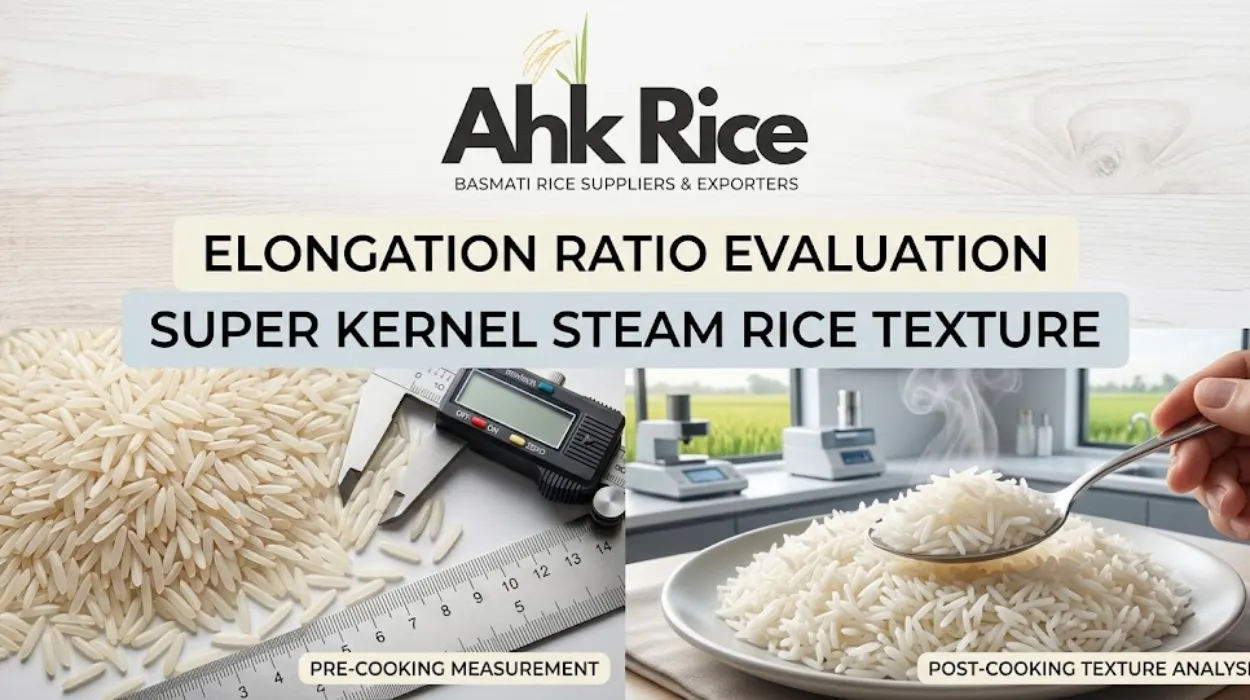
Evaluating Elongation Ratio and Texture of Super Kernel Steam Rice
Super Kernel Steam Rice is best evaluated by cooked-grain elongation, post-cooking texture, broken-grain control, and consistency between batches, not by raw grain length alone. For buyers choosing the right grade, the critical question is how reliably the grain extends, separates, and retains its structure after cooking.
Super Kernel is a traditional Pakistani Basmati variety grown primarily in Punjab. It has an average raw grain length around 7.2 mm, while current commercial specifications commonly place cooked grain at 16 mm or more. Export specifications vary by mill, so buyers should compare the exact contract specification rather than treat “Super Kernel” as a single universal grade.
For background on why cooked performance remains stable, the article:
What makes Super Kernel Steam Rice consistent after cooking provides the educational foundation for evaluating elongation, texture, moisture, and processing.
What are the available solutions for improving Super Kernel Steam Rice elongation and texture?
The main solutions are controlled steam processing, precise moisture management, careful milling, low-broken grading, optical sorting, and standardized cooking tests; together, these controls determine whether Super Kernel develops length, separation, firmness, and a consistent bite. Raw grain size establishes potential, but processing determines how that potential appears after cooking.
Super Kernel Steam Rice uses a light steaming treatment rather than the more intensive hydrothermal treatment associated with Sella or parboiled rice. The objective is to strengthen the kernel while retaining the white appearance, aroma, and comparatively soft eating quality expected from steam rice. This creates a texture positioned between raw white rice and firmer Sella rice.
The first solution is raw-material selection. Uniform paddy reduces variation in grain maturity and kernel structure. A buyer should check average grain length, broken percentage, chalky grains, foreign matter, moisture, and crop information before evaluating the finished steam rice.
The second solution is controlled steaming. Excessive treatment can push the texture toward a harder, more parboiled character. Insufficient control can reduce kernel strength and increase cooking breakage. A consistent steam cycle therefore matters when the target is a firm but not excessively hard cooked grain.
The third solution is moisture control. Current commercial Super Kernel specifications commonly place moisture around 12–14%, although individual contracts may specify tighter limits. One current Super Kernel Steam specification lists a maximum of 12%, while another lists 12.5%.
The fourth solution is milling and grading. Well-milled, polished kernels with controlled broken grains provide a more uniform cooking result. Current Super Kernel Steam specifications commonly show 0–3% broken depending on the supplier and grade.
The fifth solution is cooking-performance testing. Buyers should cook a representative sample using a controlled water ratio, cooking time, resting period, and serving temperature. The result should be assessed for cooked length, elongation ratio, firmness, stickiness, breakage, aroma, and visual separation.
How do different Super Kernel approaches compare?
Steam processing gives Super Kernel a balanced texture, while white-milled rice emphasizes softness and natural aroma and Sella emphasizes maximum firmness and grain separation; grade selection therefore depends on the required elongation, bite, cooking method, and customer segment. No single processing method is optimal for every market.
| Attribute | Super Kernel Steam | Super Kernel White | Super Kernel Sella |
|---|---|---|---|
| Processing | Light steam treatment | Raw milled | Parboiled/steam-treated before milling |
| Raw grain length | About 7.0–7.2 mm | About 7.2 mm | About 7.2 mm |
| Cooked elongation | Typically 16 mm+ target in current commercial specs | Around 16 mm+ in current commercial references | Strong expansion with firm structure |
| Texture | Firm, fluffy, moderately soft | Softer, fluffy, aromatic | Firmest and most separate |
| Typical broken specification | Up to about 2–3% | Up to about 2% | Often 0–2% |
| Moisture specification | Commonly about 12–12.5% max | Commonly about 13.5–14% max | Commonly about 12% max |
| Best use case | Foodservice, biryani, retail requiring balanced texture | Retail and dishes favoring softer aromatic rice | High-volume foodservice requiring firm separation |
The table shows why elongation ratio should not be treated as a standalone quality metric. A grain can become longer after cooking but still fail a foodservice requirement if it becomes too soft, sticky, or fragile during holding.
Elongation ratio is generally evaluated by comparing cooked grain length with raw grain length. For example, a 7.2 mm raw grain reaching 16 mm after cooking has an elongation ratio of approximately 2.22 times. This calculation is useful for comparison, but the buyer should also record the percentage of grains that reach the target rather than relying on the longest individual kernels.
E=\frac{L_c}{L_r}
Here, (L_c) represents cooked grain length and (L_r) represents raw grain length. A stronger specification evaluates the average cooked length across a sample and then checks the distribution around that average.
For Super Kernel Steam Rice, this distinction matters because a visually impressive sample can hide inconsistent kernels. If only a small percentage reaches the longest measurement, the batch may not deliver the same plate presentation at commercial scale.
Which method works best for different cases?
Super Kernel Steam is the strongest choice when buyers need a balance between elongation, aroma, firmness, and manageable cost; white Super Kernel suits softer-texture retail applications, while Sella suits buyers prioritizing maximum separation and holding strength. The correct grade follows the cooking requirement.
Which grade suits GCC foodservice buyers?
GCC means the Gulf Cooperation Council, covering Bahrain, Kuwait, Oman, Qatar, Saudi Arabia, and the United Arab Emirates. These markets have strong demand for Basmati rice in biryani, pulao, catering, restaurants, and retail.
Super Kernel and 1121 are established Basmati choices in the GCC. Current market information lists Super Kernel among popular UAE imports, while Saudi Arabia also lists Super Kernel alongside 1121 Steam and Sella grades.
For GCC foodservice, Super Kernel Steam fits applications where the buyer wants visible elongation without the harder texture associated with heavily parboiled rice. A target around 16 mm cooked length, controlled breakage, and a firm but tender bite gives a practical balance for biryani and large-batch cooking.
For Saudi or Iraqi-style applications where holding and grain separation dominate, Sella can be stronger. For premium retail where natural aroma and a softer cooked mouthfeel are more important, white Super Kernel can be more appropriate.
Which grade suits USA wholesale distribution?
The USA market includes ethnic grocery, specialty food, restaurant, and wholesale distribution channels. Pakistani Basmati sold in the United States must meet applicable FDA requirements, while importers covered by the Foreign Supplier Verification Program must maintain the required supplier-verification controls.
For USA wholesale, Super Kernel Steam works when the distributor needs consistent cooked texture and recognizable Basmati aroma without positioning the product exclusively around extra-long grain length. If the retail proposition depends heavily on maximum visual elongation, 1121 Steam can provide a stronger long-grain presentation because current references place 1121 at about 8.3 mm raw and 22 mm+ cooked, compared with approximately 7.2 mm raw and 18 mm+ cooked for Super Kernel in one current commercial comparison.
This difference creates a useful grade decision. Choose Super Kernel when the product needs classic Basmati character, balanced elongation, and competitive premium positioning. Choose 1121 when the cooked grain length itself is a central selling feature.
What are the current price differences between the two regions?
FOB Karachi pricing provides the cleanest 2026 comparison because freight and destination charges differ by market; current Super Kernel Basmati indications sit around $1,165–$1,205 per metric ton, while GCC freight is materially shorter than USA ocean transit and therefore usually creates a lower logistics burden. Exact landed cost requires a destination-specific quote.
Current July 2026 commercial data places Super Kernel Basmati at approximately $1,165–$1,205/MT FOB Karachi. This is a Pakistan-origin export price before destination freight, insurance, duties, port handling, and inland delivery.
| Market region | Grade preference | Indicative Super Kernel price basis | Logistics consideration |
| GCC / Middle East | Super Kernel Steam, Super Kernel White, 1121 Steam/Sella | About $1,165–$1,205/MT FOB Karachi | Jebel Ali routes can be around 4–10 days from Karachi |
| USA | Super Kernel for ethnic wholesale; 1121 Steam for stronger elongation positioning | About $1,165–$1,205/MT FOB Karachi | USA ocean transit is substantially longer and destination costs must be added |
The FOB range should not be interpreted as a fixed USA or GCC landed price. Current UAE trade references list Super Kernel at the same FOB basis while leaving CNF freight subject to quotation. Current USA references similarly require freight to be quoted according to the destination port and vessel conditions.
What are the pros and cons of each Super Kernel grade?
Super Kernel Steam offers the most balanced texture-to-elongation profile, but it does not deliver the maximum grain length of 1121 or the maximum firmness of Sella; white rice offers softer eating quality, while Sella provides stronger separation and holding performance. The right grade depends on the final dish.
What are the advantages of Super Kernel Steam?
The primary advantage is balance. The grain receives enough treatment to improve structural strength while retaining the white appearance and aromatic profile associated with Basmati.
For biryani, catering, and restaurant production, this balance is useful. The grain can elongate visibly while maintaining a firm bite. The product also fits buyers who do not want the golden color or harder texture associated with Sella.
Another advantage is commercial consistency. A controlled specification for moisture, broken percentage, grain length, and cooked performance allows buyers to compare supplier samples more objectively.
What are the limitations of Super Kernel Steam?
Super Kernel Steam is not the best choice when the buyer’s primary requirement is maximum visual elongation. 1121 provides a longer raw kernel and a greater cooked-length target in current commercial specifications.
It is also not the strongest option for applications requiring prolonged hot holding where maximum firmness and separation are essential. Sella has an advantage in that environment because parboiling strengthens the grain more extensively.
The other limitation is specification variation. Different exporters publish different moisture, broken, and cooked-length specifications. A buyer should therefore approve a physical sample and written specification together.
What factors should buyers use to choose the right grade?
Buyers should rank cooked elongation first, texture second, broken percentage third, then moisture, market positioning, price, and holding performance; this sequence prevents a low purchase price or attractive raw grain from overriding the actual cooking requirements of the finished product. The decision should be specification-led.
| Decision factor | What to check | Best interpretation |
| 1. Elongation | Raw vs cooked average length | Select the grade matching the required visual expansion |
| 2. Texture | Firmness, softness, stickiness after resting | Match texture to restaurant, retail, or catering use |
| 3. Broken percentage | Contract maximum and actual sample result | Lower breakage supports better presentation and yield |
| 4. Moisture | Certificate and pre-shipment test | Consistent moisture supports predictable storage and cooking |
| 5. Holding performance | Texture after 30–60 minutes | Critical for catering, restaurants, and buffet service |
A buyer should request a retained sample, meaning a sealed reference sample kept for comparison with the shipped lot. The buyer should also request the product specification, crop information, moisture result, broken-grain result, and cooking-test protocol.
The cooking test should use the same water ratio, soaking period, cooking temperature, resting time, and serving conditions for every candidate. Otherwise, the test compares cooking methods rather than rice grades.
For elongation, measure at least 10 representative grains or use a larger standardized sample for commercial approval. Record raw average length, cooked average length, percentage of broken cooked grains, and the visual separation of the cooked batch. This produces a more useful evaluation than photographing a few exceptionally long grains.
Shelf life also belongs in the decision. Under suitable dry, cool, clean, pest-controlled storage, commercially packed milled rice can remain stable for an extended period, but shelf life is not a single fixed number determined by variety alone. Packaging, moisture, warehouse conditions, oxygen exposure, pest control, and storage temperature all affect quality retention.
For the two main regions, the practical shelf-life decision is therefore about storage resilience and distribution duration rather than assigning an artificial region-specific shelf-life number. GCC distribution often has shorter ocean transit from Pakistan, while USA distribution involves longer international logistics. Current references indicate approximately 4–10 days to Jebel Ali and roughly 24–40 days by sea to New York or Los Angeles, depending on route and vessel conditions.
A buyer serving fast-moving GCC foodservice can prioritize fresh crop turnover and cooking performance. A USA wholesaler should place greater emphasis on moisture control, packaging integrity, container conditions, warehouse storage, and documented quality at loading because the supply chain is longer.
Which Super Kernel grade should a buyer choose?
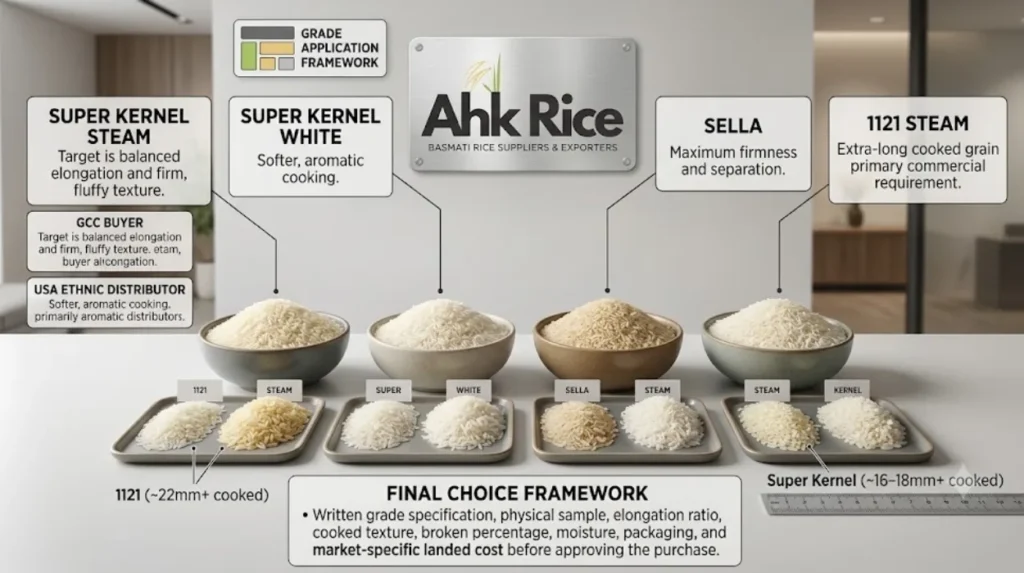
Choose Super Kernel Steam when the target is balanced elongation and firm, fluffy texture; choose Super Kernel White for softer aromatic cooking, Sella for maximum firmness and separation, and 1121 Steam when extra-long cooked grain is the primary commercial requirement. This framework connects grade choice directly to the final application.
For a GCC restaurant or catering buyer, Super Kernel Steam is the logical grade when the required result is aromatic rice with visible elongation and a firm but tender bite. For a USA ethnic wholesale distributor, it is suitable when classic Basmati identity and balanced texture matter more than maximum grain length.
A buyer should move to 1121 Steam when the product specification requires a substantially longer cooked grain. Current commercial references place 1121 at approximately 22 mm+ cooked compared with around 16–18 mm+ for Super Kernel depending on the specification.
The final choice should never be made from the variety name alone. Compare the written grade specification, physical sample, elongation ratio, cooked texture, broken percentage, moisture, packaging, and market-specific landed cost before approving the purchase.
For buyers moving from evaluation to procurement, the next decision-focused resource is:
Buying Super Kernel Steam Rice for USA wholesale distribution, where the evaluation can be translated into a wholesale sourcing decision.
Frequently Asked Questions
What is the ideal cooked elongation ratio for Super Kernel Steam Rice?
Super Kernel Steam Rice commonly reaches around 16–18 mm or more after cooking from a raw grain length of approximately 7.0–7.2 mm. The exact elongation ratio depends on the grade specification and cooking method.
How is the elongation ratio of Super Kernel Steam Rice calculated?
Elongation ratio is calculated by dividing the average cooked grain length by the average raw grain length. For example, a 7.2 mm raw grain reaching 16 mm after cooking has an elongation ratio of approximately 2.22 times.
What texture does Super Kernel Steam Rice have after cooking?
Super Kernel Steam Rice typically produces a firm, fluffy texture with separated grains. It provides more structural strength than white Super Kernel while remaining less firm than heavily parboiled Sella rice.
Is Super Kernel Steam better than Super Kernel White Rice?
Super Kernel Steam is preferable when the buyer needs stronger grain structure, visible elongation, and better resistance to breakage. Super Kernel White is better suited to applications prioritizing softer texture and natural Basmati aroma.
Is Super Kernel Steam better than Sella Rice?
Super Kernel Steam provides a balanced combination of aroma, elongation, and firmness. Sella is better for applications requiring maximum grain separation, firm texture, and stronger holding performance during large-scale catering.
Which Super Kernel grade is best for biryani?
Super Kernel Steam is a strong choice for biryani when the required result is long, separated grains with a firm but tender texture. The final selection should follow the restaurant’s cooking method and required cooked-grain specification.
Which Super Kernel grade is suitable for USA wholesale distribution?
Super Kernel Steam suits USA wholesale buyers seeking balanced Basmati aroma, elongation, and texture. Buyers requiring maximum visual grain length should also compare 1121 Steam before selecting the final grade.
Which Super Kernel grade is preferred in GCC markets?
GCC buyers commonly evaluate Super Kernel Steam, Super Kernel White, 1121 Steam, and Sella according to their application. Super Kernel Steam fits foodservice requirements where elongation and balanced firmness are both important.
What moisture level should Super Kernel Steam Rice have?
Commercial specifications commonly place Super Kernel Steam moisture around 12–12.5%, although the exact contractual limit varies by exporter and grade. Buyers should approve the moisture specification before shipment.
What broken percentage is acceptable for Super Kernel Steam Rice?
Commercial Super Kernel Steam specifications commonly allow approximately 0–3% broken grains depending on the grade. Buyers seeking premium presentation should specify a tighter broken-grain tolerance in the purchase contract.
How should buyers test Super Kernel Steam Rice before purchasing?
Buyers should compare raw grain length, cooked grain length, elongation ratio, broken grains, texture, stickiness, aroma, moisture, and post-cooking separation using a standardized cooking test. The same method should be applied to every supplier sample.
Does Super Kernel Steam Rice have a longer shelf life than white rice?
Steam processing strengthens the kernel, but shelf life depends primarily on moisture, packaging, storage temperature, humidity, pest control, and warehouse conditions. Buyers should evaluate the complete storage specification rather than variety alone.
What is the difference between Super Kernel and 1121 Basmati Rice?
Super Kernel generally has a shorter raw and cooked grain than 1121. Current commercial specifications commonly place Super Kernel around 7.0–7.2 mm raw and 16–18 mm+ cooked, while 1121 can reach around 8.3 mm raw and 22 mm+ cooked.
How do buyers choose the right Super Kernel grade?
Buyers should prioritize the required cooked elongation, texture, broken percentage, moisture, holding performance, market preference, and total landed cost. The best grade is the one that meets the final cooking and distribution requirements consistently.