What Makes Super Kernel Steam Rice Consistent After Cooking?
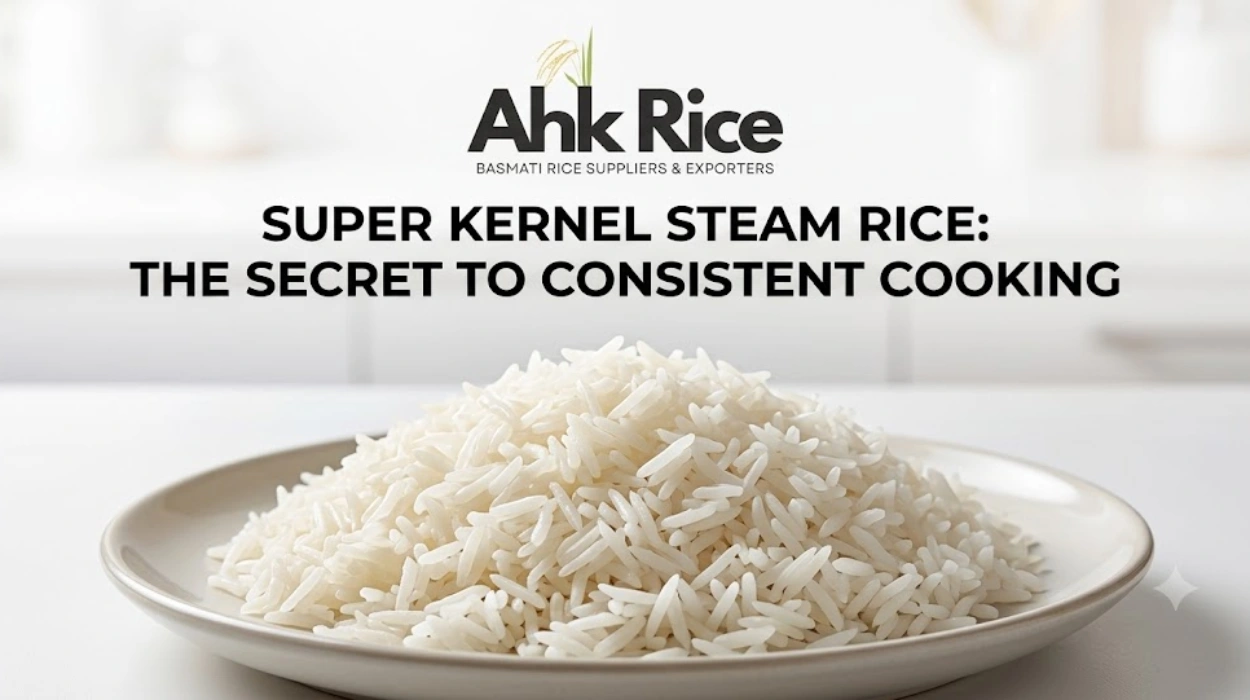
Super Kernel Steam Rice stays consistent after cooking because four factors work together: genetic grain structure, controlled steaming, uniform milling, and controlled moisture. These factors determine how evenly the kernels absorb water, expand lengthwise, resist breakage, and remain separate after cooking.
What Is Super Kernel Steam Rice?
Super Kernel Steam Rice is a Pakistani Basmati rice variety processed with controlled steam before milling, producing long, aromatic grains with stable cooking behavior, good lengthwise expansion, and a separate texture when correct water, heat, and cooking time are used.
Super Kernel is a traditional Basmati variety associated with Pakistan’s Punjab growing belt. Basmati rice is defined by its aromatic character, slender grain structure, cooking expansion, and distinctive texture. Super Kernel is generally shorter than 1121 Basmati but is valued for aroma, grain appearance, and balanced cooking performance. Current commercial specifications commonly place Super Kernel raw grain length around 7.0–7.6 mm, depending on crop, milling specification, and buyer contract.
The word Steam describes the processing method rather than a separate genetic variety. Paddy is exposed to controlled steam before the final milling stages. This treatment changes the physical structure of the grain and strengthens the kernel. The result is different from ordinary white-milled Super Kernel because steam processing influences water absorption, starch behavior, firmness, and resistance to breakage.
The distinction between variety and processing type is important. Super Kernel identifies the rice variety. Steam identifies the hydrothermal processing method. The same variety can therefore be discussed as Super Kernel White or Super Kernel Steam, depending on processing.
Super Kernel Steam Rice is also different from Sella or parboiled rice. Sella involves a more extensive parboiling process that includes hydration, steaming, and drying. Steam rice uses a different hydrothermal treatment and generally preserves a whiter appearance while developing greater structural strength than untreated white rice.
The cooking result depends on the complete specification rather than grain length alone. A 7.2 mm kernel with controlled moisture, low broken content, uniform milling, and consistent steaming performs differently from a mixed lot with uneven moisture and damaged kernels.
How Does Steam Processing Make Super Kernel Rice Consistent?
Steam processing strengthens the rice kernel before milling, allowing starch and moisture to interact more uniformly during cooking. The stronger structure reduces excessive breakage, supports lengthwise expansion, and helps individual grains retain their shape after water absorption.
The process starts with paddy, which is rice grain still protected by its outer husk. The paddy is cleaned to remove stones, straw, dust, immature material, and other foreign matter. Cleaning establishes a more uniform raw material for the following stages.
The cleaned paddy is conditioned according to the mill’s steam-processing specification. Controlled heat and moisture affect the internal structure of the grain. Steam treatment partially changes the starch structure and strengthens the kernel before husk removal and polishing.
After steaming, the paddy is dried to reach a controlled moisture level suitable for milling and storage. Drying requires control because excessive drying creates stress inside the kernel. That stress increases cracking and can raise the broken-grain percentage during milling.
The dried paddy enters the husking stage, where the husk is removed. The resulting brown rice then passes through milling equipment that removes the bran layers.
Polishing follows milling when the required commercial specification calls for a polished surface. Color sorting then removes discolored kernels and visible defects. Grading equipment separates kernels according to size and quality characteristics.
The finished rice is tested before packing. Typical quality checks include moisture, broken kernels, foreign matter, grain dimensions, milling quality, appearance, and cooking performance.
This sequence explains why processing consistency matters. Steam treatment alone does not guarantee identical cooking results. Uniform raw paddy, controlled steaming, controlled drying, accurate milling, sorting, and final quality inspection all contribute to the final texture.
Which Components Control the Cooking Texture of Super Kernel Steam Rice?
Cooking consistency comes from grain genetics, starch structure, moisture, kernel integrity, milling uniformity, broken-grain percentage, steam treatment, and storage conditions. Each component affects water absorption, expansion, firmness, separation, or resistance to breakage.
Grain structure
Super Kernel has a slender, elongated structure that supports lengthwise expansion during cooking. Its genetic characteristics establish the basic cooking profile before processing begins.
Starch structure
Rice contains starches dominated by amylose and amylopectin. Their proportions influence how rice absorbs water, softens, swells, and separates after cooking. Processing modifies the physical behavior of the starch matrix.
Moisture content
Moisture affects milling stability and storage performance. Excess moisture creates conditions for deterioration and inconsistent processing. Excessive drying increases kernel stress and breakage.
Kernel integrity
Whole kernels have more structural strength than broken kernels. A high percentage of whole kernels therefore supports a more uniform cooked appearance.
Steam treatment
Controlled steam treatment strengthens the kernel and changes its internal structure. The intensity and uniformity of this treatment influence final firmness and expansion.
Milling quality
Uniform milling removes bran layers without creating excessive fractures. Poor milling increases broken grains and creates a less consistent cooking batch.
Sorting and grading
Color sorting removes visibly defective kernels. Size grading reduces variation between kernels. A more uniform lot receives water and heat more evenly during cooking.
Storage conditions
Rice quality changes when temperature and humidity are poorly controlled. Stable storage protects moisture balance and reduces the risk of quality deterioration before cooking.
These components work as a system. A strong variety cannot compensate for poor drying. Controlled steaming cannot compensate for excessive broken kernels. Good milling cannot compensate for poor storage.
What Happens to Super Kernel Steam Rice During Cooking?
Cooking begins when water enters the kernel, followed by starch swelling, softening, and lengthwise expansion. Controlled steam processing helps the grain withstand this transformation, so the kernel expands without excessive splitting, clumping, or structural collapse.
When Super Kernel Steam Rice enters boiling water, water moves into the grain. Heat accelerates this process and causes the starch structure to swell.
The kernel does not expand equally in every direction. Basmati rice is valued for lengthwise elongation, meaning the cooked grain becomes longer while maintaining a relatively slender profile.
The cooking result depends on the starting grain, water ratio, temperature, cooking time, and handling. A properly processed kernel maintains enough structural strength to expand without becoming excessively soft.
The term elongation ratio describes the relationship between cooked grain length and raw grain length.
For example, if a raw kernel measures 7.2 mm and the cooked kernel measures 13.7 mm, the elongation ratio is:
13.7 ÷ 7.2 = 1.90
That means the cooked grain reaches approximately 1.90 times its raw length.
Elongation should not be confused with total swelling. A grain can increase in length while also increasing in width. Cooking quality therefore requires measurement of both length and texture.
This is why:
Evaluating elongation ratio and cooked texture provides a more complete assessment than looking at raw grain length alone.
Texture is also influenced by starch behavior. A well-processed Super Kernel Steam grain becomes tender enough to eat while retaining enough structure to remain recognizable as an individual kernel.
What Are the Key Quality Grades of Super Kernel Steam Rice?
Super Kernel Steam Rice is sold under buyer-specific export specifications rather than one universal global grade. Common specifications distinguish whole kernels, broken percentages, moisture, purity, milling finish, grain dimensions, and sorting quality for different commercial requirements.
The term grade can create confusion because rice exporters use commercial specifications that differ by market and contract.
Common Super Kernel specifications include:
| Commercial specification | Main quality distinction |
|---|---|
| 100% Whole / premium | Very high whole-kernel percentage with minimal broken grains |
| 0–2% Broken | Maximum 2% broken kernels |
| 2–5% Broken | Maximum 5% broken kernels |
| 5–10% Broken | Maximum 10% broken kernels |
| Custom buyer grade | Contract-defined limits for broken, moisture, purity, length, and appearance |
These figures are commercial examples, not a universal legal grading system. The buyer’s purchase specification determines the accepted limits.
The Codex Standard for Rice, CXS 198-1995, provides internationally recognized terminology for whole kernels, head rice, large broken kernels, medium broken kernels, small broken kernels, chips, damaged kernels, and other quality factors. The standard also identifies measurement methods such as ISO 7301 for several kernel-quality categories.
A head rice kernel is defined by Codex as a kernel whose length is at least three-quarters of the average length of the corresponding whole kernel. This classification helps buyers and laboratories describe broken fractions consistently.
For Super Kernel Steam Rice, buyers commonly specify several attributes together. These include grain length, broken percentage, moisture, foreign matter, damaged kernels, milling degree, color, and cooking performance.
This is why the word premium alone is not a technical specification. A purchase contract requires measurable limits.
What Benefits Does Consistent Super Kernel Steam Rice Provide?
Consistent Super Kernel Steam Rice produces predictable grain appearance, controlled elongation, better kernel separation, lower breakage during cooking, and more uniform texture. These characteristics matter most when rice is prepared repeatedly in households, restaurants, catering operations, and commercial kitchens.
The first benefit is visual consistency. Similar grain dimensions create a more uniform appearance on the plate.
The second benefit is controlled elongation. A consistent raw grain population produces a more predictable cooked length when cooking conditions remain controlled.
The third benefit is kernel separation. Stronger grains resist excessive collapse and clumping, especially in dishes where individual grains need to remain visible.
The fourth benefit is texture consistency. A controlled processing profile supports a repeatable balance between tenderness and firmness.
The fifth benefit is lower cooking loss from broken kernels. Whole grains remain intact more effectively than already fractured kernels.
These benefits are particularly important for dishes such as biryani, pulao, rice platters, pilaf, and bulk food-service preparations.
Where Is Super Kernel Steam Rice Used?

Super Kernel Steam Rice is used in household cooking, restaurants, hotels, catering, retail packs, wholesale distribution, and prepared rice dishes where aroma, grain appearance, lengthwise expansion, and separate cooked kernels are important quality characteristics.
Biryani is one of the strongest use cases because the grain needs to remain visible after cooking and mixing with spices, meat, vegetables, or sauces.
Pulao and pilaf also benefit from separate grains because the rice is usually cooked with seasoned stock and other ingredients.
Food-service kitchens use long-grain Basmati when consistent portion appearance matters. Large cooking batches increase the importance of uniform grain quality because a small variation in kernel behavior becomes visible across an entire tray or serving batch.
Retail consumers also select Super Kernel for its balance between aroma and cooking appearance. It provides a recognizable Basmati profile without relying only on maximum grain length.
International markets for Pakistani Basmati include the Gulf region, Middle East, Europe, United Kingdom, North America, and other rice-consuming markets. Market preference differs by cuisine, retail positioning, packaging format, and buyer specification.
For export, the final product must also meet the destination market’s food safety, labeling, plant-health, and documentation requirements.
What Certifications and Export Documents Apply to Super Kernel Steam Rice?
Export requirements depend on the destination country, shipment conditions, and buyer specification. Phytosanitary certification addresses plant-health requirements, while food-safety systems, laboratory reports, halal certification, and other certifications apply when required by the market or purchasing contract.
A phytosanitary certificate is an official plant-health document issued according to the importing country’s requirements. Pakistan’s Department of Plant Protection states that exporters must meet the importing country’s phytosanitary requirements and undergo inspection, sampling, treatment where required, and certification under ISPM 12 procedures.
Export documentation can include the commercial invoice, packing list, container information, treatment certificate where applicable, import permit information, and other documents required by the destination market.
Food-safety requirements are separate from phytosanitary requirements. Buyers can request laboratory analysis covering parameters such as moisture, contaminants, pesticide residues, microbiological criteria, or other destination-specific limits.
HACCP, ISO 22000, BRCGS, and Halal are examples of certifications or food-safety credentials encountered in international food supply chains. They are not automatically mandatory for every Super Kernel Steam shipment. The exact requirement depends on the buyer, destination, retailer, and applicable law.
Codex standards also provide an international reference framework for rice quality and food safety. The current Codex listing shows CXS 198-1995, Standard for Rice, as modified in 2025.
The correct approach is therefore to match the certification package to the destination market instead of treating every certificate as universally mandatory.
What Common Problems Affect Super Kernel Steam Rice After Cooking?
Inconsistent cooking usually results from uneven grain quality, excessive broken kernels, incorrect water ratios, uncontrolled cooking time, poor storage, or inconsistent steam processing. Raw grain length alone does not guarantee uniform cooked texture or elongation.
One common misconception is that longer raw rice always produces better cooked rice. Grain length matters, but structure, moisture, starch behavior, processing, and kernel integrity also control the final result.
Another misconception is that steam rice is the same as Sella rice. Both involve heat and moisture, but their processing profiles differ. Sella is parboiled and develops a characteristic firmer texture and color.
A third misconception is that steaming guarantees non-sticky rice. Cooking conditions still matter. Excess water, excessive cooking time, aggressive stirring, or unsuitable cooling can damage the desired texture.
A fourth misconception is that all Super Kernel rice performs identically. Commercial lots differ by crop, harvest conditions, milling specification, steam treatment, moisture, broken percentage, and storage history.
A fifth misconception is that raw grain appearance proves cooking quality. Cooking tests provide stronger evidence because they measure actual elongation, separation, firmness, and breakage.
A practical evaluation therefore compares raw and cooked grain length, calculates elongation ratio, examines broken kernels, assesses texture, and records cooking conditions. This approach turns the phrase “consistent after cooking” into measurable quality attributes.
Super Kernel Steam Rice achieves consistency when the entire production chain is controlled. The variety establishes the genetic foundation. Steam treatment strengthens the kernel. Drying protects structural integrity. Milling and sorting reduce variation. Moisture control protects stability. Cooking conditions then determine how those characteristics appear on the plate.
Frequently Asked Questions
What makes Super Kernel Steam Rice consistent after cooking?
Super Kernel Steam Rice stays consistent because its grain structure, steam processing, moisture level, milling quality, and broken-kernel percentage are controlled. These factors support uniform water absorption, elongation, firmness, and grain separation.
What is Super Kernel Steam Rice?
Super Kernel Steam Rice is a Pakistani Basmati rice variety processed with controlled steam before milling. Steam treatment strengthens the grain structure and supports consistent cooking performance, including lengthwise expansion and separate cooked kernels.
How does steam processing affect Super Kernel Rice?
Steam processing changes the internal starch structure and strengthens the rice kernel. Controlled steaming helps reduce breakage during milling and cooking while supporting predictable water absorption, grain expansion, and cooked texture.
Where is Super Kernel Rice grown?
Super Kernel Rice is primarily associated with Pakistan’s Punjab rice-growing region. The area provides suitable soil, irrigation, climate, and agricultural conditions for producing aromatic Basmati rice varieties.
What is the elongation ratio of Super Kernel Steam Rice?
The elongation ratio compares cooked grain length with raw grain length. For example, a 7.2 mm raw grain that reaches 13.7 mm after cooking has an elongation ratio of approximately 1.90.
Is Super Kernel Steam Rice the same as Sella rice?
No. Super Kernel identifies the rice variety, while Steam and Sella describe processing methods. Sella rice undergoes parboiling, while steam processing follows a different heat and moisture treatment profile.
What affects the texture of Super Kernel Steam Rice?
Texture depends on grain structure, starch composition, moisture, steam treatment, milling quality, broken percentage, water ratio, cooking temperature, and cooking time. Storage conditions also affect the rice before preparation.
Why does Super Kernel Steam Rice remain separate after cooking?
Controlled steam processing strengthens the kernel, while uniform grain size and low broken content reduce variation during water absorption. Correct cooking conditions then help the grains expand without excessive collapse or clumping.
What grades of Super Kernel Steam Rice are available?
Commercial specifications commonly include 100% whole or premium grades and specifications with maximum broken percentages such as 2%, 5%, or 10%. Exact limits depend on the buyer’s contract and destination-market requirements.
What are the main uses of Super Kernel Steam Rice?
Super Kernel Steam Rice is used for biryani, pulao, pilaf, rice platters, household meals, restaurants, hotels, catering, retail packs, and wholesale distribution where aroma, grain appearance, and separate cooked kernels are important.
Which markets import Pakistani Super Kernel Rice?
Pakistani Basmati rice is exported to markets across the Gulf, Middle East, Europe, the United Kingdom, North America, and other rice-consuming regions. Specific Super Kernel specifications vary according to local cuisine and buyer requirements.
What certifications apply to Super Kernel Steam Rice exports?
Export requirements depend on the destination market and buyer. Common documentation and certifications can include phytosanitary certificates, food-safety documentation, laboratory analysis, HACCP, ISO 22000, BRCGS, and Halal certification where applicable.
Does longer raw grain always mean better cooking quality?
No. Raw grain length is only one quality factor. Cooking performance also depends on grain structure, starch behavior, moisture, steam processing, milling quality, broken percentage, water ratio, temperature, and cooking time.
How should Super Kernel Steam Rice cooking quality be tested?
Cooking quality can be assessed by measuring raw and cooked grain length, calculating elongation ratio, checking grain separation, evaluating firmness, measuring broken kernels, and recording the water ratio and cooking time used during testing.