Evaluating Grain Length and Cooking Performance of 1121 Steam Rice
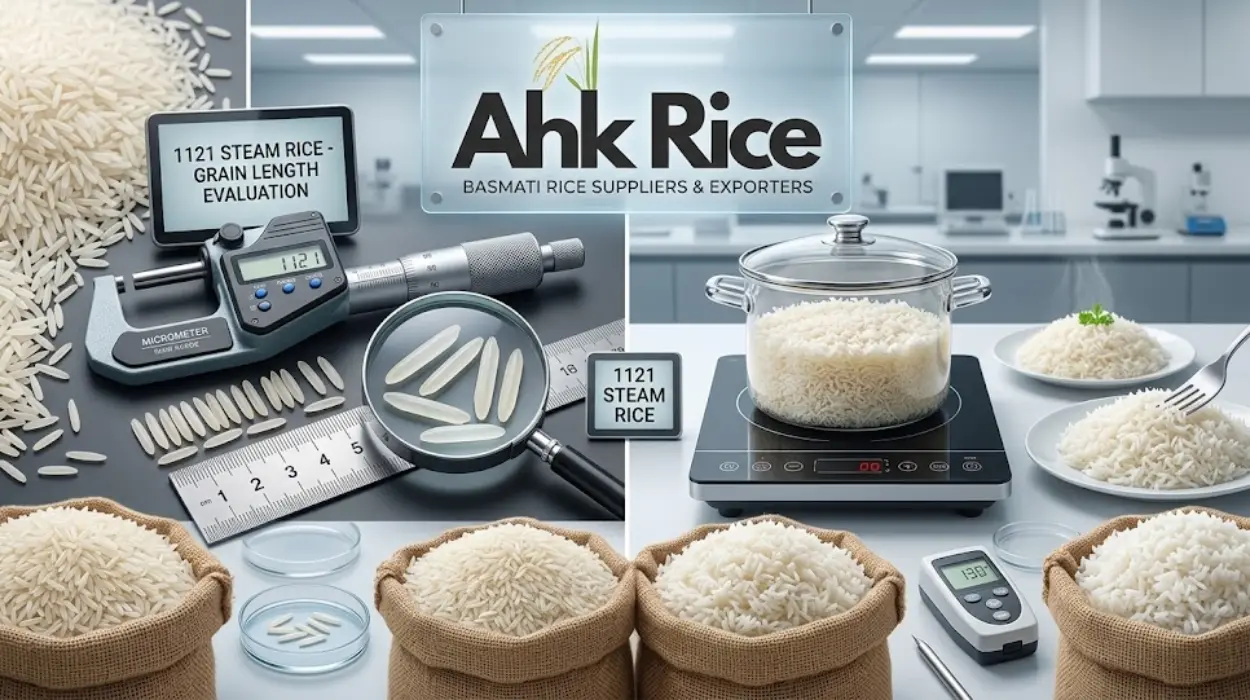
Choosing high-quality 1121 Steam Rice depends on more than appearance. Grain length, elongation after cooking, texture, moisture balance, milling quality, and processing standards all influence restaurant performance, retail acceptance, and export value. Buyers who evaluate these factors together consistently achieve better cooking results, lower wastage, and stronger customer satisfaction across food service and retail markets.
Long-grain rice buyers increasingly compare physical specifications before placing bulk orders because consistent cooking performance directly affects operational costs and customer experience. If you are still learning why restaurants increasingly choose this rice category, our guide on:
Why many food service businesses choose premium long-grain Pakistani steam rice for consistent kitchen performance provides useful background before comparing technical quality parameters. Understanding these fundamentals makes specification evaluation far more accurate.
What is 1121 Steam Rice, and why is grain length important?
1121 Steam Rice is a premium long-grain Pakistani Basmati variety processed through steam treatment before milling. Its naturally extra-long kernels, excellent elongation ratio, fluffy texture, and stable cooking performance make it one of the most preferred export rice varieties for restaurants, wholesalers, and premium retail markets worldwide.
1121 Steam Rice belongs to the Basmati family, known for its naturally aromatic, slender grains and exceptional cooking qualities. Unlike parboiled rice, steam processing partially gelatinises the starch under carefully controlled conditions without exposing the grain to the same level of pressure used in traditional parboiling. This helps strengthen the grain while preserving its premium appearance.
Grain length remains one of the most visible quality indicators because buyers often associate longer kernels with premium value. In international trade during 2026, exporters generally classify 1121 Steam Rice according to average grain length, broken percentage, moisture content, milling quality, and purity.
Typical export specifications include:
| Specification | Premium Export Standard |
|---|---|
| Average Grain Length | 8.30–8.50 mm |
| Broken Grains | 1–2% |
| Moisture | 12–13% |
| Purity | 95–98% |
| Foreign Matter | Minimal |
| Crop Year | Current export season |
| Colour | Uniform creamy white |
Longer grains also produce greater visual appeal after cooking. Restaurants serving biryani, kabsa, mandi, pulao, and premium buffet meals depend heavily on this presentation because customers associate separated, elongated grains with authenticity and quality.
How does grain length affect cooking performance?
Longer rice grains create better elongation, improved plate presentation, reduced clumping, and stronger grain separation after cooking. These characteristics increase serving consistency, minimise breakage during preparation, and improve operational efficiency for commercial kitchens handling large production volumes every day.
Grain length influences several cooking characteristics simultaneously.
First, longer kernels absorb water more evenly. Uniform hydration reduces uneven cooking where some grains become soft while others remain firm.
Second, premium 1121 Steam Rice expands mainly in length rather than width. This creates elegant presentation that restaurants prefer for premium dishes.
Third, stronger grain structure helps maintain individual kernels during cooking, mixing, and serving.
Cooking performance also depends on:
- Protein content
- Amylose level
- Steam processing quality
- Moisture consistency
- Proper storage conditions
- Milling precision
Professional kitchens value consistency more than maximum expansion alone. When every batch produces similar results, chefs require fewer cooking adjustments and experience less food waste.
What quality indicators should buyers evaluate besides grain length?
Professional buyers evaluate seven major quality indicators together because grain length alone cannot predict cooking consistency. Moisture balance, broken percentage, milling quality, purity, aroma, colour uniformity, and elongation ratio collectively determine commercial value and long-term customer satisfaction.
Many first-time buyers focus almost entirely on grain length. Experienced importers evaluate a complete specification profile.
The following comparison demonstrates why.
| Quality Attribute | Why It Matters |
|---|---|
| Grain Length | Premium appearance before cooking |
| Cooked Elongation | Attractive presentation after cooking |
| Broken Percentage | Higher whole-grain yield |
| Moisture Level | Storage stability |
| Milling Quality | Better appearance and lower defects |
| Purity | Fewer mixed varieties |
| Aroma & Texture | Better eating experience |
A rice shipment with excellent grain length but poor milling quality may still produce excessive broken grains during transportation.
Likewise, low moisture control shortens storage life and increases quality deterioration.
Professional procurement teams therefore review laboratory inspection reports together with physical samples before confirming contracts.
What are the available solutions for evaluating cooking quality before purchasing?
Importers use laboratory analysis, cooking trials, specification verification, sample evaluation, supplier audits, and independent inspection reports to measure cooking performance before committing to commercial purchases. Combining these evaluation methods provides the highest confidence in product consistency and export quality.
Several evaluation methods exist.
Laboratory specification testing
Independent laboratories verify:
- Moisture
- Broken percentage
- Purity
- Chalkiness
- Grain dimensions
- Foreign matter
These reports provide objective measurements that support procurement decisions.
Sample cooking trials
Commercial buyers frequently request cooking samples before placing container orders.
They evaluate:
- Water absorption
- Aroma
- Grain separation
- Elongation
- Texture
- Cooling behaviour
This practical assessment often reveals differences not visible in laboratory reports.
Supplier processing review
Processing standards strongly influence final quality.
Buyers examine:
- Cleaning systems
- Colour sorting
- Milling technology
- Quality assurance
- Packaging standards
- Traceability
Independent inspection
Many international importers appoint third-party inspection companies before shipment.
Inspection reduces disputes by confirming that exported goods match contractual specifications.
How do different evaluation approaches compare?
Each evaluation method measures different aspects of rice quality. Laboratory testing provides objective specifications, cooking trials demonstrate real kitchen performance, while supplier audits verify production consistency. Combining all three approaches produces the most reliable purchasing decisions for commercial buyers.
Comparison between evaluation methods helps buyers understand their strengths.
| Evaluation Method | Measures | Strength | Limitation |
|---|---|---|---|
| Laboratory Testing | Physical specifications | Highly objective | Does not show cooking behaviour |
| Cooking Trial | Actual performance | Real kitchen results | Small sample size |
| Supplier Audit | Production capability | Long-term consistency | Requires supplier access |
| Third-Party Inspection | Shipment verification | Reduces risk | Conducted before shipment |
| Historical Performance | Repeat consistency | Reliable forecasting | Depends on previous orders |
No single method replaces the others.
Professional buyers usually combine several evaluation tools before making long-term sourcing decisions.
Which method works best for different buying situations?

Different purchasing situations require different evaluation priorities. Restaurants benefit most from cooking trials, wholesalers focus on specification consistency, retailers emphasise appearance, while importers handling container volumes combine laboratory analysis, supplier verification, and shipment inspection for maximum quality assurance.
Different buyers value different characteristics.
Restaurants
Restaurants prioritise:
- Cooked grain length
- Plate presentation
- Consistent texture
- Fast preparation
- Low wastage
Retail distributors
Retail customers often evaluate:
- Visual appearance
- Uniform grains
- Attractive packaging
- Shelf appeal
- Consumer expectations
Food manufacturers
Industrial users prioritise:
- Batch consistency
- Moisture stability
- Production efficiency
- Cost control
International importers
Importers evaluate the complete supply chain.
This includes:
- Export documentation
- Processing standards
- Container loading
- Packaging quality
- Product consistency
- Delivery reliability
How do major export markets compare in their quality preferences?
Regional markets prioritise different specification profiles based on cuisine, consumer expectations, and commercial applications. North American restaurant buyers generally favour maximum grain elongation, while Gulf markets emphasise aroma, appearance, and premium presentation for traditional rice dishes.
The two largest premium export regions demonstrate distinct buying preferences.
| Market Region | Preferred Grade | Main Application | Priority |
|---|---|---|---|
| United States & Canada | 1121 Steam Premium | Restaurants, catering | Long cooked grains |
| GCC Countries | 1121 Steam Extra Long | Biryani, kabsa, mandi | Aroma and presentation |
Although both regions demand premium quality, purchasing priorities differ slightly.
North American restaurants often emphasise cooking consistency across repeated batches because operational efficiency directly affects profitability.
Gulf buyers traditionally place greater importance on aroma, grain appearance, and presentation for premium hospitality and family dining.
Price comparison per metric tonne (2026 export averages)
| Grade | USA Market (USD/MT) | GCC Market (USD/MT) |
|---|---|---|
| Standard 1121 Steam | 930–980 | 920–970 |
| Premium 1121 Steam | 990–1,080 | 980–1,070 |
| Extra Premium Selected | 1,090–1,180 | 1,080–1,170 |
Actual pricing varies according to crop quality, packing specification, freight costs, contract volume, destination port, and inspection requirements.
Shelf life comparison
| Storage Condition | Expected Shelf Life |
|---|---|
| Standard warehouse | 18 months |
| Cool, dry commercial storage | 24 months |
| Vacuum or moisture-controlled packaging | Up to 24 months with maintained quality |
Proper humidity control remains the most important factor affecting long-term storage quality.
What are the advantages and disadvantages of focusing on grain length?
Grain length provides an excellent visual quality indicator but should never be evaluated independently. The strongest purchasing decisions combine grain dimensions with cooking behaviour, milling quality, moisture control, and processing standards to predict real commercial performance accurately.
Advantages include:
- Premium appearance
- Better cooked presentation
- Higher perceived product value
- Strong export demand
- Restaurant preference
- Excellent elongation potential
Potential limitations include:
- Long grains alone do not guarantee flavour.
- Poor processing reduces cooking performance.
- Moisture imbalance affects storage quality.
- Excessive breakage lowers commercial yield.
- Mixed varieties reduce consistency.
For example, two rice samples may both measure 8.4 mm before cooking.
However, one sample may produce longer cooked grains because of superior processing, lower breakage, and better starch characteristics.
This demonstrates why complete quality evaluation always outperforms judging rice solely by kernel length.
Which decision factors matter most when selecting premium 1121 Steam Rice?
Successful buyers compare technical specifications, cooking performance, intended application, processing standards, packaging quality, supplier consistency, and storage stability together because each factor contributes directly to long-term purchasing success and commercial profitability.
The following framework simplifies purchasing decisions.
| Decision Factor | Importance | Evaluation Priority |
|---|---|---|
| Grain Length | Very High | Initial screening |
| Cooking Performance | Very High | Mandatory cooking trial |
| Moisture Level | High | Laboratory verification |
| Supplier Consistency | High | Production review |
| Packaging & Storage | Medium | Export inspection |
No single specification determines overall quality.
Instead, successful procurement combines measurable physical standards with verified cooking performance and dependable processing consistency.
For buyers comparing sourcing options from Pakistan, reviewing the:
Complete procurement process from quality verification through export documentation and restaurant supply requirements provides the final stage of evaluation before placing commercial orders. That decision-focused guidance naturally fits once technical quality comparisons have been completed.
Frequently Asked Questions
How is 1121 Steam Rice different from other Basmati rice varieties?
1121 Steam Rice has naturally extra-long grains, excellent elongation after cooking, and a fluffy, non-sticky texture. Steam processing also improves grain strength, making it ideal for restaurants and large-scale catering.
What is the ideal grain length for premium 1121 Steam Rice?
Premium export-grade 1121 Steam Rice typically has an average grain length of 8.30–8.50 mm before cooking. Longer, uniform grains are generally preferred in international markets.
Does longer grain length always mean better cooking performance?
No. While grain length is important, cooking performance also depends on moisture content, milling quality, purity, starch composition, and proper steam processing.
Which industries benefit most from 1121 Steam Rice?
Restaurants, hotels, catering companies, food manufacturers, wholesalers, supermarkets, and international rice importers all benefit from the consistent quality and cooking performance of 1121 Steam Rice.
How should 1121 Steam Rice be stored?
Store the rice in a cool, dry place away from direct sunlight and moisture. Proper storage helps maintain grain quality, aroma, and cooking performance for up to 24 months under suitable conditions.
What quality checks should buyers perform before importing 1121 Steam Rice?
Buyers should evaluate grain length, broken percentage, moisture level, purity, cooking performance, inspection reports, and supplier processing standards before placing bulk export orders.