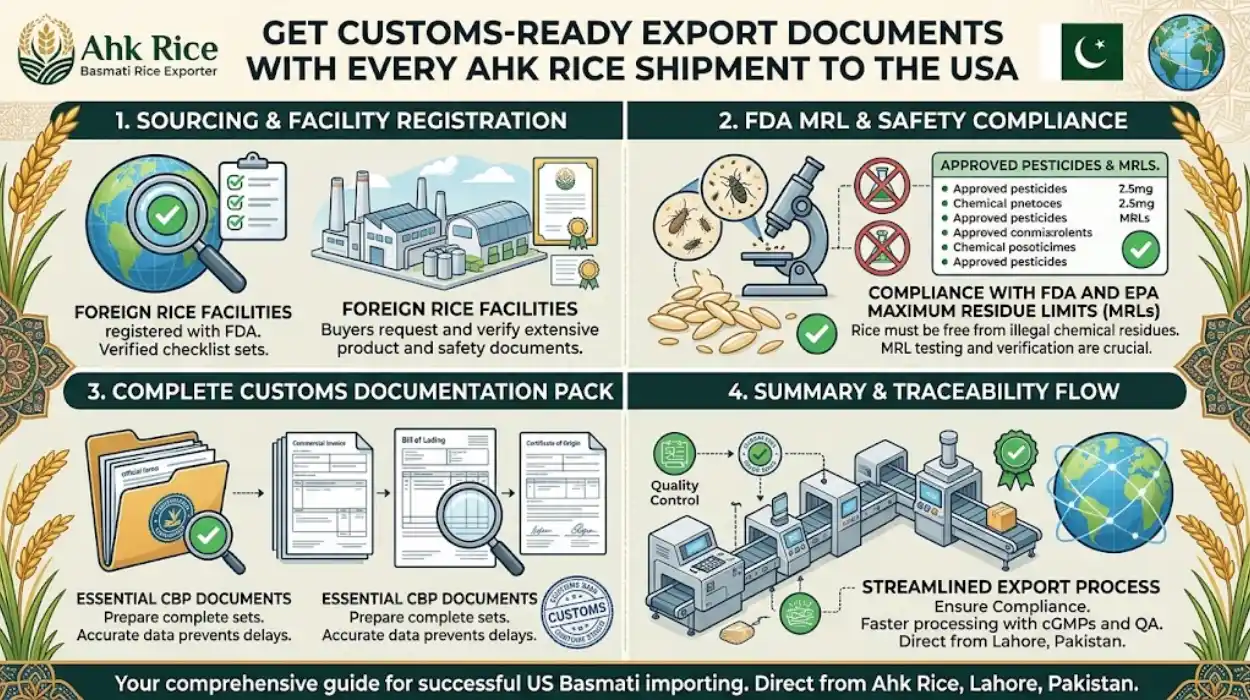
Get Customs-Ready Export Documents with Every AHK Rice Shipment to the USA
The best solution is to prepare a complete, consistent export document set before dispatch, verify US import requirements with the importer, and coordinate customs entry, FDA Prior Notice, and shipment records before arrival. This process reduces documentation errors, prevents avoidable clearance delays, and gives US importers better control over their rice supply chain.
Importing Pakistani Basmati rice into the United States involves coordination between the Pakistani exporter, freight forwarder, US importer, customs broker, and relevant regulatory authorities. Each party handles different responsibilities, so a missing certificate or inconsistent shipment detail can disrupt the entire process.
For a practical overview of the entry process, read our guide on how US Customs clears Basmati rice shipments from Pakistan. Importers should use this educational resource to understand the sequence of documentation, customs entry, and regulatory checks before placing an order.
A customs-ready shipment typically requires the following documents and records, depending on the product, shipment, and applicable regulations:
- Commercial invoice: Identifies the seller, buyer, product description, quantity, unit price, total value, currency, and agreed Incoterm.
- Packing list: Specifies package counts, net and gross weights, packaging formats, and shipment identification details.
- Bill of lading: Records the ocean carrier, shipment details, consignee information, and transportation arrangements.
- Certificate of Origin: Supports verification of the rice’s declared country of origin when required by the importer, customs broker, or applicable rules.
- Phytosanitary certificate: Obtained from the relevant Pakistani plant-protection authority when required by US agricultural import conditions.
- FDA Prior Notice confirmation: Documents the required advance notification for imported food shipments.
- Customs entry information: Supports the US importer’s customs broker in preparing the applicable entry and admissibility submissions.
- Product specifications and laboratory reports: Help demonstrate that the shipment meets agreed quality requirements and applicable safety standards.
Not every shipment requires every document in the same form. Requirements depend on the rice product, packaging, origin, applicable US regulations, and import arrangements. The importer and customs broker should confirm the final checklist before shipment.
Why Choose AHK Rice for US Rice Export Documentation?
Choose an exporter that coordinates product specifications, packing details, shipment records, and export paperwork before dispatch. AHK Rice supplies Pakistani Basmati rice with shipment planning that helps buyers organize documentation, verify commercial details, and prepare their US import process.
AHK Rice is a Pakistani Basmati rice exporter based in Punjab, supplying 1121 Basmati, Super Kernel, and 1509 varieties to international markets. Its export service combines rice sourcing, processing, grading, packaging, and shipment coordination to help importers manage their procurement requirements.
For US buyers, documentation begins with a clearly defined purchase order. The buyer should confirm the variety, processing type, grade, grain specifications, broken percentage, moisture limits, packaging, quantity, and destination before the exporter prepares the commercial documents.
AHK Rice can coordinate shipment information around the agreed product and commercial specifications. Buyers should confirm the exact documents, certifications, inspection arrangements, and regulatory responsibilities included in their individual contract before making payment or authorizing dispatch.
What Documentation Support Should US Importers Confirm?
Importers should establish who prepares each document, who verifies it, and who submits it to the relevant authority. The exporter generally prepares commercial export records, while the US importer and its customs broker manage the US entry process and importer-specific compliance obligations.
| Document or record | Main purpose | Responsibility to confirm |
|---|---|---|
| Commercial invoice | Declares product and transaction details | Exporter |
| Packing list | Records packages and shipment weights | Exporter |
| Bill of lading | Records ocean transportation | Carrier or freight forwarder |
| Certificate of Origin | Supports origin verification | Exporter and issuing authority, as applicable |
| Phytosanitary certificate | Addresses applicable plant-health requirements | Relevant Pakistani authority, when required |
| FDA Prior Notice | Provides advance food-shipment notification | Responsible filer, coordinated with the importer |
| CBP entry filing | Requests customs entry and release | US importer and customs broker |
| Product test reports | Support quality and safety verification | Agreed testing or inspection provider |
This allocation is a planning guide, not a universal legal checklist. The importer should verify current US requirements before the shipment leaves Pakistan.
What Results Can US Importers Expect from Proper Documentation?
Accurate documentation improves shipment visibility, reduces preventable discrepancies, and helps the importer prepare for customs and food-regulatory review. It does not guarantee immediate release because US authorities may request additional information, inspect the cargo, or place a shipment on hold.
Consider a US distributor ordering 20 metric tons of 1121 Steam Basmati rice in retail-ready packaging. The purchase order specifies the grade, quantity, packaging weight, and delivery terms. The commercial invoice, packing list, and shipping instructions must reflect those agreed details.
If the invoice lists a different quantity from the packing list, the broker may need clarification before completing entry procedures. If the declared origin or product description is unclear, the importer may need supporting records to resolve the discrepancy.
AHK Rice helps buyers establish clear product and shipment specifications before dispatch. Importers should also arrange their own customs broker, verify regulatory obligations, and ensure that required filings are completed within the applicable deadlines.
The expected business benefits include:
- Fewer avoidable errors: Consistent commercial records reduce discrepancies between the purchase order, invoice, packing list, and transport documents.
- Better shipment planning: Early document review gives the importer and broker more time to identify missing information.
- Improved quality verification: Agreed specifications and available laboratory reports help buyers assess whether the shipment matches the purchase contract.
- Clearer accountability: Assigning responsibilities before dispatch reduces confusion about who must submit each document.
- More controlled purchasing: Buyers can compare suppliers using documented specifications, packaging requirements, inspection arrangements, and delivery terms.
The actual clearance outcome depends on complete and accurate filings, admissibility requirements, government processing, inspection decisions, and the importer’s compliance arrangements.
How Do HTS Codes, Import Duties, and CBP Entry Documents Affect the Shipment?
The importer must establish the correct Harmonized Tariff Schedule classification, applicable duty treatment, customs value, and entry requirements before shipment. These decisions affect landed cost, entry preparation, and the records needed to support the import declaration.
The product’s classification should reflect its actual characteristics and the applicable US tariff provisions. Basmati rice may fall under a classification based on factors such as whether the rice is husked, milled, or otherwise processed. Importers should not assume that every Basmati variety uses the same tariff line.
For a deeper decision-stage comparison, review HTS codes, import duties, and CBP entry documents for Basmati rice in the USA. This guide helps buyers identify the customs classification, duty questions, and entry documentation they need to resolve before confirming an import order.
The US importer or customs broker should verify the current HTSUS classification and duty rate using official US resources. Additional charges may apply depending on the product classification, origin, applicable trade measures, and shipment circumstances.
Importers should also confirm the requirements of the US Food and Drug Administration. Imported food generally requires Prior Notice, and the applicable facility-registration, food-safety, and importer obligations must be evaluated for the transaction. Where the Foreign Supplier Verification Programs rule applies, the US importer must meet its relevant verification responsibilities.
Do not treat an exporter’s commercial documents as a substitute for US entry filings or importer compliance records. A well-prepared document package supports the process, but the importer remains responsible for fulfilling its legal obligations.
How Many Days Does Shipping Pakistani Basmati Rice to the USA Take?
Ocean transit from Pakistan to the United States commonly takes several weeks, with the actual duration depending on the destination port, carrier schedule, transshipment, and congestion. Importers should budget additional time for origin handling, customs entry, inspections, and inland delivery.
The following are indicative planning ranges, not guaranteed transit schedules:
| US destination or route | Indicative ocean transit planning range |
|---|---|
| US West Coast ports | 25–40 days |
| US East Coast ports | 35–50 days |
| Gulf Coast ports | 30–45 days |
Actual transit times vary by sailing, service availability, transshipment, and port conditions. Buyers should request a current carrier schedule before agreeing to a delivery date.
The shipment timeline also includes activities before and after ocean transport. Export processing, container loading, document preparation, vessel departure, arrival formalities, customs entry, FDA review where applicable, and final delivery all affect the total lead time.
AHK Rice buyers should agree on the shipment window, document submission deadlines, and responsibility for freight and destination charges before confirming the order. The importer should coordinate with its broker well before arrival rather than waiting until the container reaches the US port.
What Factors Affect the Cost of Customs-Ready Rice Shipments?
Total import cost depends on rice grade, order quantity, packaging, export processing, freight, insurance, applicable duties, customs brokerage, inspections, and destination handling. Buyers should compare the complete landed cost rather than selecting an exporter solely on the quoted rice price.
The main cost factors are:
- Rice variety and grade: 1121, Super Kernel, and 1509 have different commercial positioning and specification requirements.
- Processing and sorting: Steam processing, Sella processing, and additional optical sorting can affect the product price.
- Packaging: Bulk bags, foodservice bags, and retail-ready private-label packaging have different material and preparation costs.
- Shipment volume: Order size influences unit economics, container utilization, and freight arrangements.
- Freight and insurance: Ocean rates vary with carrier, season, routing, equipment availability, and agreed Incoterm.
- Import charges: Customs duties, brokerage, port fees, examination costs, and applicable regulatory expenses affect the landed cost.
- Testing and certification: Laboratory analysis, inspection services, and certificates may create additional charges when required or contractually agreed.
A reliable quotation should distinguish the rice price from freight, insurance, documentation, inspection, and destination charges. Buyers should also confirm the currency, payment terms, quotation validity, shipment quantity, and responsibility for each cost.
AHK Rice can use these details to prepare a product-specific export quotation. No fixed customs-ready price should be assumed without confirming the order specifications, destination, and required services.
How Does the AHK Rice Sample Process Work, and What Does It Cost?
A sample lets buyers assess grain appearance, aroma, cooking performance, and suitability before committing to a commercial shipment. Confirm the sample quantity, courier method, shipping charges, and any applicable inspection or plant-health requirements with AHK Rice before dispatch.
The sample process should follow five steps.
Step 1: Define the product. The buyer selects 1121, Super Kernel, or 1509 and specifies the processing type, such as White, Steam, or Sella. The buyer should also state the intended use, target market, and required grain specifications.
Step 2: Confirm sample availability. AHK Rice confirms whether the requested variety and grade are available and agrees on the sample quantity. Buyers should clarify whether the sample is representative of the proposed commercial specification.
Step 3: Agree on charges. The parties confirm sample preparation costs, courier fees, and any applicable documentation, inspection, or plant-health charges. For an eligible offer, AHK Rice has previously indicated samples of up to 20 kg of Super Kernel Basmati at no charge, with courier shipping and applicable phytosanitary costs payable by the buyer. Buyers must reconfirm current availability and conditions before relying on this offer.
Step 4: Arrange dispatch and documentation. The exporter and buyer confirm the courier route, declared sample description, shipment value where required, and any import permissions or certificates applicable to the sample. Small samples are not automatically exempt from US import rules.
Step 5: Complete the cooking test. The buyer checks aroma, grain elongation, texture, color, broken grains, and consistency against the purchase specification. Once the sample is approved, both parties confirm the final commercial grade, packaging, quantity, and shipment terms.
Sample charges are not universal. Courier pricing depends on the parcel’s weight, dimensions, destination, service level, and applicable surcharges. Any required phytosanitary documentation or other compliance service must be priced separately when applicable.
How Can US Importers Get Started with AHK Rice?
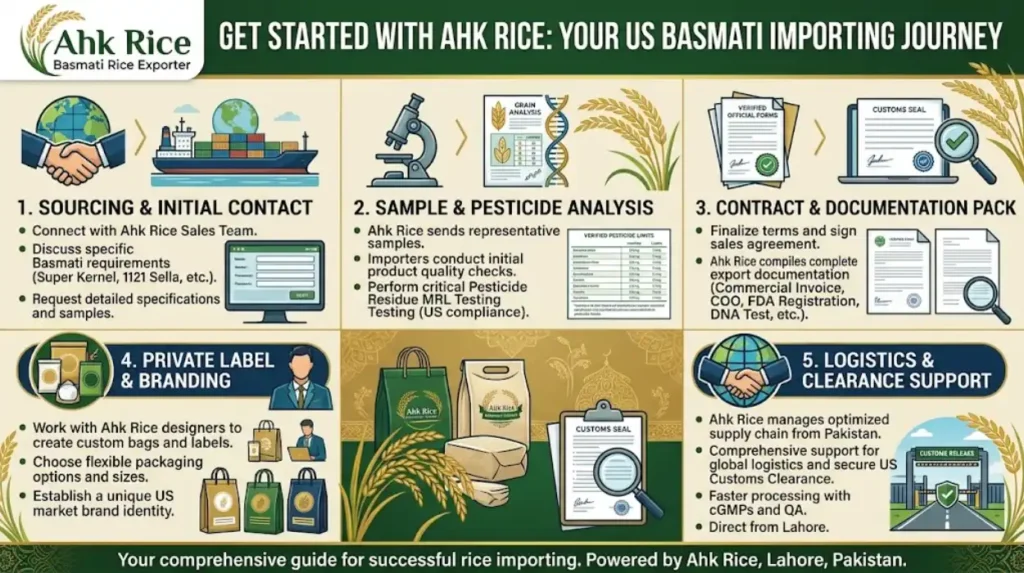
Start by submitting a detailed purchase requirement and identifying the US importer of record and customs broker. Confirm the rice specification, documentation checklist, applicable import requirements, quotation, sample terms, and shipment schedule before approving production or container loading.
Prepare the following information for the initial enquiry:
- Rice variety and processing type.
- Required grade, grain length, moisture, and broken percentage.
- Order quantity and preferred packaging.
- US destination port and final delivery location.
- Requested Incoterm and shipping window.
- Private-label requirements, if applicable.
- Required product testing, inspection, and certificates.
- Importer and customs broker contacts for entry coordination.
AHK Rice can then assess the commercial requirement and clarify which export documents and shipment records can be provided under the agreed order. The buyer should independently confirm the US customs classification, FDA requirements, admissibility conditions, and any additional import obligations with qualified advisers or the relevant authorities.
Before releasing the shipment, the parties should approve the final product specification, invoice details, packing information, transport arrangements, and responsibility for regulatory filings. This creates a documented basis for procurement and gives the US importer a clearer path from sample approval to commercial delivery.
For a shipment-specific quotation and confirmation of documentation arrangements, submit your requirements through the AHK Rice request-a-quote page.
Frequently Asked Questions
What documents are required to import Pakistani Basmati rice into the USA?
US rice imports generally require commercial and transport records, customs entry information, and FDA Prior Notice where applicable. A Certificate of Origin, phytosanitary certificate, or laboratory report may also be needed depending on the shipment. The importer and broker should confirm the complete checklist before dispatch.
Does AHK Rice guarantee US customs clearance?
No exporter can guarantee release by US authorities. AHK Rice can coordinate agreed export documentation and shipment details, while the importer and its broker must complete applicable US filings. Customs inspections, admissibility reviews, and additional document requests can affect release.
How long does Pakistani Basmati rice take to reach the USA?
Ocean transit commonly requires approximately 25–50 days, depending on the destination and route. Origin handling, transshipment, customs processing, regulatory reviews, and inland transportation can extend the total delivery time. Buyers should confirm current carrier schedules before placing an order.
How much does a Basmati rice sample from Pakistan cost?
The cost depends on sample availability, quantity, courier service, destination, and applicable documentation requirements. Eligible Super Kernel sample offers may cover the rice itself, while the buyer pays courier and applicable phytosanitary charges. Confirm the current offer and total payable cost with AHK Rice.
Who is responsible for FDA Prior Notice and US customs entry?
Responsibility depends on the filing arrangement and applicable regulations. FDA Prior Notice must be submitted by an eligible party, while the US importer and customs broker coordinate customs entry and other required filings. Both parties should confirm responsibilities and deadlines before shipment.