Get FOB, CNF and CIF Pricing for Your Market
FOB, CNF and CIF quotations help rice importers compare the actual cost of Pakistani Basmati rice before placing an export order. Here is why: each pricing term covers different logistics responsibilities, and the correct quotation depends on your destination, grade, packaging and shipment requirements. AHK Rice supplies Pakistani Basmati rice with export quotations structured around these requirements.
International buyers need more than a rice price per metric ton. A complete quotation must explain the rice specification, export port, freight, insurance, delivery port and applicable charges. The top Basmati rice importing countries in 2026 overview helps identify market requirements before requesting a quotation. The next step is understanding which pricing term fits your procurement decision.
What is the difference between FOB, CNF and CIF rice pricing?
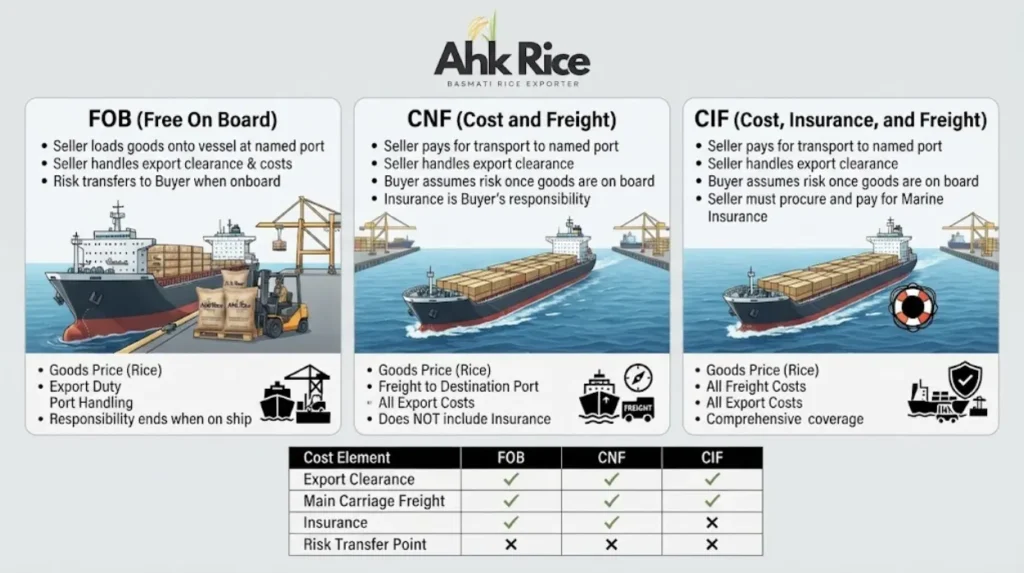
FOB covers the rice and delivery to the named loading port, CNF adds ocean freight, and CIF adds marine insurance to the destination port. Here is why: these Incoterms define which costs and responsibilities the exporter and importer assume during shipment.
FOB pricing
FOB means Free On Board. The exporter prepares the rice, completes export clearance and loads the cargo on the vessel at the named port. The importer arranges ocean freight, marine insurance and destination charges.
A buyer ordering 1121 Steam Basmati rice from Karachi can request an FOB quotation. The price covers the agreed rice specification, packaging, export preparation and loading. The buyer then works with a shipping provider for freight and insurance.
CNF pricing
CNF, also called CFR, means Cost and Freight. The exporter pays the ocean freight to the named destination port. The importer remains responsible for marine insurance and destination charges.
CNF pricing helps buyers compare the rice cost with the freight included. For example, a distributor importing rice into Jakarta can compare CNF Jakarta prices against quotations from other suppliers. Insurance and local port charges still require separate budgeting.
CIF pricing
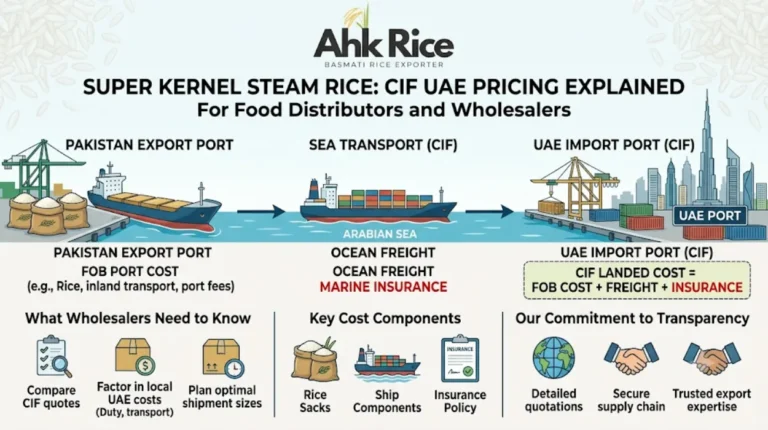
CIF means Cost, Insurance and Freight. The exporter arranges the rice, export clearance, loading, ocean freight and marine insurance to the named destination port.
CIF pricing provides a broader landed-cost estimate than FOB. The buyer still pays destination port charges, customs duties, taxes and inland transport. A complete CIF quotation should identify the destination port and insurance coverage.
Pricing comparison
| Pricing term | Exporter pays | Importer pays |
|---|---|---|
| FOB | Rice, export clearance, loading | Freight, insurance, destination costs |
| CNF | Rice, export clearance, loading, freight | Insurance, destination costs |
| CIF | Rice, export clearance, loading, freight, insurance | Destination costs, duties, taxes |
These terms establish the cost responsibilities. The next question is which service can turn those responsibilities into a practical export quotation.
Why choose AHK Rice for your Basmati rice quotation?
AHK Rice provides Pakistani Basmati rice export quotations based on grade, packaging, destination, shipping term and order requirements. Here is why: importers need a consistent specification before comparing FOB, CNF or CIF offers.
AHK Rice supplies 1121, Super Kernel and 1509 Basmati rice from Pakistan. The service includes end-to-end processing, custom packaging and export coordination for international buyers.
Rice grades for export procurement
1121 Basmati rice suits buyers seeking extra-long grains and a premium rice specification. The grade is available in Steam, White and Sella processing types.
Super Kernel Basmati rice provides a long-grain option for buyers who require a different variety specification. 1509 Basmati rice supports procurement plans that require a separate grade and processing profile.
AHK Rice can discuss the required grade, processing type, packaging and destination before preparing a quotation. This approach helps buyers compare offers using the same specification rather than comparing prices alone.
Packaging and export preparation
Packaging protects rice during handling, loading and international shipment. Buyers can request packaging formats based on retail, wholesale or foodservice distribution requirements.
AHK Rice coordinates processing and packaging requirements for export orders. The buyer should specify the required bag size, packaging material, private-label needs and destination before quotation preparation.
With the product and service requirements established, the next step is understanding the results a complete quotation can provide.
What results can be expected from a complete rice quotation?
A complete quotation provides a comparable rice specification, shipment term, estimated freight, order quantity and delivery timeline. Here is why: these details allow importers to calculate procurement costs before approving a purchase order.
Specification confirmation
A quotation should identify the rice variety, processing type, grain specification, broken percentage, moisture requirement and packaging format. The buyer can then compare the offered product against the approved procurement specification.
For example, a distributor requesting 1121 Golden Sella should receive a quotation for that exact grade. A quotation for 1121 Steam should not be treated as an equivalent product without specification approval.
Shipping timeline
Shipping days depend on the loading port, destination port, vessel schedule, transshipment and customs clearance. The following planning ranges are indicative, not confirmed transit times.
| Market | Indicative ocean transit | Planning consideration |
|---|---|---|
| Indonesia | 20–35 days | Port congestion and transshipment |
| Malaysia | 15–25 days | Vessel schedule and destination clearance |
| UAE | 10–20 days | Port availability and documentation |
| Saudi Arabia | 15–25 days | Destination clearance |
| Qatar | 15–25 days | Vessel schedule and port handling |
| Philippines | 15–30 days | Transshipment and customs clearance |
| United Kingdom | 25–40 days | Vessel schedule and import clearance |
Actual shipping days require a carrier quotation and confirmed vessel schedule. AHK Rice can discuss the expected shipping timeline after receiving the destination port and order details.
Export documentation
Export documentation supports customs clearance and shipment verification. Typical documents include the commercial invoice, packing list, certificate of origin, bill of lading and applicable phytosanitary or inspection certificates.
The required documents depend on the destination country and product specification. Buyers should confirm the requirements with their customs broker before shipment.
The quotation therefore provides a procurement starting point. The next question is how much the buyer should budget for the complete export order.
What factors affect FOB, CNF and CIF rice prices?
Rice grade, order quantity, packaging, freight, insurance, destination charges and exchange rates affect the final export quotation. Here is why: each cost component changes the total amount paid by the importer.
Rice specification and grade
1121 Basmati rice generally represents a premium specification compared with standard long-grain rice. Steam, White and Sella processing types also require different production and processing arrangements.
The buyer should compare prices for the same grade and processing type. A lower quotation for 1509 rice does not directly establish savings against 1121 rice.
Order quantity
Order quantity affects the cost per metric ton. Larger orders can support more efficient container utilization and production planning.
For example, a buyer requesting a full container should compare the total container cost and per-ton price. A smaller shipment may require a different freight arrangement.
Packaging
Packaging material, bag size, printing and private-label requirements affect the quotation. Standard export bags and customized retail packaging require different preparation.
The buyer should confirm the required packaging before comparing supplier offers. A quotation for standard bags does not automatically include custom printing.
Freight and insurance
Freight depends on the destination port, container availability, carrier rates and shipping schedule. Insurance depends on the shipment value and coverage requirements.
FOB buyers arrange freight separately. CNF buyers receive freight-inclusive pricing. CIF buyers receive freight and marine insurance included in the quotation.
Destination costs
Destination port handling, customs duties, taxes, storage and inland transport are separate from the FOB rice price. These charges can materially affect the final landed cost.
For example, a CIF Jakarta quotation still requires the importer to budget for destination charges and local delivery. The buyer should obtain a local clearance estimate before approving the order.
The next decision is selecting the quotation term that matches the buyer’s logistics capability.
Which pricing term should your market use?
FOB suits buyers managing freight, CNF suits buyers seeking freight-inclusive pricing, and CIF suits buyers requesting freight and insurance in one quotation. Here is why: each term assigns different responsibilities during shipment.
| Buyer requirement | Suitable quotation term |
|---|---|
| Buyer manages international freight | FOB |
| Buyer wants freight included | CNF |
| Buyer wants freight and insurance included | CIF |
| Buyer compares supplier rice prices | FOB |
| Buyer compares shipment cost to destination | CNF or CIF |
FOB offers greater control over freight arrangements. CNF provides a freight-inclusive export price. CIF combines freight and insurance, while destination charges remain separate.
The correct choice depends on the importer’s shipping arrangements and financial planning. The next step is requesting a quotation with complete specifications.
How can you get started with AHK Rice?
Send your rice specification, order quantity, destination port and preferred pricing term to AHK Rice for quotation preparation. Here is why: complete information helps the exporter calculate the relevant rice and logistics costs.
Step 1: Confirm the product
Specify the rice variety, processing type, grain length, broken percentage and packaging requirement. Include the target market and intended use.
Step 2: Confirm the shipment
Provide the destination port, order quantity and preferred Incoterm. State whether you require FOB, CNF or CIF pricing.
Step 3: Request a sample
A sample allows the buyer to evaluate the offered rice before approving the final order. The buyer should confirm the required sample grade and packaging.
Step 4: Review the quotation
Compare the rice specification, price per metric ton, freight, insurance, shipment timeline and documentation. Confirm that the quotation matches the approved procurement requirements.
Step 5: Approve the order
Approve the specification and commercial terms before production and dispatch. AHK Rice can coordinate the export preparation and shipment process for the confirmed order.
The quotation process begins with a clear product requirement. The following sample process explains how buyers can evaluate the rice before making a commercial decision.
How does the rice sample process work, and what does it cost?
A rice sample process includes specification confirmation, sample preparation, dispatch, evaluation and final quotation approval. Here is why: the buyer needs to verify product suitability before committing to the commercial order.
Sample preparation
The buyer provides the required rice variety, processing type, packaging preference and destination. AHK Rice prepares the sample according to the agreed specification.
Sample dispatch
The exporter arranges sample dispatch through an appropriate courier or shipping method. Sample delivery time depends on the destination country and courier service.
Sample evaluation
The buyer checks grain appearance, aroma, moisture, broken percentage, cooking performance and packaging suitability. The buyer can compare the sample against the approved procurement specification.
Sample cost
Sample charges depend on sample quantity, packaging, courier fees and destination. AHK Rice should confirm the applicable sample cost before dispatch.
The sample process reduces specification uncertainty before a commercial order. The next step is reviewing common questions about FOB, CNF and CIF quotations. Request your market-specific FOB, CNF or CIF quotation from AHK Rice to begin your procurement process.
Frequently Asked Questions
What does FOB rice pricing include?
FOB includes the rice product and export preparation.
The exporter completes export clearance.
The exporter loads the cargo onto the vessel.
The importer arranges freight and insurance.
Destination charges remain the importer’s responsibility.
What does CNF rice pricing include?
CNF includes the rice and ocean freight.
The exporter arranges freight to the named destination port.
The importer arranges marine insurance.
Destination charges remain separate.
CNF is also called CFR.
What does CIF rice pricing include?
CIF includes rice, freight and marine insurance.
The exporter arranges the shipment to the named port.
The importer pays destination charges and applicable taxes.
The quotation should identify the destination port.
Insurance coverage should be confirmed before approval.
How long does rice shipping take?
Shipping time depends on the loading and destination ports.
Vessel schedules affect the dispatch date.
Transshipment can extend the transit period.
Customs clearance adds destination time.
AHK Rice can discuss the expected shipping timeline.
How much does a rice sample cost?
Sample cost depends on quantity and destination.
Packaging requirements can affect the charge.
Courier fees vary by country.
The buyer should confirm the sample cost before dispatch.
AHK Rice can discuss the sample arrangement with the buyer.
What information is needed for a quotation?
The buyer should provide the rice variety.
The buyer should specify the processing type.
The buyer should confirm the order quantity.
The buyer should provide the destination port.
The buyer should select FOB, CNF or CIF.