How Can Businesses Evaluate Pakistani Basmati Rice Export Partners?
Businesses should compare exporters on specification consistency, certification, landed cost, shelf life, logistics, and documentation rather than price alone. Here is why: a lower FOB quotation can become more expensive after testing, freight, delays, rejected batches, or inconsistent grain quality. A reliable exporter gives buyers a repeatable specification, transparent commercial terms, and controlled export execution.
Pakistani Basmati sourcing begins with understanding the export chain from Punjab cultivation to international delivery. Businesses evaluating suppliers should first understand how paddy is milled, graded, tested, packed, and dispatched. The educational guide on how Pakistani Basmati rice moves through the export process provides that foundation.
What are the available solutions for sourcing Pakistani Basmati rice?
Four sourcing models dominate: direct mill sourcing, integrated exporters, trading companies, and local distributors. Each model offers a different balance between price control, specification visibility, documentation support, inventory access, and procurement risk for commercial rice buyers.
Direct mill sourcing
Direct mill sourcing connects the importer with a rice processing facility. The buyer can negotiate specifications directly and review milling capabilities. This model can reduce intermediary margins and improve production visibility.
The limitation is operational responsibility. Buyers may need to manage freight, export documents, inspection, packaging coordination, and customs communication themselves.
Integrated export sourcing
Integrated exporters combine milling, grading, packaging, documentation, and shipment coordination. AHK Rice operates this type of model from Punjab, processing 1121, Super Kernel, and 1509 varieties for international buyers.
This model suits wholesalers, distributors, retailers, and private-label businesses that need one accountable supply partner.
Trading-company sourcing
Trading companies aggregate rice from several mills. Their advantage is product breadth and procurement flexibility. Their weakness is reduced visibility into the exact processing facility and batch-level controls.
Buyers should request the actual mill specification rather than accepting a generic product description. The supplier should identify grain length, broken percentage, moisture, packaging, crop, and inspection arrangements.
Local distributor sourcing
Local distributors hold inventory closer to the final market. This reduces international shipping complexity and can support smaller purchase quantities. The trade-off is additional distribution margin.
Local inventory also limits direct control over the original export batch. Buyers seeking private-label consistency normally require stronger upstream traceability.
With the four sourcing models defined, the next step is comparing their measurable specifications and commercial implications.
How do different Pakistani Basmati sourcing approaches compare?
Integrated exporters provide the strongest balance for businesses requiring consistent specifications, export documentation, custom packaging, and direct shipment control. Direct mills suit experienced import teams, while distributors suit smaller buyers prioritising local availability over origin-level control.
| Attribute | Direct Mill | Integrated Exporter | Trading Company | Local Distributor |
|---|---|---|---|---|
| Specification control | Very high | High | Medium | Medium |
| Price transparency | High | High | Medium | Low |
| Custom packaging | High | High | Medium | High |
| Export documentation | Buyer-managed | Supplier-managed | Shared | Distributor-managed |
| Batch traceability | High | High | Medium | Lower |
| International logistics | Buyer-managed | Coordinated | Coordinated | Local |
| Scalability | High | Very high | High | Medium |
The specification table shows why supplier evaluation must extend beyond the quoted rice price. A buyer purchasing 100 MT needs repeatability across several containers, not merely one approved sample.
UK importers also face regulatory requirements that affect supplier selection. Great Britain classifies rice under heading 1006 according to processing and grain characteristics. Basmati is specifically recognised as an aromatic, slender, long-grain rice category.
Rice imported into Great Britain must meet equivalent food hygiene standards, while certain rice imports can also fall under licensing or quota requirements.
The supplier therefore becomes part of the compliance chain. Documentation accuracy, product classification, certificates, and testing arrangements directly affect procurement risk.
With the sourcing models compared, market requirements determine which model provides the strongest commercial fit.
Which Pakistani Basmati grades suit different market regions?
Scotland and the wider UK favour premium 1121 and Super Kernel for retail and foodservice, while Gulf buyers commonly prioritise 1121 Sella, Steam, and Super Kernel for catering. Grade selection should match cooking requirements, storage conditions, retail positioning, and target price.
Scotland and wider UK market
UK buyers commonly evaluate 1121 White, 1121 Steam, 1121 Golden Sella, and Super Kernel. AHK Rice’s UK specifications identify long grain, controlled moisture, low broken percentages, and export-ready packaging as key product attributes.
1121 White suits premium retail and restaurant applications because its long grain and white appearance provide strong shelf presentation.
1121 Steam suits buyers seeking aromatic rice with a soft cooked texture. AHK Rice lists UK-oriented 1121 Steam specifications around 8.35 mm+ grain length, under 12.5% moisture, and under 1% broken grains for its referenced product specification.
Super Kernel provides a traditional slender-grain profile. It suits premium retail, foodservice, and buyers seeking strong aroma with a softer texture.
Gulf market
Gulf procurement places greater emphasis on parboiled grades for large-scale catering and warm-storage environments. 1121 Golden Sella provides stronger grain structure during bulk cooking and extended storage.
AHK Rice’s market material states that Golden Sella can maintain quality for up to 18 months at 40°C, compared with approximately 12 months for Steam rice under the cited conditions.
The UAE also represents a major Pakistani Basmati destination. Current market listings show 1121 White, 1121 Sella, 1121 Golden Sella, 1121 Steam, and Super Kernel as principal commercial categories.
This creates a practical regional distinction. UK buyers often optimise retail presentation and compliance. Gulf buyers often optimise cooking resilience, storage performance, and catering economics.
How do Pakistani Basmati prices compare between the two regions?
Indicative FOB Karachi prices sit around $1,135–$1,205 per MT for major Basmati grades, while destination freight and compliance create different landed costs. Buyers should compare FOB, freight, insurance, inspection, duties, and destination handling rather than comparing product quotations alone.
Current indicative July 2026 pricing places UK-oriented 1121 White around $1,165–$1,205 per MT FOB Karachi. 1121 Golden Sella is listed around $1,145–$1,185, while 1121 Steam sits around $1,160–$1,200.
UAE market listings show similar Karachi FOB ranges. 1121 White is listed at $1,165–$1,205, Golden Sella at $1,145–$1,185, and Steam at $1,160–$1,200 per MT.
The regional difference therefore appears more strongly in landed economics than in origin price. UAE shipments benefit from shorter Karachi-to-Jebel Ali sailing times. UK shipments involve longer ocean transit and additional destination considerations.
UK buyers should also account for current rice quota mechanisms. The UK government publishes specific rice import quota notices, including provisions covering Pakistani milled rice.
A price comparison is useful only when every cost component uses the same Incoterm and shipment quantity.
Which method works best for different business cases?
Direct mill sourcing works best for experienced high-volume importers, integrated exporters suit repeat commercial programs, and distributors suit smaller buyers needing local stock. The correct model depends on procurement capability, required volume, compliance burden, and desired control.
For UK retail brands
Integrated export sourcing provides stronger control over packaging, specifications, documentation, and repeat production. Private-label buyers can define bag sizes, artwork requirements, grain specifications, and shipment quantities.
For Scottish wholesalers
An integrated exporter can coordinate production and export documentation while the wholesaler manages domestic distribution. This model reduces the number of parties involved in international procurement.
For Gulf catering buyers
Golden Sella and other parboiled grades can provide stronger storage and bulk-cooking performance. Direct or integrated sourcing allows buyers to specify broken percentages and grain length before production.
For price-sensitive distributors
1509 can provide a useful balance between cost and long-grain cooking performance. AHK Rice identifies 1509 as a cost-competitive Basmati variety used across Southeast Asia, Africa, and Middle Eastern markets.
For private-label businesses
Integrated export sourcing provides the strongest packaging flexibility. Buyers can align bag sizes and presentation with retail requirements while maintaining a defined origin and product specification.
With application-specific sourcing clarified, the next issue is understanding the advantages and limitations of each approach.
What are the pros and cons of each sourcing approach?
Direct mills maximise production visibility, integrated exporters reduce administrative complexity, traders increase sourcing flexibility, and distributors improve local availability. Each benefit carries a corresponding limitation that businesses should include in their procurement assessment.
| Approach | Main advantage | Main limitation | Best example |
|---|---|---|---|
| Direct mill | Maximum production control | More buyer administration | 500 MT annual importer |
| Integrated exporter | One-chain export management | Requires supplier verification | Scottish wholesaler |
| Trading company | Multiple supply options | Less mill visibility | Multi-grade distributor |
| Local distributor | Immediate local stock | Higher supply margin | Small retailer |
Direct mill sourcing becomes attractive when the buyer already has freight and compliance teams. Integrated exporters become stronger when the importer wants production and logistics coordinated through one supplier.
Trading companies can help buyers compare several origins or grades quickly. Their structure can make batch-level verification more important.
Local distributors reduce lead-time exposure. Their inventory model can also increase the delivered price because storage and domestic handling become part of the commercial chain.
The best supplier is therefore not automatically the cheapest supplier. The best supplier is the one whose operating model matches the buyer’s risk tolerance and procurement infrastructure.
What decision factors should businesses use before choosing an exporter?
Businesses should score exporters on specification consistency, compliance, price transparency, logistics reliability, and scalability before signing a supply contract. A five-factor framework converts supplier claims into measurable procurement criteria.
| Decision factor | What to verify | Buyer benchmark |
|---|---|---|
| Specification | Grain, moisture, broken percentage | Written batch specification |
| Compliance | Certificates and testing | Destination-ready documentation |
| Price | FOB or CIF structure | Comparable landed cost |
| Logistics | Dispatch and transit process | Defined shipment schedule |
| Scalability | Production and packaging capacity | Repeat container availability |
Specification consistency should come first. A supplier should provide measurable values rather than descriptions such as “premium quality.”
Compliance should follow. UK buyers need documentation aligned with current import requirements. Great Britain has also updated its controlled-food list for Pakistani rice contaminants, including aflatoxins and ochratoxin A.
Price should be compared using identical quantities and Incoterms. A $1,150/MT FOB quote cannot be compared directly with a CIF quotation.
Logistics should include production time, container loading, port dispatch, vessel scheduling, and document release. AHK Rice’s UK export information describes production, documentation, loading, and UK delivery as connected stages.
Scalability determines whether a supplier can support the second, fifth, and tenth shipment. A buyer should verify available grades, packaging formats, production scheduling, and inspection arrangements before committing to recurring procurement.
This framework turns supplier evaluation from a sales conversation into a documented commercial comparison.
How should businesses verify a Pakistani Basmati export partner?

Businesses should approve suppliers through samples, specifications, certification checks, inspection arrangements, commercial verification, and a controlled first shipment. This sequence reduces the risk of approving a supplier solely from photographs, quotations, or marketing claims.
Start with the product specification. Define variety, processing grade, grain length, moisture, broken percentage, packaging, crop, and destination.
Request a physical sample. Compare the sample against the written specification and intended cooking application.
Verify certification. Review the issuing organisation, certificate scope, validity, and product relevance.
Confirm inspection arrangements. Third-party inspection can verify shipment conformity before container release.
Review commercial terms. Compare FOB, CFR, or CIF terms using identical quantities and destination ports.
Validate export documentation. Confirm the supplier can prepare the documents required for customs and food import procedures.
Run a controlled first shipment. Use the first container to evaluate production consistency, packaging, documentation, transit execution, and arrival quality.
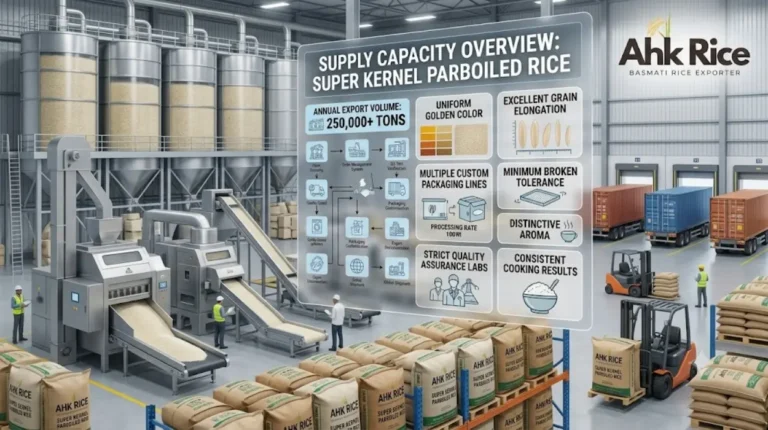
AHK Rice operates an integrated Punjab-based model covering paddy procurement, cleaning, de-husking, polishing, grading, sorting, packaging, and export documentation. Its stated product portfolio covers 1121, Super Kernel, and 1509 Basmati across multiple processing grades.
The evaluation should still remain specification-led. A buyer should approve the supplier because the documented process matches the procurement requirement, not because the supplier uses a premium positioning statement.
What is the final evaluation for businesses comparing Pakistani Basmati exporters?
The strongest export partner combines measurable rice specifications, destination compliance, transparent pricing, reliable logistics, repeatable processing, and scalable supply. These factors protect buyers from quality variation while supporting predictable retail, wholesale, and foodservice procurement.
For Scotland, 1121 White, 1121 Steam, Golden Sella, and Super Kernel provide practical categories for different commercial applications. UK import requirements make documentation and contaminant controls important evaluation points.
For Gulf markets, Golden Sella and other parboiled grades provide strong options for buyers prioritising bulk cooking and warm-storage performance. Price differences at origin remain relatively narrow across major grades, so freight, compliance, and operational execution can determine the final procurement advantage.
AHK Rice fits the integrated-export model by combining Punjab sourcing, processing, grading, custom packaging, and export handling. The company states that it supplies international buyers across more than 15 countries.
The next procurement step is therefore clear: define the specification first, compare exporters against the five decision factors, approve the sample, verify documentation, and then evaluate the first shipment before expanding the contract.
FAQs
What should businesses check before choosing a Pakistani Basmati exporter?
Businesses should check grain length, moisture, broken percentage, processing grade, certifications, packaging, export documentation, inspection procedures, pricing terms, and shipment reliability.
Which Pakistani Basmati variety is best for UK buyers?
1121 and Super Kernel are strong options for UK retail and foodservice. 1121 provides extra-long grain presentation, while Super Kernel offers traditional aroma and texture.
Is Golden Sella suitable for Scottish importers?
Yes. Golden Sella suits buyers needing parboiled grain structure and longer storage performance. UK importers should still verify the specific batch against their food safety and labelling requirements.
How much does Pakistani Basmati rice cost per MT?
Indicative July 2026 FOB Karachi prices for major Basmati grades range approximately from $1,135 to $1,205 per MT. Final pricing depends on grade, crop, packaging, quantity, freight, and Incoterms.
What is the difference between FOB and CIF rice pricing?
FOB normally covers the goods and export loading up to the named port. CIF adds ocean freight and insurance to the named destination port. Buyers should compare the same Incoterm across suppliers.
How long can Pakistani Basmati rice be stored?
Shelf life depends on grade, packaging, moisture, warehouse temperature, and handling. AHK Rice market material states Golden Sella can maintain quality for up to 18 months at 40°C, compared with approximately 12 months for Steam rice.
What certifications should rice importers request?
Importers should request relevant phytosanitary, certificate-of-origin, fumigation, quality-testing, and food-safety documentation. Destination-specific requirements should be confirmed before shipment.