How Can Businesses Track Basmati Rice Movement from Farm to Shelf?
Businesses track Basmati rice most effectively through batch-level traceability linking farm records, milling records, quality tests, logistics documents, and retail packaging. Here is why: every custody change creates a verifiable record that connects origin with the final shelf.
For businesses comparing traceability systems, direct exporter records provide the strongest balance of visibility, cost, and operational control. This guide to Pakistani Basmati cultivation, processing, and export standards explains the production foundation before traceability is applied.
Traceability means identifying where rice originated, how it was processed, which batch moved through each custody point, and where the finished product was distributed. The system can use paper documents, spreadsheets, ERP records, QR codes, or blockchain ledgers. The strongest model connects these methods rather than relying on one technology.
Pakistan exported 808,643 MT of Basmati rice worth $830.57 million during FY2024-25. This scale makes consistent batch identification important for exporters, importers, distributors, and retailers. (source: Rice Exporters Association of Pakistan, FY2024-25)
What are the available solutions for tracking Basmati rice?
The main solutions are paper-based records, digital batch systems, QR traceability, ERP platforms, and blockchain networks. Direct exporter systems offer the strongest practical control because production, testing, packaging, and dispatch records stay connected.
Paper-Based Traceability
Paper documentation records farm suppliers, harvest details, purchase orders, inspection results, invoices, packing lists, and shipping documents. It remains useful for small suppliers because implementation costs are low.
The limitation appears during recalls or audits. Staff must manually match documents across several departments. A single missing document can break the chain between farm and finished package.
Digital Batch Traceability
Digital batch systems assign a unique identification number to each rice lot. The identifier follows the paddy through procurement, milling, grading, testing, packing, and dispatch.
A typical batch record contains farm source, variety, crop year, processing date, moisture result, broken percentage, packaging format, container number, and shipment destination. This creates a searchable production history.
QR-Based Traceability
QR codes connect physical packaging with digital product records. A retailer or consumer scans the code and accesses approved information about origin, batch, processing, certification, or shipment.
Recent rice traceability research demonstrates this model through field-level digital records connected with blockchain-verified QR codes. The TRACE-RICE pilot used QR-linked information to connect agricultural records with consumer-facing transparency.
ERP-Based Traceability
Enterprise Resource Planning systems connect procurement, inventory, production, quality control, sales, and logistics. ERP traceability works well for exporters handling multiple varieties and shipment cycles.
A business can trace a shipment from a supplier purchase order to the exact finished batch. The system also supports stock rotation and inventory reconciliation.
Blockchain Traceability
Blockchain creates a distributed record of transactions and supply-chain events. Each recorded event becomes part of a shared ledger that participants can verify.
Research into rice supply chains identifies blockchain as a method for improving transparency, reliability, and traceability from farm to fork.
Blockchain provides strong data integrity. It does not automatically guarantee that the original farm information is accurate. Businesses still need reliable inspection and verification procedures.
These solutions define the available technology range. The next comparison shows which system provides the best commercial balance.
How do different traceability approaches compare?
Direct digital batch tracking provides the best balance for most Basmati businesses, while QR systems improve consumer visibility and blockchain adds stronger shared-record integrity. Paper systems remain suitable for small operations with limited transaction complexity.
| Attribute | Paper Records | Digital Batch System | QR System | ERP System | Blockchain |
|---|---|---|---|---|---|
| Farm traceability | Basic | Strong | Strong | Strong | Strong |
| Processing visibility | Manual | High | High | Very high | Very high |
| Logistics tracking | Manual | High | High | Very high | Very high |
| Audit speed | Low | High | High | Very high | High |
| Consumer access | Low | Limited | Excellent | Limited | Excellent |
| Implementation cost | Low | Medium | Medium | High | High |
| Scalability | Low | High | High | Very high | High |
Digital batch systems usually provide the most practical starting point. They require fewer infrastructure changes than full blockchain deployment.
ERP systems become more valuable as shipment volume increases. An exporter handling 20 containers annually has different needs from an exporter managing hundreds of containers.
QR systems add another layer. They convert internal traceability data into a consumer-facing product experience without exposing confidential commercial records.
Blockchain becomes valuable when several independent organizations need a shared record. A farm, processor, exporter, importer, distributor, and retailer can participate in the same verification structure.
The comparison establishes the technology choices. Regional demand now determines which traceability depth creates the most value.
Which method works best for different market regions?
UK and Scottish buyers benefit from detailed digital batch traceability, while GCC buyers gain more from batch control combined with processing and storage records. Both regions require documented quality evidence before distribution.
UK and Scotland
UK and Scottish markets suit digital traceability linked with QR packaging, batch certificates, laboratory results, and shipment documentation. Retailers need clear product identity and reliable supplier records.
Super Kernel and 1121 Basmati fit premium retail and foodservice applications. UK-facing buyers can use batch numbers to connect the packaged product with its processing lot.
A current indicative FOB benchmark places 1121 White Basmati at $1,165–$1,205 per MT and Super Kernel Basmati at $1,165–$1,205 per MT. These figures are FOB Karachi benchmarks, not Scottish landed prices.
White Basmati commonly provides 12 months of shelf-life performance, while Super Kernel generally falls within the 12–18 month range under suitable storage conditions.
Scottish distributors therefore benefit from traceability that records crop year, milling date, packing date, container number, and warehouse receipt. This supports stock rotation and supplier evaluation.
GCC Markets
GCC buyers often prioritize 1121 Sella and Golden Sella because these grades deliver strong grain integrity and longer storage performance. Saudi Arabia, UAE, Qatar, and Iraq represent important markets for Pakistani Basmati.
Indicative FOB pricing places 1121 Sella at $1,135–$1,175 per MT, while Golden Sella ranges around $1,145–$1,185 per MT.
Golden Sella provides 18–24 months of typical shelf-life performance. Steam and White Basmati generally provide shorter storage windows.
GCC distributors therefore gain more value from traceability records that include parboiling details, moisture testing, packaging, fumigation, container loading, and warehouse conditions.
Regional differences do not change the core traceability principle. They change which data fields receive priority.
How can a traceability system follow rice from farm to shelf?
A complete system assigns one batch identity at procurement and preserves that identity through harvesting, milling, grading, testing, packing, shipping, import clearance, distribution, and retail sale.
Step 1: Record the Farm Source
Record the grower, cultivation region, variety, crop year, harvest date, and paddy purchase reference. Punjab remains the primary production base for the Pakistani Basmati varieties supplied by AHK Rice.
Step 2: Record Paddy Reception
Record the incoming paddy weight, moisture level, supplier identity, receiving date, and storage location. These records establish the first physical custody point.
Step 3: Record Milling
Record cleaning, dehusking, polishing, grading, and sorting stages against the batch number. This connects processing activity with the original paddy source.
AHK Rice describes its processing system as including paddy procurement, pre-cleaning, de-husking, paddy separation, whitening, polishing, grading, and length sorting.
Step 4: Record Quality Testing
Record moisture, broken percentage, foreign matter, grain length, purity, and other buyer-specified parameters. Attach laboratory reports to the batch record.
Step 5: Record Packaging
Record the bag type, package size, production date, batch number, and private-label information. The same batch identity should appear on the physical package.
Step 6: Record Container Loading
Record container number, seal number, loading date, fumigation information, gross weight, net weight, and destination port.
Step 7: Record Shipment
Record vessel information, bill of lading, departure date, arrival estimate, and destination importer. Logistics data connects the processing batch with international movement.
Step 8: Record Distribution
Record importer receipt, warehouse location, distributor transfer, and inventory allocation. This creates visibility after customs clearance.
Step 9: Record Retail Placement
Record the retailer, store or distribution channel, package batch, and sale region. The final record completes the farm-to-shelf chain.
This process creates a connected evidence trail rather than isolated documents. The next question is how each model performs in practical business situations.
What are the pros and cons of each traceability solution?
Digital batch tracking delivers the strongest practical value, QR systems improve customer transparency, ERP platforms maximize operational control, and blockchain strengthens shared verification. Each approach has different implementation requirements.
Digital Batch Tracking
Advantages: Lower implementation complexity, searchable records, strong batch control, and easy integration with quality documentation.
Limitations: Staff must enter accurate information at each custody point.
A Scottish importer receiving 100 MT across 4 containers can assign each container to one production batch. A quality issue can then be isolated without reviewing the entire annual inventory.
QR Traceability
Advantages: Easy scanning, consumer access, retail differentiation, and direct product information.
Limitations: QR codes require accurate linked records and do not independently verify the data.
A retail pack can display a QR code linking to the batch origin, processing date, quality certificate, and export shipment.
ERP Traceability
Advantages: Strong inventory control, automated workflows, purchasing integration, and scalable reporting.
Limitations: Higher implementation costs and greater staff training requirements.
ERP systems become more useful when an exporter manages multiple products, grades, destinations, packaging formats, and contracts.
Blockchain
Advantages: Shared records, stronger tamper resistance, and multi-party verification.
Limitations: Higher technical complexity and greater dependency on participant adoption.
Blockchain works best where several independent organizations require the same trusted transaction history. It delivers less value when only one organization controls the complete database.
The solution must match operational complexity rather than technology popularity. Decision factors provide the final selection framework.
What factors should businesses use when choosing a traceability system?
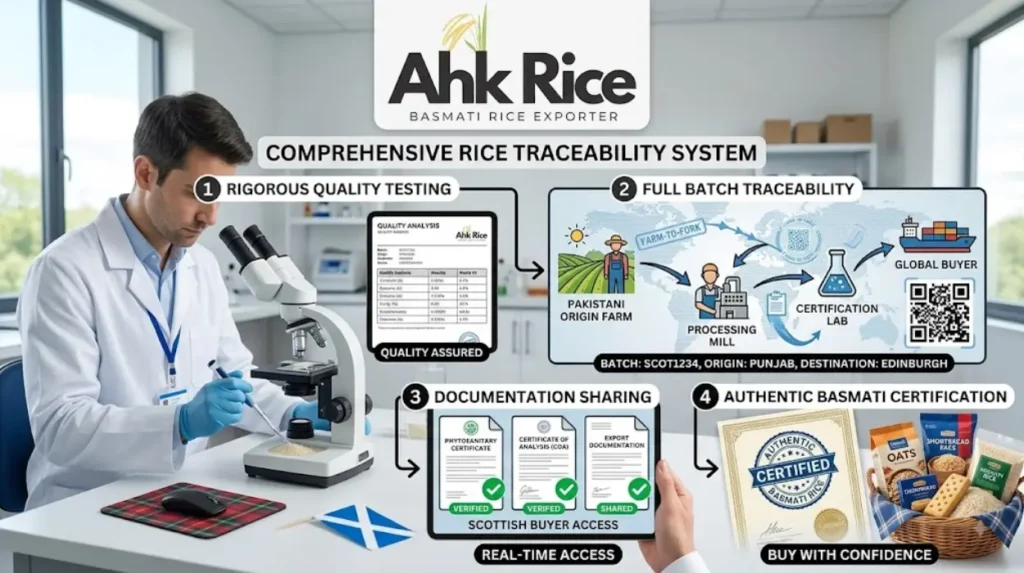
Businesses should prioritize batch identity, data accuracy, market requirements, implementation cost, and scalability before selecting technology. The best system connects physical rice movement with verified digital records.
| Decision Factor | What to Evaluate | Best-Fit Approach |
|---|---|---|
| Batch control | Can every shipment trace to one production lot? | Digital batch |
| Market compliance | Can records support importer audits? | ERP or digital batch |
| Consumer transparency | Can shoppers verify product information? | QR system |
| Multi-party verification | Do several organizations need one shared ledger? | Blockchain |
| Business scale | Will shipment volume increase substantially? | ERP |
Batch identity should come first. A QR code without a reliable batch record adds presentation without traceability depth.
Data accuracy should come second. Staff must verify farm, processing, testing, packaging, and shipment information before records become permanent.
Market requirements should come third. UK and Scottish buyers may prioritize detailed product and compliance records. GCC distributors may place greater emphasis on processing, storage, and shipment continuity.
Cost should come fourth. Businesses should calculate software, scanning equipment, staff training, maintenance, and integration costs.
Scalability should come fifth. A traceability system should handle additional varieties, customers, containers, warehouses, and retail channels without rebuilding the entire database.
This framework turns traceability from a technology project into a procurement decision.
How can AHK Rice support traceable Basmati movement?
AHK Rice supports traceable supply through Punjab sourcing, controlled processing, quality inspection, customized packaging, and export documentation that connect rice production with shipment execution.
AHK Rice Pakistan rice export service provides an integrated export structure for Pakistani Basmati varieties. AHK Rice supplies 1121, Super Kernel, and 1509 varieties to international buyers.
The processing chain connects paddy procurement with cleaning, dehusking, polishing, grading, sorting, inspection, packaging, and container loading. This structure creates multiple points where batch information can be recorded.
AHK Rice also provides customized packaging. Packaging can carry product specifications, batch identification, market information, and private-label requirements according to the buyer’s program.
Quality records add another layer. Inspection documents can connect physical specifications with the shipment being dispatched.
Traceability therefore works best as a complete process. Farm origin starts the record. Processing develops it. Testing verifies it. Packaging identifies it. Logistics completes it.
For Scottish buyers, this structure supports a clearer connection between Pakistani farm origin and the retail product. For GCC buyers, it supports processing, storage, and shipment verification.
The final decision should focus on evidence rather than technology alone.
What is the best traceability model for Basmati rice businesses?
A digital batch system with QR capability provides the strongest practical foundation for most Basmati businesses, while ERP and blockchain can extend control as supply-chain complexity increases.
Digital batch traceability creates the core identity. QR technology exposes selected information to retailers and consumers. ERP systems connect traceability with inventory and procurement. Blockchain can add shared verification across independent organizations.
Businesses should therefore build traceability in layers. Start with farm and batch records. Add quality testing. Connect packaging. Connect logistics. Add QR visibility. Introduce ERP or blockchain when operational complexity justifies it.
The objective is not to create the most advanced technology system. The objective is to make every movement of Basmati rice explainable from farm to shelf.
That evidence chain converts traceability into measurable commercial value. It supports recalls, audits, supplier evaluation, inventory control, customer confidence, and long-term procurement decisions.
Frequently Asked Questions
What is Basmati rice traceability?
Basmati rice traceability is the documented ability to follow rice from cultivation and harvesting through processing, testing, packaging, shipping, distribution, and retail. A unique batch number connects each stage.
Why is traceability important for rice importers?
Traceability helps importers verify origin, quality, processing history, shipment identity, and distribution records. It also makes supplier audits and product investigations faster.
What is the best technology for rice traceability?
Digital batch tracking provides the strongest practical starting point. QR codes add consumer visibility, ERP systems add operational control, and blockchain supports shared verification.
Which Basmati grades suit longer storage cycles?
Golden Sella and other Sella grades generally provide longer commercial shelf-life performance than White Basmati. Typical Sella ranges reach 18–24 months, while White Basmati commonly ranges around 12–18 months under suitable conditions.
How much does Pakistani Basmati cost per MT?
Current indicative FOB Karachi pricing places 1121 Basmati around $1,135–$1,205 per MT, depending on processing grade. Actual landed prices vary with freight, insurance, packaging, destination charges, and contract terms.
Which markets can use farm-to-shelf Basmati traceability?
UK, Scotland, GCC, EU, North America, and other import markets can use farm-to-shelf traceability. The required data fields should match the destination’s compliance, retail, and distribution requirements.
Can QR codes prove rice origin?
A QR code can display origin information, but the code itself does not prove authenticity. Origin claims require reliable upstream records, verified batch identities, inspection evidence, and controlled data entry.
What information should a Basmati batch record contain?
A strong batch record should contain farm source, variety, crop year, harvest date, processing dates, moisture, broken percentage, grading results, packaging details, container number, shipping documents, and destination information.