How Can Production Capacity Affect Rice Delivery Performance?
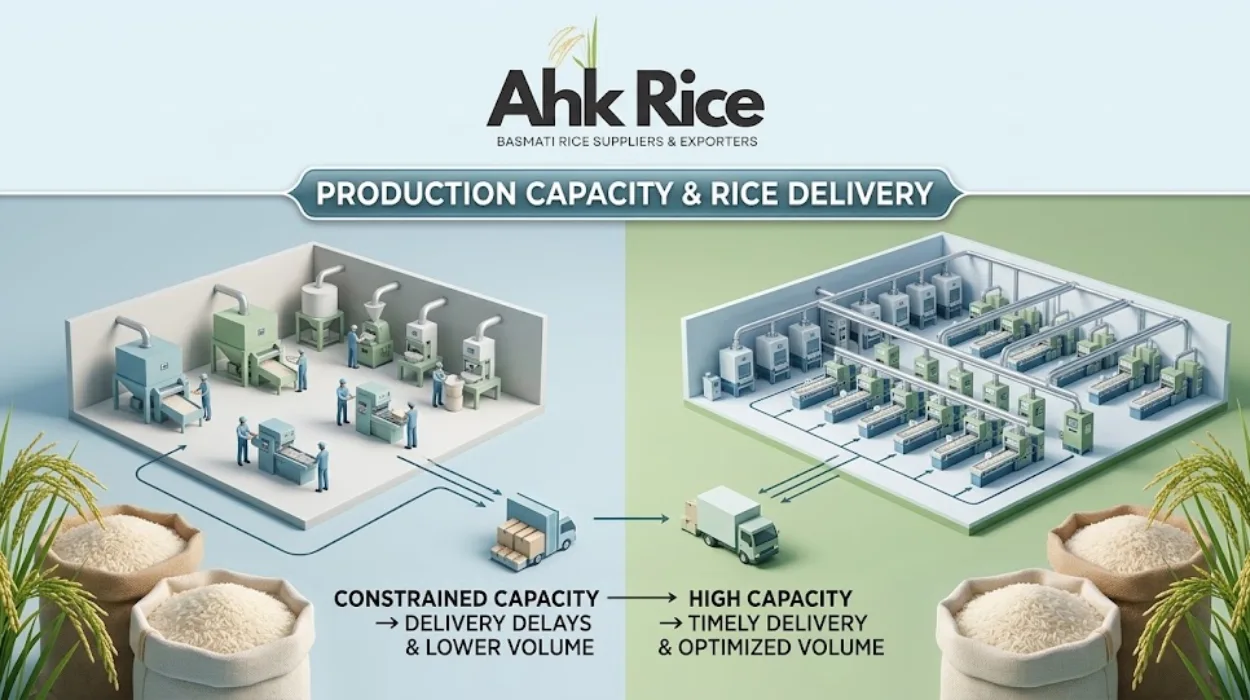
Production capacity affects rice delivery performance by determining how reliably an exporter can convert paddy into the required grade, process the contracted volume, prepare export documentation, load containers, and maintain shipment schedules; for Pennsylvania buyers, capacity-backed supply is more dependable than price alone.
For wholesalers, distributors, foodservice suppliers, and private-label importers, production capacity should be evaluated as a delivery-performance factor rather than simply as factory size. A buyer assessing:
Why Pennsylvania wholesalers assess supplier production capacity needs to examine available processing lines, daily output, storage capacity, grading capability, packaging flexibility, quality-control systems, and the supplier’s ability to allocate production during peak demand.
Pakistan remains a major global rice supplier. USDA data placed Pakistan’s 2025 rice exports at about 5.2 million metric tons, while Pakistan’s FY2025–26 data recorded more than 4.29 million metric tons of rice exports and 794,638 metric tons of Basmati exports. These volumes show why production and export capacity directly influence international supply continuity.
What does production capacity mean for rice delivery performance?
Production capacity is the quantity of rice an exporter can process to specification within a defined period while maintaining quality, packaging, storage, documentation, and loading controls without disrupting existing contracts or shipment schedules.
Production capacity is different from theoretical factory output. A mill may advertise a high daily capacity, but usable export capacity depends on cleaning, de-husking, whitening, grading, colour sorting, parboiling, drying, packing, warehousing, and container-loading availability.
For example, an exporter receiving a 100 MT order of 1121 Basmati must have sufficient paddy or finished stock, processing availability, packaging materials, quality-control capacity, and warehouse space. If one stage becomes a bottleneck, the advertised factory capacity does not translate into faster delivery.
Capacity also affects repeat orders. A Pennsylvania wholesaler may initially purchase 20 MT, but a successful retail program can increase requirements to 100 MT or more per shipment. A supplier must therefore demonstrate how production scales when demand increases.
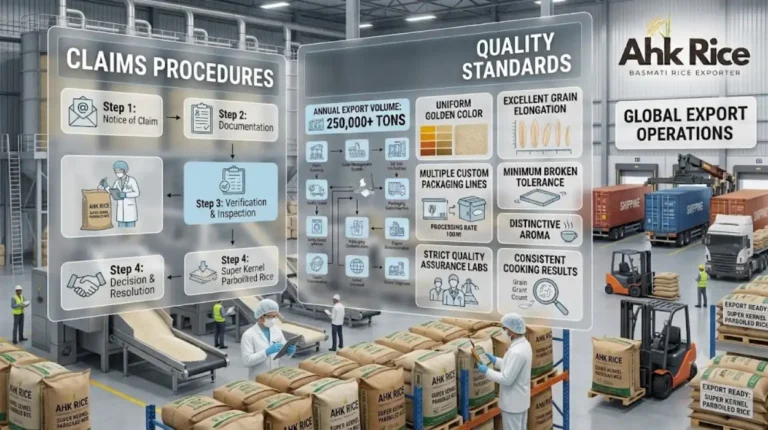
AHK Rice operates an integrated processing and export facility in Punjab and describes its workflow from paddy procurement through cleaning, de-husking, grading, colour sorting, controlled drying, packaging, documentation, and container loading.
What are the available solutions for managing rice delivery capacity?
The main solutions are ready-stock purchasing, scheduled production, dedicated production allocation, multi-grade planning, and integrated mill-to-port coordination; each approach solves a different delivery problem and should match the buyer’s volume, timing, and specification requirements.
Ready-stock supply
Ready stock is finished rice that has already been processed, graded, packed, and stored for dispatch. It is the fastest option when the buyer needs a shipment without waiting for the complete production cycle.
This method works well for urgent replenishment, promotional launches, seasonal demand, and smaller wholesale programs. Its limitation is inventory availability. A supplier cannot maintain unlimited quantities of every grade and packaging format.
Scheduled production
Scheduled production reserves processing time for a confirmed order. The exporter plans raw material allocation, milling, grading, packing, inspection, and loading against the buyer’s required shipment window.
This approach suits predictable monthly or quarterly purchasing. It also gives the buyer greater control over grain length, moisture, broken percentage, packaging, and grade.
Dedicated production allocation
Dedicated allocation gives a larger buyer a defined portion of production capacity during a contracted period. Instead of competing for available production after placing each order, the buyer establishes a planned supply schedule.
This method is useful for supermarket programs, regional distributors, foodservice chains, and private-label brands that require repeat shipments.
Multi-grade production planning
Multi-grade planning allows an exporter to manage different Basmati specifications across available processing lines. A buyer may require 1121 Steam for one channel, Super Kernel White for another, and 1509 Steam for a value-oriented range.
This strategy reduces dependence on a single product and allows importers to match product grades with different customer segments.
Integrated export coordination
Integrated coordination connects processing, packaging, quality inspection, documentation, container loading, and freight scheduling. The objective is to prevent a completed production batch from waiting because another export stage is incomplete.
This is particularly important for overseas buyers because delivery performance includes more than milling time.
How do different rice production approaches compare?
Ready stock provides the shortest production lead time, scheduled production provides stronger specification control, dedicated allocation offers the best repeat-order security, and integrated capacity management provides the strongest overall balance for commercial import programs.
| Attribute | Ready Stock | Scheduled Production | Dedicated Allocation | Integrated Capacity Planning |
|---|---|---|---|---|
| Production lead time | Lowest | Moderate | Planned | Planned and controlled |
| Volume flexibility | Moderate | High | Very high | Very high |
| Specification control | Moderate | High | High | High |
| Packaging flexibility | Moderate | High | High | Very high |
| Repeat-order security | Moderate | High | Very high | Very high |
| Inventory requirement | High at supplier | Moderate | Planned | Optimised |
| Best use case | Urgent replenishment | Regular orders | Large contracts | Long-term programs |
The comparison shows that capacity should not be judged by one number. A factory’s annual production figure does not tell a buyer whether the required grade can be processed during the required week.
A better evaluation connects volume + specification + production window + packaging + inspection + loading.
For example, a supplier with 10,000 MT annual theoretical capacity may still struggle to deliver 200 MT of a specific 1121 Sella grade if that grade is not currently scheduled. Another supplier with lower total capacity but dedicated processing availability may complete the same order more predictably.
How does capacity affect 1121, Super Kernel, and 1509 Basmati delivery?
Capacity affects each Basmati variety through raw-material availability, processing requirements, grade segregation, ageing or parboiling schedules, packaging demand, and inventory planning; the best supply model therefore depends on the product specification and the buyer’s delivery window.
1121 Basmati is widely used for premium wholesale and foodservice programs because of its extra-long grain and strong elongation after cooking. It is available in white, steam, brown, parboiled, Golden Sella, and Creamy Sella grades. A supplier needs appropriate processing and sorting capacity to maintain the selected specification.
Super Kernel Basmati occupies a premium position because of its aromatic profile and slender grain. It is commonly positioned for higher-value foodservice, retail, and ethnic-market applications. Its processing capacity must support consistent grain selection and appearance.
1509 Basmati provides a cost-oriented alternative to 1121 while retaining long-grain cooking characteristics. It can suit buyers seeking a lower procurement cost without moving away from a premium long-grain category. A supplier with flexible production capacity can allocate 1509 separately from higher-value 1121 programs.
The practical lesson is important: capacity must be matched to the exact grade, not simply the Basmati category.
How do Pennsylvania and Northeast U.S. markets differ from Mid-Atlantic foodservice markets?
Pennsylvania and the broader Northeast typically favour consistent premium grades for ethnic retail, wholesale, and foodservice channels, while Mid-Atlantic buyers can place greater emphasis on repeat replenishment, flexible pack formats, and competitive grades for high-volume distribution.
For this comparison, the Northeast market includes Pennsylvania and surrounding distribution markets where imported Basmati serves wholesalers, ethnic supermarkets, restaurants, caterers, and private-label retailers.
The Mid-Atlantic foodservice market includes Pennsylvania, Maryland, Delaware, New Jersey, Virginia, and Washington, D.C. distribution networks where rice moves through foodservice distributors, restaurant suppliers, and institutional channels.
| Market region | Typical grade preference | Indicative procurement positioning | Commercial shelf-life target | Capacity priority |
| Northeast retail and wholesale | 1121 White, 1121 Steam, Super Kernel | Premium, approximately $1,050–$1,250/MT FOB Pakistan depending on specification | Up to 24 months when packed and stored under validated conditions | Consistent grade and packaging |
| Mid-Atlantic foodservice | 1121 Steam, 1509 Steam, selected Super Kernel | Value-to-premium, approximately $950–$1,150/MT FOB Pakistan depending on grade | Up to 24 months when specification and storage conditions support it | Repeat-volume availability |
These are indicative procurement bands rather than live quotations. Actual FOB pricing changes with crop availability, grain length, ageing, broken percentage, moisture, processing grade, packaging, order quantity, currency, and freight conditions. Pakistan’s FY2025–26 Basmati exports averaged roughly $1,061 per MT when calculated from reported export value and volume, providing a useful market-level reference rather than a product-specific quotation.
Shelf life should also be treated as a specification rather than a universal number. Commercial white and parboiled rice commonly target storage periods around 24 months when moisture, packaging, warehouse conditions, and lot stability are controlled. Buyers should confirm the declared shelf life on the specific product specification and packaging.
U.S. supply conditions also make dependable import planning relevant in 2026. USDA reported that U.S. 2026/27 rice production was reduced to a 39-year low, while projected long-grain imports increased to a record 49.8 million hundredweight.
Which production method works best for different Pennsylvania buyers?
Small wholesalers benefit from ready stock, recurring distributors from scheduled production, large retailers from dedicated allocation, and private-label programs from integrated capacity planning that connects specifications, packaging, quality control, inventory, and export scheduling.
A small wholesaler with irregular purchasing needs should prioritize ready-stock availability. Holding large volumes of inventory internally can increase working-capital pressure, so shorter supplier production cycles are valuable.
A regional distributor with monthly demand should use scheduled production. Forecasting three to six months of expected demand allows the exporter to reserve processing time and packaging materials.
A large retailer needs dedicated allocation. Retail promotions can create sudden demand increases, and a missed delivery can create empty shelves across multiple stores. Capacity reservations reduce this exposure.
A private-label importer requires the strongest coordination because product specifications, bag design, printing, packaging materials, inspection, and documentation must all align. Production capacity without packaging capacity does not solve the delivery problem.
A foodservice distributor should prioritize repeatability. Restaurants may not require the most premium grade, but they need the same cooking performance and product availability across replenishment cycles.
What are the pros and cons of higher rice production capacity?
Higher production capacity improves volume scalability, scheduling flexibility, and repeat-order potential, but capacity alone does not guarantee quality or delivery; buyers must evaluate whether the additional capacity is controlled, available, specification-specific, and supported by logistics.
Advantages
Higher volume scalability: A supplier can accommodate larger purchase orders without completely disrupting other production commitments.
Better scheduling: Multiple processing lines or planned production windows allow orders to be sequenced according to shipment deadlines.
Improved repeat supply: Capacity planning supports recurring monthly or quarterly contracts.
Greater packaging flexibility: Larger operations can allocate separate packing schedules for retail bags, foodservice sacks, and private-label packaging.
Lower interruption risk: Integrated capacity can reduce dependence on a single processing stage.
Disadvantages
Large capacity can hide quality variation: High output means little if grading and sorting controls cannot maintain specifications.
Capacity may already be committed: A factory can have significant annual capacity while having little open capacity during peak export periods.
Inventory can become expensive: Maintaining ready stock across multiple grades ties up working capital.
Complexity increases with product variety: Producing 1121, Super Kernel, and 1509 across multiple processing grades requires disciplined segregation and scheduling.
The buyer should therefore ask for available capacity, not only installed capacity.
What five decision factors should Pennsylvania rice buyers use?
Pennsylvania buyers should evaluate production capacity through five factors: available volume, specification control, scheduling reliability, inventory readiness, and export execution; together these factors reveal whether stated factory capacity can translate into dependable delivered supply.
| Decision factor | What to verify | Why it affects delivery |
| Available production | Open MT capacity during the required period | Confirms whether the order can actually enter production |
| Specification control | Grain length, moisture, broken percentage, purity, grade | Prevents production from meeting volume but missing specifications |
| Production schedule | Milling, sorting, packing, inspection, and loading dates | Converts capacity into a realistic shipment plan |
| Inventory position | Finished stock and raw-material availability | Determines whether urgent orders can bypass production |
| Export execution | Documentation, inspection, container loading, freight coordination | Prevents completed rice from becoming a delayed shipment |
This framework is more useful than asking, “How many tons can your factory produce?”
A serious capacity assessment should ask how many tons are available for the buyer’s specification and delivery window.
What are the main risks when production capacity is too low?
Insufficient production capacity creates delayed processing, missed vessel cutoffs, rushed quality checks, packaging shortages, inconsistent specifications, and weaker replenishment reliability, making capacity constraints a direct commercial risk for Pennsylvania importers and wholesalers.
The first risk is production delay. If an exporter accepts more orders than its available processing schedule can support, the buyer’s shipment can move beyond the planned production window.
The second risk is specification substitution. A supplier under pressure may attempt to offer an alternative grade to meet a deadline. That can create retail, foodservice, and customer-service problems.
The third risk is packaging delay. Custom packaging requires printed bags, labels, approved artwork, and packing schedules. Rice can be finished while the shipment remains unready.
The fourth risk is vessel cutoff failure. Container loading must occur before the terminal’s required cutoff. Missing the planned vessel can add days or weeks depending on the next sailing.
The fifth risk is replenishment instability. One delayed shipment can affect the next purchasing cycle because inventory forecasts are based on expected arrival dates.
How should buyers evaluate a scalable rice supply program?
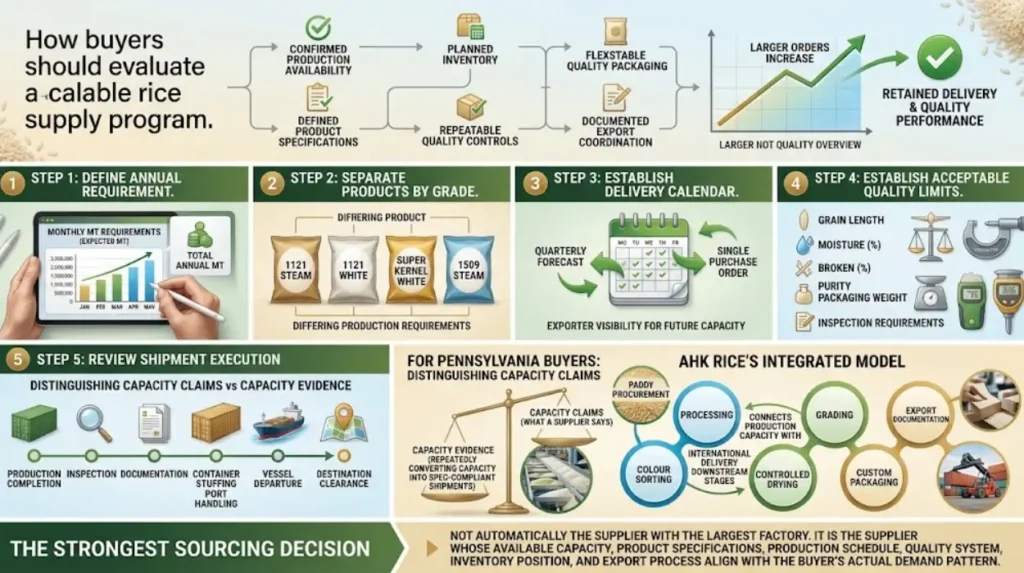
A scalable supply program should combine confirmed production availability, defined product specifications, planned inventory, repeatable quality controls, flexible packaging, and documented export coordination so larger orders can increase without reducing delivery or quality performance.
The first step is to define the annual requirement. A buyer should calculate expected MT by month rather than presenting only an annual total.
The second step is to separate products by grade. For example, 1121 Steam, 1121 White, Super Kernel White, and 1509 Steam should be forecast separately because production requirements differ.
The third step is to establish a delivery calendar. A quarterly forecast is stronger than a single purchase order because it gives the exporter visibility over future capacity requirements.
The fourth step is to establish acceptable quality limits. Grain length, moisture, broken percentage, purity, packaging weight, and inspection requirements should be recorded before production.
The fifth step is to review shipment execution. Production completion is only one milestone. Inspection, documentation, container stuffing, port handling, vessel departure, and destination clearance all influence delivery performance.
For Pennsylvania buyers, this creates a practical distinction between capacity claims and capacity evidence. The first describes what a supplier says it can produce. The second demonstrates whether the supplier can repeatedly convert that capacity into specification-compliant shipments.
AHK Rice’s integrated model covers paddy procurement, processing, grading, colour sorting, controlled drying, custom packaging, export documentation, and container loading, which connects production capacity with the downstream stages required for international delivery.
The strongest sourcing decision is therefore not automatically the supplier with the largest factory. It is the supplier whose available capacity, product specifications, production schedule, quality system, inventory position, and export process align with the buyer’s actual demand pattern.
For Pennsylvania wholesalers planning larger or recurring Basmati programs, the next decision stage can be covered through:
AHK Rice Provides Scalable Basmati Rice Supply for Pennsylvania, where the capacity discussion can move from evaluation criteria toward a supplier-specific sourcing decision.
Frequently Asked Questions
How does production capacity affect rice delivery performance?
Production capacity determines how much rice an exporter can process, grade, pack, inspect, and prepare for shipment within a specific timeframe. Higher available capacity supports more reliable delivery schedules.
Why should Pennsylvania rice wholesalers assess supplier production capacity?
Pennsylvania wholesalers should assess production capacity to reduce the risk of delayed production, packaging shortages, missed vessel cutoffs, and inconsistent replenishment when order volumes increase.
What is the difference between installed capacity and available capacity?
Installed capacity is the maximum output a factory can theoretically produce. Available capacity is the production volume actually open for a buyer’s order during a specific period.
Which Basmati rice varieties require production capacity planning?
1121 Basmati, Super Kernel Basmati, and 1509 Basmati require capacity planning because each variety and grade can involve different processing, grading, sorting, parboiling, packaging, and inventory requirements.
Is ready-stock rice faster than scheduled production?
Yes. Ready-stock rice can usually move into packaging, inspection, and export preparation faster because processing has already been completed. Scheduled production provides stronger control over specifications and future supply.