How Malaysian Rice Importers Work with Pakistani Exporters in 2026
Malaysian rice importers achieve better sourcing outcomes by partnering directly with Pakistani exporters that provide verified quality control, export documentation, flexible packaging, and stable supply chains. Here is why: Pakistan remains one of Malaysia’s most important rice sourcing origins, offering multiple Basmati and non-Basmati grades, competitive pricing, and established shipping routes.
Malaysia imports rice to supplement domestic production and meet growing consumer demand. Pakistani exporters supply premium Basmati varieties, parboiled rice, and white rice grades that serve retail, wholesale, foodservice, and industrial buyers. The relationship between Malaysian importers and Pakistani exporters has become more structured in 2026 because buyers increasingly prioritize traceability, certifications, and long-term procurement planning.
Businesses researching rice origins often begin by understanding production regions, processing methods, and export grades.
Pakistan’s rice sector benefits from large cultivation areas in Punjab. Exporters mill, sort, inspect, package, and ship rice according to destination market requirements. Malaysian importers evaluate suppliers based on product consistency, logistics performance, certification compliance, and commercial terms.
Before comparing sourcing methods, it is important to understand the available solutions Malaysian buyers use when importing rice from Pakistan.
What Are the Available Solutions for Malaysian Rice Importers?
Direct exporter partnerships, trading companies, procurement agents, contract sourcing programs, and private-label supply agreements represent the primary sourcing solutions available to Malaysian rice importers in 2026.
Malaysian importers generally choose among five sourcing models. Each model provides different levels of control, pricing transparency, and operational involvement.
Direct Exporter Partnerships
Direct sourcing connects Malaysian buyers with Pakistani exporters such as AHK Rice. The exporter manages milling, grading, inspection, documentation, packaging, and shipment coordination.
Direct sourcing reduces intermediary costs. Importers gain greater visibility into production specifications and quality procedures.
Trading Companies
Trading companies purchase rice from multiple mills and consolidate export orders.
This approach provides flexibility when buyers require several grades from different sources. Trading companies often simplify procurement for smaller importers.
Procurement Agents
Procurement agents represent the buyer in Pakistan.
Agents inspect mills, negotiate prices, verify documentation, and monitor production schedules. This model works well for buyers without a local sourcing team.
Contract Sourcing Programs
Contract sourcing establishes annual or multi-year purchasing agreements.
Long-term contracts stabilize supply volumes and pricing structures. Foodservice distributors and supermarket chains frequently use this model.
Private Label Supply
Private-label sourcing allows Malaysian brands to sell Pakistani rice under their own label.
Exporters package products according to retailer specifications. This model supports brand development and market differentiation.
The available sourcing models create different operational outcomes. The next question is how these approaches compare across important buying criteria.
How Do Different Approaches Compare?
Direct exporter sourcing delivers the best price transparency, contract sourcing offers supply stability, procurement agents improve verification, and trading companies provide sourcing flexibility.
Specification Comparison Table
| Attribute | Direct Exporter | Trading Company | Procurement Agent | Contract Program |
|---|---|---|---|---|
| Price Transparency | High | Medium | High | High |
| Supply Stability | High | Medium | Medium | Very High |
| Quality Visibility | Very High | Medium | High | High |
| Communication Speed | Fast | Medium | Medium | Fast |
| Custom Packaging | Available | Limited | Depends on Supplier | Available |
| Traceability | Full | Partial | High | High |
| Cost Efficiency | Highest | Medium | Lower | High |
Direct exporter relationships provide the clearest visibility into processing operations. Buyers can verify grading standards, moisture levels, broken percentage, and packaging specifications before shipment.
Trading companies simplify procurement when buyers require multiple product categories. However, additional margins often increase landed costs.
Procurement agents add oversight. Buyers gain independent inspection and supplier verification before export.
Contract sourcing reduces supply disruptions. Retail chains and distributors frequently use contracts because predictable inventory supports long-term planning.
Comparison becomes more meaningful when reviewing actual market preferences and commercial specifications.
Which Rice Grades Do Malaysian Buyers Prefer Compared With Other Markets?
Malaysian buyers primarily prefer 1121 Steam, 1121 Sella, Super Kernel Basmati, and selected white rice grades, while Gulf markets emphasize Golden Sella and premium long-grain specifications.
Malaysia Market Preferences
Malaysia’s retail and foodservice sectors favor aromatic rice varieties with consistent cooking performance.
Common preferences include:
- 1121 Steam Basmati
- 1121 Sella Basmati
- Super Kernel Basmati
- IRRI white rice grades
- Long grain white rice
Malaysian consumers prioritize aroma, grain elongation, and texture after cooking.
Gulf Market Preferences
Gulf importers often prioritize shelf stability and extended storage performance.
Common preferences include:
- 1121 Golden Sella
- PK 386 Rice
- Super Kernel Golden Sella
- Premium long-grain parboiled rice
Golden Sella maintains quality during long storage periods. In warehouses operating above 40°C, Golden Sella typically performs better than Steam rice.
Grade Comparison Table
| Market | Preferred Grade | Main Application |
|---|---|---|
| Malaysia | 1121 Steam | Retail |
| Malaysia | Super Kernel | Retail & Restaurants |
| Malaysia | IRRI White Rice | Wholesale |
| UAE | 1121 Golden Sella | Catering |
| Saudi Arabia | Golden Sella | Distribution |
| Qatar | Premium Basmati | Retail |
Regional preferences influence purchasing decisions. Pricing and shelf life further determine which specification creates the highest value.
How Do Price and Shelf Life Compare Across Rice Types?
1121 Steam offers strong retail appeal, while Golden Sella provides longer storage performance and lower quality degradation during extended warehousing periods.
Price Comparison per Metric Ton
| Rice Grade | Average Export Price Range (USD/MT) |
|---|---|
| 1121 Steam Basmati | $1,050–1,250 |
| 1121 Golden Sella | $1,100–1,300 |
| Super Kernel Steam | $900–1,100 |
| IRRI White Rice | $500–700 |
Prices vary according to crop quality, packaging, destination port, and contract volume (source: REAP export data, December 2025).
Shelf Life Comparison
| Rice Type | Typical Shelf Life |
|---|---|
| 1121 Steam | 12–18 Months |
| 1121 Golden Sella | 18–24 Months |
| Super Kernel Steam | 12–18 Months |
| IRRI White Rice | 12–18 Months |
Golden Sella lasts longer than Steam rice. In tropical storage conditions, Golden Sella retains grain integrity for longer periods. Malaysian distributors maintaining larger inventories often benefit from this characteristic.
Price and shelf life help narrow options. The next step is identifying the best sourcing model for specific buyer situations.
Which Method Works Best for Different Importer Types?
Direct sourcing suits experienced importers, procurement agents support first-time buyers, trading companies help mixed-product sourcing, and contracts benefit large-volume distributors.
Decision Framework Table
| Buyer Situation | Recommended Method | Primary Benefit |
|---|---|---|
| First Import Order | Procurement Agent | Risk Reduction |
| Large Distributor | Contract Program | Supply Stability |
| Retail Brand | Private Label | Brand Growth |
| Restaurant Supplier | Direct Exporter | Cost Control |
| Mixed Product Portfolio | Trading Company | Flexibility |
First-time importers benefit from local verification support. Procurement agents inspect mills, review documentation, and monitor production schedules.
Established distributors often prefer annual contracts. Fixed procurement plans simplify inventory forecasting and budgeting.
Retail brands frequently select private-label packaging. Customized branding strengthens market positioning.
Restaurant suppliers prioritize cost efficiency. Direct exporter relationships typically provide the strongest value proposition.
Selecting the right sourcing model requires understanding advantages and limitations. That comparison follows next.
What Are the Pros and Cons of Each Approach?
Every sourcing model provides specific benefits, but each also introduces operational trade-offs that importers must evaluate before committing resources.
Direct Exporter
Pros
- Lower sourcing costs
- Better specification control
- Faster communication
- Direct quality verification
Cons
- Requires supplier evaluation
- Greater importer involvement
Trading Company
Pros
- Multiple sourcing options
- Simplified procurement
- Product consolidation
Cons
- Additional margins
- Reduced production visibility
Procurement Agent
Pros
- Independent verification
- Reduced sourcing risk
- Local market expertise
Cons
- Service fees
- Additional coordination layer
Contract Program
Pros
- Stable supply
- Predictable planning
- Long-term pricing structure
Cons
- Reduced flexibility
- Volume commitments
Importers should align sourcing methods with operational objectives rather than focusing exclusively on price.
Understanding advantages and disadvantages leads directly to the final decision criteria.
What Decision Factors Should Malaysian Importers Evaluate in 2026?
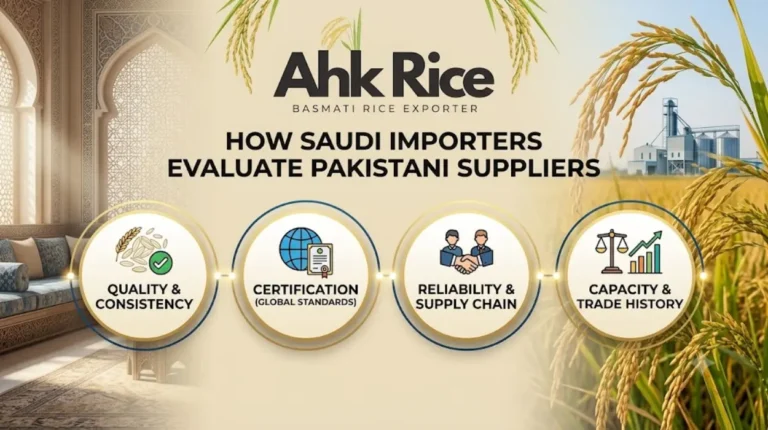
Supplier reliability, quality systems, export experience, documentation accuracy, logistics performance, and product consistency remain the most important decision factors.
Evaluate Quality Systems
Inspect testing procedures.
Verify moisture control, grain length measurement, broken percentage analysis, and contamination testing.
Evaluate Certifications
Review certification records.
Common requirements include ISO certification, phytosanitary certificates, fumigation certificates, and food safety documentation.
Evaluate Export Experience
Review shipment history.
Experienced exporters understand customs procedures, packaging requirements, and destination regulations.
Evaluate Logistics Capability
Assess shipment performance.
Reliable exporters coordinate container loading, customs clearance, vessel scheduling, and documentation preparation.
Evaluate Product Consistency
Request representative samples.
Sample approval reduces quality disputes and improves purchasing confidence.
AHK Rice supports Malaysian buyers through end-to-end processing, grading, packaging, inspection, and export management. Buyers can compare available specifications against operational requirements before selecting a sourcing model.
The decision process becomes easier when supported by market data and trade forecasts. Readers evaluating procurement opportunities should also review our detailed analysis of Pakistan–Malaysia rice trade performance and future demand trends.
Frequently Asked Questions
How long does rice shipping from Pakistan to Malaysia take?
Typical transit times range from 10–20 days, depending on departure port, shipping line, and customs processing.
Which Pakistani rice grade is most popular in Malaysia?
1121 Steam Basmati and Super Kernel Basmati remain among the most commonly imported premium varieties.
What documents are required for rice imports?
Common requirements include:
- Commercial Invoice
- Packing List
- Bill of Lading
- Phytosanitary Certificate
- Certificate of Origin
- Fumigation Certificate
Why do Malaysian buyers choose Pakistani exporters?
Pakistani exporters provide competitive pricing, multiple rice grades, strong production capacity, and established export infrastructure.
Can Malaysian importers request custom packaging?
Yes. Many exporters offer 1kg, 5kg, 10kg, 25kg, and 50kg packaging formats with private-label options.