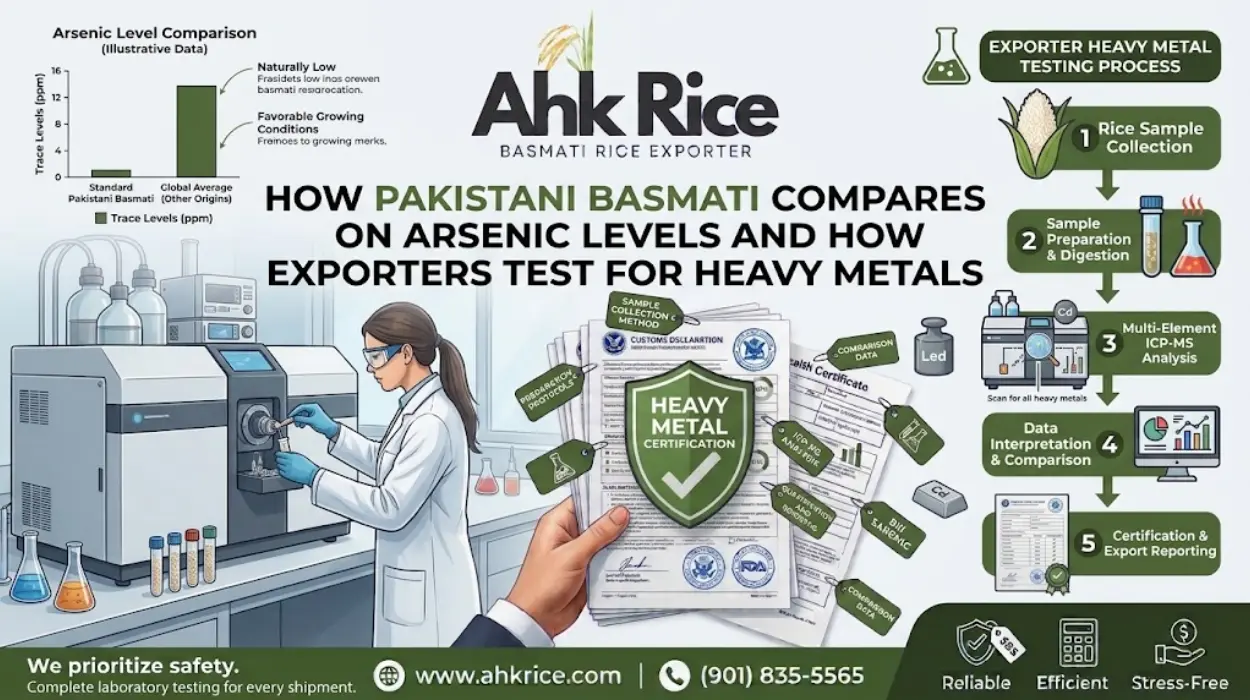
How Pakistani Basmati Compares on Arsenic Levels and How Exporters Test for Heavy Metals
Pakistani Basmati rice should be evaluated for arsenic and other heavy metals through representative sampling, validated laboratory testing, and shipment-specific reports rather than country-of-origin assumptions. For US importers, the strongest purchasing decision combines verified test results, traceability, and applicable food-safety requirements.
Arsenic testing matters because rice absorbs elements from the soil and irrigation water in which it grows. Inorganic arsenic is a particular concern because of its potential health effects. The US Food and Drug Administration (FDA) monitors arsenic in food and distinguishes total arsenic from inorganic arsenic when further analysis is necessary. Buyers can learn more about the issue in our educational guide, Is There Arsenic in Basmati Rice and Why Do US Buyers Ask About It?.
For importers comparing Pakistani Basmati grades, including 1121, Super Kernel, and 1509, the central question is not whether one variety is automatically safer than another. It is whether the specific production lot meets the buyer’s documented acceptance criteria. A laboratory report connects the product to measurable results and helps retailers assess suppliers before placing commercial orders.
What are the available solutions for testing arsenic and heavy metals in Pakistani Basmati?
Rice exporters can use supplier screening, independent laboratory analysis, third-party pre-shipment inspections, and integrated traceability programmes. Each method serves a different purpose, but representative sampling and reliable laboratory analysis provide the essential evidence for evaluating arsenic, lead, cadmium, and mercury in a specific rice lot.
A heavy metal is an element that can create health concerns when exposure reaches harmful levels. In rice procurement, buyers commonly request testing for arsenic, lead, cadmium, and mercury. Arsenic analysis should distinguish total arsenic from inorganic arsenic when the buyer’s specification requires that distinction.
Four main approaches support purchasing decisions.
1. Supplier and agricultural-source screening
Supplier screening reviews growing regions, irrigation practices, sourcing records, processing controls, and previous analytical results. It helps buyers identify potential risks before selecting a supplier. However, historical results cannot establish the contaminant levels of a new shipment.
2. Independent laboratory testing
A laboratory analyses representative rice samples using a validated analytical method. Inductively coupled plasma mass spectrometry (ICP-MS) measures trace concentrations of elements such as lead, cadmium, and total arsenic. High-performance liquid chromatography coupled with ICP-MS (HPLC-ICP-MS) can separate arsenic species, including inorganic arsenic, before measurement.
3. Third-party inspection
An independent inspection company can supervise sampling, verify lot identification, inspect packaging, and document container loading. These activities improve shipment transparency, but a visual inspection cannot determine heavy metal concentrations.
4. Integrated quality assurance
An integrated programme combines supplier screening, laboratory analysis, batch identification, processing records, and shipment documentation. It gives importers a clearer connection between the rice they purchase and the analytical evidence they receive.
How do Pakistani and other Basmati supplies compare on arsenic levels?
Pakistani Basmati cannot be ranked above or below Indian or other rice solely by country of origin. Arsenic concentrations vary with soil, irrigation water, growing conditions, grain characteristics, and production practices. Buyers need comparable laboratory data collected and analysed under consistent conditions.
Rice absorbs arsenic from its growing environment, and flooded cultivation can influence its uptake. The FDA has published research and sampling information on arsenic in rice and rice products, demonstrating variation across samples and product categories. Its findings support evaluating measured concentrations instead of assuming every rice shipment from a particular country has the same profile.
For commercial procurement, the relevant comparison includes the same contaminant, the same reporting units, comparable sampling procedures, and equivalent analytical methods. A total arsenic result cannot be compared directly with an inorganic arsenic result because the measurements represent different quantities.
Seven-attribute comparison table
| Attribute | Pakistani Basmati | Indian Basmati | What US buyers should compare |
|---|---|---|---|
| Country of origin | Pakistan | India | Verified origin and production records |
| Arsenic concentration | Requires lot-specific testing | Requires lot-specific testing | Results in mg/kg or µg/kg |
| Arsenic type | Total or inorganic arsenic, as specified | Total or inorganic arsenic, as specified | Equivalent analytical measurement |
| Other heavy metals | Lead, cadmium, and mercury results | Lead, cadmium, and mercury results | Results against buyer specifications |
| Laboratory method | Validated method appropriate to the analyte | Validated method appropriate to the analyte | Method suitability and reporting limits |
| Batch traceability | Connect report to the identified lot | Connect report to the identified lot | Lot numbers and sampling records |
| Commercial acceptance | Based on applicable requirements and contract | Based on applicable requirements and contract | Documented acceptance criteria |
This comparison deliberately avoids assigning unsupported arsenic figures to either country. A credible country-level comparison requires a sufficiently representative dataset with consistent testing methods and clearly identified rice types. A single laboratory report establishes information about its tested sample, not every shipment from the same country.
How do laboratory testing methods compare?
ICP-MS provides sensitive multi-element analysis, while HPLC-ICP-MS distinguishes arsenic species when the specification requires inorganic arsenic results. Validated atomic absorption methods can also measure selected elements. The correct method depends on the contaminant, required detection limit, sample matrix, and buyer’s reporting requirements.
Laboratory methods differ in analytical scope, equipment, cost, and ability to distinguish chemical forms. Importers should request the method used for each reported analyte rather than accepting a certificate that simply states that the rice passed testing.
| Testing method | Main application | Advantages | Limitations |
|---|---|---|---|
| ICP-MS | Multi-element analysis | High sensitivity and simultaneous measurement of several elements | Requires appropriate sample preparation and quality controls |
| HPLC-ICP-MS | Arsenic speciation | Distinguishes inorganic arsenic from other arsenic species | More specialised analysis and interpretation |
| Atomic absorption spectroscopy | Selected elements | Established method for specific analytes | Scope and detection capability depend on the technique |
| Rapid screening | Preliminary risk assessment | Useful for prioritising samples | Requires suitable validation and may not replace confirmatory laboratory analysis |
The laboratory should report the analytical method, units, detection or quantification limits, sample identification, and results. A result reported as below the limit of quantification does not mean the contaminant is completely absent. It means the laboratory cannot reliably quantify it below the stated threshold under the method used.
For higher-confidence procurement, buyers should also assess laboratory competence and relevant accreditation scope. Accreditation alone does not establish that a sample represents an entire shipment or that every reported method is suitable for the required decision.
Which testing method works best for different US import scenarios?
The best testing approach depends on the product’s intended use, the buyer’s specification, and the risk associated with the shipment. Routine retail rice procurement generally benefits from multi-element analysis, while products intended for infant foods require particular attention to applicable product-specific guidance and inorganic arsenic testing.
Different purchasing situations require different levels of verification.
For mainstream retail rice: Request a representative sample and a laboratory report covering the heavy metals specified in the purchase contract. Ensure the report identifies the rice lot and uses suitable methods.
For premium Basmati and private-label products: Add documented supplier traceability, processing records, lot-specific testing, and independent inspection when required by the buyer’s quality programme.
For infant-food ingredients: Establish the exact product category and applicable regulatory requirements before setting acceptance criteria. The FDA’s action level of 100 parts per billion (ppb) for inorganic arsenic applies to infant rice cereals, not automatically to all bags of uncooked Basmati rice. It is a product-specific action level, not a universal rice limit.
For repeat container orders: Use a documented testing schedule, defined sampling plans, and clear rules for retesting when the source, crop, processing conditions, or supplier changes. Previous results support risk assessment but do not replace testing required by the contract or applicable regulations.
What are the pros and cons of different heavy metal testing strategies?
Laboratory testing offers measurable evidence, supplier screening helps prioritise risk, and independent inspection improves shipment verification. Integrated programmes provide the strongest overall documentation, but they require coordination, defined procedures, and additional costs. Buyers should select a proportionate approach based on intended use and risk.
Laboratory analysis is the primary choice when a buyer needs actual contaminant concentrations. Its main benefit is objective measurement. Its limitations include laboratory fees, sample preparation, turnaround time, and the possibility that a poorly collected sample will misrepresent the lot.
Supplier screening reduces the time spent evaluating unsuitable sources. It helps procurement teams compare growing regions, previous results, and supplier controls. However, it cannot prove that a newly harvested or processed batch meets a specific threshold.
Third-party inspection creates a documented record of sampling, packaging, loading, and shipment identification. This is valuable when the buyer needs independent oversight. The limitation is that inspection does not itself provide chemical analysis unless laboratory testing forms part of the service.
An integrated programme combines these approaches. For example, a US retailer purchasing several containers can specify a heavy metal panel, require the report to identify the relevant lot, and arrange independent sampling before shipment. This creates a stronger audit trail than relying on a supplier’s general quality statement.
How should US buyers interpret arsenic results and applicable requirements?
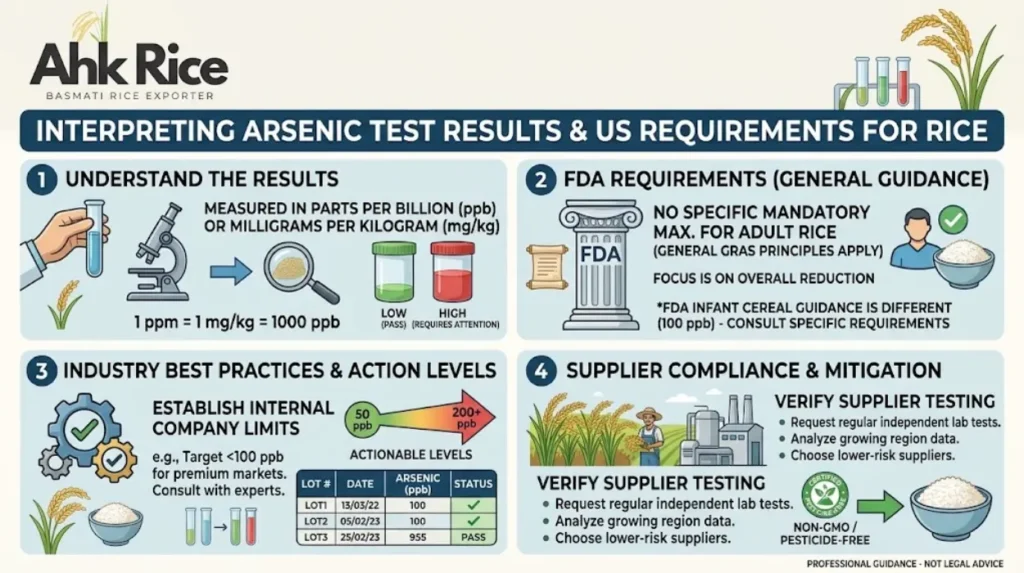
Buyers should distinguish laboratory results from regulatory limits and contractual specifications. They must identify the relevant food category, compare the correct arsenic measurement with the applicable criterion, and retain evidence connecting the result to the imported lot. A test report alone does not guarantee regulatory compliance.
The FDA monitors chemical contaminants in food and may take action when contamination makes food unsafe. Its published arsenic guidance establishes a 100 ppb action level for inorganic arsenic in infant rice cereals. That figure must not be presented as a universal legal threshold for all Basmati rice products.
Buyers should establish written acceptance criteria before ordering. The specification should identify the contaminant, measurement type, units, threshold, analytical method requirements, sampling procedure, and response when a result does not meet the agreed limit. If the destination or intended use has additional requirements, the importer should confirm those requirements with a qualified regulatory professional.
A report should also state whether the result is expressed on an as-received or dry-weight basis when that distinction matters. Results using different bases are not directly comparable without conversion. The same principle applies to units: 1 mg/kg equals 1,000 µg/kg, and 1 µg/kg equals 1 ppb by mass.
How do US and Middle Eastern markets differ in their testing priorities?
US retailers generally need testing and documentation aligned with their product specifications, importer responsibilities, and applicable FDA requirements. Middle Eastern buyers also use laboratory reports to support food-safety review and destination-specific import checks. In both regions, requirements depend on the product, destination, and contract.
In the United States, retailers and importers focus on documented food safety, traceability, supplier verification, and evidence that imported food meets applicable requirements. Buyers selling private-label products often establish their own testing panels and acceptance criteria in addition to regulatory obligations.
In the Gulf region, including the UAE and Saudi Arabia, importers assess laboratory documentation alongside the destination’s food-control and customs requirements. The exact documentation and analytical criteria vary by market and product category, so exporters should confirm them before shipment.
The following comparison is a procurement guide, not a statement that every buyer in either region uses the same requirements.
| Decision factor | United States | UAE and Saudi Arabia |
|---|---|---|
| Main priority | Applicable food-safety requirements and retailer specifications | Destination requirements and importer specifications |
| Testing scope | Agreed contaminant panel and intended product use | Agreed contaminant panel and destination requirements |
| Documentation | Laboratory reports, traceability, and import records | Laboratory reports, traceability, and import documents |
| Acceptance decision | Applicable rules plus buyer criteria | Destination rules plus buyer criteria |
| Best procurement practice | Confirm requirements before contracting | Confirm requirements before contracting |
How do testing costs, purchase prices, and shelf life compare?
Laboratory testing costs depend on the number of analytes, analytical methods, sample count, and laboratory turnaround. There is no defensible universal testing fee or price premium for low-arsenic Pakistani Basmati without a defined testing scope and comparable supplier quotations.
| Commercial factor | Standard procurement | Enhanced verification |
|---|---|---|
| Testing cost | Depends on required routine checks | Higher when additional analyses and independent sampling are included |
| Price per metric tonne | Depends on variety, grade, crop, quantity, packing, and Incoterm | Depends on the same factors plus agreed verification services |
| Shelf life | Depends on moisture, packaging, storage, and product condition | The same physical factors apply; testing alone does not extend shelf life |
| Buyer confidence | Depends on available records | Strengthened by traceable, relevant, lot-specific evidence |
Buyers should compare quotations on the same basis, including grade, quantity, packaging, freight terms, and testing scope. A supplier charging more for a laboratory report should identify exactly which analyses, samples, and verification services the price covers.
Shelf life requires separate consideration. Heavy metal analysis does not establish shelf life because arsenic, lead, cadmium, and mercury are not indicators of moisture control or microbial stability. Storage life depends on the product’s condition, moisture, packaging integrity, warehouse temperature, humidity, and pest control.
What decision factors should buyers use before selecting a Pakistani Basmati exporter?
US buyers should select suppliers based on relevant test coverage, representative sampling, laboratory competence, batch traceability, transparent acceptance criteria, and consistent documentation. Price matters, but the lowest quotation does not establish the lowest compliance risk or the strongest evidence of product safety.
Use this five-row decision framework to compare suppliers.
| Decision factor | Question to ask | Evidence to request |
|---|---|---|
| Laboratory capability | Can the supplier test each required contaminant using a suitable method? | Laboratory report and analytical method |
| Sampling quality | Does the sample represent the identified production lot? | Sampling plan and sample identification |
| Traceability | Can the result be connected to the goods being shipped? | Lot number, batch record, and shipment documents |
| Regulatory fit | Does the report address the relevant product and destination requirements? | Written specification and compliance review |
| Commercial reliability | Can the supplier maintain the agreed testing and documentation process? | Quality procedures and shipment-specific records |
AHK Rice is a Pakistani Basmati rice exporter based in Punjab, supplying 1121, Super Kernel, and 1509 varieties to international markets. Its end-to-end processing, custom packaging, and export coordination provide a framework for discussing product specifications and shipment documentation with buyers. Importers should state their heavy metal testing requirements before confirming an order and verify that the requested analyses are included in the agreed scope.
For buyers comparing supply options, the most useful next step is to request a specification that defines the variety, packaging, testing panel, reporting limits, sample procedure, and shipment documentation. The resulting quotation can then be evaluated against comparable suppliers rather than against price alone.
The strongest sourcing decision combines verified analytical results with traceability, clear specifications, and documented shipment controls. Country of origin and rice variety are not substitutes for laboratory evidence. Buyers should compare the same contaminants, methods, units, and acceptance criteria before selecting a supplier.
For US retail procurement, AHK Rice buyers can begin by defining their required heavy metal panel, intended product category, packaging, and shipment documentation. The supplier evaluation should then establish which analyses are available, how samples will be identified, and how the results will be connected to the shipment.
A structured approach makes quotations easier to compare and gives importers a stronger basis for supplier approval. The objective is not simply to obtain a test certificate. It is to establish a repeatable process for verifying the rice that reaches the market.
Frequently asked questions about arsenic and heavy metals in Pakistani Basmati
Does Pakistani Basmati contain arsenic?
Arsenic can occur in rice because rice plants absorb elements from soil and water. The concentration varies between samples and growing conditions. A representative laboratory test is required to determine the arsenic concentration of a specific lot.
Is Pakistani Basmati lower in arsenic than Indian Basmati?
Neither country can be declared consistently lower in arsenic without comparable, representative data. Buyers should compare equivalent rice types tested with consistent methods and distinguish total arsenic from inorganic arsenic.
Which heavy metals should rice importers test for?
Buyers commonly specify arsenic, lead, cadmium, and mercury. The appropriate panel depends on the product, intended use, buyer requirements, and applicable regulations. Arsenic speciation is important when inorganic arsenic must be measured separately.
What does 100 ppb arsenic mean for US rice importers?
The FDA’s 100 ppb action level applies to inorganic arsenic in infant rice cereals. It is not a universal action level for every uncooked rice product. Importers must establish the applicable criteria for their particular product.
Can an exporter guarantee that Basmati rice is free from heavy metals?
A responsible exporter should provide measurable test results against defined specifications rather than promise absolute absence. Analytical results depend on the sample, method, and reporting limit. A result below a method’s detection or quantification limit does not prove absolute zero concentration.
How often should exporters test rice shipments?
Testing frequency should follow the buyer’s specification, risk assessment, source variability, and applicable requirements. Shipment-specific testing provides direct evidence for the identified lot, while historical results help monitor consistency across orders.
What should a heavy metal report include?
A useful report identifies the laboratory, sample, lot or batch, sampling information where available, analytical methods, test date, units, results, reporting limits, and relevant quality controls. Buyers should confirm that the report covers every required contaminant.
Can washing or cooking remove heavy metals from rice?
Washing and cooking practices can affect the amount of some contaminants retained in the prepared food, but the reduction varies by contaminant and method. They do not replace supplier controls, laboratory testing, or compliance with applicable food-safety requirements.