Import Lab-Tested Pakistani Basmati Rice with Heavy Metal Reports for USA Retailers
The best solution is to source Pakistani Basmati rice from an exporter that can arrange appropriate laboratory testing, provide lot-specific documentation, and coordinate shipment specifications before dispatch. US retailers should verify arsenic and other relevant heavy metal results against applicable requirements and their own purchasing standards.
Rice importers need more than attractive grain length, aroma, and competitive pricing. They need evidence that the product meets agreed quality specifications and that their supply chain supports food safety verification. Arsenic, cadmium, lead, and mercury are among the metals buyers may consider when establishing a testing programme, although the appropriate analytical scope depends on the product, risk assessment, and applicable requirements.
Before purchasing, buyers should understand why US buyers ask about arsenic in Basmati rice. A clear understanding of the concern helps importers distinguish between general food safety information and laboratory evidence for a specific commercial shipment.
For a purchasing decision, request a laboratory report identifying the tested sample, analytical method, reporting units, detection or quantification limits, and measured results. Confirm whether the report represents the proposed production lot. A report for a different crop, supplier, or shipment should not automatically be treated as evidence for the rice being purchased.
Why Choose AHK Rice for Lab-Tested Pakistani Basmati Rice?
AHK Rice supplies Pakistani Basmati rice for international buyers and coordinates product specifications, processing requirements, packaging, and export arrangements. US retailers should confirm laboratory testing availability, report scope, and documentation requirements before approving a purchase order or shipment.
AHK Rice is a Pakistani Basmati rice exporter based in Punjab, supplying varieties including 1121, Super Kernel, and 1509 Basmati rice to international markets. Its export process covers sourcing, processing, grading, packaging, and shipment coordination.
Retailers can explore the available products and export services through AHK Rice when evaluating a potential supplier.
For US distribution, buyers should specify the grade, grain characteristics, packaging format, destination, and required laboratory checks at the quotation stage. This gives the exporter a defined purchasing brief and helps identify any additional testing or documentation needed before shipment.
A practical procurement specification should include:
- Rice variety: 1121, Super Kernel, or 1509 Basmati.
- Product condition: Raw, Steam, Golden Sella, or another agreed grade.
- Quality parameters: Grain length, broken percentage, moisture, foreign matter, and other contractual specifications.
- Laboratory testing: Relevant heavy metals, analytical methods, reporting units, and agreed acceptance criteria.
- Packaging: Retail-ready bags or bulk commercial packaging, with approved artwork and labelling.
- Documentation: Commercial invoice, packing list, transport documents, certificate of origin where applicable, and relevant laboratory reports.
- Shipment terms: Agreed Incoterm, destination, inspection arrangements, and dispatch schedule.
AHK Rice should confirm the availability and cost of the requested laboratory tests for the specific order. Buyers should not assume that every product automatically includes a heavy metal report or that a report alone guarantees regulatory compliance.
Which Heavy Metals Should US Retailers Test for in Pakistani Basmati Rice?
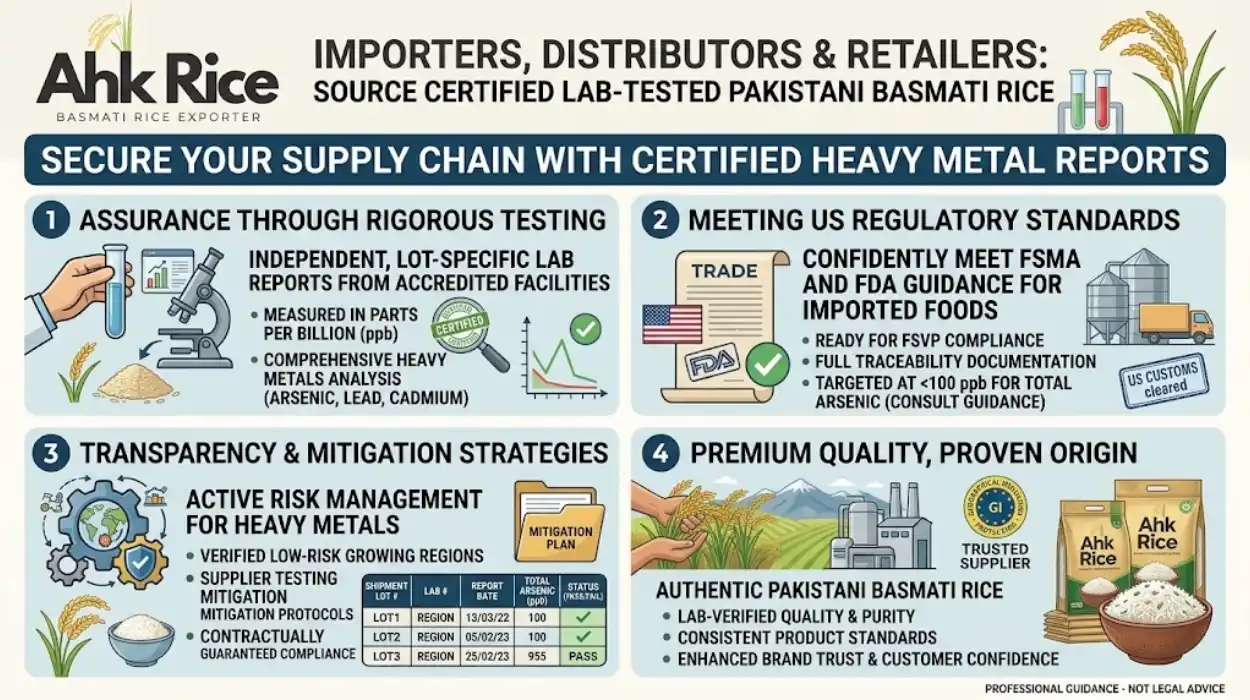
US retailers should select testing parameters through a documented food safety risk assessment and confirm applicable requirements for their product. Inquiries commonly include inorganic arsenic, cadmium, lead, and mercury, but testing scope and acceptance criteria should reflect current regulations and customer specifications.
Arsenic receives particular attention because rice can absorb arsenic from its growing environment. However, arsenic occurs in different chemical forms, and total arsenic is not interchangeable with inorganic arsenic when the relevant requirement concerns the inorganic form.
Retailers should therefore identify the analytical result they need before requesting a quotation. If their specification requires inorganic arsenic, they should confirm that the laboratory method measures that form rather than relying on a total arsenic result alone.
Cadmium and lead may also be included in a risk-based testing plan. Mercury testing should be considered where justified by the risk assessment or customer requirements. Testing every possible contaminant on every shipment is not automatically necessary, but omitting a relevant parameter can leave an important verification gap.
Buyers should request reports from a suitably qualified laboratory and verify the laboratory’s scope of accreditation for the relevant method. The report should identify the sample, date, method, units, results, and applicable detection limits.
A laboratory result must be interpreted against the correct legal or contractual criterion. Retailers should not assume that a limit established for infant rice cereal, drinking water, or another food category automatically applies to ordinary packaged Basmati rice.
How Can Buyers Compare Arsenic Levels and Testing Methods?
Buyers should compare laboratory results only when the sample type, arsenic form, analytical method, reporting units, and reporting limits are sufficiently consistent. Results from unrelated samples or different analytical scopes cannot establish that one supplier’s rice is safer than another’s.
Importers comparing Pakistani Basmati suppliers should review the evidence behind each claim instead of relying on general statements about origin. Growing conditions, soil, irrigation water, processing, and the specific lot can influence the results.
For a deeper technical comparison, read how Pakistani Basmati compares on arsenic levels and how exporters test for heavy metals. This comparison supports supplier evaluation by explaining why testing methods and sample-specific evidence matter.
When comparing two offers, retailers should ask whether both reports concern the same type of arsenic, use comparable units, and apply suitable methods. They should also confirm that the results correspond to the proposed product and whether the tested sample was collected under an agreed sampling procedure.
A supplier offering a lower price without relevant testing may initially appear more competitive. However, additional testing, relabelling, shipment delays, rejected stock, or corrective action can increase the total cost of procurement.
AHK Rice buyers should establish the required testing scope before confirming the order. This allows both parties to discuss laboratory availability, sample preparation, testing charges, report delivery, and the release conditions for the shipment.
What Results Can US Retailers Expect?
Retailers can expect a clearer basis for supplier approval, documented product specifications, and better visibility into the tested sample when appropriate laboratory analysis is completed. Results depend on the actual lot and test method; no exporter can guarantee a particular outcome without supporting evidence.
The commercial benefit is stronger purchasing control. A retailer can compare a laboratory report with the approved specification, maintain records for internal quality assurance, and share relevant documentation with its compliance team when required.
Consider a US distributor preparing a private-label launch of 1121 Basmati rice in five-pound and ten-pound retail bags. The buyer can define the product grade, moisture limit, packaging artwork, and heavy metal testing requirements before approving production. The exporter can then coordinate the agreed checks and provide the available documentation for review.
If the laboratory results meet the buyer’s specified acceptance criteria, the retailer can proceed with the remaining import checks. If a result falls outside the agreed specification, the parties can investigate the sample, verify the method, arrange confirmatory analysis where appropriate, and determine whether the lot should be rejected or otherwise handled.
Passing a laboratory test does not automatically establish compliance with every US import requirement. Importers must also address applicable FDA requirements, facility registration where required, prior notice, food safety responsibilities, and other obligations relevant to their circumstances.
AHK Rice can coordinate export-side requirements, but the US importer remains responsible for confirming its own regulatory obligations and determining whether the available evidence is sufficient for distribution.
How Much Does Heavy Metal Testing and Export Procurement Cost?
The total cost depends on rice grade, order volume, laboratory scope, sample handling, packaging, inspection, freight, insurance, and destination charges. Buyers should request an itemised quotation rather than relying on a single price per metric tonne that excludes testing and logistics.
A useful commercial quotation separates the rice price from additional services. The following factors influence the final landed cost:
| Cost factor | What buyers should confirm |
|---|---|
| Rice grade | Variety, grain length, broken percentage, moisture, and processing type |
| Laboratory testing | Metals tested, analytical methods, number of samples, and laboratory fees |
| Sampling and courier | Sample quantity, courier destination, collection arrangements, and applicable charges |
| Packaging | Bag size, packaging material, printing, and private-label requirements |
| Inspection | Independent inspection, sampling, and any additional certification |
| Freight | Container size, route, shipping terms, and freight charges |
| Import expenses | Customs brokerage, duties where applicable, port charges, and inland delivery |
Laboratory costs cannot be stated reliably without the test scope and laboratory quotation. Testing four metals in one sample may have a different cost from testing inorganic arsenic separately, analysing multiple lots, or requesting additional parameters.
AHK Rice should confirm the testing charge, whether the cost is included in the rice quotation, and whether repeat testing or independent inspection creates additional fees.
Buyers should also compare the Incoterm carefully. An FOB quotation does not represent the same total purchasing cost as a CIF quotation, and neither necessarily includes US customs brokerage, import duties, terminal handling, or inland delivery.
How Long Does Shipping Take from Pakistan to the USA?
Shipping time depends on the destination port, vessel routing, carrier schedules, transshipment, port congestion, and customs processing. US buyers should obtain a shipment-specific estimate and distinguish ocean transit from total order lead time, which also includes testing and production.
A realistic schedule should include order confirmation, sample approval, procurement, processing, laboratory testing, packaging, container loading, export clearance, ocean transport, and destination handling.
For planning purposes, importers can use the following preliminary ocean-transit estimates, subject to carrier confirmation:
| US destination | Indicative ocean transit from Pakistan |
|---|---|
| East Coast ports, including New York/New Jersey | Approximately 30–45 days |
| Gulf Coast ports, including Houston | Approximately 30–45 days |
| West Coast ports, including Los Angeles | Approximately 35–50 days |
These are planning estimates, not guaranteed transit times or current vessel schedules. Actual routes may differ, and customs examination or port congestion can extend delivery.
Laboratory testing before dispatch can add time depending on the number of parameters, laboratory workload, and whether repeat analysis is required. Buyers should obtain the expected report turnaround and agree whether shipment release depends on satisfactory results.
AHK Rice should confirm the proposed loading schedule, estimated transit window, shipping terms, and documentation timeline before the buyer commits to a retail launch date.
How Does the Rice Sampling Process Work, and What Does It Cost?
A commercial sample allows buyers to assess grain appearance, cooking performance, and suitability before placing a larger order. Heavy metal verification requires an appropriately collected and tested sample, with laboratory charges, courier costs, and responsibilities agreed in advance.
The sample process should follow five stages.
Stage 1: Define the requirement. The buyer specifies the variety, processing type, target grade, intended packaging, destination, and whether the request is for a cooking sample, a laboratory sample, or both.
Stage 2: Confirm availability and charges. AHK Rice confirms the sample quantity, preparation arrangements, courier estimate, applicable phytosanitary charges if required, and any laboratory fees. Charges depend on destination, sample weight, test scope, and courier service.
Stage 3: Dispatch the sample. The parties agree on shipping arrangements and identify who pays the courier and any applicable charges. A cooking sample should not be represented as a laboratory-certified sample unless it has undergone the required testing and is supported by the relevant report.
Stage 4: Review the results. The buyer evaluates grain length, aroma, cooking behaviour, and agreed specifications. If heavy metal testing is required, the parties confirm sample identity, analytical scope, and report suitability before using the results for procurement approval.
Stage 5: Approve the commercial order. The buyer confirms the grade, price, packaging, quantity, testing requirements, shipment terms, and documentation conditions in writing.
There is no single reliable sample cost for every US destination. AHK Rice should provide a specific estimate for the requested sample, courier service, and laboratory work before dispatch. Buyers should also establish whether the sample is representative of the production lot or intended only for preliminary evaluation.
How Can US Retailers Start an Order with AHK Rice?
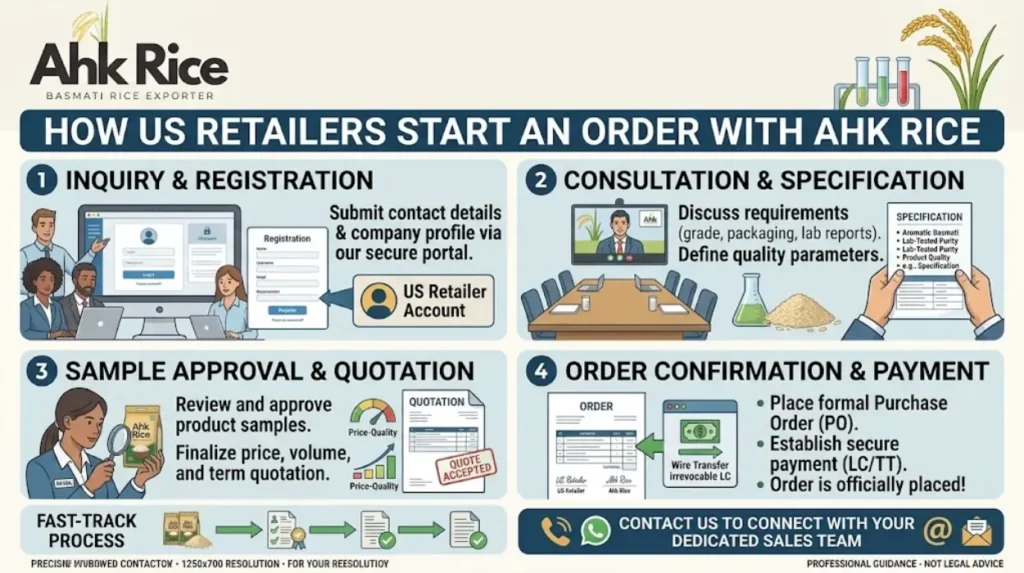
Start by sending a written purchasing specification covering rice variety, quantity, destination, packaging, testing requirements, and delivery terms. Review the quotation and available laboratory documentation, approve the sample where needed, and confirm shipment conditions before authorising production.
AHK Rice can assess the request using the buyer’s commercial requirements. A complete inquiry should include the intended retail channel, preferred Basmati variety, estimated order volume, packaging format, required heavy metals, acceptable results, and target arrival date.
The buyer should then review the quotation, confirm testing responsibilities, and establish the documents required before shipment. Where private-label packaging is involved, artwork and labelling should be approved before production.
Before releasing a purchase order, confirm the following:
- Product specifications and agreed quality tolerances.
- Laboratory scope, sample identity, and report requirements.
- Testing charges and payment responsibilities.
- Packaging design and labelling requirements.
- Incoterm, destination port, and estimated shipping schedule.
- Export documents and US import compliance responsibilities.
- Procedure for handling unsatisfactory test results.
This process gives the retailer a documented basis for supplier approval and reduces avoidable uncertainty before committing to a container shipment.
To request a quotation for Pakistani Basmati rice, laboratory testing arrangements, packaging, and export delivery, contact AHK Rice through its request-a-quote page.
Frequently Asked Questions
Can AHK Rice provide heavy metal reports for US buyers?
AHK Rice can discuss the required testing and documentation for a proposed order. Buyers should confirm report availability, laboratory qualifications, testing scope, charges, and whether the report relates to the specific production lot before placing an order.
Which heavy metals should Basmati rice be tested for?
The testing programme may include inorganic arsenic, cadmium, lead, and mercury. The final scope should reflect the buyer’s risk assessment, applicable regulations, customer specifications, and the laboratory methods available for the product.
Does a laboratory report guarantee FDA approval?
No. A laboratory report provides evidence about the tested sample and parameters. US importers must separately meet applicable FDA requirements, import procedures, food safety obligations, and other regulatory requirements relevant to the product.
How much does a rice sample cost to ship to the USA?
The cost depends on sample weight, destination, courier service, and any applicable charges. Laboratory testing is a separate cost unless expressly included. Buyers should obtain a written estimate before authorising dispatch.
How long does a Pakistani Basmati rice shipment take to reach the USA?
Ocean transit commonly requires several weeks, depending on the destination port and shipping route. Testing, processing, documentation, customs clearance, and inland delivery add time. Confirm the complete shipment schedule before planning retail distribution.