How Philippine Rice Distributors Source and Negotiate Bulk Imports from Pakistan
Philippine rice distributors achieve better margins and supply stability by sourcing directly from Pakistan. Here is why: Pakistan offers competitive pricing, multiple rice grades, large export volumes, and established logistics routes to the Philippines. Buyers that work with experienced exporters such as AHK Rice gain access to verified quality specifications, structured documentation, and predictable shipment schedules.
Import demand continues to grow because domestic production does not fully cover national consumption requirements (source: Philippine Statistics Authority, 2025). Distributors that understand supplier evaluation, negotiation methods, and shipment management consistently reduce procurement risks and improve profitability.
For buyers researching market trends before procurement, our guide on Philippines rice import dependency and opportunities for Pakistani exporters provides important market context.
What is the best solution for Philippine distributors sourcing bulk rice from Pakistan?
Direct procurement from verified exporters, contract-based pricing, independent quality inspections, and structured logistics management create the lowest-risk import model for Philippine distributors purchasing container or vessel quantities from Pakistan.
Philippine distributors face three common challenges. Price volatility affects margins. Quality inconsistency affects customer retention. Shipment delays affect inventory planning.
Direct sourcing solves these challenges when distributors work with export-focused suppliers rather than multiple intermediaries.
AHK Rice supports distributors through a complete export process. AHK Rice helps buyers source appropriate rice grades, verify specifications, arrange inspections, prepare export documents, and coordinate shipment schedules.
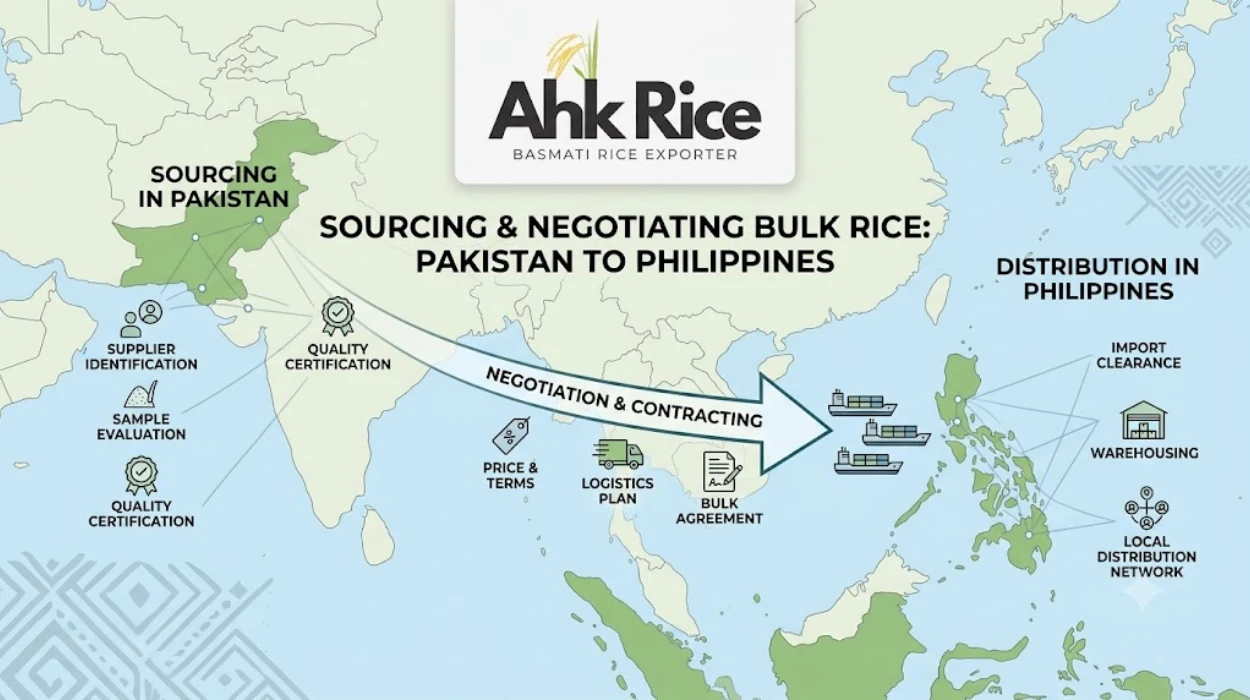
The sourcing process follows a clear structure:
- Identify required rice grade.
- Request specifications and samples.
- Verify quality standards.
- Negotiate commercial terms.
- Approve contract conditions.
- Confirm production schedule.
- Load and dispatch cargo.
- Clear export documentation.
- Deliver shipment to destination port.
Distributors that follow this process typically experience fewer quality disputes and lower landed-cost uncertainty.
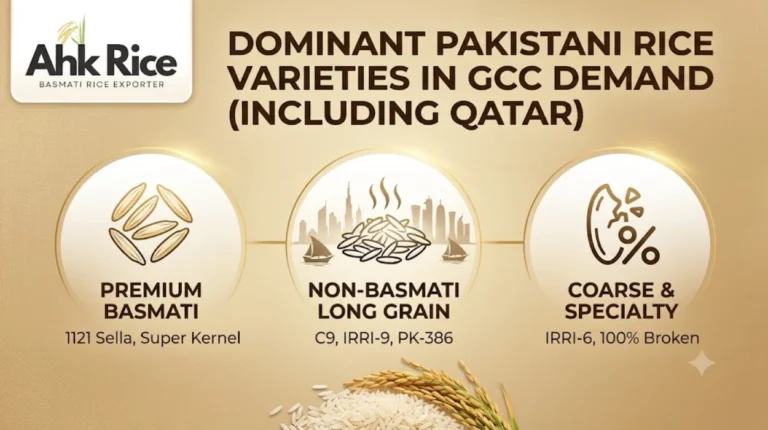
Rice procurement decisions also depend on variety selection. Buyers comparing specifications can review our analysis of Pakistani rice varieties preferred by Philippine buyers before selecting commercial grades.
With the sourcing framework established, the next question is how suppliers are evaluated before negotiations begin.
Why choose AHK Rice for Philippine bulk rice imports?
Export experience, consistent quality control, verified documentation, flexible packaging options, and structured shipment management make AHK Rice a practical sourcing partner for Philippine distributors.
Rice imports succeed when exporters maintain consistent standards across every shipment.
AHK Rice follows a documented export workflow that includes:
- Quality inspection
- Moisture testing
- Grain grading
- Length sorting
- Color sorting
- Packaging verification
- Container loading supervision
AHK Rice supplies multiple rice categories that match Philippine market demand.
Long Grain White Rice
Long grain white rice serves wholesale distributors, retailers, and food service buyers seeking affordable daily consumption products.
IRRI-6 Rice
IRRI-6 rice remains a common import category because it balances cost and volume requirements.
1121 Basmati Rice
1121 Basmati rice serves premium retail channels and hospitality sectors requiring aroma and extra-long grain characteristics.
Super Kernel Basmati Rice
Super Kernel Basmati rice supports specialty retail programs targeting higher-value consumers.
AHK Rice provides buyers with product specifications before contract confirmation. This process reduces disputes after shipment arrival.
Quality assurance remains critical for Philippine distributors. AHK Rice conducts inspection procedures before dispatch to ensure cargo meets agreed specifications.
Export capability matters equally. AHK Rice manages documentation requirements including:
- Commercial Invoice
- Packing List
- Certificate of Origin
- Phytosanitary Certificate
- Bill of Lading
- Fumigation Certificate
- Inspection Reports
Reliable documentation reduces customs clearance delays.
With supplier selection addressed, distributors next need to understand the negotiation process that determines final profitability.
How do Philippine distributors negotiate better prices with Pakistani suppliers?
Volume commitments, specification clarity, payment security, annual contracts, and shipment forecasting create stronger negotiating positions and lower procurement costs.
Price negotiations begin long before discussing rates.
Distributors that provide clear requirements receive more accurate quotations.
Key information includes:
- Rice variety
- Required quantity
- Packaging size
- Delivery schedule
- Destination port
- Payment terms
Exporters calculate pricing based on these specifications.
Several factors affect negotiated rates.
Quantity Purchased
Larger volumes usually reduce unit costs because production and logistics efficiencies increase.
A distributor importing ten containers generally receives better pricing than a distributor importing one container.
Packaging Requirements
Packaging affects procurement costs.
Common options include:
- 5 kg retail bags
- 10 kg retail bags
- 25 kg PP bags
- 50 kg PP bags
Customized branding increases packaging expenses but improves retail positioning.
Payment Structure
Secure payment terms create better commercial flexibility.
Common methods include:
- Letter of Credit
- Telegraphic Transfer
- Documentary Collection
Exporters typically offer stronger pricing when payment risk decreases.
Contract Duration
Annual agreements often provide greater stability than spot purchases.
Distributors that commit to recurring shipments frequently secure more favorable pricing structures.
AHK Rice works with buyers to align product specifications with budget targets before production begins.
Strong negotiation practices reduce purchasing costs. The next step is understanding shipment timelines and delivery expectations.
What shipping times can Philippine importers expect from Pakistan?
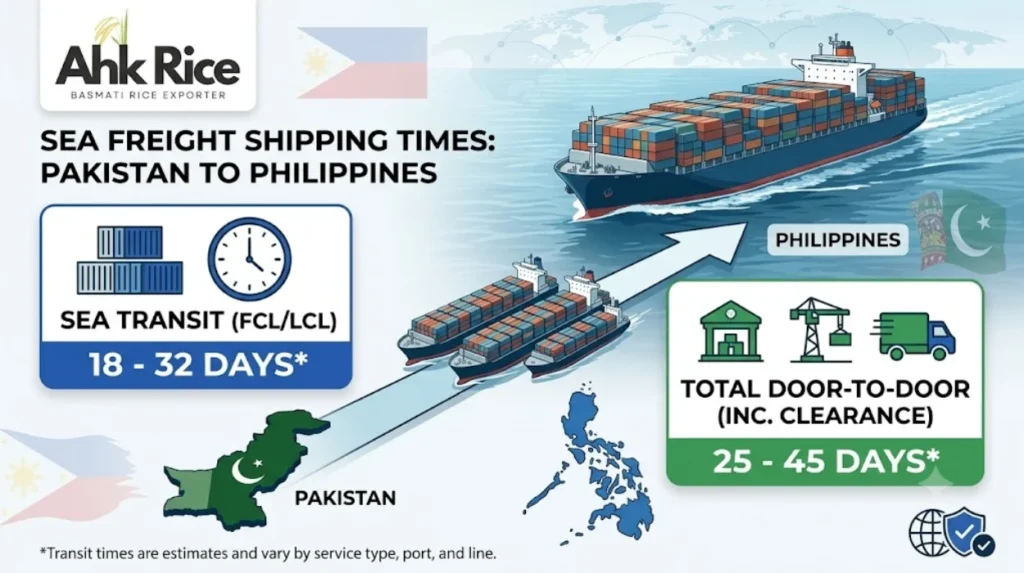
Most Philippine rice shipments arrive within 18–35 days depending on vessel schedules, transshipment routes, port congestion, customs procedures, and destination terminal operations.
Shipping timelines directly influence inventory planning.
Typical transit estimates include:
| Route | Estimated Transit Time |
|---|---|
| Karachi to Manila | 22–30 days |
| Karachi to Cebu | 24–35 days |
| Karachi to Davao | 25–35 days |
Transit schedules vary according to shipping line availability and transshipment requirements.
Production scheduling also affects delivery timing.
Typical export preparation includes:
| Activity | Estimated Days |
|---|---|
| Production planning | 2–4 days |
| Milling and grading | 3–7 days |
| Packaging preparation | 2–4 days |
| Documentation processing | 2–5 days |
| Container loading | 1–3 days |
Total preparation before vessel departure generally ranges from 10–20 days.
Sample shipments move faster than commercial cargo.
AHK Rice usually prepares evaluation samples within a few working days after specification confirmation.
Accurate timeline planning prevents stock shortages. Understanding the sample process further reduces procurement risk.
What is the sample process and cost before placing a bulk order?
Professional sampling allows distributors to verify grain quality, cooking performance, appearance, and specifications before committing to container-scale purchases.
Sample evaluation reduces uncertainty.
AHK Rice encourages distributors to approve physical samples before confirming commercial orders.
The sample process follows a structured workflow.
Step 1: Define Specifications
Specify:
- Rice variety
- Grain length
- Moisture level
- Packaging preference
- Target market
Step 2: Prepare Samples
AHK Rice prepares representative samples from production-ready stock.
Step 3: Dispatch Samples
AHK Rice ships samples through courier services.
Step 4: Conduct Evaluation
Importers inspect:
- Grain appearance
- Broken percentage
- Aroma
- Cooking expansion
- Texture
Step 5: Confirm Commercial Order
Approved samples become the reference standard for production.
Sample costs vary.
| Sample Type | Typical Cost |
|---|---|
| Product sample | Often free |
| Courier charges | USD 40–150 |
| Multiple varieties | Higher courier cost |
Courier expenses depend on destination, sample weight, and carrier selection.
AHK Rice coordinates sample preparation to accelerate procurement decisions.
Once quality approval is complete, distributors can evaluate expected commercial outcomes.
What results can distributors expect from importing rice from Pakistan?
Improved sourcing flexibility, broader product selection, competitive landed costs, and consistent inventory availability are the primary outcomes achieved by Philippine distributors importing from Pakistan.
Import performance depends on supplier selection and contract execution.
Many distributors use Pakistan as part of a diversified sourcing strategy.
Benefits include:
- Stable product availability
- Multiple rice categories
- Competitive export pricing
- Flexible packaging options
- Scalable supply volumes
AHK Rice supports distributors seeking long-term procurement relationships rather than isolated transactions.
Operational efficiency improves when distributors standardize specifications across recurring orders.
AHK Rice helps buyers establish repeatable procurement processes that reduce administrative complexity.
Reliable supply creates stronger commercial performance. The final consideration involves understanding overall cost drivers.
What factors affect bulk rice import pricing?
Rice variety, grade specifications, packaging format, freight rates, payment terms, shipment volume, and seasonal market conditions have the greatest impact on import costs.
Rice pricing changes according to product characteristics.
Premium aromatic varieties command higher prices than commodity grades.
Major cost factors include:
Product Grade
Higher-grade rice requires stricter sorting and quality control.
Freight Costs
Ocean freight influences landed pricing significantly.
Shipping line conditions can change transportation expenses rapidly.
Packaging Requirements
Custom packaging increases production costs.
Exchange Rates
Currency fluctuations affect international trade transactions.
Seasonal Demand
Harvest cycles and global demand patterns influence export pricing.
AHK Rice provides quotation structures based on actual buyer requirements rather than generic estimates.
Transparent pricing improves procurement planning. The final step is understanding how to begin the sourcing process.
How can Philippine distributors get started with AHK Rice?
Define product specifications, request samples, review commercial terms, approve quality standards, and schedule shipment volumes to begin importing rice from Pakistan efficiently.
Procurement success begins with clear requirements.
Distributors should prepare information regarding volume targets, preferred rice grades, packaging specifications, and destination ports before requesting quotations.
AHK Rice reviews these requirements and recommends suitable export options.
AHK Rice then prepares product specifications and sample arrangements for evaluation.
After sample approval, AHK Rice issues commercial quotations and shipment schedules aligned with buyer requirements.
AHK Rice manages documentation, loading coordination, and export procedures through the completion of the order.
The sourcing process becomes significantly more predictable when distributors establish supplier relationships before peak demand periods. For product specifications, samples, pricing, and shipment schedules, submit your requirements through Request a Quote.
Frequently Asked Questions
How much rice can Philippine distributors import from Pakistan?
Container loads and vessel-scale shipments are both available. Volume requirements determine logistics planning. Most distributors begin with container shipments. Larger importers often transition to recurring contracts. Export capacity depends on product availability and production schedules.
Which Pakistani rice variety is most popular in the Philippines?
Long grain white rice and IRRI-6 remain common commercial choices. Premium channels often prefer Basmati varieties. Market positioning determines the correct selection. Retail buyers and food service operators have different requirements. Product testing should occur before large purchases.
What documents are required for rice imports?
Commercial invoices, packing lists, certificates of origin, phytosanitary certificates, bills of lading, and inspection documents are commonly required. Import regulations may change periodically. Buyers should verify local compliance requirements. Complete documentation reduces customs delays. Exporters typically coordinate document preparation.
How are rice samples evaluated?
Importers inspect grain appearance and cooking performance. Moisture levels require verification. Aroma and texture influence acceptance decisions. Approved samples establish shipment standards. Evaluation protects buyers from specification mismatches.
Why work with AHK Rice?
AHK Rice provides export support, quality verification, documentation management, and shipment coordination. AHK Rice supplies multiple rice categories. AHK Rice supports Philippine distributors with structured procurement processes. AHK Rice focuses on consistency and transparency. AHK Rice helps reduce sourcing risk across repeat orders.