How should exporters choose a rice container loading method for Jebel Ali?
Floor loading generally maximizes usable container space for bulk rice shipments, while palletized loading improves handling and warehouse efficiency. The right choice depends on bag size, buyer requirements, container payload, destination handling equipment, moisture protection, and the importer’s receiving process.
Shipping Pakistani Basmati rice to Jebel Ali Port requires more than selecting a container and filling it with bags. Exporters must coordinate packaging, weight distribution, cargo protection, fumigation requirements, inspection, and shipping documents. A mismatch between bag dimensions and container space reduces loading efficiency, while poor moisture control increases the risk of damaged packaging and lower grain quality.
For a practical introduction to container dimensions, payload limits, and estimated rice quantities, read our educational guide, how many tons of Basmati rice fit in a 20ft container?. This helps importers and exporters estimate shipment size before comparing bag formats and loading methods.
AHK Rice is a Pakistani Basmati rice exporter based in Punjab, supplying 1121, Super Kernel, and 1509 varieties to more than 15 countries. Its Basmati rice export and supply service covers processing, custom packaging, and export coordination. For UAE shipments, the loading plan should connect the agreed rice specification with packaging dimensions, container selection, and the buyer’s import and warehouse requirements.
What are the available solutions for rice container loading?
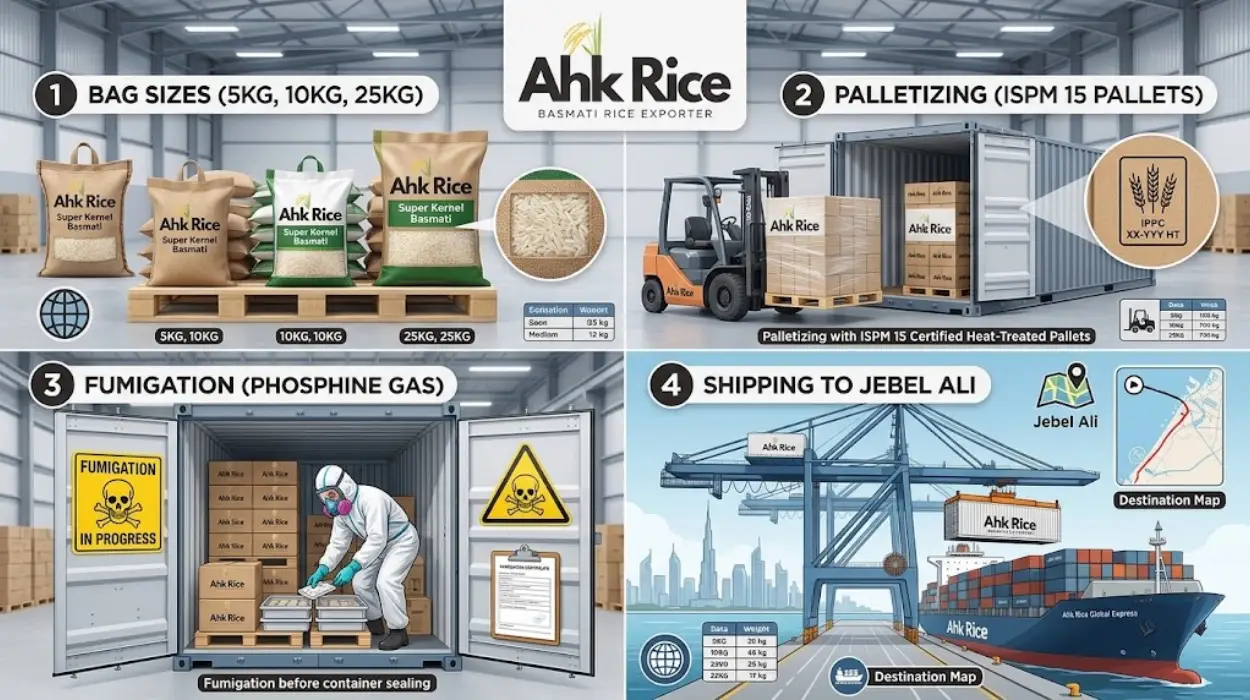
Exporters generally choose between floor-loaded bags, palletized bags, and bulk handling where suitable equipment and packaging support the method. For conventional bagged Basmati rice shipments, floor loading and palletized loading are the principal options because they serve different transport and warehouse priorities.
Floor loading means placing individual rice bags directly on the container floor and stacking them in a planned arrangement. This method uses the available internal space efficiently because pallets do not consume additional height or floor area. It suits importers that receive bags manually or use warehouse teams to unload them.
Palletized loading means arranging rice bags on pallets, securing the load, and moving complete units with forklifts or pallet trucks. It improves handling speed and reduces repeated manual lifting at equipped warehouses. However, pallet dimensions, pallet weight, wrapping, and handling clearances reduce the space available for rice.
Bulk handling is a separate approach for operations designed to move rice in bulk rather than conventional retail or wholesale bags. It requires suitable handling equipment and appropriate cargo containment. It does not replace bagged loading when buyers require labelled 5 kg, 10 kg, 25 kg, or 50 kg packs.
The loading plan must also account for the container’s maximum payload, door opening, internal dimensions, cargo securing, and the shipping line’s limits. A container’s theoretical volume is not its permissible cargo weight. Exporters must comply with the container’s verified payload and applicable transport regulations.
How do different rice container loading methods compare?
Floor loading usually delivers higher bag-count efficiency, while palletized loading improves mechanical handling and warehouse organization. Neither method is universally superior. The best comparison uses cargo weight, usable floor space, bag dimensions, unloading labour, packaging durability, and the receiving facility’s equipment.
| Comparison attribute | Floor-loaded bags | Palletized bags |
|---|---|---|
| Space utilization | Generally higher | Lower due to pallets and gaps |
| Loading process | Bags placed and stacked individually | Bags arranged and secured on pallets |
| Unloading process | More manual handling | Faster with suitable equipment |
| Labour requirements | Higher during unloading | Lower where forklifts are available |
| Bag stability | Depends on stacking pattern and securing | Depends on pallet pattern, wrapping, and stability |
| Packaging protection | Bags contact the container floor unless protected | Pallets separate bags from the floor |
| Best application | Bulk wholesale deliveries and manual unloading | Distribution centres and mechanized warehouses |
Consider a shipment of 25 kg Basmati rice bags. Floor loading allows the exporter to arrange bags closely while maintaining stable layers and suitable weight distribution. Palletizing creates organized units that can be transferred directly into a warehouse, but the pallets reduce the usable loading area and add tare weight.
The actual difference in shipped tonnage depends on container dimensions, pallet specifications, bag dimensions, stacking restrictions, and maximum payload. Exporters should calculate the loading plan before confirming the commercial quantity instead of relying on a fixed tonnage estimate for every shipment.
Which rice bag sizes work best for shipments to Jebel Ali?
Bag size should match the buyer’s sales channel, warehouse capacity, and container loading plan. Five and 10 kg bags suit retail distribution, 25 kg bags support wholesale and foodservice, and 50 kg bags suit bulk trade where local handling practices and buyer specifications permit them.
Bag size affects the number of units per shipment, packaging cost, handling time, and the space available for stacking. Smaller bags need more individual units to achieve the same net cargo weight. Larger bags reduce the unit count but require suitable lifting practices and durable packaging.
| Bag size | Typical target market | Loading consideration |
|---|---|---|
| 5 kg | Supermarkets and retail brands | High bag count and more handling |
| 10 kg | Family retail and cash-and-carry | Balance between consumer size and distribution |
| 25 kg | Wholesalers, restaurants, and caterers | Practical for commercial handling |
| 50 kg | Bulk wholesalers and institutional buyers | Heavier manual handling and robust bag construction |
These formats are commercial examples, not mandatory UAE packaging sizes. The importer and exporter must agree on the exact net weight, bag material, dimensions, printed information, and packaging specification before production.
For private-label retail orders, the design must accommodate the required product name, country of origin, net weight, production and expiry information, and applicable Arabic-language labelling. For wholesale shipments, woven polypropylene bags with suitable liners may be appropriate when agreed by the buyer. Packaging material must protect the grain against moisture exposure and handling damage throughout transport.
Bag dimensions also affect loading geometry. Two 25 kg bags from different manufacturers may have different widths, heights, and filled profiles. Exporters should confirm actual filled-bag measurements before calculating the number of bags per row or layer.
How do container size and cargo weight affect rice loading?
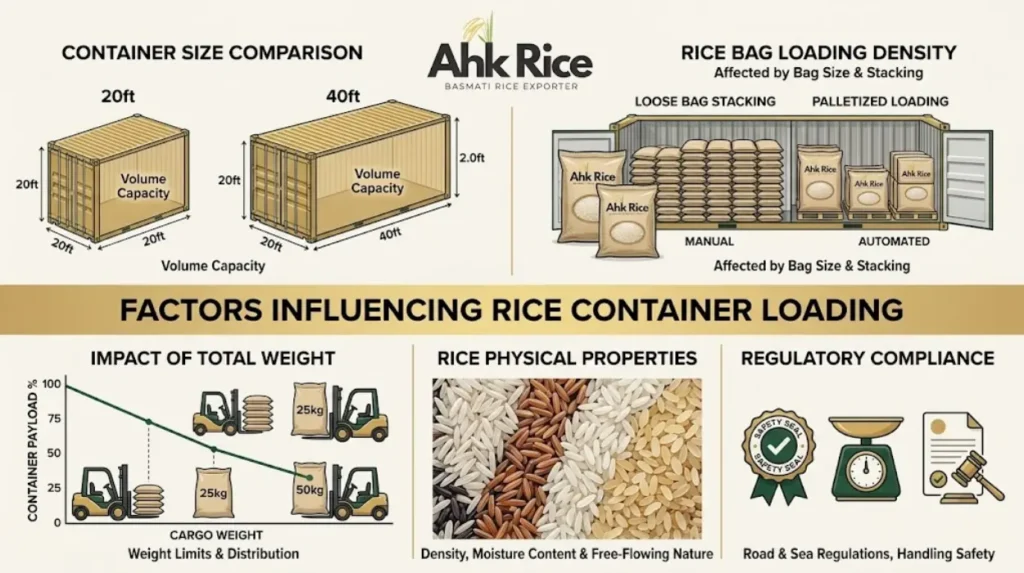
A 20ft container generally suits smaller full-container shipments, while a 40ft container offers more internal volume for cargo that benefits from additional space. Rice is relatively dense, so payload limits and the shipping line’s restrictions can determine the practical load before container volume becomes the constraint.
A 20ft dry container is a common choice for bagged rice because its payload capacity can accommodate substantial cargo weight within a compact loading space. A 40ft container provides greater internal volume, but its maximum permitted payload is not necessarily twice that of a 20ft container.
Container selection must consider four measurements:
- Internal dimensions: Determine the space available for arranging bags or pallets.
- Door opening: Determines whether the planned stack or pallet configuration can enter and exit safely.
- Maximum payload: Sets the container’s permissible cargo weight after accounting for container tare weight and applicable limits.
- Gross vehicle and transport limits: Govern the combined weight of the container, cargo, and carrying vehicle where road transport applies.
For example, a 25,000 kg net rice order packed in 25 kg bags contains 1,000 bags. A 50 kg format contains 500 bags for the same net rice quantity. Both orders carry the same rice weight, but their unit count, stacking pattern, and handling requirements differ.
The final loading quantity must also include packaging tare weight and any pallets or securing materials. Exporters must not assume that a standard container can accept every requested tonnage. The packing list, shipping instructions, verified container payload, and applicable road limits must agree.
What are the pros and cons of palletizing versus floor loading?
Floor loading is most suitable when maximizing bag quantity and controlling freight cost per tonne are priorities. Palletizing is preferable when rapid unloading, forklift access, and organized warehouse movement create greater operational value than the space sacrificed to pallets and handling equipment.
Floor loading offers high space utilization and suits importers with trained unloading teams. It also avoids pallet procurement and pallet disposal costs. Its main disadvantages are labour-intensive unloading and greater dependence on a stable stacking pattern. Bags can shift, become compressed, or suffer damage when the load is poorly arranged or secured.
Palletizing offers easier movement between receiving, storage, and distribution areas. It can reduce repeated handling and simplify inventory organization. Its disadvantages include additional material costs, reduced loading efficiency, and the need for pallets that meet the buyer’s requirements. Pallets must remain stable under the cargo weight and comply with any applicable wood-packaging rules.
For example, a Dubai wholesaler receiving 25 kg bags for redistribution to smaller shops may favour floor loading if it has a trained unloading team. A distribution centre serving multiple retail outlets may favour palletized cargo because forklifts can transfer complete units into designated storage areas.
Neither method removes the need for container inspection, moisture protection, load securing, and a final weight check. The exporter must select the method according to the complete delivery operation rather than the loading stage alone.
How should rice containers be prepared for fumigation before shipping?
Fumigation must follow the destination’s applicable phytosanitary rules, the cargo’s treatment requirements, and the instructions of an authorized provider. Exporters must confirm the treatment method, timing, ventilation controls, and required certificate before loading or vessel departure, according to the approved procedure.
Fumigation is a pest-control treatment that uses an authorized fumigant under controlled conditions. Its purpose is to manage specified pests when treatment is required. It is not a substitute for cleaning, dry packaging, pest prevention, or inspection.
Preparation begins with checking the empty container. The container should be structurally sound, dry, clean, free from residual cargo, and suitable for food transport. Holes, damaged door seals, wet floors, and signs of infestation require attention before loading. A container that smells of chemicals or carries residues from previous cargo should not be accepted for rice without appropriate clearance.
The exporter and fumigation provider must establish whether treatment applies to the rice, the packaging, the container, or another component of the shipment. Requirements depend on the commodity, origin, destination, and applicable regulations. Wood packaging may also trigger separate phytosanitary requirements.
The treatment record must accurately identify the shipment and the approved procedure. Where required, the fumigation certificate should match the commercial shipment details and other export documentation. Treatment must be performed by an authorized provider using the prescribed safety controls. Untrained personnel must never introduce fumigants into a container or enter a container before it has been declared safe.
What should exporters check before sealing the container?
- Confirm the container is clean, dry, odour-free, and free from visible pests.
- Check bag stitching, packaging integrity, labels, and net weights.
- Verify the loading plan against the agreed quantity and payload limits.
- Apply approved pest treatment when required by the relevant authority or contract.
- Record the treatment details and obtain the required certificate.
- Secure the cargo and inspect the doors and seals before dispatch.
- Record the container number and seal number for shipping documents.
Fumigation does not guarantee that rice will remain dry throughout the voyage. Moisture protection also depends on the rice’s condition at packing, packaging integrity, container condition, and transport exposure. Exporters must manage these risks separately.
Which rice grades and loading methods suit different UAE market regions?
Premium retail, ethnic grocery, and foodservice buyers select rice according to grain appearance, aroma, cooking performance, price, and packaging. Grade selection should therefore be agreed before container planning, with 1121 and Super Kernel serving premium-oriented demand and 1509 supporting buyers prioritizing value and supply efficiency.
Dubai’s trading and re-export network includes retail distributors, ethnic food wholesalers, restaurants, caterers, and bulk buyers. Their requirements vary by sales channel. Premium retailers often emphasize grain length, aroma, cooking consistency, and branded packaging. Foodservice buyers place greater weight on cooking results, batch consistency, and cost per serving.
Abu Dhabi and other UAE distribution markets also include retail, institutional, and wholesale buyers. Their procurement choices depend on customer demand, warehouse capabilities, pack sizes, and the balance between quality and price. These are buyer-segment differences, not fixed rules for every emirate.
| Market segment | Suitable variety to evaluate | Common pack formats | Loading priority |
|---|---|---|---|
| Dubai premium retail | 1121 Basmati | 5 kg, 10 kg | Brand protection and consistent presentation |
| UAE ethnic wholesalers | Super Kernel or 1121 | 25 kg, 50 kg | Efficient bulk loading |
| Restaurants and caterers | 1121, Super Kernel, or 1509 | 25 kg, 50 kg | Cooking consistency and cost control |
| Price-sensitive distributors | 1509 Basmati | 25 kg, 50 kg | Competitive landed cost |
| Private-label grocery supply | Buyer-approved 1121, Super Kernel, or 1509 | 5 kg, 10 kg, 25 kg | Label accuracy and packaging integrity |
These are starting points for evaluation rather than guaranteed purchasing preferences. Buyers should approve the variety, grade, broken percentage, moisture specification, and cooking sample before the exporter finalizes packaging and container loading.
How do rice prices per metric tonne and shelf life compare?
The landed cost per metric tonne depends on rice variety, grade, packaging, freight, insurance, inspection, and destination charges. Shelf life depends on grain condition, moisture, packaging, and storage. Exporters should compare written quotations and documented shelf-life specifications rather than treating either figure as universal.
Price comparison should separate the rice’s export price from its delivered cost. FOB pricing generally covers the goods and agreed export-side responsibilities up to loading on board at the named port. CIF pricing includes the cost, insurance, and freight to the named destination port under the agreed Incoterms rules. Neither term automatically includes every destination clearance, duty, or local handling charge.
The following regional comparison identifies the factors buyers should assess. Actual prices must come from current, specification-matched supplier quotations; they cannot be established from bag size or container type alone.
| Cost or quality factor | Dubai import and re-export trade | Abu Dhabi and other UAE distribution |
|---|---|---|
| Rice price per MT | Compare FOB origin and CIF Jebel Ali quotations | Compare the same rice specification and delivery basis |
| Packaging cost per MT | Include retail printing or wholesale bag costs | Include required pack formats and local distribution needs |
| Freight and handling | Confirm port, terminal, and onward re-export costs | Include delivery from port to the receiving warehouse |
| Shelf-life specification | Obtain the supplier’s declared shelf life and packing date | Check the same specification and expected storage conditions |
| Stock rotation | Align order size with sales and re-export turnover | Align order size with warehouse capacity and local demand |
For a valid comparison, request quotations for the same variety, crop or lot specification, grain length where applicable, broken percentage, moisture limit, bag weight, quantity, and Incoterm. A cheaper price per tonne may not produce the lowest landed cost if packaging, handling, quality consistency, or local delivery costs are higher.
Shelf life is also not determined by whether the container is 20ft or 40ft. White rice commonly retains quality for an extended period under cool, dry, pest-controlled storage, while brown rice generally has a shorter shelf life because its higher oil content makes it more susceptible to rancidity. The supplier’s product-specific declaration and applicable UAE requirements should determine the stated shelf life for the shipment.
Rice should be stored away from moisture, direct sunlight, strong odours, pests, and excessive heat. Importers should inspect incoming bags, record batch and date information, and rotate stock using a first-expiry-first-out system where expiry dates apply. The remaining shelf life at arrival matters as much as the declared total shelf life.
Which rice container loading method works best for different cases?
Choose the method that matches the receiving operation, not simply the largest theoretical cargo quantity. Floor loading suits manual unloading and bulk wholesale orders, palletizing suits mechanized distribution, and smaller retail bags require closer coordination between packaging dimensions, bag stability, and warehouse handling.
The following decision framework helps buyers and exporters choose a loading strategy before finalizing the order.
| Decision factor | Recommended approach | Reason |
|---|---|---|
| Maximum practical rice quantity | Floor loading, subject to safe stacking and payload | Uses container space efficiently |
| Fast warehouse unloading | Palletized loading | Supports forklift movement |
| Retail and private-label supply | Approved 5 kg or 10 kg bags with a planned stacking layout | Protects labels and retail presentation |
| Wholesale and foodservice | 25 kg or 50 kg bags, where buyer-approved | Reduces the number of units handled |
| Long-distance moisture and pest control | Dry container, suitable packaging, and treatment where required | Addresses separate cargo-protection risks |
For example, a wholesaler purchasing 25 MT of rice may prioritize floor loading to reduce handling materials and maximize space. A retailer distributing several brands to different warehouses may accept a lower bag count per container in exchange for palletized loads that speed up receiving.
A shipment using 5 kg bags requires substantially more individual units than the same tonnage in 25 kg bags. The exporter must consider labour, stacking stability, bag strength, and the time required to unload. A high-volume shipment is not operationally efficient if the buyer cannot receive it within the agreed delivery window.
The decision should be documented in the purchase contract or shipment specification. This prevents disagreements about pallets, bag sizes, loading quantity, treatment certificates, and unloading responsibilities after the cargo reaches the UAE.
What export documents should accompany a rice shipment to Jebel Ali?
A UAE-bound rice shipment needs documents that match the goods, origin, shipping arrangement, and applicable import rules. The commercial invoice, packing list, transport document, certificate of origin, and required phytosanitary or fumigation documents must be coordinated with the importer before dispatch.
The exact document set depends on the product, shipment, and current UAE requirements. Exporters should obtain confirmation from the UAE importer, customs broker, and relevant authorities before loading.
- Commercial invoice: Identifies the seller, buyer, goods, quantity, unit price, total value, and agreed trade terms.
- Packing list: Records bag sizes, package counts, net and gross weights, and other shipment details.
- Bill of lading: Provides the principal ocean transport record and shipment details.
- Certificate of origin: Identifies the declared country of origin, subject to the applicable issuance procedure.
- Phytosanitary certificate: Required when applicable to the commodity and import conditions.
- Fumigation certificate: Documents the treatment when required by the applicable rules or contractual specification.
- Inspection or laboratory documents: Supplied where the buyer, contract, or authority requires them.
The container number, seal number, package count, declared weights, rice description, and consignee details should remain consistent across relevant documents. Errors can delay clearance or require document amendments.
The UAE importer must confirm current product registration, food labelling, customs, and clearance requirements for the particular consignment. A fumigation certificate does not replace a phytosanitary certificate when both are required. Similarly, a certificate of origin does not prove that a shipment meets every food safety or labelling requirement.
Before vessel departure, the exporter should send the buyer the agreed document set or drafts for review where the process allows. Early review reduces avoidable discrepancies and supports a smoother arrival process at Jebel Ali.
What should buyers confirm before booking a full container of Basmati rice?
Before booking, buyers should approve the rice specification, bag size, loading method, quantity, price basis, treatment requirements, and shipping documents. Confirming these details in writing reduces loading errors, protects cargo quality, and aligns the shipment with the receiving warehouse’s capabilities.
Use this checklist before confirming the shipment:
- Approve the rice variety, grade, broken percentage, moisture limit, and sample.
- Confirm bag material, net weight, dimensions, labelling, and quantity.
- Select floor loading or palletizing based on receiving arrangements.
- Verify the container’s payload, loading plan, and cargo-securing requirements.
- Confirm fumigation and phytosanitary requirements with the relevant parties.
- Agree on the Incoterm, freight quotation, shipping schedule, and required documents.
- Check container condition and confirm the container and seal numbers after loading.
AHK Rice’s export workflow connects rice sourcing and processing with packaging and export coordination. A documented specification allows the exporter and importer to agree on the cargo before the container is sealed and dispatched to Jebel Ali.
Frequently asked questions about rice container loading for Jebel Ali
How many tonnes of Basmati rice fit in a 20ft container?
A 20ft container can carry a substantial quantity of bagged rice, but the final net tonnage depends on the permitted payload, container tare weight, bagging materials, pallets, and transport restrictions. Confirm the loading plan against the actual container specifications.
Which bag size is best for exporting rice to the UAE?
Five and 10 kg bags suit retail distribution, while 25 kg and 50 kg bags suit many wholesale and foodservice operations. The best format depends on the buyer’s sales channel, packaging specification, warehouse equipment, and handling requirements.
Is palletizing better than floor loading for rice exports?
Palletizing improves mechanical handling and warehouse organization. Floor loading generally uses container space more efficiently and can increase the quantity loaded. The correct option depends on unloading equipment, labour costs, bag stability, and the buyer’s receiving process.
Is fumigation mandatory for every Basmati rice shipment to Jebel Ali?
Fumigation is not automatically required for every shipment under every circumstance. The exporter must verify the applicable UAE import conditions, phytosanitary requirements, buyer contract, and any treatment instructions from the relevant authorities before dispatch.
How long does Basmati rice remain usable after shipping?
Shelf life depends on the rice type, moisture, packaging, storage conditions, and supplier specification. Dry, pest-controlled storage helps preserve quality. Importers should verify the declared shelf life, packing date, and remaining shelf life expected when the cargo arrives.
Which documents are needed for Pakistani rice exports to the UAE?
Common documents include a commercial invoice, packing list, bill of lading, and certificate of origin. Phytosanitary, fumigation, inspection, or laboratory documents may also be required, depending on the shipment and applicable import conditions.
How can buyers compare rice prices per metric tonne?
Compare quotations for the same rice variety, grade, broken percentage, moisture limit, packaging, quantity, and Incoterm. Calculate the landed cost by accounting for freight, insurance where applicable, inspection, destination handling, clearance, and other relevant charges.