Import Pakistan Basmati Rice with Verified Moisture Test Reports into Saudi Arabia
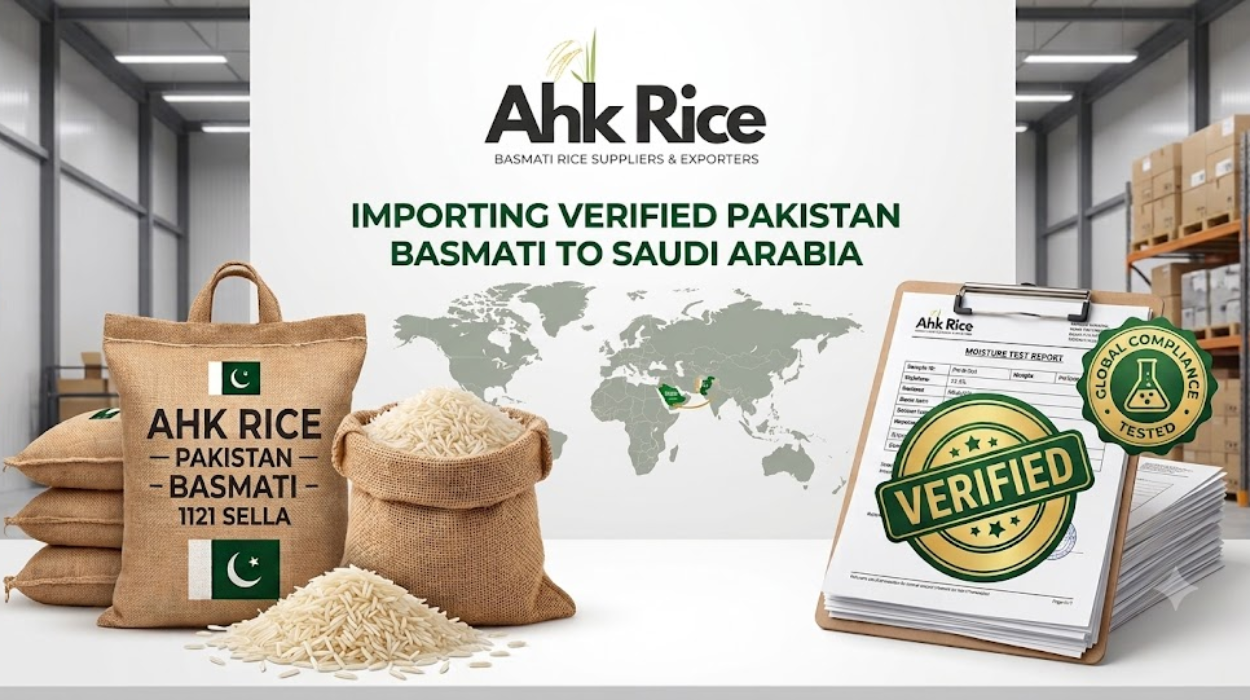
Importing Pakistan Basmati rice with verified moisture test reports is the most reliable way to protect grain quality, reduce commercial risk, and meet Saudi buyer expectations. Before selecting a supplier, it helps to understand why moisture management directly affects rice quality during storage and shipment. You can learn more in our guide on:
Why moisture control matters for Pakistan Basmati rice quality in Saudi Arabia.
Saudi Arabia remains one of the largest importers of premium Pakistani Basmati rice. Importers, distributors, wholesalers, food service companies, supermarkets, and private-label brands increasingly require documented quality assurance before confirming contracts. In 2026, verified moisture testing has become an essential part of export documentation because it helps minimise claims related to mould, breakage, quality deterioration, and storage losses.
AHK Rice supplies premium Pakistani Basmati rice to Saudi Arabia with complete quality documentation, verified moisture reports, export certifications, and commercial support throughout the purchasing process. Every shipment from AHK Rice undergoes strict quality control procedures before loading to ensure consistent product quality for buyers.
What is the best solution for importing Pakistan Basmati rice into Saudi Arabia without quality risks?
The best solution is choosing an experienced exporter that verifies moisture levels before shipment, provides laboratory-supported quality reports, follows recognised export standards, and manages documentation correctly. This approach significantly reduces quality disputes, protects product value, improves storage performance, and supports long-term commercial relationships between suppliers and Saudi importers.
Moisture content is one of the most important quality specifications in international rice trading. Even premium Pakistani Basmati rice can experience quality problems if moisture exceeds acceptable export levels.
Professional exporters inspect every production batch before packing. The testing process normally includes:
- Moisture analysis
- Grain length measurement
- Broken percentage inspection
- Chalkiness evaluation
- Foreign matter inspection
- Colour consistency
- Milling quality verification
AHK Rice performs moisture verification before shipment so buyers receive documented evidence of product quality before containers leave Pakistan.
Most Saudi buyers request moisture reports because they directly affect:
- Warehouse stability
- Retail shelf life
- Cooking consistency
- Product appearance
- Customer satisfaction
- Commercial claims
For buyers comparing specifications, our article explaining:
How moisture influences grain breakage during exports to Saudi Arabia provides additional technical guidance.
Why choose Saudi Arabia export services from AHK Rice?
Professional export services combine consistent product quality, verified documentation, experienced logistics coordination, responsive commercial communication, flexible order volumes, and shipment transparency. Working with one reliable exporter simplifies procurement, reduces operational delays, supports regulatory compliance, and creates confidence throughout every stage of international rice purchasing.
Saudi Arabia imports various grades of Pakistani Basmati rice including:
- Super Kernel Basmati Rice
- 1121 Steam Basmati Rice
- 1121 Sella Basmati Rice
- 1509 Basmati Rice
- PK 386 Long Grain Rice
AHK Rice supplies these varieties according to buyer specifications, packaging requirements, and private label programmes.
When selecting an exporter, Saudi buyers generally evaluate:
| Specification | Commercial Importance |
|---|---|
| Moisture Level | Storage stability |
| Grain Length | Premium appearance |
| Broken Percentage | Contract compliance |
| Crop Year | Freshness |
| Packaging Quality | Market presentation |
| Export Documentation | Customs clearance |
| Shipment Reliability | Supply continuity |
The Saudi Arabia service offered by AHK Rice supports buyers from quotation through shipment, documentation, container loading, and after-sales communication.
Export documentation commonly includes:
- Commercial Invoice
- Packing List
- Certificate of Origin
- Phytosanitary Certificate
- Fumigation Certificate (when required)
- Moisture Test Report
- Quality Inspection Report
- Bill of Lading
This documentation helps Saudi importers complete customs clearance more efficiently while maintaining product traceability.
What results can Saudi importers expect from verified moisture test reports?
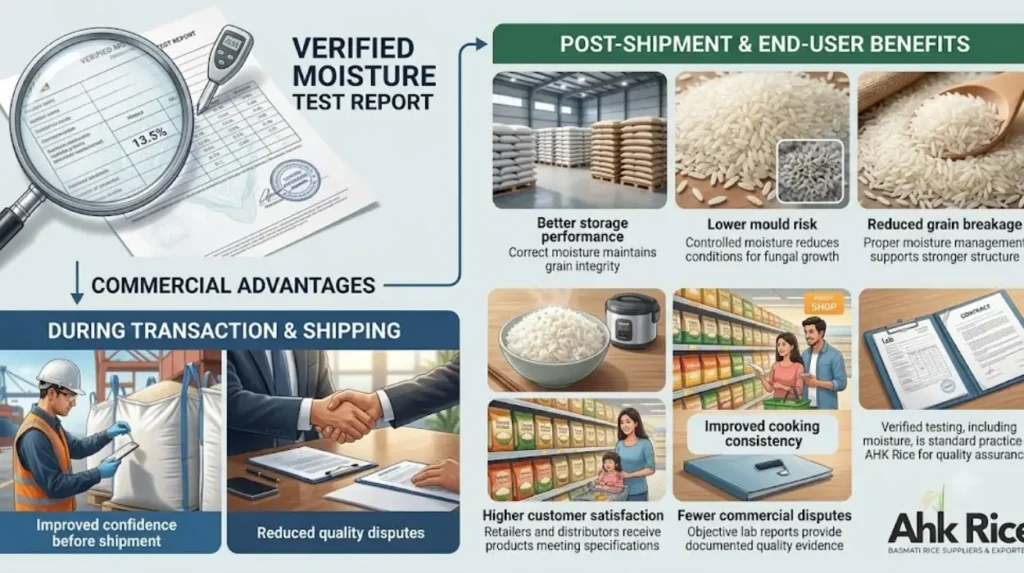
Verified moisture reports improve confidence before shipment, reduce the likelihood of quality disputes, support longer storage periods, minimise grain deterioration during transportation, strengthen purchasing decisions, and provide objective quality evidence that benefits both exporters and importers throughout commercial transactions.
Verified testing creates measurable commercial advantages.
Expected outcomes include:
Better storage performance
Correct moisture levels help maintain grain integrity during warehouse storage.
Lower mould risk
Controlled moisture reduces the conditions that encourage fungal growth.
Reduced grain breakage
Proper moisture management supports stronger grain structure during transportation.
Improved cooking consistency
Stable moisture contributes to more consistent cooking performance.
Higher customer satisfaction
Retailers and distributors receive products that meet expected specifications.
Fewer commercial disputes
Objective laboratory reports provide documented evidence of shipment quality.
AHK Rice includes moisture verification as part of its quality assurance programme because many Saudi buyers now consider this documentation a standard purchasing requirement rather than an optional report.
How much does importing Pakistan Basmati rice into Saudi Arabia cost?
Rice pricing depends on product variety, crop quality, order quantity, packaging specifications, freight conditions, certification requirements, seasonal availability, currency movements, and destination logistics. Buyers receive accurate quotations after confirming technical specifications, packaging preferences, shipment terms, and required documentation.
There is no universal export price because every shipment differs.
Major pricing factors include:
| Cost Factor | Effect on Price |
|---|---|
| Rice Variety | Premium varieties command higher prices |
| Grade | Export grade influences value |
| Packaging | Retail packaging costs more than bulk bags |
| Order Volume | Larger quantities improve pricing efficiency |
| Freight Rates | Shipping market conditions vary |
| Incoterms | FOB, CFR, and CIF pricing differ |
| Additional Certifications | Extra inspections increase documentation costs |
Premium aged Basmati generally costs more than freshly milled rice because ageing improves aroma and cooking characteristics.
Private-label packaging may also increase production costs depending on:
- Bag design
- Printing
- Material quality
- Barcode requirements
- Retail compliance
AHK Rice provides customised quotations based on confirmed buyer requirements rather than generic pricing estimates.
What is the sample process before placing a commercial order?
Professional exporters offer structured sampling so buyers can independently verify quality before committing to container orders. The process includes specification confirmation, sample preparation, laboratory verification where requested, international courier dispatch, technical evaluation, commercial discussion, and final contract confirmation after buyer approval.
Sampling reduces purchasing uncertainty.
A typical export sample process includes:
Step 1 – Product consultation
The buyer confirms:
- Rice variety
- Grain length
- Broken percentage
- Moisture specification
- Packaging preference
Step 2 – Sample preparation
AHK Rice prepares representative samples from available production batches.
Step 3 – Quality inspection
Samples can be verified using laboratory testing before dispatch if requested.
Step 4 – Courier shipment
Samples are shipped internationally through recognised courier services.
Typical courier delivery to Saudi Arabia:
- 3–6 working days
Typical sample quantities:
- 500 g
- 1 kg
- 2 kg
Sample costs
Most exporters follow one of these commercial models:
- Complimentary product sample with courier charges paid by the buyer.
- Complimentary sample and courier for confirmed high-volume buyers.
- Sample preparation included with negotiated commercial discussions.
- Laboratory testing charged separately only when additional analysis is requested.
Actual costs vary according to courier destination, requested quantity, and laboratory requirements.
Once approved, commercial production begins according to agreed specifications.
How long does shipping from Pakistan to Saudi Arabia take?
Transit times depend on destination port, shipping line schedules, container availability, customs procedures, and seasonal congestion. Planning procurement around realistic shipping timelines helps buyers maintain inventory continuity while avoiding supply interruptions throughout wholesale and retail distribution operations.
Typical sea freight transit estimates in 2026 are:
| Saudi Destination | Estimated Transit Time |
|---|---|
| Jeddah Islamic Port | 10–15 days |
| Dammam | 12–18 days |
| Riyadh (via Dammam) | 16–23 days |
| King Abdullah Port | 11–16 days |
| Jubail | 14–20 days |
Production before shipment generally requires:
- 7–15 days depending on quantity
- Additional time for customised packaging
- Container booking confirmation
Peak agricultural seasons and international shipping demand may affect schedules.
AHK Rice keeps buyers informed throughout production, documentation, container loading, vessel booking, and shipment departure.
How do verified moisture reports help Saudi food businesses?
Verified reports support procurement teams, distributors, supermarkets, wholesalers, hospitality companies, and food manufacturers by providing measurable quality assurance before shipment. This documentation strengthens purchasing confidence, simplifies supplier evaluation, supports compliance requirements, and reduces uncertainty during international sourcing decisions.
Large procurement organisations often purchase multiple containers annually.
Quality verification supports:
- Long-term contracts
- Retail distribution
- Government tenders
- Hospitality supply
- Food manufacturing
- Brand protection
Documented moisture levels become particularly valuable when comparing suppliers offering similar pricing.
Rather than selecting purely on price, experienced buyers evaluate:
- Product consistency
- Documentation quality
- Export experience
- Production capacity
- Communication
- Shipment reliability
These factors usually determine long-term supplier performance more than small price differences.
How do you get started with AHK Rice?
The purchasing process begins with discussing product specifications, packaging requirements, target quantity, destination port, documentation needs, and delivery terms. After reviewing samples and commercial quotations, buyers confirm contracts, production schedules, shipment arrangements, and export documentation before container dispatch.
Working with AHK Rice follows a straightforward commercial process.
- Submit your product requirements.
- Discuss specifications and packaging.
- Receive a customised quotation.
- Approve representative samples.
- Confirm the purchase agreement.
- Begin production.
- Complete quality inspection.
- Receive moisture test reports and export documentation.
- Load containers.
- Track shipment until arrival in Saudi Arabia.
Throughout the process, AHK Rice maintains communication so buyers receive updates on production progress, documentation status, and shipment schedules.