Import FDA-Compliant Pakistani Basmati Rice with Complete Supplier Documentation from AHK Rice
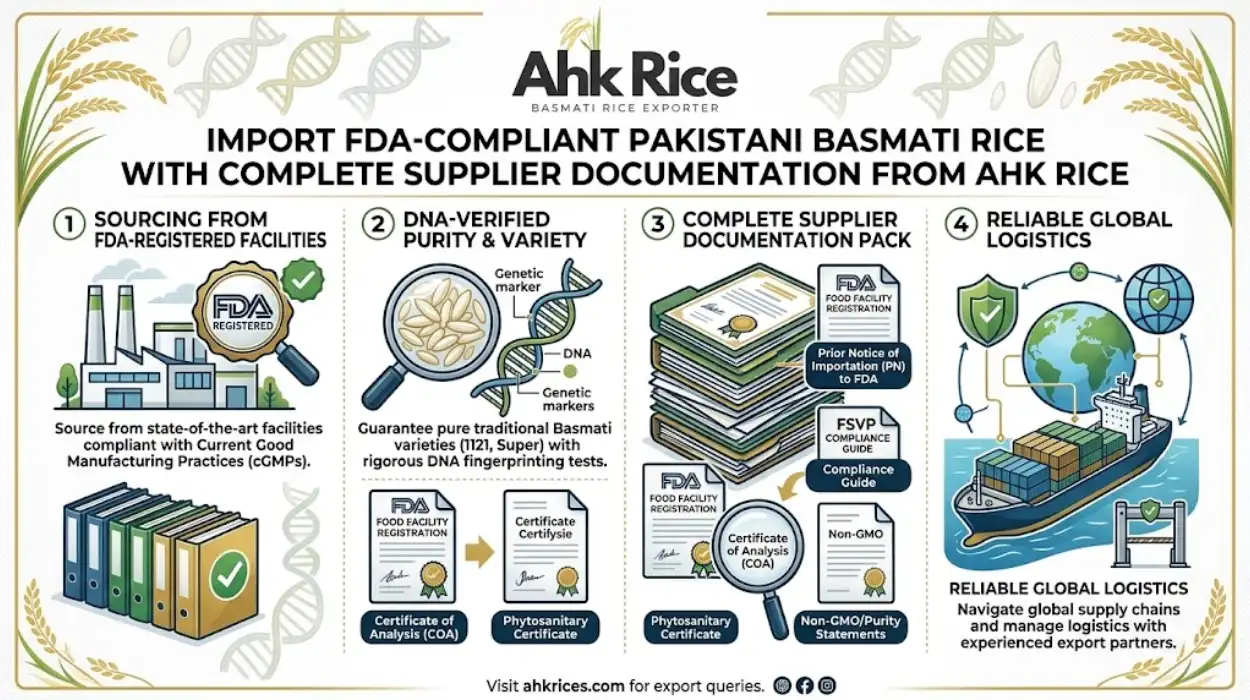
Importing Pakistani Basmati rice into the United States requires reliable supplier documentation, correct FDA procedures, and coordinated shipping arrangements. US importers must address food facility registration, Prior Notice, Foreign Supplier Verification Programs (FSVP), and applicable food safety requirements before shipments arrive. AHK Rice helps US buyers source Pakistani Basmati rice with agreed product specifications, export documentation, and shipment coordination to support a more controlled import process.
Importers should first understand the FDA requirements for importing Basmati rice into the USA, including which responsibilities belong to the importer and which documents must be obtained from the supplier. Buyers should also review FDA food facility registration, Prior Notice and FSVP requirements for rice importers before confirming their first commercial order.
What Is the Best Solution for Importing FDA-Compliant Pakistani Basmati Rice?
The best solution combines a documented Pakistani rice supplier, verified product specifications, appropriate food safety records, and an import compliance plan managed by the US importer. This approach reduces documentation gaps, supports shipment preparation, and helps buyers address FDA requirements before cargo reaches a US port.
Rice importers face several practical challenges. A supplier may provide commercial invoices and packing lists but lack other records requested during compliance reviews. Product specifications may also differ from the buyer’s approved sample, creating quality disputes after delivery.
The solution is to confirm compliance responsibilities before placing the purchase order. Importers should establish the product grade, processing type, moisture limits, broken-grain percentage, packaging format, and shipment quantity in writing.
AHK Rice supplies Pakistani Basmati varieties, including 1121, Super Kernel, and 1509 Basmati rice, subject to availability and agreed specifications. Buyers can explore its Pakistani Basmati rice sourcing and export services to discuss product selection, packaging, documentation, and shipment arrangements.
FDA compliance must be distinguished from a supplier’s commercial documentation. FDA generally does not issue a universal certificate declaring imported rice compliant. Import admissibility depends on applicable regulations, facility registration where required, Prior Notice, importer obligations, product conditions, and any relevant inspection or enforcement requirements.
Why Choose AHK Rice for Pakistani Basmati Rice Imports?
AHK Rice offers US buyers a coordinated sourcing process covering rice specifications, sample evaluation, packaging discussions, export paperwork, and shipment planning. This helps importers establish clear purchasing conditions and request the records needed by their customs broker and food safety compliance team.
Choosing a supplier involves more than comparing the price per metric tonne. Importers must evaluate grain quality, consistency between batches, packaging suitability, traceability, document accuracy, and the supplier’s ability to meet agreed shipment schedules.
AHK Rice focuses on Pakistani Basmati varieties sourced from Punjab. Its product range supports different commercial requirements, from premium retail packaging to bulk supply for distributors, wholesalers, and foodservice businesses.
Before confirming an order, buyers should request a written specification sheet identifying the rice variety, processing method, grain length, moisture level, broken percentage, packaging weight, and applicable quality tolerances. The supplier and buyer should agree on the inspection method and the documents that will accompany the shipment.
Importers should also confirm which records AHK Rice can provide for the particular consignment. These may include a commercial invoice, packing list, certificate of origin, applicable phytosanitary documentation, transport documents, product specifications, and available quality or laboratory reports.
AHK Rice can support the supplier-side documentation process, but US importers remain responsible for verifying their own FDA, FSVP, customs, and other applicable regulatory obligations. Buyers should confirm requirements with their qualified compliance provider before cargo dispatch.
Which FDA Documents and Import Requirements Should Buyers Confirm?
US rice importers should verify applicable food facility registration, Prior Notice, FSVP, customs entry requirements, and supporting product records before shipment. The exact requirements depend on the transaction, the facilities involved, applicable exemptions, and current US regulations.
The following checklist helps buyers organize the process:
| Requirement | Purpose | Responsible party |
|---|---|---|
| FDA food facility registration | Registers covered facilities that manufacture, process, pack, or hold food for US consumption | Each covered facility or its authorized representative |
| FDA Prior Notice | Provides advance information about an incoming food shipment | Importer, broker, or other authorized filer |
| FSVP records | Demonstrates the US importer’s verification of applicable foreign-supplier food safety requirements | US FSVP importer, unless an applicable exemption or modified requirement applies |
| Commercial invoice | Identifies the goods, transaction value, seller, and buyer | Exporter and importer |
| Packing list | Specifies packages, weights, and shipment contents | Exporter |
| Certificate of origin | Supports origin documentation where required | Relevant issuing authority or authorized party |
| Phytosanitary documentation | Addresses applicable plant-health requirements | Relevant competent authority, where required |
| Product specifications and test reports | Document agreed quality parameters and available analytical results | Supplier and testing provider, as applicable |
FDA food facility registration is not the same as product approval. A registered facility does not automatically establish that every shipment meets US requirements. Importers should also confirm whether registration renewal or other facility-specific obligations apply.
Prior Notice must be submitted within the applicable timeframe. The importer or broker should confirm the correct filing details, including product identity, manufacturer information, country of production, shipment information, and arrival details.
FSVP is a separate importer responsibility. It generally requires hazard analysis and risk-based foreign-supplier verification, subject to the applicable regulatory framework. Buyers should identify the responsible FSVP importer and maintain the required records.
AHK Rice can coordinate available supplier documents with the buyer’s purchasing team. However, importers should not assume that a supplier’s document package automatically satisfies every FDA or US Customs and Border Protection requirement.
How Much Does FDA-Compliant Pakistani Basmati Rice Cost?
The total import cost depends on the rice variety, grade, quantity, packaging, inspection arrangements, freight, insurance, customs charges, and destination. FDA-related compliance expenses vary according to the importer’s existing systems, service providers, and shipment-specific requirements.
A useful quotation separates the rice price from logistics and compliance-related expenses. This allows buyers to compare suppliers using the same product specifications and delivery terms.
The main cost factors include:
- Rice variety: 1121, Super Kernel, and 1509 have different market positions and purchasing requirements.
- Processing type: Raw, Steam, and Sella rice involve different processing specifications and commercial uses.
- Quality grade: Grain length, broken percentage, moisture, cleanliness, and agreed tolerances affect pricing.
- Packaging: Retail bags, private-label printing, and bulk export sacks have different material and production costs.
- Order volume: Larger orders can change per-unit packaging, handling, and freight economics.
- Shipping terms: FOB, CFR, and CIF quotations allocate freight, insurance, and responsibilities differently.
- Compliance services: Laboratory testing, inspections, customs brokerage, and specialist FSVP support may add costs.
There is no single FDA compliance fee that applies to every rice import. Buyers should distinguish government charges, third-party service fees, and supplier costs rather than accepting an unexplained compliance surcharge.
For an accurate quotation, provide the requested variety, processing type, target specification, quantity in metric tonnes, packaging format, destination port, and preferred Incoterm. AHK Rice can then assess the commercial requirements and identify which supplier-side documents and shipment arrangements need to be confirmed.
What Is the Complete Rice Sampling Process and How Much Does It Cost?
A commercial sample lets buyers evaluate grain appearance, aroma, cooking performance, and suitability before committing to a larger shipment. The process involves agreeing on the variety, confirming sample availability, arranging courier delivery, evaluating the rice, and approving the commercial specification.
The sampling process should follow these steps:
- Submit the requirement: Specify the variety, processing type, intended market, packaging needs, and approximate order volume.
- Confirm sample availability: Ask AHK Rice to confirm the available grade, sample quantity, and dispatch conditions.
- Agree on costs: Confirm whether the sample is free and whether courier charges, documentation, testing, or applicable phytosanitary expenses are payable by the buyer.
- Arrange dispatch: Confirm the delivery address, courier service, tracking arrangements, and any import requirements applicable to the sample.
- Conduct the evaluation: Assess grain uniformity, aroma, cooking expansion, texture, and broken-grain levels against the agreed criteria.
- Approve the specification: Record the accepted product details, packaging, quality tolerances, and any required laboratory tests.
- Confirm the order: Agree on price, quantity, Incoterm, payment terms, documentation, and the shipment schedule.
Sample costs cannot be quoted accurately without confirming the destination and dispatch arrangements. AHK Rice may offer samples of up to 20 kg of Super Kernel Basmati for evaluation under its sampling terms. The buyer should confirm current availability and whether the sample is free, while covering courier charges and applicable phytosanitary costs where specified.
A cooking test is useful for evaluating eating quality, but it does not replace regulatory verification or laboratory analysis. Where the buyer requires evidence concerning pesticide residues, contaminants, or other food safety parameters, the parties should agree on appropriate testing and acceptable limits before the commercial order.
How Many Days Does Shipping Pakistani Basmati Rice to the USA Take?
Shipping time depends on the Pakistani loading port, destination port, carrier schedule, transshipment route, customs clearance, and any inspection or documentation delays. Buyers should obtain a current freight estimate rather than treating an indicative transit period as a guaranteed delivery date.
For planning purposes, ocean freight from Pakistan to the United States may take approximately 25–45 days to major East Coast destinations and 35–55 days to West Coast destinations, depending on the route and service. These are indicative planning ranges, not confirmed carrier schedules.
The full delivery timeline also includes cargo preparation, container loading, export clearance, sailing schedules, arrival handling, customs entry, and inland transport. Port congestion or a documentation discrepancy can extend the total lead time.
Importers should distinguish ocean transit time from the time required to complete the entire order. A realistic purchasing schedule includes product preparation, any agreed inspection, shipping documentation, vessel availability, and destination clearance.
Before booking, ask AHK Rice and the freight forwarder to confirm the loading port, destination port, estimated departure date, expected transit time, transshipment arrangements, and shipping document deadlines. The US importer should coordinate Prior Notice and customs entry with the responsible filing parties.
What Results Can US Importers Expect from a Documented Supply Process?
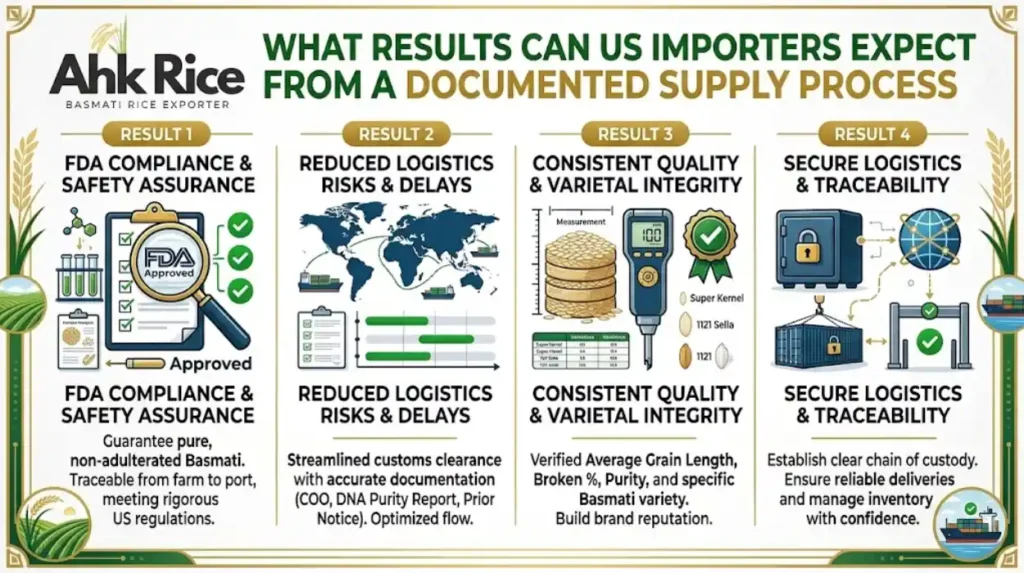
A properly managed sourcing process gives importers clearer product specifications, better purchasing visibility, and an organized set of supplier records. These controls can reduce avoidable documentation errors and quality disputes, although they cannot guarantee FDA clearance, a specific delivery date, or uninterrupted market access.
Consider a US distributor preparing to launch a 1121 Basmati rice product. Before placing a container order, the distributor requests a sample, approves the grain and cooking characteristics, agrees on the packaging artwork, and confirms the commercial specification.
The distributor then coordinates facility registration checks, FSVP responsibilities, Prior Notice arrangements, and customs entry with the appropriate parties. The supplier prepares the agreed export documents, while the importer checks that product descriptions and shipment details match across the paperwork.
This process creates a traceable purchasing record and makes discrepancies easier to identify before dispatch. It also helps the buyer compare future consignments against the original specification.
AHK Rice can coordinate supplier-side preparation and shipment communication. The importer should retain the relevant purchase order, approved specifications, supplier verification records, applicable test results, and entry documentation according to its regulatory and business requirements.
How Can You Start an Import Order with AHK Rice?
Start by defining your target Basmati variety, quality specification, shipment volume, packaging format, and US destination port. A written requirement allows the supplier to prepare a more relevant quotation and helps your compliance team identify the documentation needed before the first shipment.
Use this purchasing sequence:
Step 1: Define the product. Select 1121, Super Kernel, or 1509 and specify the processing type, grade, grain parameters, and intended use.
Step 2: Request the sample. Confirm quantity, courier cost, dispatch conditions, and any applicable sample documentation or testing expenses.
Step 3: Approve the specification. Document the agreed quality parameters, packaging, inspection arrangements, and acceptable tolerances.
Step 4: Verify compliance responsibilities. Confirm facility registration where required, identify the FSVP importer, arrange Prior Notice, and coordinate customs requirements with your broker.
Step 5: Review the commercial offer. Check the price, order quantity, payment terms, Incoterm, loading arrangements, and estimated shipping schedule.
Step 6: Approve shipment documents. Verify invoice details, packing information, origin documentation, transport documents, and other applicable certificates before dispatch.
Step 7: Plan arrival and clearance. Coordinate the entry process, applicable FDA requirements, and any examination or inspection with your US service providers.
AHK Rice works with buyers seeking a structured Pakistani Basmati sourcing process. Clear specifications, agreed documentation responsibilities, and advance coordination help both parties manage the order more effectively.
For a product-specific quotation, sample arrangements, and a documented export plan, submit your requirements through AHK Rice’s request-a-quote page.
Frequently Asked Questions
Does FDA approve Pakistani Basmati rice before import?
FDA does not generally issue a universal pre-approval certificate for Basmati rice.
Importers must meet applicable food safety and entry requirements.
Facility registration may be required for covered foreign facilities.
Prior Notice and FSVP obligations must also be assessed.
Confirm shipment-specific requirements before dispatch.
Can AHK Rice provide documents for US rice imports?
AHK Rice can coordinate available supplier-side export documents.
These may include invoices, packing lists, and origin documentation.
Additional certificates depend on the product and shipment.
Laboratory reports should be confirmed before ordering.
The importer remains responsible for its US regulatory obligations.
How much does a Basmati rice sample cost?
Sample pricing depends on the variety and quantity requested.
Courier charges depend on the destination and service.
Applicable phytosanitary or testing costs may also arise.
Confirm whether the sample itself is free before dispatch.
Request the complete sample cost breakdown in advance.
How long does shipping from Pakistan to the USA take?
Ocean transit can take several weeks, depending on the route.
East Coast and West Coast services have different schedules.
Transshipment and port congestion can affect arrival dates.
Customs clearance and inspections may add further time.
Obtain a current estimate before confirming the purchase order.
What should US importers confirm before ordering?
Confirm the variety, grade, quantity, and packaging requirements.
Review the supplier’s available documentation and quality specifications.
Identify the responsible FSVP importer and Prior Notice filer.
Coordinate customs entry and applicable FDA requirements.
Approve the quotation and shipment schedule before dispatch.