What Is the Foreign Supplier Verification Program (FSVP) for Imported Rice?
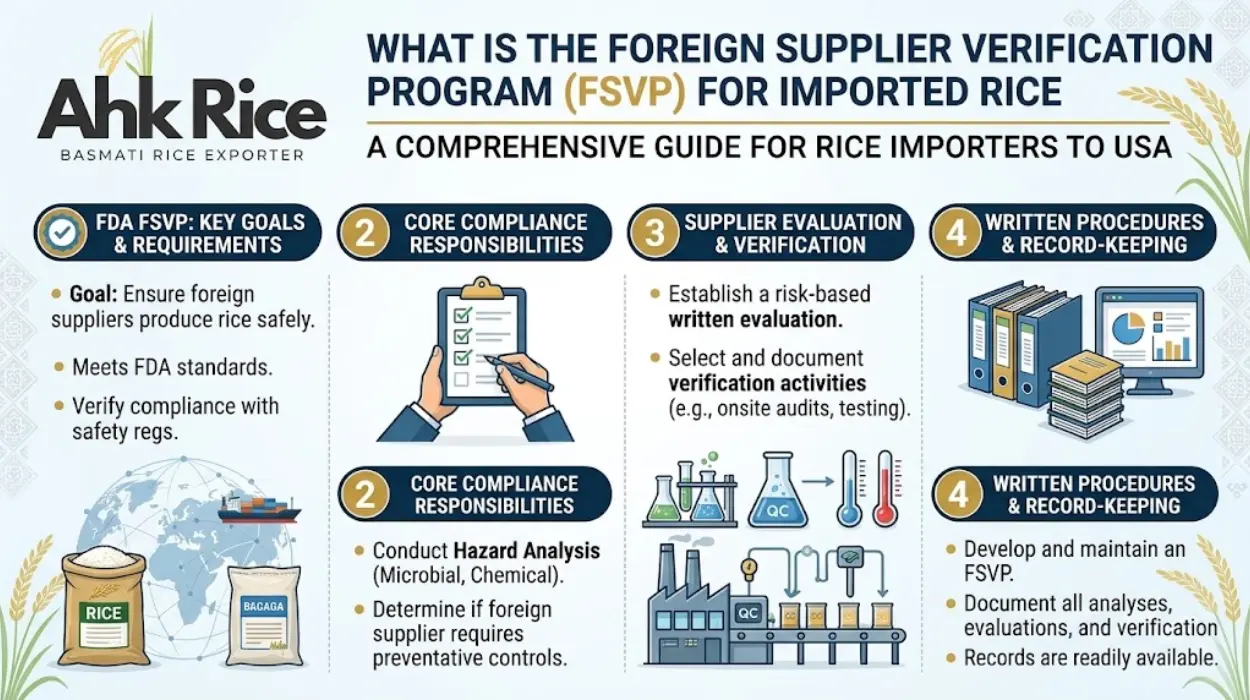
The Foreign Supplier Verification Program (FSVP) is a United States food safety requirement that makes importers responsible for verifying that imported food meets applicable US food safety standards. For imported rice, FSVP establishes a documented process for evaluating foreign suppliers, assessing food safety hazards, reviewing supplier controls, and maintaining verification records.
Rice importers sourcing Pakistani Basmati rice, including 1121, Super Kernel, and 1509 Basmati rice, need to understand how FSVP applies to their supply chains. The program connects supplier approval, hazard analysis, verification activities, and corrective actions. It operates under the US Food and Drug Administration (FDA) regulations established by the Food Safety Modernization Act (FSMA).
Understanding FSVP helps importers identify food safety risks before shipments enter the United States. It also clarifies the responsibilities of importers, foreign rice processors, exporters, and other supply chain participants.
What Is the Foreign Supplier Verification Program (FSVP)?
The Foreign Supplier Verification Program is an FDA regulation requiring covered US food importers to verify that foreign suppliers produce food according to applicable US food safety requirements. It establishes documented procedures for hazard evaluation, supplier approval, verification activities, corrective actions, and recordkeeping.
FSVP is governed by the FDA’s regulations in 21 CFR Part 1, Subpart L. It applies to covered food imports unless a specific exemption or modified requirement applies.
For rice imports, the importer must determine the relevant hazards and verify that the foreign supplier controls those hazards appropriately. The assessment depends on the rice product, its processing methods, intended use, supplier history, and applicable food safety requirements.
For example, an importer purchasing Pakistani 1121 Basmati rice for retail distribution must evaluate the supplier’s food safety controls and establish appropriate verification activities. A commercial invoice or export certificate alone does not establish complete FSVP compliance.
FSVP is separate from customs clearance, tariff classification, and other import documentation. A shipment that has the correct commercial documents still requires compliance with applicable FDA requirements.
Why Does FSVP Matter for Imported Rice?
FSVP matters because it makes covered US importers accountable for verifying foreign supplier food safety controls. The program helps identify contamination risks, establish supplier approval criteria, maintain traceability, and support corrective action when food safety requirements are not met.
Rice moves through multiple stages before reaching US consumers. These stages include cultivation, harvesting, drying, milling, polishing, sorting, packing, storage, and transportation. Each stage introduces different food safety considerations.
Potential hazards include chemical contaminants, environmental contaminants, biological hazards, and physical materials. Their relevance depends on the product and its production environment. For example, pesticide residues require consideration when agricultural chemicals are used, while physical hazards include stones or metal fragments introduced during handling or processing.
FSVP encourages importers to evaluate these risks before approving a supplier. It also supports documented communication between importers and foreign suppliers when testing, sanitation, processing controls, or corrective actions require attention.
FSVP does not guarantee that every shipment is free from hazards. It establishes a risk-based verification system intended to help ensure that imported food meets applicable US food safety requirements.
How Does FSVP Work for Imported Rice?
FSVP follows a documented sequence of hazard analysis, foreign supplier evaluation, supplier approval, verification activities, corrective action, and recordkeeping. A qualified individual performs the required activities, reviews relevant evidence, and updates the program when new information changes the food safety risk.
The process begins when a US importer identifies the rice product and its foreign supplier. The importer then determines which FDA requirements apply and evaluates the associated food safety hazards.
1. Identify the imported rice and foreign supplier
The importer records the product identity, supplier details, manufacturing location, and intended use. For example, the product could be Pakistani 1121 Steam Basmati rice packed in 5 kg retail bags or 25 kg commercial sacks.
2. Conduct a hazard analysis
The importer evaluates known or reasonably foreseeable biological, chemical, and physical hazards associated with the rice. The analysis considers the product, processing methods, agricultural practices, transportation, and intended consumer use.
3. Evaluate the foreign supplier
The importer assesses the supplier’s food safety procedures, relevant inspection results, compliance history, corrective actions, and other evidence appropriate to the identified hazards.
4. Approve the supplier
The importer establishes approval criteria based on the hazard evaluation and supplier performance. The decision must be supported by documented evidence rather than price, product quality, or export capacity alone.
5. Conduct supplier verification
Verification activities depend on the risk and supplier history. They include appropriate testing, review of relevant food safety records, onsite audits, or other suitable activities.
6. Document findings and take corrective action
The importer maintains records of verification activities and responds to identified problems. Corrective actions address the immediate issue and reduce the likelihood of recurrence.
7. Reassess the program
The importer reevaluates the supplier and hazard analysis when significant changes occur or new information emerges. Periodic reassessment also follows the applicable regulatory requirements.
What Are the Key Components of an FSVP for Rice?
An FSVP contains the records and procedures needed to demonstrate that a covered importer evaluates hazards, approves foreign suppliers, conducts appropriate verification, responds to compliance problems, and reassesses food safety risks. Each component supports a documented, risk-based supplier management process.
The main components include:
- Hazard analysis: Identifies relevant biological, chemical, and physical hazards associated with the imported rice.
- Supplier evaluation: Examines the supplier’s food safety performance, controls, and compliance history.
- Supplier approval: Establishes whether the supplier meets the importer’s documented approval criteria.
- Verification procedures: Specifies appropriate activities, their frequency, and the evidence used to assess supplier performance.
- Corrective actions: Defines how the importer responds to hazards, inadequate controls, or supplier noncompliance.
- Recordkeeping: Maintains the documentation supporting FSVP decisions and activities.
- Qualified individual: Ensures that required FSVP activities are performed by a person with the necessary education, training, or experience.
A rice supplier’s specification sheet, laboratory results, processing records, and food safety certificates provide useful supporting evidence. However, the importer must determine whether each document is relevant and sufficient for the identified hazards.
A certificate showing compliance with a food safety management standard does not automatically satisfy every FSVP obligation. The importer remains responsible for meeting the requirements applicable to the specific food and supplier.
What Documents Support FSVP Compliance for Imported Rice?
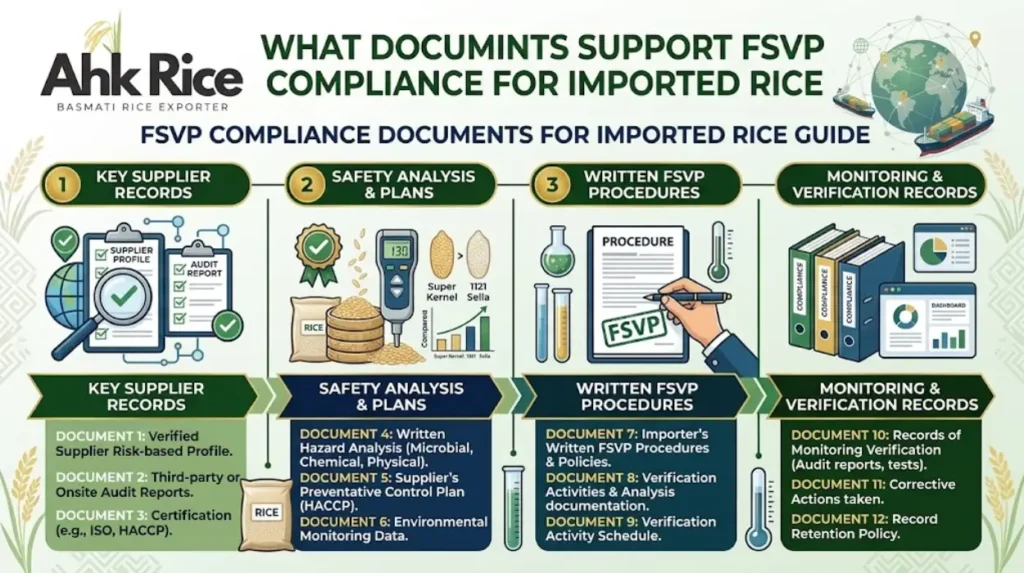
FSVP documentation supports supplier evaluation, hazard analysis, verification decisions, and corrective action. Relevant records include product descriptions, hazard analyses, supplier assessments, verification results, food safety records, and corrective action documentation, selected according to the product’s hazards and applicable FDA requirements.
For Pakistani rice imports, useful supporting documents include product specifications, processing descriptions, supplier identification records, laboratory test reports, and relevant food safety procedures.
A laboratory report can provide evidence about a particular contaminant or quality parameter. Its value depends on the test method, sample representativeness, laboratory reliability, and the hazard being assessed.
Export documents also help establish shipment identity and traceability. Examples include commercial invoices, packing lists, certificates of origin, and shipping records. These documents support import operations but do not independently demonstrate that the importer has completed the required FSVP activities.
The importer must maintain the records required by the regulation and ensure that the documentation accurately reflects the supplier and product being imported.
What Benefits Does FSVP Provide to Rice Importers?
FSVP gives rice importers a structured method for evaluating foreign suppliers and documenting food safety decisions. It strengthens supply chain oversight, improves risk identification, supports traceability, and provides a clear process for addressing supplier problems before they affect subsequent shipments.
A documented supplier verification process helps importers compare suppliers using consistent food safety criteria. This is particularly important when sourcing multiple varieties, processing styles, or package formats.
For example, an importer purchasing both 1121 Steam and 1509 Golden Sella rice needs product-specific information about processing and relevant hazards. A single generic supplier questionnaire does not replace an appropriate hazard evaluation.
FSVP records also help purchasing teams, quality managers, and compliance personnel communicate about supplier performance. When a problem occurs, documented findings make it easier to identify the affected product, investigate the cause, and determine appropriate corrective action.
These benefits depend on the quality of the verification process. Completing paperwork without assessing relevant hazards does not provide an effective food safety control system.
Which Rice Import Scenarios Require FSVP Consideration?
FSVP consideration is important for covered commercial rice imports entering the United States from foreign suppliers. Applicability depends on the food, importer, transaction, and any relevant exemptions or modified requirements, rather than rice variety, package size, or country of origin alone.
Common scenarios include importing bulk rice for distribution, purchasing private-label retail rice, sourcing parboiled rice for foodservice, and importing milled Basmati rice for wholesale customers.
For example, a US distributor importing Pakistani Super Kernel rice in 25 kg bags needs to establish whether the transaction falls under FSVP and identify the applicable supplier verification responsibilities.
A retailer importing 5 kg packages for supermarket shelves also needs to consider FDA food import requirements. Retail packaging does not automatically remove the product from FSVP.
Certain categories of food, importers, and transactions qualify for exemptions or modified requirements under the regulations. Importers must evaluate the specific circumstances before deciding that standard FSVP requirements do not apply.
What Common FSVP Problems and Misconceptions Affect Rice Imports?
Common FSVP problems include relying on certificates alone, failing to document hazard analysis, approving suppliers without sufficient evidence, and confusing customs documentation with FDA compliance. Importers must address these issues through appropriate verification, accurate records, and corrective action.
One misconception is that an FDA registration or facility listing automatically proves FSVP compliance. Facility registration and FSVP are separate regulatory matters, and neither should be treated as a substitute for the other.
Another problem is assuming that a supplier’s HACCP plan, ISO certification, or laboratory report automatically fulfills every importer obligation. These documents support an evaluation, but their relevance depends on the hazards and verification requirements.
Importers also sometimes overlook product-specific differences. Raw milled rice, parboiled rice, broken rice, and flavored rice products have different processing characteristics and intended uses. The hazard analysis must reflect the actual food being imported.
A final mistake is treating FSVP as a one-time onboarding form. Supplier performance, production processes, hazard information, and regulatory requirements change. Importers need a documented process for reassessment and corrective action.
How Can US Importers Verify a Pakistani Rice Supplier Under FSVP?
US importers verify Pakistani rice suppliers by assessing the supplier’s food safety controls, reviewing hazard-specific evidence, establishing supplier approval criteria, and conducting appropriate verification activities. The importer documents these decisions and maintains responsibility for applicable FSVP requirements.
A practical evaluation begins with the supplier’s identity, production location, product specifications, and processing description. The importer then reviews the hazard analysis and supporting evidence relevant to the rice being purchased.
Evidence can include laboratory results, sanitation procedures, pest control records, traceability information, and applicable food safety certifications. The importer determines which evidence is appropriate rather than collecting documents without evaluating their significance.
The importer also establishes verification activities based on the hazard analysis and supplier performance. These activities can include testing, records review, or onsite audits when appropriate under the regulations.
For a detailed explanation of supplier assessment, documentation, and verification decisions, read the guide on how US importers verify a Pakistani rice supplier under FSVP rules.
The central principle is that foreign suppliers provide evidence about their operations, while the covered US importer remains responsible for meeting applicable FSVP obligations. Clear communication, accurate records, and risk-based verification help both parties maintain a consistent food safety process.
Frequently Asked Questions
What does FSVP mean in rice imports?
FSVP stands for Foreign Supplier Verification Program. It requires covered US food importers to verify that foreign suppliers meet applicable US food safety requirements through documented hazard analysis, supplier evaluation, verification activities, and corrective actions.
Does FSVP apply to Pakistani Basmati rice?
FSVP generally applies to covered commercial imports of Pakistani Basmati rice into the United States unless a specific exemption or modified requirement applies. Importers must determine their responsibilities based on the product, supplier, transaction, and applicable FDA regulations.
Who is responsible for FSVP compliance?
The US importer is responsible for complying with applicable FSVP requirements. A foreign rice exporter provides relevant product information and food safety evidence, but the importer must ensure that required verification activities and records are completed.
What documents are needed for FSVP?
Relevant documents include hazard analyses, supplier evaluations, supplier approval records, verification results, laboratory reports, and corrective action records. Product specifications, processing information, and food safety certifications also support the assessment when relevant.
Is FDA registration the same as FSVP?
No. FDA food facility registration and FSVP are separate requirements. Facility registration does not automatically establish FSVP compliance, and importers must assess their obligations under each applicable FDA regulation.