Improve Rice Procurement Efficiency with AHK Rice in Mississippi
Mississippi rice buyers can improve procurement efficiency by replacing fragmented sourcing with a specification-led Pakistan-to-USA supply process covering product selection, sampling, quality control, documentation, shipping, and landed-cost planning. AHK Rice provides this integrated model for commercial buyers.
Mississippi buyers operate in a rice-producing state, yet domestic production does not eliminate the need for imported specialty rice. Pakistani Basmati serves wholesalers, ethnic retailers, restaurants, foodservice operators, processors, and private-label distributors that need long-grain aromatic varieties. USDA’s August 2026 outlook projects U.S. 2026/27 all-rice imports at a record 49.8 million hundredweight, while ending stocks remain 33% below the previous year.
Procurement efficiency therefore depends on more than finding the lowest FOB quotation. Buyers need consistent specifications, predictable production, complete export documentation, controlled sampling, reliable container planning, and a realistic delivery window. This directly connects with:
Why procurement teams focus on supply efficiency.
The next decision is whether to manage each stage separately or use one export partner that controls the origin-side workflow.
What is the best solution for improving rice procurement efficiency in Mississippi?
The best solution is a controlled export workflow that connects rice specification, sample approval, production, inspection, documentation, container loading, ocean freight, U.S. customs preparation, and Mississippi delivery planning under one commercial process.
A Mississippi buyer purchasing Pakistani Basmati needs a defined specification before requesting a final price. The specification should identify variety, processing type, grain length, broken percentage, moisture, foreign matter, packaging, quantity, destination, inspection requirements, and Incoterm.
This approach prevents two common procurement problems. The first is comparing different rice grades under similar product names. The second is comparing FOB prices without calculating the cost of getting the container into the buyer’s warehouse.
AHK Rice operates from Bucheki, Nankana Sahib, Punjab, and supplies Pakistani Basmati varieties including 1121, Super Kernel, and 1509. Its USA export workflow covers processing, grading, sorting, packaging, export documentation, inspection coordination, and container shipment.
For Mississippi, the destination calculation is especially important. A buyer near Jackson, for example, needs to compare the economics of routing through a Gulf gateway such as New Orleans or Houston against alternative U.S. ports. The cheapest ocean freight is not automatically the cheapest delivered supply.
The procurement target is the lowest reliable landed cost that satisfies the approved specification and delivery schedule.
Buyers evaluating:
How Can Rice Buyers Streamline International Purchasing Processes? can compare supplier qualification, documentation, sampling, logistics, and landed-cost controls before selecting an export partner.
Why choose the USA export service from AHK Rice?
The USA export service combines Pakistani rice sourcing, processing, grading, packaging, inspection coordination, export documentation, and container logistics, giving Mississippi buyers one origin-side procurement workflow instead of managing multiple disconnected suppliers.
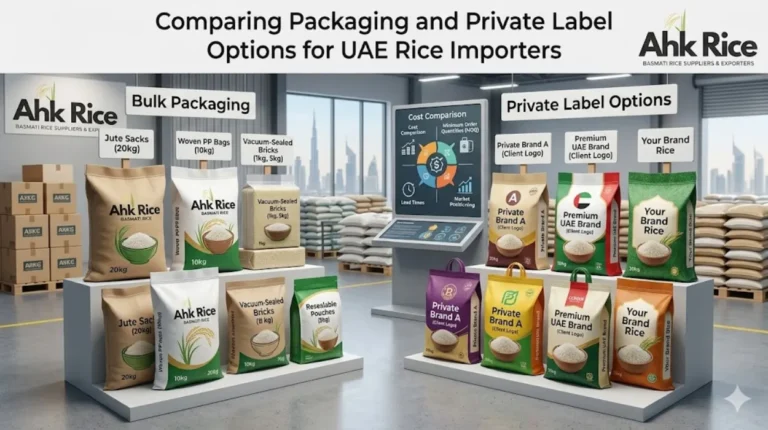
The USA rice export service is designed for U.S. importers purchasing commercial quantities of Pakistani rice. AHK Rice lists 1121 Basmati, Super Kernel, and other Pakistani varieties, with bulk and customized packaging options.
The first advantage is specification control. Buyers can establish a product specification before production. This creates one technical reference for sampling, production, inspection, packing, and claims.
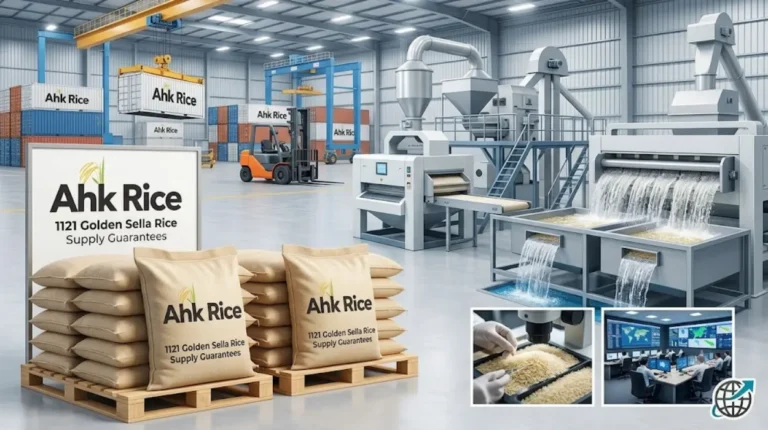
The second advantage is origin-side processing control. AHK Rice manages cleaning, milling, grading, sorting, packaging, and shipment preparation in Pakistan. This reduces the number of supplier handoffs before export.
The third advantage is sampling before a bulk commitment. AHK Rice states that samples up to 20 kg are available, with the buyer covering courier and phytosanitary certificate costs. If the buyer proceeds with the commercial order, sample-related charges can be waived in the final quotation.
The fourth advantage is U.S. import preparation. FDA’s Foreign Supplier Verification Program requires covered U.S. food importers to perform risk-based verification of foreign suppliers and maintain an FSVP for each applicable food and foreign supplier relationship.
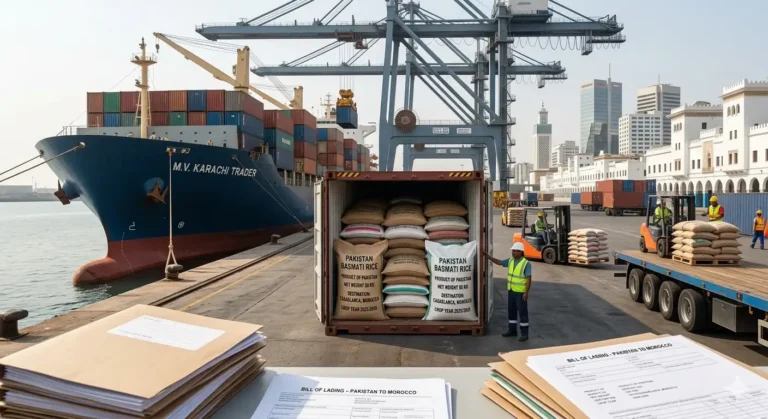
AHK Rice provides export documentation including the Bill of Lading, Certificate of Origin, phytosanitary documentation, packing list, and quality reports as part of its USA export process.
This does not transfer the importer’s legal responsibility. The Mississippi importer remains responsible for its U.S. import and FSVP obligations. The commercial advantage is having a supplier organized around the documentation and verification requirements.
How does the AHK Rice sample process work for a Mississippi buyer?
The sample process starts with a defined specification, moves through sample preparation and courier shipment, continues with physical and cooking evaluation, and ends with written approval before commercial production, reducing the risk of buying an unsuitable grade.
A practical sample process contains six stages.
1. Define the specification
The buyer identifies the required variety and grade. A typical requirement can specify 1121 Basmati, white or Sella processing, grain-length standard, maximum broken percentage, moisture limit, packaging format, and required quantity.
2. Request the sample
AHK Rice provides samples up to 20 kg. The rice itself is offered as a sample, while courier and phytosanitary costs are paid by the buyer. Buyers can also provide their own sample packaging where required.
3. Ship the sample to Mississippi
AHK Rice states that USA samples can be sent through DHL or FedEx, with its USA export page indicating typical sample delivery of approximately 5–7 days by air courier.
The buyer should treat the courier and phyto charges as the sample-stage cost rather than mixing them into the bulk rice price.
4. Test the rice
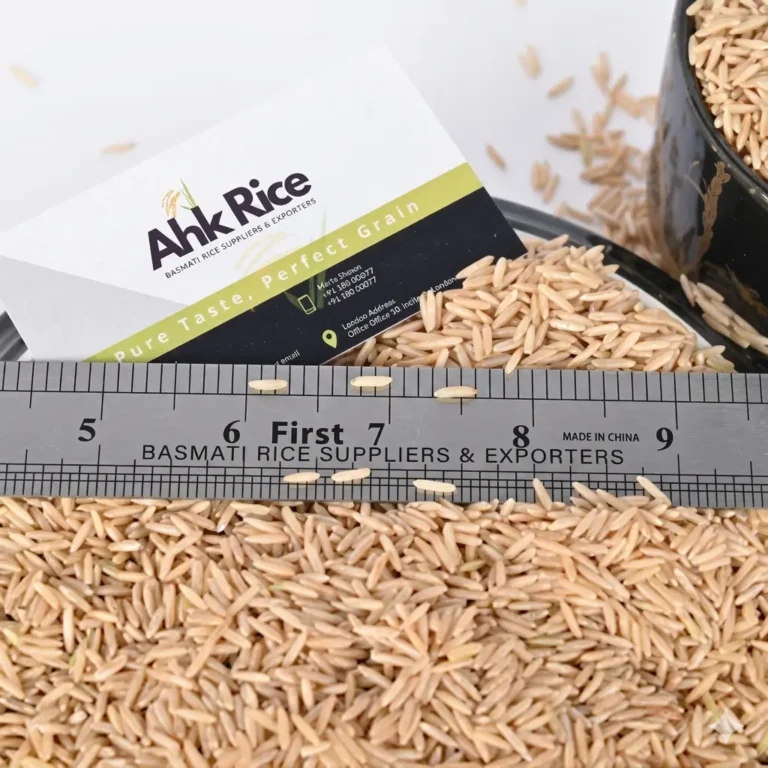
The procurement team should assess appearance, aroma, grain uniformity, broken grains, cooking elongation, texture, taste, and performance after cooking. Commercial buyers can also request laboratory or third-party verification for defined specifications.
5. Approve the specification
Approval should be documented. The approved sample becomes the physical reference for the commercial order.
6. Convert approval into production
After approval, the buyer confirms quantity, packing, Incoterm, destination port, payment terms, inspection requirements, and shipment schedule. AHK Rice then schedules production and export preparation.
This process is more efficient than negotiating a large order first and discovering specification differences after arrival.
What shipping days should Mississippi rice buyers plan for?
Mississippi buyers should plan international procurement around the complete production-to-delivery cycle, not ocean transit alone; current 2026 lane estimates show roughly 32–38 days Port Qasim to New Orleans and about 40–45 days Karachi to Houston before final inland delivery.
Shipping time changes with origin port, vessel routing, transshipment, destination port, customs processing, and inland transportation. Buyers therefore need a planning range rather than a single promised arrival date.
For a Mississippi buyer using the Gulf route, current public freight data provides useful benchmarks. A Port Qasim-to-New Orleans FCL estimate is approximately 32–38 days, while a Karachi-to-Houston FCL estimate is around 40–45 days on the current quoted service.
A Mississippi procurement schedule should therefore include additional time for production, inspection, export documentation, vessel booking, U.S. customs clearance, and inland movement to the warehouse.
Mississippi and Gulf market
New Orleans is a natural comparison point for Mississippi buyers because of its geographic relationship with the state and the wider Gulf logistics network. Current Port Qasim-to-New Orleans estimates show 32–38 days for an FCL service.
Houston and Southern U.S. distribution
Houston provides another Gulf option. Current Karachi-to-Houston FCL estimates show approximately 40–45 days on one active service, with alternative routings producing different schedules.
East Coast alternative
Savannah can serve buyers comparing Gulf and East Coast routing. A current Karachi-to-Savannah FCL estimate is approximately 33 days on one quoted service.
These figures are freight-market benchmarks, not guaranteed delivery commitments. A commercial purchase should use the confirmed sailing, vessel schedule, destination charges, customs plan, and inland delivery quotation supplied for the actual order.
What results can Mississippi buyers expect from AHK Rice?
Mississippi buyers can expect better specification control, clearer landed-cost calculations, fewer procurement handoffs, stronger shipment visibility, and more predictable replenishment when purchasing is organized around approved samples and documented shipment milestones.
The first measurable result is reduced specification ambiguity. Every commercial shipment works from an approved product specification instead of a generic variety name.

The second result is better landed-cost visibility. The buyer can compare rice price, freight, insurance, destination handling, customs-related costs, and inland delivery rather than evaluating FOB alone.
The third result is improved inventory planning. If the buyer consumes 100 MT per month and total replenishment takes approximately 50–65 days, purchasing cannot wait until warehouse stock reaches zero. The next order needs to enter production while sufficient inventory remains available.
The fourth result is better supplier accountability. Production, inspection, documentation, loading, vessel departure, and arrival become identifiable milestones.
The fifth result is stronger repeat-order consistency. A supplier relationship becomes more valuable when the same grade, packing format, documentation process, and shipment structure can be repeated.
This matters in 2026 because U.S. rice supply remains comparatively tight. USDA’s August outlook projects 2026/27 U.S. rice production at 158.4 million hundredweight and ending stocks at 36.0 million hundredweight, while imports remain at a record 49.8 million hundredweight.
For Mississippi procurement teams, these conditions strengthen the case for planned imports rather than reactive buying.
What does rice procurement from AHK Rice cost?
Rice procurement cost depends on variety, grade, quantity, packing, origin price, freight, destination port, inspection, insurance, customs-related charges, inland delivery, and payment terms; therefore, Mississippi buyers need a destination-specific quotation.
AHK Rice’s published USA information gives indicative commercial pricing for some products. Its Super Kernel USA page lists pricing from approximately $1,100 per metric ton on a CIF basis, while other published USA Basmati information lists different FOB starting levels depending on variety and specification.
These figures are not a fixed Mississippi landed price. The final commercial price changes with the specification and shipping conditions at the time of booking.
For procurement comparison, buyers should calculate:
Landed cost per MT = rice cost + origin charges + ocean freight + insurance + destination charges + customs-related costs + inland delivery.
The largest price variables are usually product grade, purchase volume, packaging, freight lane, Incoterm, destination, inspection requirements, and market timing.
A 20 MT order and a 100 MT order do not necessarily produce the same per-MT economics. Larger repeat volumes can improve commercial terms, while custom retail packaging can add production and packing costs.
Inspection also affects cost. A buyer requesting SGS, Bureau Veritas, Intertek, or another independent inspection should include that cost in the procurement model. AHK Rice states that third-party inspection is available at the client’s expense.
The correct comparison is therefore not “Which supplier has the lowest FOB price?” It is “Which supplier provides the lowest reliable landed cost for the approved specification?”
How should Mississippi buyers compare AHK Rice with another supplier?
Mississippi buyers should compare exporters using the same seven criteria: specification compliance, sample performance, production capacity, documentation, freight economics, delivery reliability, and repeat-order capability rather than ranking suppliers by FOB price alone.
| Procurement attribute | What to verify | Decision standard |
|---|---|---|
| Product specification | Variety, grain, moisture, broken percentage | Matches approved specification |
| Sample quality | Aroma, cooking, appearance, purity | Commercial approval |
| Processing | Milling, grading, sorting, packing | Controlled origin process |
| Compliance | Export and U.S. import documentation | Complete documentation set |
| Landed cost | Rice, freight, destination and inland charges | Lowest reliable total cost |
| Shipping | Production and transit schedule | Fits inventory cycle |
| Repeat supply | Capacity and previous export performance | Supports recurring orders |
This framework keeps the decision commercial. A supplier with a lower initial price does not win if the product specification changes, documentation is incomplete, or delivery falls outside the buyer’s inventory window.
AHK Rice’s integrated Pakistan-to-USA model is designed around these procurement requirements, including processing, custom packaging, documentation, inspection coordination, and container shipment.
How should a Mississippi buyer get started with AHK Rice?
Start with the exact rice specification, target quantity, packaging format, destination port or warehouse, preferred Incoterm, and required delivery window; then request a sample, approve the specification, and obtain a shipment-specific commercial quotation.
The process is straightforward.
Step 1: Submit the specification
State the rice variety, grade, processing type, quantity, packaging, and intended use.
Step 2: Select the destination
For Mississippi, provide the preferred port and final delivery location. This allows freight and inland costs to be evaluated correctly.
Step 3: Request the sample
Evaluate the physical rice and cooking performance before approving the commercial specification.
Step 4: Confirm compliance requirements
Coordinate the required U.S. import documentation and FSVP responsibilities with your customs broker and compliance team. FDA states that covered importers must maintain risk-based foreign supplier verification procedures.
Step 5: Compare the landed quotation
Review product cost, freight, inspection, insurance, destination charges, and inland transportation on one commercial basis.
Step 6: Confirm production and shipment milestones
Agree on production timing, inspection, loading, vessel booking, documentation, departure, and delivery expectations.
Step 7: Build the reorder cycle
Once the first shipment performs correctly, establish recurring order quantities and reorder points based on actual consumption and confirmed lead times.
For a Mississippi distributor, this creates a procurement system rather than a one-time rice purchase. The buyer gains a defined specification, controlled sampling process, transparent cost structure, and repeatable shipment workflow. In a U.S. market where USDA projects record rice imports and tighter domestic stocks for 2026/27, that procurement discipline has direct commercial value.
To start a Mississippi rice procurement discussion with AHK Rice, request a customized quote.
Frequently Asked Questions
How can AHK Rice improve rice procurement efficiency in Mississippi?
AHK Rice streamlines Pakistani rice procurement through product specification, sampling, processing, packaging, export documentation, inspection coordination, and container shipping.
What types of rice does AHK Rice supply to the USA?
AHK Rice supplies Pakistani Basmati varieties including 1121 Basmati, Super Kernel, and 1509, with different grades, processing options, and packaging formats.
How does the AHK Rice sample process work?
Buyers first provide their required specification. AHK Rice prepares the sample, arranges courier shipment, and allows the buyer to evaluate quality before approving commercial production.
How much does a rice sample from AHK Rice cost?
Sample rice can be provided up to 20 kg. The buyer covers courier and phytosanitary certificate costs. These charges can be waived from the final quotation when a commercial order proceeds.
How long does shipping from Pakistan to Mississippi take?
Shipping depends on the selected port, vessel schedule, routing, customs clearance, and inland transportation. Current 2026 estimates for Gulf routes generally require several weeks for ocean transit before final Mississippi delivery.