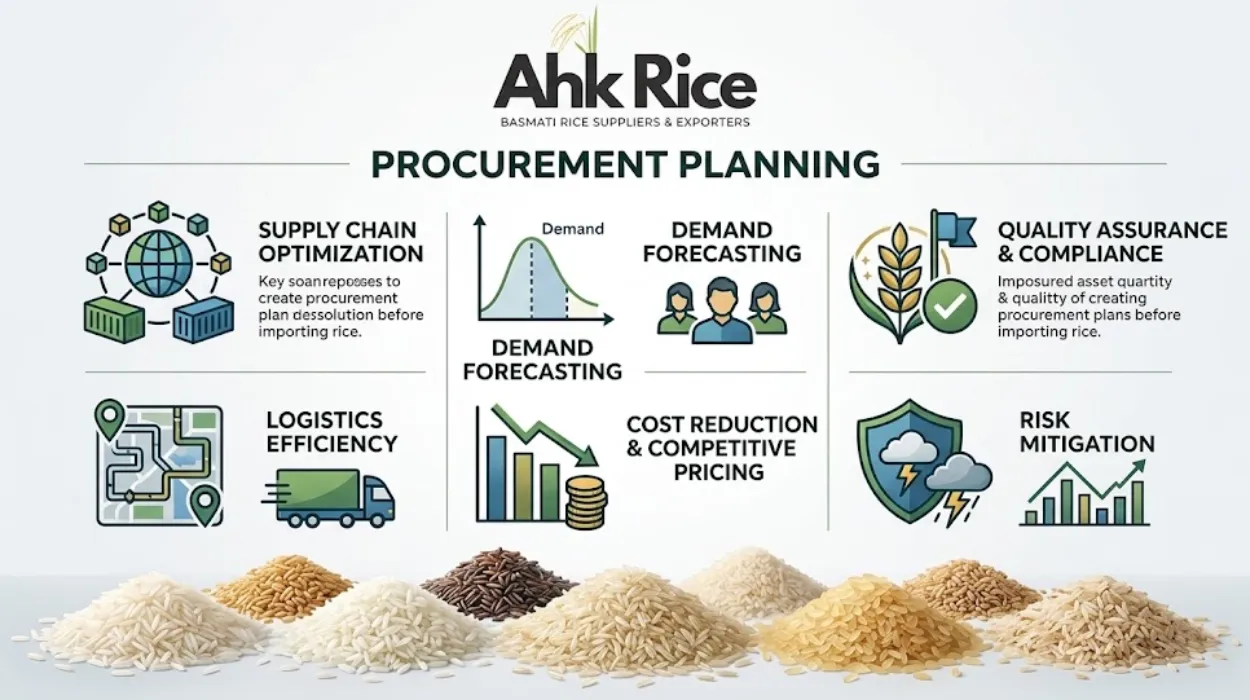
Why Should Buyers Create Procurement Plans Before Importing Rice?
Rice procurement planning is the process of deciding what rice to buy, how much to buy, when to buy it, which specification to approve, which supplier to use, and when each shipment must arrive before an import order is placed. It connects demand forecasting with product selection, supplier capacity, quality control, packaging, documentation, shipping, customs clearance, and inventory management.
For rice importers, planning is important because international procurement has longer lead times than domestic purchasing. A buyer purchasing Pakistani Basmati rice must coordinate production, milling, sorting, packing, inspection, container loading, export documentation, ocean transportation, destination clearance, and inland delivery. A procurement plan gives each activity a defined position in the supply schedule.
Pakistan remains a major rice-exporting origin. USDA’s April 2026 Pakistan Grain and Feed Annual forecasts 2026/27 rice production at 9.8 million metric tons and exports at 5.0 million metric tons, compared with projected 2025/26 exports of 4.7 million metric tons. These volumes show why buyers need structured purchasing rather than relying entirely on last-minute availability.
What Is Rice Procurement Planning?
Procurement planning is a structured process that converts expected rice demand into product specifications, quantities, budgets, supplier requirements, quality controls, shipment windows, documents, and inventory targets before purchase orders are placed, creating a defined supply schedule for each buying period.
The plan begins with expected consumption. A wholesaler, restaurant group, distributor, or retailer estimates how many metric tons it needs during a defined period. The estimate is then separated by rice variety, grade, package size, destination, and shipment month.
For Pakistani Basmati rice, the product specification can identify 1121 Basmati, Super Kernel Basmati, or 1509 Basmati. It can also specify white, steam, or parboiled processing, depending on the commercial requirement.
The buyer then defines measurable quality parameters. Examples include grain length, moisture, broken percentage, foreign matter, damaged kernels, milling quality, color, purity, and packaging requirements.
The final plan connects these requirements with supplier capacity and logistics. A purchase is therefore not treated as an isolated transaction. It becomes one part of a controlled supply cycle.
How Does a Rice Procurement Plan Work?
Rice procurement planning works by linking demand forecasts with product specifications, supplier capacity, production schedules, quality inspections, packaging, export documents, shipping bookings, customs requirements, and receiving dates through one coordinated purchasing timeline, with responsibilities and deadlines assigned to each stage.
The first step is demand estimation. Buyers review historical sales, customer contracts, seasonal demand, promotional activity, and inventory consumption. A distributor selling 100 MT per month can use that consumption rate as a starting point for its procurement schedule.
The second step is product definition. The buyer identifies the exact rice required rather than using a general description such as “Basmati rice.” A specification can state 1121 Steam Basmati, required grain length, maximum broken percentage, moisture range, bag weight, printing requirements, and inspection conditions.
The third step is volume allocation. Expected annual demand is divided into purchase quantities and shipment windows. A buyer requiring 1,200 MT annually can plan 100 MT per month or adjust the schedule according to seasonal demand and warehouse capacity.
The fourth step is supplier planning. The buyer checks whether the supplier can process, grade, pack, inspect, and prepare the required quantity within the planned period.
The fifth step is quality approval. Samples, laboratory results, specifications, and inspection requirements are agreed before production.
The sixth step is logistics coordination. Production completion, container loading, export documentation, vessel booking, port handling, destination clearance, and inland delivery are placed against target dates.
The seventh step is inventory control. The buyer tracks stock on hand, stock in transit, confirmed production, and expected consumption. This creates a practical reorder point before inventory becomes critical.
What Are the Key Components of Rice Procurement Planning?
Key procurement components include demand quantity, rice variety, grade, moisture, broken percentage, grain length, milling quality, packaging, certifications, supplier capacity, price basis, payment terms, inspection, shipping, documentation, inventory safety stock, reorder points, approved specifications, supplier review criteria, and contract controls.
Demand and volume
Demand is the expected quantity of rice required during a defined period. Buyers should separate regular demand from seasonal or promotional demand. Examples include restaurant consumption, retail sales, distributor contracts, and Ramadan-related purchasing cycles.
Rice variety and grade
A procurement plan must identify the exact variety and processing type. Common Pakistani Basmati categories include:
- 1121 Basmati White
- 1121 Basmati Steam
- 1121 Basmati Sella
- Super Kernel White
- Super Kernel Steam
- Super Kernel Sella
- 1509 White
- 1509 Steam
- 1509 Sella
Commercial grade definitions vary by supplier and destination specification, so buyers should approve measurable specifications rather than relying on grade names alone.
Quality specifications
Quality controls establish measurable acceptance criteria. These include moisture, broken kernels, foreign matter, damaged grains, chalkiness, grain length, purity, milling recovery, and cooking characteristics.
Packaging
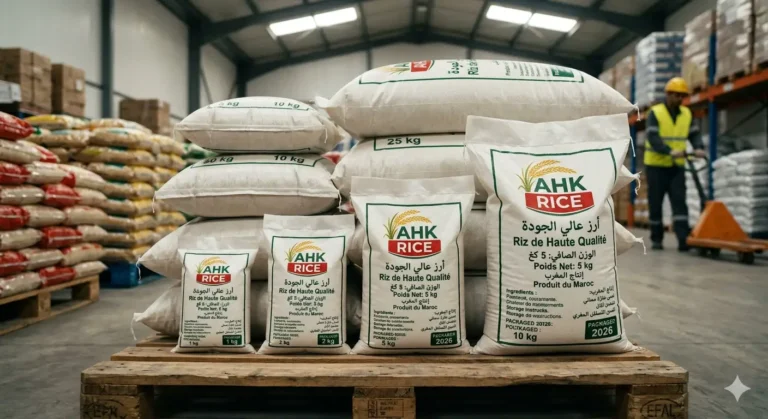
Packaging defines bag material, net weight, dimensions, printing, labeling, pallet requirements, and container configuration. Examples include 5 kg, 10 kg, 25 kg, and 50 kg formats for different distribution channels.
Supplier capacity
Capacity determines whether the supplier can fulfill the required volume within the purchasing window. Capacity includes paddy procurement, milling, aging, processing, sorting, grading, packing, inspection, documentation, and container loading.
Compliance and certification
Certification requirements depend on the destination market, customer, product, and contract. Common food-supply credentials and documents include HACCP-based food safety systems, ISO 22000, BRCGS certification, Halal certification, phytosanitary certificates, certificates of origin, laboratory reports, and health or conformity documents where applicable.
Certification should never be treated as a generic checkbox. The buyer should identify which document is required for the destination and which organization must issue it.
For U.S. imports, regulatory planning has additional importance. FDA states that imported food must meet U.S. legal requirements, and importers are responsible for ensuring food safety, sanitation, and compliant labeling. Food facilities subject to registration requirements must be registered, and prior notice is required for covered imported food shipments.
What Benefits Does Procurement Planning Provide?
Procurement planning improves performance by reducing emergency purchases, specification errors, stockouts, excess inventory, shipment delays, documentation gaps, and quality disputes. It gives buyers measurable control over cost, availability, timing, quality, compliance, and supplier performance across repeated import cycles and markets.
The first benefit is inventory continuity. Buyers know when existing stock will be consumed and when replacement cargo must arrive.
The second benefit is better specification control. Instead of accepting whatever rice is immediately available, the buyer establishes the required variety, grade, processing method, quality parameters, and packaging before production.
The third benefit is better production coordination. Suppliers receive demand information earlier. This supports paddy procurement, processing schedules, packaging-material planning, laboratory testing, and container preparation.
The fourth benefit is logistics visibility. A planned shipment has defined milestones. These include purchase confirmation, production, inspection, packing, container loading, vessel departure, arrival, customs clearance, and delivery.
The fifth benefit is financial control. Buyers can compare expected purchase quantities against budgets and cash-flow requirements. Planned purchasing also reduces dependence on emergency buying decisions.
The sixth benefit is supplier performance measurement. Buyers can compare planned versus actual quantities, production dates, inspection outcomes, documentation accuracy, shipment dates, and delivery performance.
A procurement plan therefore converts supply-chain performance from a general expectation into measurable operating data.
Which Businesses Use Rice Procurement Plans?
Rice procurement plans apply to restaurants, wholesalers, retailers, distributors, foodservice companies, private-label brands, institutional buyers, and processors. Each use case converts expected consumption into planned volumes, specifications, shipment cycles, and receiving requirements, while matching inventory with schedules and replenishment targets.
A restaurant group can use procurement planning to maintain consistent cooking performance across multiple locations. The plan identifies the required rice variety, monthly consumption, packaging format, and delivery schedule.
A wholesaler can divide procurement according to customer demand. One customer can require 1121 Steam, while another requires Super Kernel White. Separate specifications prevent product substitution.
A retailer or private-label brand needs packaging and labeling control in addition to rice specifications. Procurement planning therefore includes artwork approval, bag production, packing quantities, and shipment timing.
A foodservice distributor can coordinate several customer accounts into consolidated import shipments. This improves container utilization and reduces fragmented purchasing.
An institutional buyer such as a large catering operation can use fixed specifications and scheduled deliveries to control food costs and maintain consistent supply.
A processor or food manufacturer can integrate imported rice with its own production schedule. The procurement plan then connects inbound rice with manufacturing requirements.
What Problems Occur Without Procurement Planning?
Common procurement mistakes include buying on spot price, treating all Basmati grades as identical, ignoring lead times, ordering without safety stock, approving vague specifications, and assuming certifications or documents are identical across destination markets. These errors create avoidable purchasing problems.
One common problem is spot-price dependence. A buyer waits until inventory is nearly exhausted and then searches for the lowest available price. This removes time for detailed specification review and supplier comparison.
Another problem is unclear product identity. “Basmati rice” does not describe a complete commercial specification. 1121, Super Kernel, and 1509 have different grain characteristics and processing options.
A third problem is insufficient lead-time planning. International rice procurement includes production and logistics stages that cannot be compressed indefinitely. A missed production window can affect the planned vessel and delivery date.
A fourth problem is excess inventory. Buying large quantities without linking purchases to demand ties up working capital and warehouse space.
A fifth problem is documentation failure. Missing or inconsistent commercial invoices, packing lists, certificates, inspection reports, or destination-specific compliance documents can delay customs processing.
A sixth problem is quality disagreement. If the buyer has not defined measurable acceptance criteria before production, disagreements about broken percentage, moisture, grain length, purity, or packaging become harder to resolve.
A seventh problem is misunderstanding certification. A supplier holding one certification does not automatically satisfy every customer’s requirements. The procurement plan must identify the exact certification and document required for each market.
How Should Buyers Build a Rice Procurement Plan Before Importing?
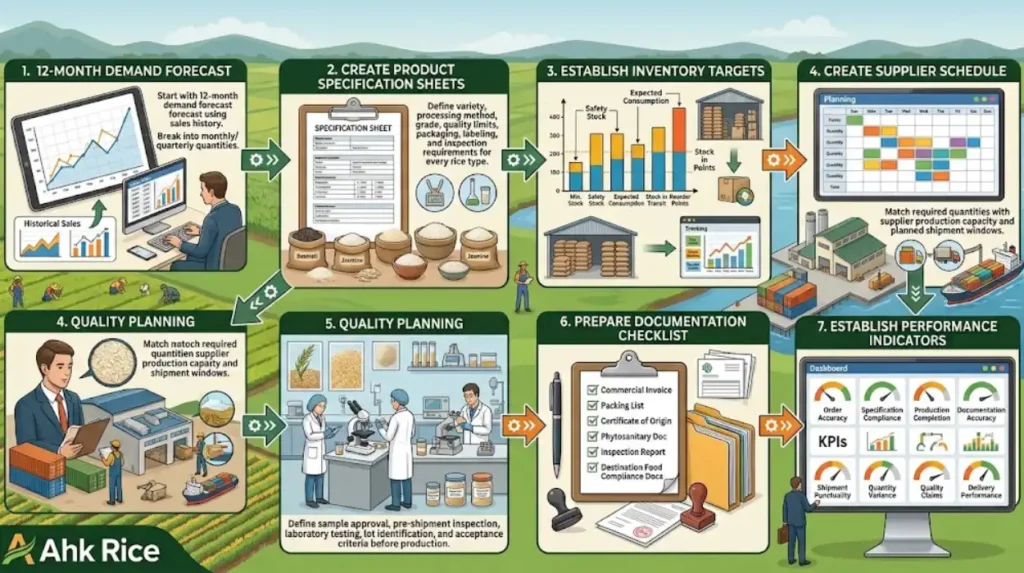
Buyers should build procurement plans from demand forecasts, then convert demand into product specifications, monthly quantities, supplier capacity requirements, quality controls, packaging instructions, compliance documents, shipment windows, inventory targets, and measurable supplier-performance indicators.
Start with a 12-month demand forecast when the business has sufficient sales history. Break the forecast into monthly or quarterly quantities.
Next, create a product specification sheet for every rice type. State the variety, processing method, grade, quality limits, packaging, labeling, and inspection requirements.
Then establish inventory targets. Define minimum stock, expected consumption, stock in transit, safety stock, and reorder points.
After that, create a supplier schedule. Match required quantities with production capacity and planned shipment windows.
The next stage is quality planning. Define sample approval, pre-shipment inspection, laboratory testing, lot identification, and acceptance criteria before production begins.
Then prepare the documentation checklist. This should cover commercial documents, packing information, certificates of origin, phytosanitary documentation, inspection reports, and destination-specific food compliance documents.
Finally, establish performance indicators. Useful measures include order accuracy, specification compliance, production completion, documentation accuracy, shipment punctuality, quantity variance, quality claims, and delivery performance.
This process creates a procurement system that can be reviewed and adjusted every month instead of being rebuilt for every shipment.
Where Does Procurement Planning Fit Into the Rice Import Process?
Procurement planning sits before purchasing but connects every later stage of the international supply chain. The sequence is demand forecast → product specification → supplier selection → quotation → purchase order → sample approval → production → quality inspection → packaging → container loading → export documentation → shipment → customs clearance → delivery → inventory review.
Buyers who understand this sequence can distinguish procurement planning from simple purchasing. Purchasing records the transaction. Procurement planning controls the conditions that make the transaction successful.
The next stage of this topic is understanding how planning affects measurable supply-chain outcomes such as lead time, inventory availability, supplier performance, cost control, and delivery reliability. For that consideration-stage analysis, the related article:
How Does Procurement Planning Improve Supply Chain Performance? should be connected as the natural next resource.
Frequently Asked Questions
Why should buyers create a procurement plan before importing rice?
A procurement plan helps buyers forecast demand, define rice specifications, schedule purchases, manage inventory, coordinate suppliers, and prepare shipping and compliance requirements before an order is placed.
What should a rice procurement plan include?
A rice procurement plan should include expected demand, variety, grade, quality specifications, quantity, packaging, supplier capacity, pricing, payment terms, inspection requirements, certifications, shipment windows, inventory targets, and documentation.
Which Pakistani Basmati rice varieties can buyers include in procurement plans?
Buyers can plan purchases for 1121 Basmati, Super Kernel Basmati, and 1509 Basmati. Each variety can be specified by processing type, such as White, Steam, or Sella.
How does demand forecasting support rice procurement?
Demand forecasting estimates the quantity of rice required during each purchasing period. It helps buyers align purchase volumes with sales, inventory levels, seasonal demand, warehouse capacity, and shipment schedules.
Why are rice quality specifications important before ordering?
Quality specifications establish measurable acceptance criteria for grain length, moisture, broken percentage, purity, damaged grains, milling quality, packaging, and other product characteristics. They reduce quality disputes between buyers and suppliers.