Launch Your Own Basmati Rice Brand in the UAE with AHK Rice Private Labelling
Launching a private label Basmati rice brand in the UAE requires a reliable Pakistani rice supplier, defined product specifications, Arabic-compliant packaging, and predictable shipment planning. The strongest approach is to approve the rice grade, packaging artwork, commercial sample, and landed-cost estimate before confirming a production order.
AHK Rice supports private label sourcing, rice processing, customized packaging, quality checks, and export coordination for UAE importers, distributors, wholesalers, and retail businesses. Buyers can establish a branded rice range without building their own milling and packaging facility.
What is the best solution for launching a private label Basmati rice brand in the UAE?
The best solution is to partner with a Pakistani Basmati rice exporter that can match your target grade, packaging design, order quantity, quality specifications, and UAE import requirements. This approach reduces operational complexity and gives your business control over its brand identity.
Building a rice brand independently requires sourcing paddy or milled rice, arranging processing, purchasing packaging, managing quality control, and coordinating international freight. These responsibilities increase costs and create additional supplier-management risks for new businesses.
Private labelling combines these activities through an export partner. You select the variety, define the quality parameters, provide branding requirements, approve the sample, and agree on commercial terms before production.
Start by comparing the options in What Is Private Label Basmati Rice and How Does It Work?. This educational guide explains the relationship between rice sourcing, processing, custom branding, and finished products.
For UAE customers, product selection should reflect the intended sales channel. Premium supermarkets may prioritize long grain appearance and aroma, while wholesalers and foodservice distributors often emphasize consistent cooking performance, competitive pricing, and dependable bulk supply.
Why choose AHK Rice for private label Basmati rice in the UAE?
AHK Rice provides Pakistani Basmati sourcing, processing, grading, customized packaging, and export coordination through one supplier relationship. Buyers can align the rice specification and brand presentation before shipment instead of managing each production stage separately.
AHK Rice is a Pakistani Basmati rice exporter based in Punjab, supplying varieties including 1121, Super Kernel, and 1509 to international markets. Its private label service supports businesses seeking to introduce their own rice products for retail, wholesale, or foodservice distribution.
Explore the AHK Rice private label and export services to understand the available sourcing and packaging support.
The appropriate variety depends on your positioning:
- 1121 Basmati: Suits premium retail positioning where extra-long grain appearance and aroma are important.
- Super Kernel Basmati: Provides a traditional aromatic option for ethnic grocery stores, distributors, and established Basmati buyers.
- 1509 Basmati: Offers a commercially attractive alternative for businesses prioritizing sourcing efficiency and competitive product pricing.
AHK Rice can coordinate product specifications, processing requirements, packaging formats, and export documentation according to the agreed order. Buyers should confirm the available grade, production schedule, testing requirements, and minimum order quantity before committing to a launch date.
How does the private label process work from sample approval to shipment?
The process begins with a product brief and supplier quotation, followed by sample evaluation, specification approval, packaging artwork confirmation, production, inspection, and export documentation. Approving these stages before loading helps reduce discrepancies between the approved product and delivered shipment.
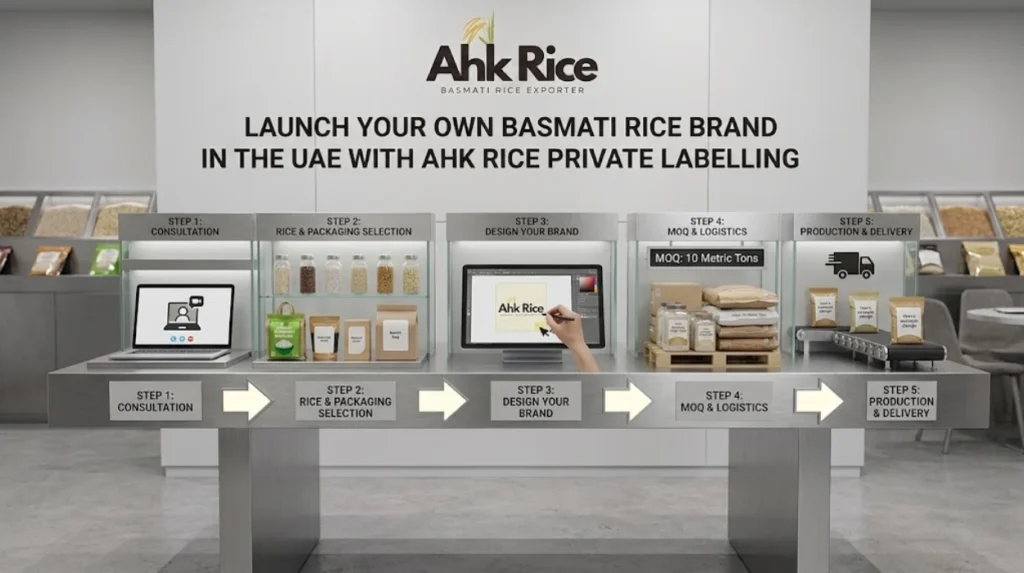
A practical workflow includes six stages.
1. Define the product. Choose the Basmati variety, processing type, grain length, broken-grain percentage, moisture limit, and intended packaging weight. Specify whether the product is raw white, steam, or parboiled rice.
2. Request a commercial sample. Evaluate the grain appearance, aroma, cleanliness, cooking performance, and consistency against your purchasing requirements. A commercial sample should represent the agreed grade as closely as practical.
3. Approve the specifications. Record the acceptable moisture level, broken percentage, foreign matter limits, packing weight, and testing requirements in the purchase agreement. Request a certificate of analysis when applicable.
4. Finalize Arabic packaging. Approve the logo, product description, net weight, country of origin, storage instructions, cooking directions, and required Arabic information. Confirm the final artwork against the applicable UAE requirements before printing.
5. Complete production and inspection. The supplier processes and packs the agreed product. Arrange any required pre-shipment inspection or laboratory testing and resolve discrepancies before the container is released.
6. Ship and distribute. Confirm the shipping documents, agreed Incoterm, destination port, freight arrangements, and import-clearance responsibilities. The UAE importer coordinates local regulatory requirements and distribution.
For a detailed comparison of design approvals, Arabic labelling, minimum order quantities, and production lead times, consult the MOFU guide, Private Label Basmati Rice Process: Design, Arabic Labelling, MOQ and Lead Time for UAE Brands. The guide should be linked to its published article URL when available.
What packaging and labelling does a UAE rice brand need?
UAE rice packaging must protect the product during transport and storage while presenting accurate product information in an appropriate format. Importers should verify current Arabic-language, food-labelling, origin, date-marking, and registration requirements with the relevant UAE authority before printing commercial packaging.
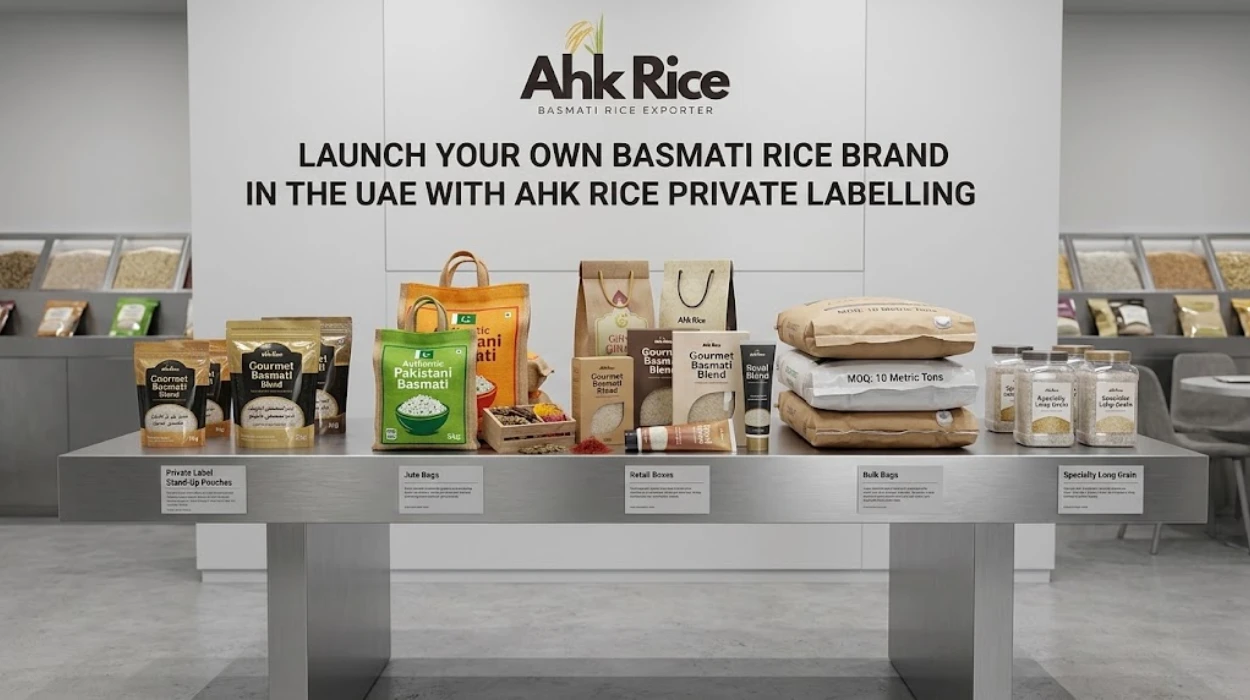
Packaging selection affects product presentation, protection, freight efficiency, and cost. Retail brands commonly evaluate 1 kg, 2 kg, 5 kg, and 10 kg bags, while wholesalers and foodservice businesses often require larger sacks.
The final format depends on the distribution channel, retailer requirements, and order economics. Food-contact packaging suitability, sealing strength, moisture protection, and print quality should be confirmed before production.
The label may need the product name, ingredients where applicable, net weight, country of origin, production and expiry or best-before information as required, storage instructions, and importer details. Arabic information and any additional mandatory declarations must follow the rules applicable to the product and market.
AHK Rice can coordinate packaging requirements with the buyer. The importer remains responsible for confirming local registration, label acceptance, and any additional approvals required before the product enters the UAE market.
What results can a UAE business expect from private labelling?
Private labelling gives a UAE business control over its brand name, product positioning, packaging, and customer relationships while using an established rice supply chain. Commercial results depend on product-market fit, landed cost, distribution coverage, pricing, and repeat-purchase demand.
Consider a Dubai grocery distributor launching a 5 kg Basmati product. The distributor selects a suitable grade, approves Arabic packaging, and tests the product with target retailers before placing a larger order.
This staged approach helps assess customer response before expanding into additional pack sizes. If the product performs well, the business can evaluate a second variety or a wholesale format using the same brand identity.
Private labelling does not guarantee a particular margin or sales volume. The buyer must calculate the complete landed cost, including rice, packaging, inland transport, freight, insurance where applicable, customs duties, taxes, clearance, warehousing, and distribution expenses.
A clear specification and approved sample also establish a reference point for repeat orders. This is important when a retailer expects the next shipment to deliver the same grain appearance, cooking results, and packaging quality.
How much does private label Basmati rice cost in the UAE?
Private label rice pricing depends on the variety, grade, order volume, packaging material, printing requirements, inspection, freight, and agreed Incoterm. Request an itemized quotation rather than comparing suppliers using rice price alone.
The main cost components are:
- Rice grade: Variety, processing type, grain length, broken percentage, and quality requirements affect the product price.
- Packaging: Bag material, weight, artwork complexity, printing method, and order quantity influence packaging costs.
- Minimum order quantity: Production and packaging economics vary by supplier and packaging format. Confirm the actual MOQ before approving artwork.
- Quality assurance: Laboratory analysis, third-party inspection, and special documentation can add charges.
- Shipping: Freight, insurance, port charges, customs clearance, and delivery arrangements affect the final landed cost.
Sample costs should be confirmed separately. Ask whether the sample rice is free, whether courier charges apply, and whether testing or documentation creates additional expenses. Any sample allowance should be documented in the supplier quotation.
For sea freight, transit time also depends on the departure port, destination, carrier schedule, transshipment, and congestion. A planning estimate of approximately 7–14 days for ocean transit from Karachi to a UAE port may be useful for initial discussions, but it is not a guaranteed delivery window. Confirm the current sailing schedule and allow additional time for production, documentation, clearance, and inland delivery.
How can you get started with AHK Rice private labelling?
Start by submitting your target market, Basmati variety, packaging size, estimated quantity, and required delivery window. AHK Rice can then assess the specification, discuss sample arrangements, and prepare a quotation based on the agreed product and shipping terms.
Prepare a brief covering these essentials:
- Target channel: Supermarket, ethnic grocery, wholesale, foodservice, or distribution.
- Product selection: 1121, Super Kernel, or 1509, including the preferred processing type.
- Quality requirements: Grain length, broken percentage, moisture, purity, and applicable testing.
- Packaging: Bag size, material, brand artwork, and Arabic-language requirements.
- Commercial terms: Estimated order quantity, destination, Incoterm, and target delivery schedule.
Next, request a sample and evaluate it against your written specification. Approve the packaging artwork only after checking the applicable UAE requirements. Before production, confirm the final price, payment terms, production lead time, inspection arrangements, shipping responsibilities, and documentation.
A well-defined order gives both parties a clear basis for quality acceptance and repeat purchasing. It also allows your team to calculate landed cost and set a realistic wholesale or retail price before committing to distribution. To discuss your specifications, packaging requirements, and export quotation, contact AHK Rice.
Frequently asked questions
Can I launch my own Basmati rice brand in the UAE without owning a rice mill?
Yes. Private labelling allows you to purchase processed rice from an exporter and sell it under your own brand. You focus on branding, distribution, and customer acquisition. Confirm supplier capabilities, product specifications, packaging arrangements, and UAE import obligations before placing an order.
Which Pakistani Basmati variety should I choose for my UAE brand?
Choose 1121 for premium long-grain positioning, Super Kernel for traditional Basmati appeal, or 1509 when competitive sourcing economics are important. The final choice depends on customer expectations, cooking performance, target selling price, and the supplier’s confirmed specifications.
Is Arabic labelling necessary for private label rice in the UAE?
Arabic-language information is generally required for food labels, subject to the applicable UAE rules and any permitted exceptions. Confirm mandatory declarations, date marking, origin information, importer details, and registration requirements with the relevant authority before printing packaging.
How long does it take to launch a private label rice product?
The timeline depends on sample approval, artwork preparation, packaging availability, production scheduling, inspection, and shipping. Repeat orders with approved artwork may be simpler, but buyers should obtain a written production schedule and current freight estimate before promising a launch date.
What costs should I confirm before ordering private label Basmati rice?
Confirm rice price, packaging and printing charges, minimum order quantity, sample and courier fees, testing, inspection, freight, insurance, customs duties, taxes, and local delivery. Request a written quotation that clearly identifies the Incoterm and the costs included or excluded.