How Do Procurement Teams Assess International Rice Export Partners?
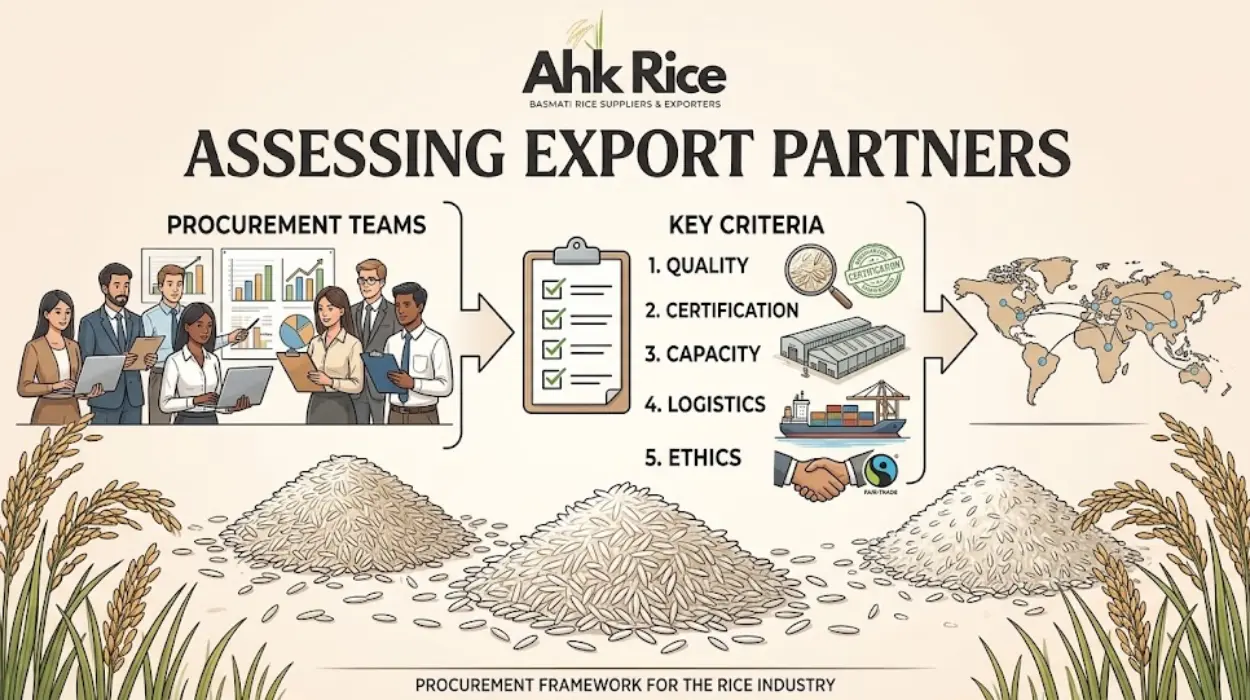
Procurement teams should select international rice export partners by comparing specification consistency, production capacity, food-safety compliance, documentation, landed cost, shipment reliability, and repeat-order performance rather than choosing the lowest initial quotation.
International rice procurement involves more risk than purchasing a standardized commodity from a domestic supplier. The buyer must evaluate the product before shipment, the exporter’s ability to reproduce the approved specification, and the documentation required for the destination market. For Minnesota buyers, this means evaluating Pakistani Basmati suppliers against U.S. import requirements and the commercial needs of distributors, retailers, restaurants, and foodservice operators.
Before comparing exporters, buyers should understand the broader procurement issue explained in:
Why Minnesota buyers should evaluate rice suppliers beyond price. The central lesson is that a lower FOB price does not necessarily produce a lower total procurement cost when quality variation, documentation errors, delays, rejected lots, or inconsistent repeat shipments create additional expenses.
For example, U.S. food importers must ensure that imported food meets applicable FDA requirements. Covered importers also have responsibilities under the Foreign Supplier Verification Program, or FSVP, which requires verification that foreign suppliers produce food in a manner that provides the required level of public-health protection. FDA also requires applicable foreign food facilities to be registered and imported food shipments to comply with Prior Notice requirements.
Pakistan remains a significant global rice-export origin. USDA’s April 2026 Pakistan Grain and Feed Annual forecasts 2026/27 Pakistani rice production at approximately 9.8 million metric tons and rice exports at about 5.0 million metric tons. This export capacity gives procurement teams a substantial supplier base, but it also makes structured supplier comparison essential.
What are the available solutions for assessing international rice export partners?
Procurement teams can assess exporters through price-led sourcing, sample-based purchasing, document-led qualification, factory-audit programs, or structured supplier scorecards, with scorecards providing the strongest method for comparing quality, compliance, capacity, cost, and delivery performance together.
A price-led approach compares FOB or CIF quotations first. FOB means Free on Board, where the exporter’s commercial responsibility generally ends at the agreed loading point after the goods are loaded according to the contract. This method is fast, but it does not adequately measure quality consistency, compliance capability, or shipment execution.
A sample-based approach adds physical product evaluation. The buyer requests a representative sample and checks grain length, broken percentage, moisture, purity, aroma, cooking performance, appearance, and processing type. This approach is stronger because it connects the commercial quotation to an actual product specification.
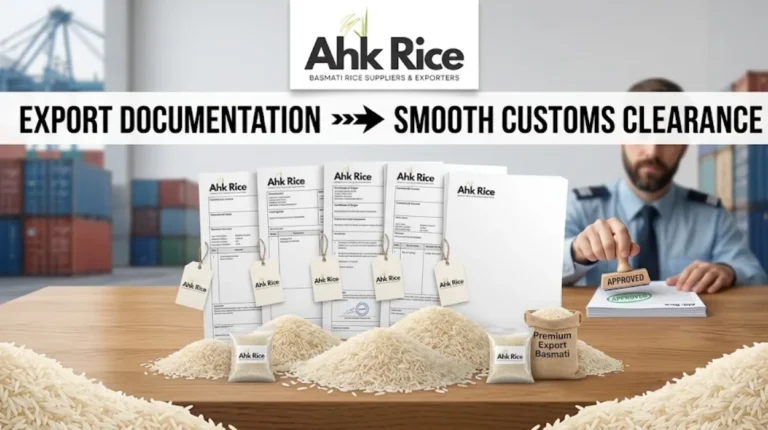
A document-led approach evaluates certificates, laboratory reports, food-safety records, export documents, facility information, traceability records, and previous shipment documentation. This is particularly important for U.S. procurement because FDA requirements apply to imported food entering interstate commerce.
A factory-audit approach evaluates the physical production system. Buyers review paddy receiving, milling, sorting, grading, color sorting, packaging, storage, laboratory controls, pest management, traceability, sanitation, and container loading.
The strongest approach combines these methods into a supplier scorecard. The scorecard converts qualitative supplier information into measurable procurement criteria. A buyer can then compare two exporters using the same technical and commercial framework.
For Minnesota procurement teams, the scorecard should also distinguish between supplier capability and shipment capability. An exporter may have strong milling capacity but weak documentation controls. Another may offer excellent documentation but lack sufficient capacity for recurring monthly orders. Both weaknesses can affect supply continuity.
How do different international rice procurement approaches compare?
Price comparison is fastest but weakest for risk control; sample approval improves product confidence, audits improve operational visibility, and a weighted supplier scorecard provides the most complete comparison because it evaluates commercial, technical, regulatory, and supply-chain performance together.
| Attribute | Price-led sourcing | Sample approval | Factory audit | Supplier scorecard |
|---|---|---|---|---|
| Price visibility | High | High | Medium | High |
| Product verification | Low | High | High | High |
| Compliance assessment | Low | Medium | High | High |
| Production-capacity assessment | Low | Low | High | High |
| Documentation assessment | Low | Medium | High | High |
| Shipment-risk assessment | Low | Medium | High | High |
| Repeat-order suitability | Low | Medium | High | Highest |
The table shows why procurement teams should not treat a supplier quotation as a complete supplier assessment. A quotation answers the question of what the supplier wants to charge. It does not answer whether the supplier can repeatedly deliver the same rice specification.
Sample approval remains important because laboratory and documentation records cannot fully replace physical product evaluation. A sample lets the buyer test the finished product before committing to a commercial shipment.
Factory audits provide another layer of evidence. An audit can determine whether the supplier actually operates the controls described in its documentation. Procurement teams can review whether grain separation, sorting, moisture control, packaging, lot identification, and storage procedures are performed consistently.
A scorecard combines the evidence into one decision model. A procurement department can assign weights such as 25% product quality, 20% compliance, 20% supply capacity, 15% logistics performance, 10% commercial terms, and 10% documentation and communication. The exact weights should reflect the buyer’s risk exposure.
This method also prevents price from dominating the decision. A supplier with a quotation that is $20 per metric ton lower can still become more expensive if the product requires rework, generates customer complaints, arrives late, or creates customs-documentation problems.
Which market regions require different rice supplier evaluation methods?
Minnesota buyers should prioritize U.S. compliance, traceability, repeat specifications, and landed cost, while Gulf buyers place greater emphasis on aromatic grade selection, grain appearance, cooking performance, packaging, and heat-resistant distribution conditions when evaluating Pakistani Basmati suppliers.
Two major market regions demonstrate how procurement criteria change by destination: North America and the Gulf.
North America
Minnesota is part of the U.S. procurement environment, so buyers must evaluate the exporter alongside U.S. food-import requirements. FDA states that imported foods must meet the same applicable legal requirements as domestically produced foods. FDA also identifies food-facility registration and Prior Notice as important import procedures.
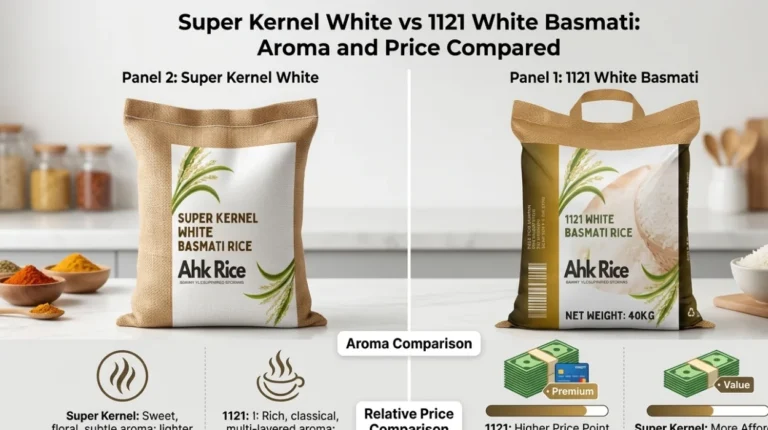
For Minnesota distributors and retailers, common Pakistani Basmati choices include 1121, Super Kernel, and 1509. 1121 is generally positioned toward premium long-grain applications because of its extra-long kernel profile and strong cooked elongation. Super Kernel provides a balance between aromatic Basmati characteristics and procurement cost. 1509 can provide another long-grain option for buyers targeting a different price and cooking-performance position.
The procurement team should calculate landed cost rather than comparing only FOB Karachi quotations. Landed cost can include ocean freight, insurance, destination port charges, customs-related costs, brokerage, inland transportation, compliance expenses, warehousing, and other distribution costs.
Gulf
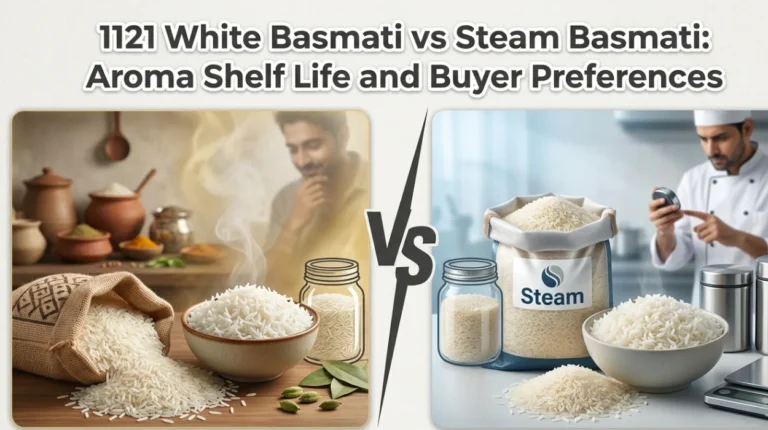
The Gulf region, including Saudi Arabia and the UAE, has strong demand for aromatic rice used in retail, restaurants, catering, biryani, mandi, and other rice-intensive foodservice applications. Buyers frequently evaluate 1121, Super Kernel, Sella, and Steam grades according to grain appearance, separation, aroma, cooking stability, and packaging.
The Gulf also creates different storage considerations because heat and humidity can affect packaging integrity and product quality. Buyers should therefore specify storage requirements and declared shelf life rather than treating shelf life as a universal characteristic of every rice grade.
Price and shelf-life comparison
| Market region | Common grade preferences | Indicative 2026 FOB reference | Typical commercial shelf-life planning |
| North America / USA | 1121 White, 1121 Steam, 1121 Sella, Super Kernel, 1509 | $1,135–$1,205/MT for comparable premium Basmati benchmarks | 12–24 months |
| Gulf / UAE & Saudi Arabia | 1121 Sella, 1121 Steam, Super Kernel, 1509 | $1,135–$1,205/MT for comparable premium Basmati benchmarks | 12–24 months |
These figures are procurement benchmarks rather than fixed transaction prices. Final pricing changes with grade, broken percentage, grain length, moisture specification, processing method, packaging, quantity, inspection, Incoterms, crop conditions, and shipment timing.
Shelf life must also be written into the commercial specification. Packaging material, moisture level, warehouse temperature, humidity, pest protection, and storage practices influence the practical shelf-life period. Procurement teams should request the manufacturer’s declared shelf-life specification and required storage conditions before approving a contract.
Which supplier approach works best for different procurement cases?
A sample-first approach suits new buyers, factory audits suit high-value or recurring programs, scorecards suit structured procurement departments, and long-term allocation agreements suit predictable demand because each method matches a different level of commercial risk and supply commitment.
A new Minnesota importer should begin with sample approval and documentation review. The buyer needs evidence that the rice matches the intended market specification before progressing to larger quantities.
A distributor purchasing several containers per year should add production-capacity verification. Capacity means the supplier’s ability to procure paddy, mill, grade, sort, pack, inspect, document, and prepare the required quantity within the agreed production period.
A high-volume buyer should add a factory audit. The audit should verify whether the supplier’s physical processes support the claimed specifications. It should also examine lot segregation, laboratory testing, packaging controls, warehouse conditions, and loading procedures.
A private-label retailer requires an even more detailed process. The retailer needs consistent grain appearance, cooking performance, packaging dimensions, labeling, batch identification, and repeat production. One approved sample is insufficient if subsequent shipments can vary.
A long-term foodservice contract requires production allocation and shipment planning. The buyer should establish monthly or quarterly volume requirements, approved specifications, delivery windows, packaging requirements, inspection procedures, and procedures for handling specification deviations.
AHK Rice illustrates the integrated supplier model by combining Pakistani Basmati sourcing with processing, grading, color sorting, customized packaging, inspection support, export documentation, and shipment coordination. Its core varieties include 1121, Super Kernel, and 1509, with international supply extending across more than 15 countries.
What are the advantages and disadvantages of each procurement method?
Each procurement method solves a different risk problem: price comparison reduces initial sourcing time, sampling controls product uncertainty, audits expose operational weaknesses, and scorecards improve long-term supplier selection, but every method becomes weaker when used without the others.
Price comparison is useful when procurement teams need to establish a market benchmark. It quickly identifies unusually high quotations and helps buyers understand the commercial position of different grades. Its weakness is that quotations can describe different specifications, Incoterms, packaging, and service levels.
Sample approval provides stronger product evidence. For example, a Minnesota buyer can compare two 1121 samples for grain length, broken kernels, moisture, aroma, cooking elongation, and appearance. The weakness is that one sample does not prove that every future production lot will match it.
Factory audits provide deeper operational evidence. A buyer can inspect processing equipment, sorting systems, laboratories, warehouses, packaging lines, and traceability procedures. The disadvantage is cost and time. An audit also evaluates a facility at one point in time, so ongoing supplier monitoring remains necessary.
Scorecards provide the strongest procurement structure. They allow several suppliers to be ranked using identical criteria. The disadvantage is that the scorecard requires accurate evidence. A poorly designed scorecard can create false precision.
The best procurement process therefore uses a sequence: commercial screening, document review, sample approval, supplier qualification, factory or third-party inspection where justified, commercial negotiation, shipment monitoring, and post-delivery performance review.
What five decision factors should procurement teams use before approving an exporter?
Procurement teams should approve international rice exporters only after confirming product specification, regulatory readiness, production capacity, landed economics, and shipment performance because these five factors determine whether a supplier can deliver commercially usable rice repeatedly rather than merely provide an attractive first quotation.
| Decision factor | What to verify | Example procurement evidence |
| Product specification | Variety, grain length, broken percentage, moisture, purity, processing grade | Approved specification sheet and laboratory report |
| Regulatory readiness | FDA requirements, FSVP support, facility information, labeling, Prior Notice documentation | Compliance records and export documents |
| Production capacity | Monthly processing, grading, packing, inspection, and loading capability | Capacity statement and production schedule |
| Landed economics | FOB price, freight, insurance, destination charges, inland transport | Landed-cost calculation per MT |
| Shipment performance | Lead time, vessel booking, documentation accuracy, tracking, delivery history | Previous shipment records and performance review |
The first factor is specification control. Buyers should define every measurable product requirement before requesting final quotations. This prevents suppliers from quoting different grades under similar product names.
The second factor is regulatory readiness. U.S. importers remain responsible for meeting applicable FDA requirements, while FSVP-covered importers must conduct supplier verification. FDA’s 2026 guidance and enforcement activity reinforce the importance of maintaining supplier verification records.
The third factor is production capacity. A supplier should have enough capacity to handle the buyer’s expected shipment schedule without weakening quality controls during peak procurement periods.
The fourth factor is landed economics. A procurement team should calculate the cost per metric ton delivered to its warehouse or distribution point in Minnesota. FOB price is only one component.
The fifth factor is shipment performance. Buyers should evaluate whether the exporter can coordinate production, inspection, documentation, vessel booking, container loading, and shipment tracking according to the agreed schedule.
How should Minnesota procurement teams make the final supplier decision?
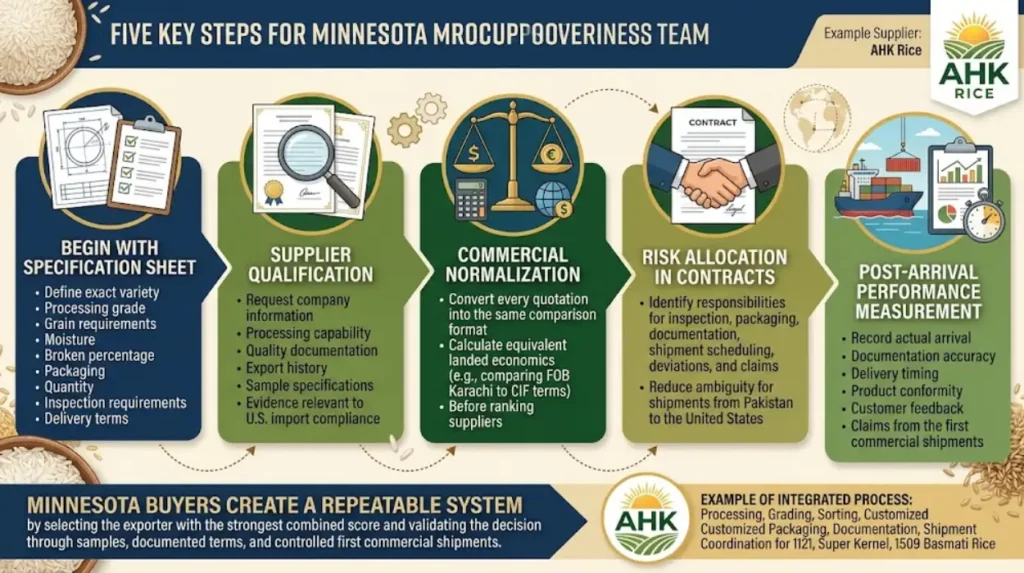
Minnesota procurement teams should select the exporter that achieves the strongest combined score across specification consistency, compliance evidence, production capacity, landed cost, and delivery reliability, then validate the decision through samples, documented terms, and controlled first commercial shipments.
The final decision should begin with a specification sheet. The buyer should define the exact variety, processing grade, grain requirements, moisture, broken percentage, packaging, quantity, inspection requirements, and delivery terms.
The next step is supplier qualification. Procurement should request company information, processing capability, quality documentation, export history, sample specifications, and evidence relevant to U.S. import compliance.
The third step is commercial normalization. Every quotation should be converted into the same comparison format. If one supplier quotes FOB Karachi and another quotes CIF or delivered pricing, the procurement team should calculate equivalent landed economics before ranking them.
The fourth step is risk allocation. Contract terms should identify responsibilities for inspection, packaging, documentation, shipment scheduling, deviations, and claims. This reduces ambiguity when the shipment moves from Pakistan to the United States.
The fifth step is performance measurement after arrival. The first shipment should not end supplier evaluation. Buyers should record actual arrival condition, documentation accuracy, delivery timing, product conformity, customer feedback, and claims.
For Minnesota buyers, this creates a repeatable procurement system. The exporter becomes a supply-chain partner only when it can demonstrate that the approved product specification, documentation process, production system, and shipment performance remain consistent across multiple orders.
AHK Rice operates from Punjab, Pakistan, and supplies 1121, Super Kernel, and 1509 Basmati rice through an integrated export process covering processing, grading, sorting, customized packaging, documentation, and shipment coordination. This model gives procurement teams a practical basis for evaluating one supplier across several of the same criteria used in a structured international sourcing scorecard.
The decision-focused next step should be the article:
Partner with AHK Rice for Minnesota Basmati Rice Procurement, which should be inserted after this article’s final supplier-selection section, where readers have completed the evaluation process and are ready to assess a specific procurement partner.
Frequently Asked Questions
How do procurement teams assess international rice export partners?
Procurement teams assess exporters by comparing rice specifications, quality controls, regulatory compliance, production capacity, landed cost, documentation, shipment reliability, and previous export performance.
Why should rice buyers compare suppliers beyond price?
Price alone does not show product consistency, compliance readiness, shipping reliability, or total landed cost. A lower quotation can become more expensive when delays, quality issues, or documentation problems occur.
What specifications should buyers verify when sourcing Pakistani Basmati rice?
Buyers should verify rice variety, grain length, broken percentage, moisture content, purity, processing type, aroma, cooking performance, packaging, and applicable inspection requirements.
How does a rice supplier scorecard help procurement teams?
A supplier scorecard lets buyers evaluate exporters using consistent criteria. It can compare product quality, compliance, capacity, landed economics, documentation, and shipment performance across multiple suppliers.
Should Minnesota rice importers request product samples?
Yes. Product samples allow buyers to evaluate grain appearance, length, broken percentage, moisture, aroma, cooking performance, and overall conformity before approving a commercial shipment.
Why is production capacity important when selecting a rice exporter?
Production capacity shows whether an exporter can consistently procure, process, grade, pack, inspect, and prepare the required volume without compromising specification or shipment schedules.
What documents should international rice buyers review?
Buyers should review product specifications, laboratory reports, export documentation, facility information, traceability records, inspection documents, packaging details, and documentation relevant to U.S. food-import requirements.
How should Minnesota buyers compare rice prices?
Minnesota buyers should compare equivalent specifications and calculate landed cost rather than comparing FOB prices alone. Freight, insurance, destination charges, inland transportation, customs-related costs, and other expenses affect the final cost per metric ton.
Which Pakistani Basmati varieties can procurement teams evaluate?
Procurement teams can evaluate varieties such as 1121 Basmati, Super Kernel, and 1509 Basmati based on grain characteristics, processing type, cooking performance, market positioning, and buyer requirements.