How to Order 1509 Basmati Rice from Pakistan: Full Step-by-Step Guide
Ordering 1509 Basmati rice from Pakistan follows a defined export process that starts with supplier selection and ends with customs clearance in the destination country. Here is why: Pakistan operates a regulated rice export chain with fixed documentation, grading standards, and shipping procedures (source: REAP export data, December 2025).
What is the process to order 1509 Basmati rice from Pakistan?
The process includes supplier selection, specification confirmation, sample approval, contract signing, production, inspection, shipment, and import clearance.
1509 Basmati rice is a short-duration basmati variety cultivated in Punjab. Farmers harvest it within 90–100 days. The grain measures 7.1–7.5 mm before cooking. Exporters mill, polish, and grade it for international markets.
Ordering this rice requires alignment between buyer specifications and exporter capabilities. Buyers define grain type, processing method, and packaging format. Exporters confirm supply based on crop availability and stock levels.
Pakistan exported over 5 million tons of rice in FY2024–25 (source: Pakistan Bureau of Statistics, FY2024-25). 1509 Basmati contributes a significant share due to its competitive pricing and shorter crop cycle.
The process begins with understanding how 1509 rice moves from farm to export-ready product.
How does the 1509 Basmati rice export process work step by step?
The export process works through 9 defined steps: supplier selection, specification alignment, sampling, contract signing, production, quality inspection, packaging, shipment, and documentation.
Step-by-step export workflow
- Select the supplier
- Define product specifications
- Request and approve samples
- Sign the sales contract
- Process and mill the rice
- Inspect and test quality
- Pack and label the goods
- Load and ship containers
- Clear customs at destination
Supplier selection requires verifying export licenses and past shipment records. Buyers confirm suppliers registered with the Rice Exporters Association of Pakistan.
Specification alignment defines grain length, moisture level, broken percentage, and processing type. For example, UAE importers prefer 5% broken steam rice, while African markets import 25% broken white rice.
Sampling ensures quality matches the contract. Exporters dispatch 1–2 kg samples via courier. Buyers test cooking length, aroma, and elongation ratio.
Contract signing finalizes pricing, quantity, and delivery terms. Most contracts use FOB or CIF Incoterms.
Processing begins after contract confirmation. Mills clean, dehusk, polish, and sort the rice.
Inspection verifies moisture (12–14%), grain length, and purity. Third-party agencies certify shipments.

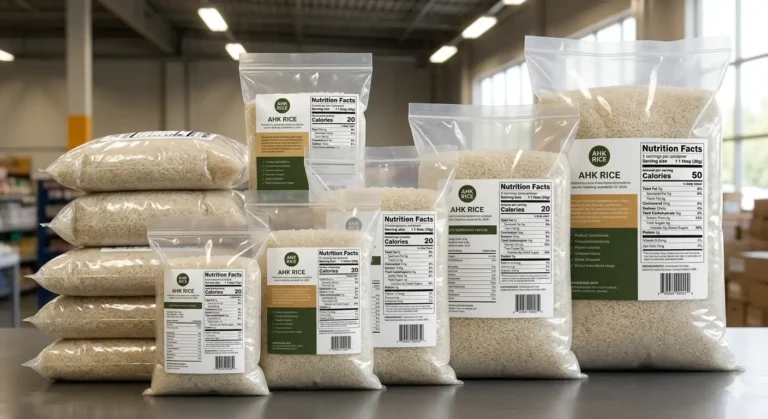
Packaging uses PP bags, BOPP bags, or private-label cartons. Common sizes include 5 kg, 10 kg, and 50 kg.
Shipment involves loading containers and dispatching through Karachi Port.
Customs clearance completes the process in the importing country.
With the workflow defined, the next step is understanding the components involved in each stage.
What are the key components required to import 1509 Basmati rice?
The key components include product specifications, processing grades, packaging types, export documents, and logistics arrangements.
Product specifications
1509 Basmati rice specifications define quality and pricing.
- Grain length: 7.1–7.5 mm
- Moisture: 12–14%
- Broken: 5%–25%
- Purity: 92–95%
Processing grades
Exporters supply 1509 rice in 5 main grades:
- White Rice
- Steam Rice
- Golden Sella
- Creamy Sella
- Parboiled Rice
Each grade differs in processing method. Golden Sella undergoes parboiling and drying, increasing shelf life.
Packaging types
Packaging protects rice during transit.
- PP woven bags
- BOPP laminated bags
- Non-woven fabric bags
- Bulk container loading
Example: Gulf markets prefer 10 kg branded bags, while African buyers import 50 kg bulk packaging.
Export documents
Export requires specific documents:
- Commercial invoice
- Packing list
- Bill of lading
- Phytosanitary certificate
- Certificate of origin
- Fumigation certificate
Each document ensures compliance with import regulations.
Logistics arrangements
Shipping includes container booking and freight handling. Transit times vary:
- UAE: 10–15 days
- Saudi Arabia: 15–20 days
- East Africa: 20–30 days
With components defined, the next question focuses on why buyers choose 1509 Basmati rice.
What are the benefits of ordering 1509 Basmati rice from Pakistan?
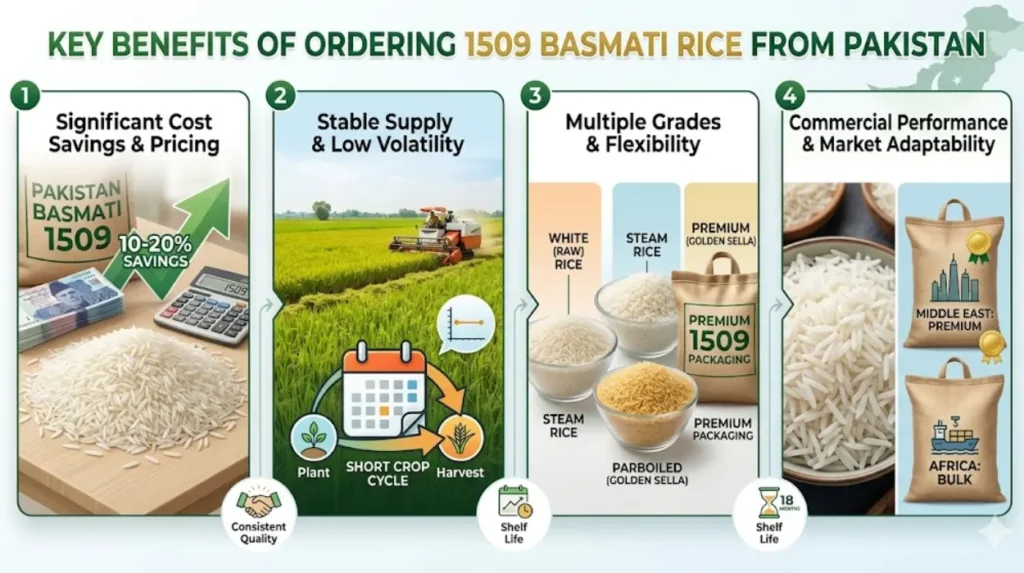
1509 Basmati offers competitive pricing, consistent grain quality, fast crop cycles, and wide availability across multiple grades.
1509 Basmati rice provides cost efficiency compared to 1121 Basmati. Importers reduce procurement costs by 10–20% per ton (source: REAP export data, December 2025).
Short crop duration ensures stable supply. Farmers harvest 1509 rice faster than traditional basmati varieties. This reduces price volatility.
Processing flexibility allows multiple grade options. Buyers select steam, white, or parboiled rice based on market demand.
Cooking performance meets commercial needs. The grain elongates moderately and maintains structure after cooking.
Shelf life depends on processing type. Golden Sella lasts up to 18 months in hot climates, while white rice requires consumption within 12 months.
Market adaptability supports different regions. Middle Eastern buyers prefer premium packaging, while African importers focus on bulk pricing.
To understand where these benefits apply, the next section explains common use cases.
Where is 1509 Basmati rice used and which markets import it?
1509 Basmati rice is used in retail, catering, and bulk food supply across the Middle East, Africa, and Asia.
Middle East markets
Countries like UAE and Saudi Arabia import premium grades. Buyers demand low broken percentage and branded packaging.
Example: UAE supermarkets stock 5 kg and 10 kg premium packs with 5% broken steam rice.
African markets
African countries import bulk quantities. Buyers prioritize affordability and higher broken ratios.
Example: Somalia imports 25% broken white rice in 50 kg bags for wholesale distribution.
Asian markets
Asian buyers focus on blending and re-export. Traders mix 1509 rice with other varieties.
Example: Malaysian traders blend 1509 with local rice for cost control.
Food service sector
Restaurants and catering companies use 1509 rice for daily consumption. The grain cooks quickly and maintains consistency.
Use cases include biryani, pulao, and plain steamed rice.
With use cases established, the next section addresses common problems buyers face.
What problems and misconceptions exist in ordering 1509 Basmati rice?
Common issues include inconsistent quality, unclear specifications, delayed shipments, and misunderstanding of grades.
Inconsistent quality
Quality varies when specifications are not defined clearly. Buyers receive mixed grain sizes or higher broken ratios.
Define exact parameters before ordering. Specify grain length, moisture, and broken percentage in the contract.
Misunderstanding grades
Buyers confuse steam, white, and parboiled rice. Each grade has different cooking and storage characteristics.
Golden Sella lasts longer than steam rice. In a 40°C warehouse, Golden Sella maintains quality for 18 months. Steam rice requires consumption within 12 months.
Documentation errors
Missing documents delay shipments at ports. Customs authorities reject incomplete paperwork.
Prepare all required certificates before shipment. Verify compliance with destination country regulations.
Shipping delays
Freight congestion affects delivery timelines. Delays occur during peak export seasons.
Book containers in advance. Confirm shipping schedules before production begins.
Price misconceptions
Buyers assume uniform pricing across grades. Prices vary based on processing type and packaging.
Detailed pricing insights help avoid confusion. For a breakdown of cost variations across grades and markets, review this guide on 1509 basmati rice price trends for importers in 2026.
With challenges clarified, the final step is understanding how to structure a successful order.
How should buyers structure a successful 1509 rice import order?
A successful order requires clear specifications, verified suppliers, approved samples, and complete documentation.
Define product specifications before contacting suppliers. Include grain length, broken percentage, and packaging format.
Verify supplier credentials through export records and certifications. Confirm membership in industry associations.
Approve samples before finalizing contracts. Test cooking performance and grain consistency.
Use clear contracts with defined Incoterms. Specify FOB or CIF terms to avoid confusion.
Monitor production and inspection stages. Request third-party quality verification before shipment.
Prepare import documentation in advance. Ensure compliance with destination country regulations.
Track shipment and coordinate customs clearance. Maintain communication with freight agents.
A structured order reduces risk and ensures consistent supply.
With the ordering process fully explained, buyers can move from understanding to execution.
Frequently Asked Questions
What is the minimum order quantity for 1509 Basmati rice export?
Minimum order quantity for 1509 Basmati rice is 1 full container load (20–25 metric tons). Exporters ship rice in 20-foot or 40-foot containers. Buyers choose MOQ based on packaging type and destination market requirements.
How long does it take to receive a 1509 rice shipment?
Delivery time ranges between 10 to 30 days depending on destination. Gulf countries receive shipments within 10–15 days, while African ports require 20–30 days. Production and documentation add 7–10 days before dispatch.
Which payment terms are used in rice import transactions?
Common payment terms include Letter of Credit (LC), Telegraphic Transfer (TT), and advance payment. LC ensures secure transactions for new buyers. TT with partial advance works for repeat orders with trusted suppliers.
How is quality verified before shipment?
Quality is verified through lab testing, physical inspection, and third-party certification. Inspectors test moisture, grain length, and broken percentage. Agencies like SGS or Bureau Veritas issue inspection certificates before shipment.
What certifications are required for importing 1509 Basmati rice?
Required certifications include phytosanitary certificate, certificate of origin, fumigation certificate, and quality inspection report. These documents ensure compliance with food safety and import regulations in the destination country.