1509 Basmati Rice Price per Ton in 2026: What Importers Should Expect
1509 basmati rice price per ton in 2026 will range between $780–$1,050 FOB Pakistan depending on grade, processing method, and destination market requirements. Here is why: supply stability, lower aging cost compared to 1121, and strong demand in Africa and Gulf markets are keeping prices competitive (source: REAP export data, December 2025).
1509 Basmati rice dominates cost-sensitive import markets because it offers long grain structure without extended aging cost. Importers prefer it when they need volume, consistency, and faster shipment cycles. For a complete understanding of how 1509 is cultivated, processed, and graded, review this foundational guide on 1509 Basmati rice production and export structure.
What determines 1509 basmati rice price per ton in 2026?
1509 rice pricing depends on five variables: paddy cost, processing grade, moisture level, broken percentage, and export logistics. Each factor directly shifts FOB value by $50–$200 per ton depending on specification.
Core price drivers explained
1509 paddy cost sets the base price because farmers harvest this variety earlier than 1121. Early harvesting reduces field risk and stabilizes supply. Paddy rates in Punjab remained between PKR 3,800–4,500 per 40kg in late 2025 (source: Pakistan Bureau of Statistics, FY2024-25).
Processing method changes value because each method alters shelf life and grain strength. Mills parboil, steam, or polish rice to meet buyer specifications. Golden Sella increases durability. Steam maintains natural color. White rice reduces cost but lowers storage life.
Broken percentage defines export grade because buyers pay premium for uniform grain length. A 2% broken specification commands $80–$120 higher price than 10% broken grade in bulk contracts.
Moisture content affects shipment stability because rice above 14% moisture risks spoilage. Export-grade rice must remain between 12–13% moisture to pass inspection and maintain quality during transit.
Freight and logistics impact final FOB because shipping congestion, container availability, and fuel cost shift export rates monthly. Gulf routes remain stable, while West Africa shows higher volatility due to port congestion.
With pricing factors defined, the next step is understanding available sourcing and procurement solutions.
What are the available solutions for sourcing 1509 basmati rice in 2026?
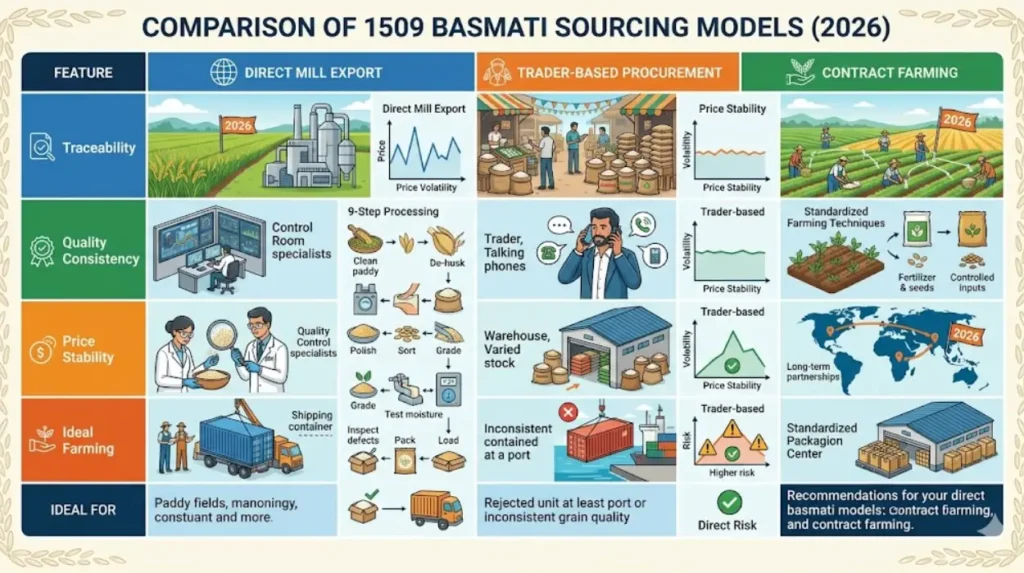
Importers can choose between three sourcing models: direct mill export, trader-based procurement, or contract farming partnerships. Each model offers different control levels, pricing transparency, and quality consistency.
Direct mill export
Direct mill sourcing provides full control because the exporter mills, grades, and dispatches rice under one system. This method ensures traceability from paddy to container loading.
AHK Rice follows a 9-step processing system:
- Clean the paddy
- De-husk the grain
- Polish the rice
- Sort by length
- Grade by broken percentage
- Test moisture level
- Inspect for defects
- Pack in specified bags
- Load and dispatch containers
Direct sourcing reduces risk because the same entity controls quality inspection and export documentation.
Trader-based procurement
Trader sourcing reduces operational burden because traders aggregate supply from multiple mills. This method suits small importers who need mixed specifications or lower quantities.
Trader-based models increase risk because quality varies across suppliers. Inconsistent grain length and moisture levels often lead to rejection at destination ports.
Contract farming partnerships
Contract farming secures long-term supply because exporters cultivate rice with controlled inputs. This model stabilizes pricing across seasons.
This method requires volume commitment because farmers allocate land based on forward contracts. Importers benefit from consistent grain quality and predictable pricing.
With sourcing solutions explained, comparing these approaches clarifies which delivers the best value.
How do different sourcing approaches compare for importers?
Direct mill export delivers highest consistency, trader sourcing offers flexibility, and contract farming ensures long-term price stability. Importers must choose based on volume, risk tolerance, and storage capacity.
Specification comparison table
| Attribute | Direct Mill Export | Trader Procurement | Contract Farming |
|---|---|---|---|
| Price Control | High | Medium | High |
| Quality Consistency | High | Variable | Very High |
| Minimum Order | 1 container | Flexible | High volume |
| Traceability | Full | Limited | Full |
| Lead Time | 15–25 days | 10–20 days | 30–60 days |
| Risk Level | Low | Medium–High | Low |
| Custom Packaging | Available | Limited | Fully customizable |
Direct mill export suits structured import businesses because it ensures specification compliance. Trader sourcing fits opportunistic buying strategies because it allows quick deals. Contract farming works for large distributors because it guarantees supply across seasons.
Price per ton comparison by model
Direct mill export prices range between $850–$1,050 per ton FOB depending on grade. Trader procurement ranges between $780–$950 per ton FOB because of mixed sourcing. Contract farming stabilizes prices around $820–$980 per ton FOB over long-term agreements.
With sourcing comparison complete, evaluating regional demand explains how prices vary across markets.
How do different regions affect 1509 basmati pricing and grade selection?
Gulf markets prefer higher-grade Steam and Sella rice at $900–$1,050 per ton, while African markets prioritize low-cost White and IRRI-blend alternatives at $780–$900 per ton.
Gulf Cooperation Council (GCC) markets
Gulf importers demand premium grain length because consumers prefer long, aromatic rice. Steam and Golden Sella grades dominate this region.
Golden Sella lasts longer than Steam. In UAE warehouse conditions at 40°C, Golden Sella maintains quality for 18–24 months, while Steam requires consumption within 12–15 months.
Bulk buyers in Saudi Arabia and UAE pay higher FOB rates because packaging and branding requirements increase cost.
African markets
West African markets prioritize affordability because rice is consumed in large volumes. White rice and higher broken percentages dominate imports.
Nigeria and Senegal import 5–10% broken grades because lower pricing allows wider distribution (source: FAO Rice Market Monitor, 2025).
African buyers accept shorter shelf life because turnover rates are faster in wholesale markets.
Shelf life comparison
| Grade | Shelf Life | Best Use Case |
|---|---|---|
| Golden Sella | 18–24 months | Hot climate storage |
| Steam | 12–15 months | Retail distribution |
| White | 6–12 months | Fast turnover markets |
Regional demand directly shapes pricing strategies. Understanding this helps importers choose the right grade for their market.
With regional dynamics clear, selecting the best approach depends on business goals.
Which sourcing method works best for different importer types?
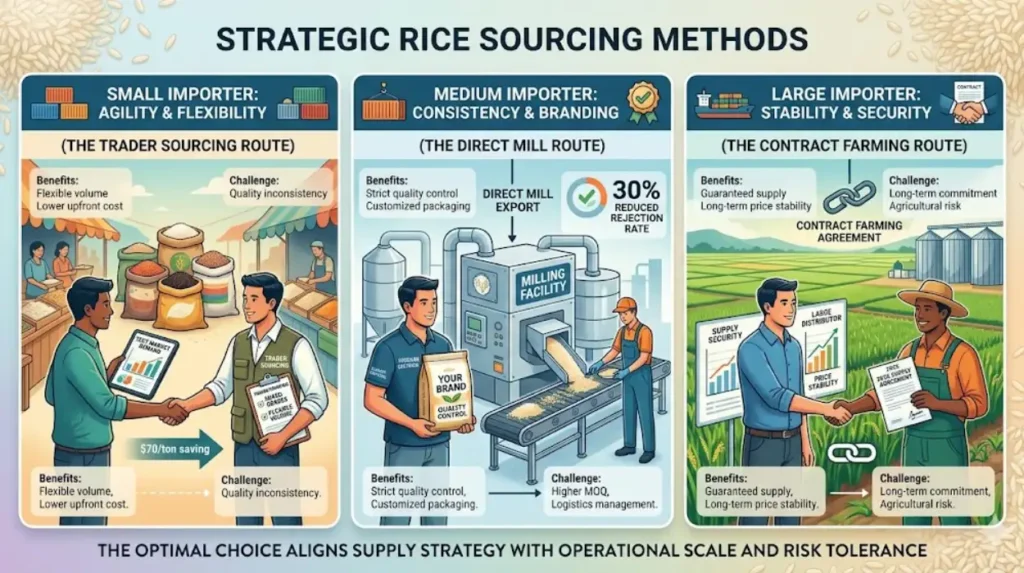
Small importers benefit from trader sourcing, medium importers gain from direct mill partnerships, and large distributors achieve maximum value through contract farming agreements.
Decision framework table
| Importer Type | Best Method | Reason |
|---|---|---|
| Small wholesalers | Trader sourcing | Flexible volume |
| Medium distributors | Direct mill export | Quality control |
| Large importers | Contract farming | Price stability |
| Retail brands | Direct mill export | Packaging control |
| Government tenders | Contract farming | Supply security |
Small buyers choose flexibility because they test market demand. Medium buyers choose consistency because brand reputation depends on quality. Large buyers choose stability because supply disruption risks business continuity.
Each method aligns with operational scale and risk tolerance.
Pros and cons with examples
Direct mill export ensures quality because a single entity manages processing. A UAE importer reduced rejection rates by 30% after switching to direct sourcing.
Trader sourcing reduces upfront cost because buyers can negotiate mixed grades. A Ghana importer saved $70 per ton but faced quality inconsistency issues.
Contract farming guarantees supply because production aligns with demand. An Iraqi distributor secured stable pricing during a supply shortage in 2025.
Each approach presents trade-offs. The correct choice depends on pricing goals and supply strategy.
With decision factors established, importers can refine their buying strategy further.
What decision factors should importers evaluate before buying 1509 basmati rice?
Importers must evaluate price stability, quality consistency, storage conditions, logistics efficiency, and supplier credibility before finalizing contracts.
Key evaluation factors
Price stability matters because volatile markets affect margins. Fixed contracts reduce risk during seasonal fluctuations.
Quality consistency matters because customer satisfaction depends on uniform grain length and cooking performance.
Storage conditions matter because high humidity damages rice quality. Golden Sella suits non-climate-controlled warehouses.
Logistics efficiency matters because delayed shipments increase costs. Reliable exporters dispatch within defined timelines.
Supplier credibility matters because certifications ensure compliance. Exporters must provide:
- Phytosanitary certificate
- Fumigation certificate
- Certificate of origin
- SGS or third-party inspection report
- Packing list and commercial invoice
Each document confirms that rice meets import regulations and quality standards.
Importers should verify suppliers through sample testing before placing bulk orders. A structured sample process reduces risk and ensures specification alignment.
For importers ready to evaluate suppliers and request verified samples, this detailed guide on requesting 1509 basmati samples and export specifications explains the full process step by step.
With all decision factors covered, the final step is aligning sourcing strategy with market demand.
Frequently Asked Questions
What is the average 1509 basmati rice price per ton in 2026?
1509 basmati rice price in 2026 ranges between $780 and $1,050 per ton FOB Pakistan depending on grade, broken percentage, and processing method. Steam and Golden Sella grades command higher prices because they offer better grain strength and shelf life.
Why is 1509 basmati cheaper than 1121 basmati rice?
1509 basmati costs less because it requires shorter aging time and lower cultivation cost. Farmers harvest 1509 earlier, and mills process it faster, which reduces storage expenses and overall export pricing compared to 1121.
Which 1509 basmati grade is best for bulk import?
Golden Sella and Steam grades are best for bulk import because they provide strong grain structure and longer shelf life. Golden Sella works well in hot climates, while Steam suits retail markets needing natural color and aroma.
How does broken percentage affect rice pricing?
Broken percentage directly impacts price because buyers pay more for uniform grains. A 2% broken grade can cost $80–$120 more per ton than a 10% broken grade due to better appearance and cooking consistency.
What documents are required to import 1509 basmati rice?
Importers need phytosanitary certificate, fumigation certificate, certificate of origin, inspection report, and commercial invoice. These documents ensure compliance with international food safety and customs regulations.