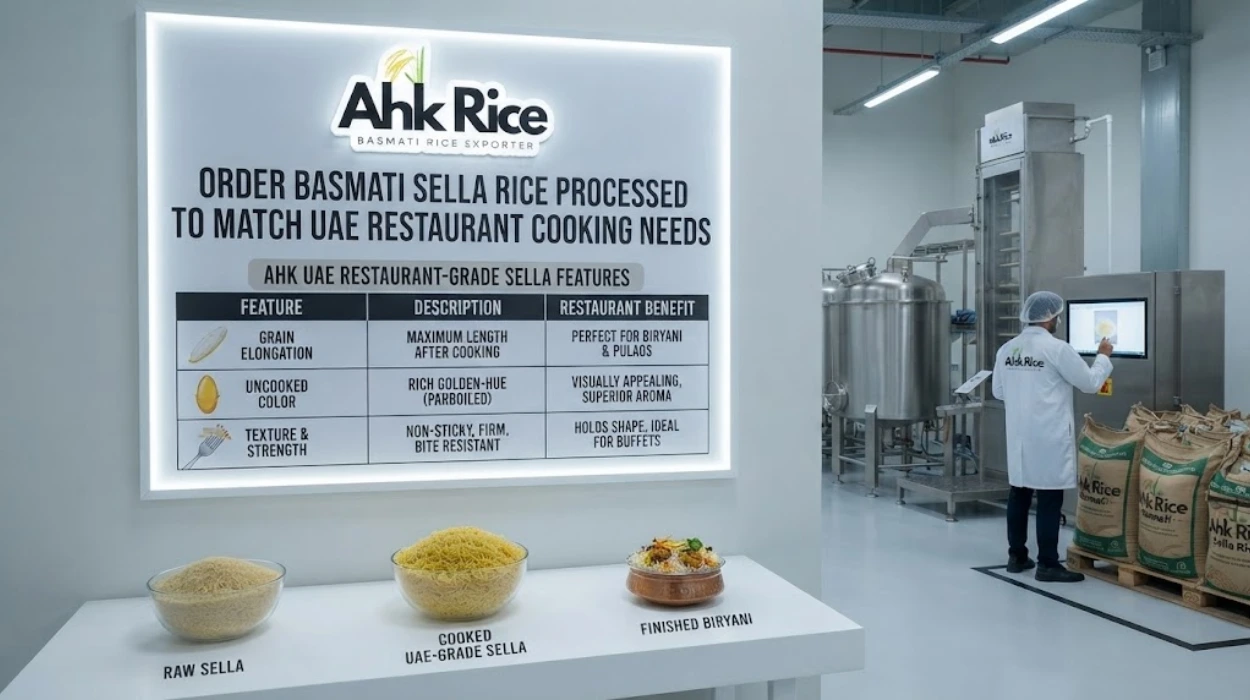
Order Basmati Sella Rice Processed to Match UAE Restaurant Cooking Needs
UAE restaurants should order Basmati Sella rice with processing, grain quality, cooking performance, and packaging matched to their menus. Here is why: the right specification supports consistent portions, separate grains, reliable bulk cooking, and predictable kitchen operations. AHK Rice supplies Pakistani Basmati rice for commercial buyers seeking defined specifications and export coordination. Buyers can review what Sella (parboiled) Basmati rice is and how it is made through the educational guide before selecting a grade and requesting a commercial sample.
What Is the Best Solution for UAE Restaurants Ordering Basmati Sella Rice?
Golden Sella or Creamy Sella Basmati, selected through cooking trials, provides a practical starting point for UAE restaurants. The best choice depends on menu colour, grain separation, cooking volume, holding time, and customer expectations. AHK Rice helps buyers define these requirements before confirming an export order.
Golden Sella generally has a golden appearance because of its parboiling process. Creamy Sella offers a lighter, cream-coloured appearance. Both can suit commercial kitchens, but neither should be selected by colour alone.
Restaurant operators should evaluate four purchasing requirements:
- Grain length: Select the required variety and length specification for the menu.
- Processing grade: Match Golden Sella, Creamy Sella, or another suitable grade to the desired appearance.
- Cooking performance: Test water absorption, grain separation, texture, and cooked yield.
- Delivery format: Choose packaging sizes that fit receiving, storage, and daily kitchen consumption.
A biryani restaurant serving large family platters may prioritise long, separate grains and colour consistency. A hotel buffet may prioritise batch consistency and the ability to maintain suitable texture during service.
For a deeper technical comparison, read the differences between Steam, Golden Sella, Creamy Sella, and White Sella. This comparison helps buyers identify the appropriate processing grade before approving samples and specifications.
With the grade selected, the next decision is choosing an exporter who can supply it consistently.
Why Choose AHK Rice for Pakistani Basmati Sella Rice?
AHK Rice provides Pakistani Basmati sourcing and export coordination for buyers requiring defined product specifications, packaging, and shipment planning. Based in Punjab, Pakistan, AHK Rice supplies 1121, Super Kernel, and 1509 varieties to international markets. Its commercial process connects grade selection with sample evaluation and order confirmation.
For UAE restaurant groups, wholesalers, distributors, and foodservice suppliers, purchasing should begin with a written specification rather than a general request for Sella rice. This reduces ambiguity between the buyer and supplier.
AHK Rice can discuss the following requirements during order preparation:
- Variety selection: Compare suitable Pakistani Basmati varieties for the intended menu and budget.
- Processing selection: Define the required Sella grade and acceptable colour range.
- Grain specifications: Confirm grain length, broken percentage, moisture limits, and other agreed parameters.
- Quality verification: Establish inspection requirements and the documents needed before shipment.
- Packaging configuration: Confirm bag material, net weight, labelling, and private-label requirements.
- Export coordination: Plan dispatch, shipping arrangements, and documentation according to the destination.
Buyers can review the AHK Rice Pakistani Basmati export and supply service before discussing an order. The key is to confirm the exact product specification, available quantity, and commercial terms in writing.
A supplier’s suitability depends on measurable specifications and verified samples, so the next step is defining the results the restaurant expects.
What Results Can UAE Restaurants Expect from the Right Sella Rice Specification?
A properly matched Sella grade can support repeatable cooking, consistent grain appearance, and more predictable bulk preparation. Actual results depend on the rice variety, processing quality, storage conditions, kitchen equipment, and cooking method. Restaurants should validate performance before committing to recurring shipments.
The first result to measure is cooked-grain consistency. Kitchens should prepare the sample using their existing recipe and record the water ratio, soaking time, cooking duration, resting period, and final texture.
The second result is portion control. Comparing the dry weight with the cooked yield helps chefs estimate servings and food cost. This is especially useful for catering kitchens preparing biryani, mandi, pulao, and buffet rice in large batches.
The third result is operational reliability. A consistent approved specification gives purchasing teams a clear reference when placing repeat orders. It also helps kitchen managers identify differences between a delivered batch and the original approved sample.
AHK Rice recommends agreeing on measurable acceptance criteria before commercial dispatch. Buyers should document the approved grade, grain specifications, moisture limit, broken percentage, packaging, and inspection procedure.
A successful sample establishes the product requirements; the commercial quotation then translates those requirements into a workable landed cost.
How Much Does Basmati Sella Rice Cost for UAE Restaurants?
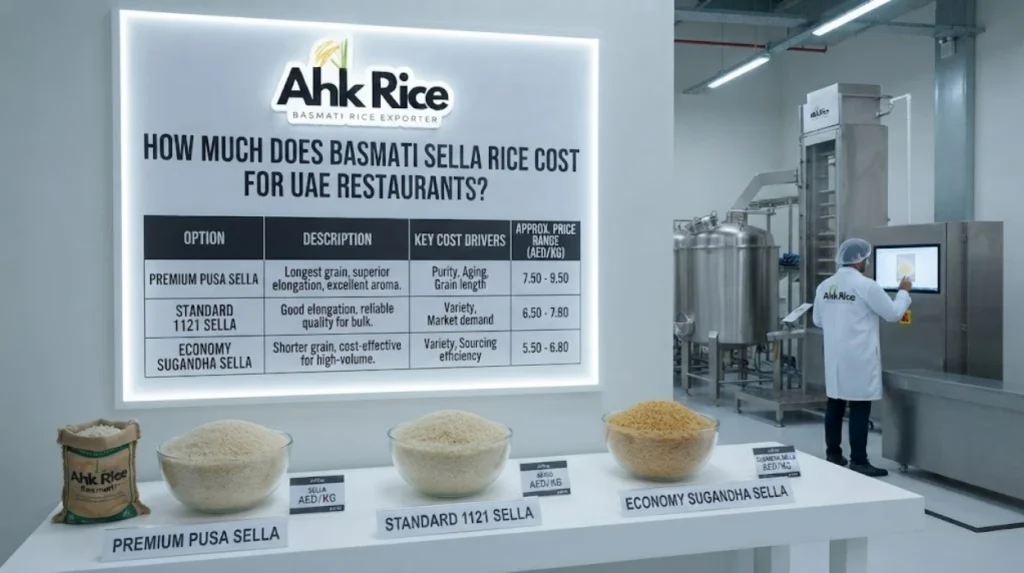
The final price depends on variety, processing grade, order volume, packaging, quality specifications, and delivery terms. Buyers should compare the quoted product price with freight, insurance, customs charges, clearance, and inland delivery. AHK Rice prepares quotations against the buyer’s agreed requirements.
Which factors affect the price per metric tonne?
| Cost factor | What buyers should confirm |
|---|---|
| Rice variety | 1121, Super Kernel, or 1509 |
| Processing grade | Golden Sella, Creamy Sella, or another agreed grade |
| Grain specification | Length, broken percentage, moisture, and quality limits |
| Order quantity | Trial order, pallet quantity, or full container |
| Packaging | Standard export bags or custom-printed retail packaging |
| Shipping terms | FOB, CFR, or CIF, depending on the agreement |
| Destination costs | Customs clearance, duties, inspections, and local delivery |
FOB pricing covers the seller’s obligations up to loading aboard the vessel at the agreed port. CIF pricing includes cost, insurance, and freight to the named destination port, subject to the contract’s terms. Neither price automatically includes every destination charge.
UAE buyers should request quotations in USD per metric tonne and specify the required Incoterm. They should also confirm the quotation’s validity, payment terms, minimum order quantity, and any inspection costs.
AHK Rice should confirm current prices against the required grade, quantity, packaging, and shipment schedule. A reliable comparison uses identical specifications rather than comparing different grades on price alone.
Once the price basis is clear, buyers should establish the sample costs and approval procedure before placing a bulk order.
What Is the Sample Process and How Much Does It Cost?
The sample process should verify cooking performance, physical quality, and specification compliance before bulk production or dispatch. AHK Rice can discuss sample availability, sample quantity, courier arrangements, and applicable testing requirements with the buyer. The final sample cost depends on the arrangement agreed by both parties.
A restaurant buyer should follow these steps:
- Define the specification. Identify the variety, Sella grade, grain length, broken percentage, moisture limit, and packaging requirements.
- Request a sample. Confirm the available sample weight, preparation time, and dispatch location with AHK Rice.
- Confirm sample charges. Agree on the rice cost, courier fee, laboratory testing charges, and any applicable phytosanitary or handling fees.
- Arrange delivery. Provide the recipient’s full address and contact details for courier coordination.
- Test the rice. Cook the sample using the restaurant’s standard recipe and evaluate grain separation, texture, appearance, aroma, and yield.
- Approve the specification. Record the accepted grade and agreed quality parameters in writing.
- Confirm the order. Approve the quotation, packaging artwork, documents, payment terms, and shipment schedule.
What sample budget should buyers prepare?
Sample costs cannot be stated accurately without a confirmed weight, courier route, and testing scope. Buyers should obtain an itemised quotation rather than assume that samples or international delivery are free.
| Sample cost | Pricing basis |
|---|---|
| Rice sample | Supplier-confirmed sample terms |
| International courier | Destination, weight, and service level |
| Laboratory testing | Tests requested and laboratory charges |
| Phytosanitary or handling charges | Applicability and issuing authority requirements |
| Customs or import charges | Destination rules and shipment classification |
AHK Rice should confirm which charges apply before dispatch. Buyers should also establish whether the sample cost can be credited against a later commercial order.
After the restaurant approves the sample, the next step is planning export timing and delivery to the UAE.
How Many Shipping Days Should UAE Buyers Allow?
Shipping time depends on the loading port, vessel schedule, destination port, transshipment, customs clearance, and final delivery arrangements. UAE buyers should request a shipment-specific schedule from AHK Rice instead of relying on a universal transit estimate. The contract should distinguish production time from port-to-port transit.
The following planning ranges are indicative estimates, not confirmed sailing schedules.
| Destination market | Indicative sea-transit planning range from Pakistan | Key consideration |
|---|---|---|
| UAE, including Jebel Ali | Approximately 3–10 days | Vessel availability and port arrangements |
| Saudi Arabia | Approximately 5–14 days | Destination port and clearance |
| Oman | Approximately 3–10 days | Port selection and sailing frequency |
| Qatar | Approximately 5–14 days | Vessel routing and import procedures |
| Kuwait | Approximately 5–14 days | Shipping route and port clearance |
Actual transit may fall outside these ranges. Production, inspection, documentation, booking, port handling, customs clearance, and inland delivery require additional time.
For a UAE order, buyers should ask AHK Rice to confirm the expected readiness date, port of loading, destination port, estimated vessel departure, transit estimate, and document preparation schedule. A confirmed shipping plan is more useful than an unsupported promise of delivery within a fixed number of days.
Restaurant groups should also maintain enough approved stock to cover demand during shipment delays. With logistics agreed, the buyer can move to formal order confirmation.
How Can UAE Restaurants Start an Order with AHK Rice?
Start with a written rice specification, request a quotation, approve the sample, and confirm the shipment terms before committing to the order. This process gives purchasing teams a documented basis for evaluating product quality, commercial costs, and delivery expectations. AHK Rice can discuss the requirements needed to prepare an export quotation.
Prepare the following information before contacting the supplier:
- Product requirement: Preferred Basmati variety and Sella processing grade.
- Quality targets: Grain length, moisture limit, broken percentage, and other required specifications.
- Cooking application: Biryani, mandi, pulao, buffet service, or another restaurant menu.
- Order quantity: Required metric tonnes and expected repeat-order frequency.
- Packaging details: Bag weight, material, printed design, and labelling requirements.
- Destination details: UAE delivery location, preferred port, and importer information.
- Commercial terms: Preferred Incoterm, currency, payment method, and target delivery window.
AHK Rice can use these details to establish whether the requested specification, quantity, and packaging can be supplied under suitable commercial terms. The buyer should review the written quotation and verify the agreed specifications before payment and shipment confirmation.
For recurring restaurant supply, retain the approved sample record and specification sheet. Use these documents to compare subsequent deliveries and manage any quality discrepancy through an agreed inspection process.
Frequently Asked Questions
Which Sella Basmati rice is best for UAE restaurants?
Golden Sella suits kitchens seeking a golden grain appearance and suitable bulk-cooking performance. Creamy Sella provides a lighter colour profile. Restaurants should approve the grade through cooking trials before ordering commercially.
Can AHK Rice supply Basmati Sella rice in bulk?
AHK Rice supplies Pakistani Basmati varieties to international markets. Buyers should confirm the required Sella grade, available quantity, packaging, minimum order, and shipment schedule directly before placing an order.
What information is required for a quotation?
Provide the rice variety, processing grade, grain specifications, quantity, packaging, UAE destination, and preferred Incoterm. These details help establish comparable pricing and identify the applicable freight and destination costs.
How can restaurants test a sample before bulk purchasing?
Cook the sample using the restaurant’s normal recipe. Record water ratio, cooking time, grain separation, texture, appearance, and cooked yield. Approve the specification in writing before confirming the commercial order.
Does the quoted rice price include delivery to the UAE?
The answer depends on the agreed Incoterm. FOB generally covers the seller’s obligations through loading at the named port, while CIF includes freight and insurance to the named destination port. Customs and inland delivery may cost extra.