Packaging, Halal and BPOM Requirements for Selling Basmati Rice Online in Indonesia
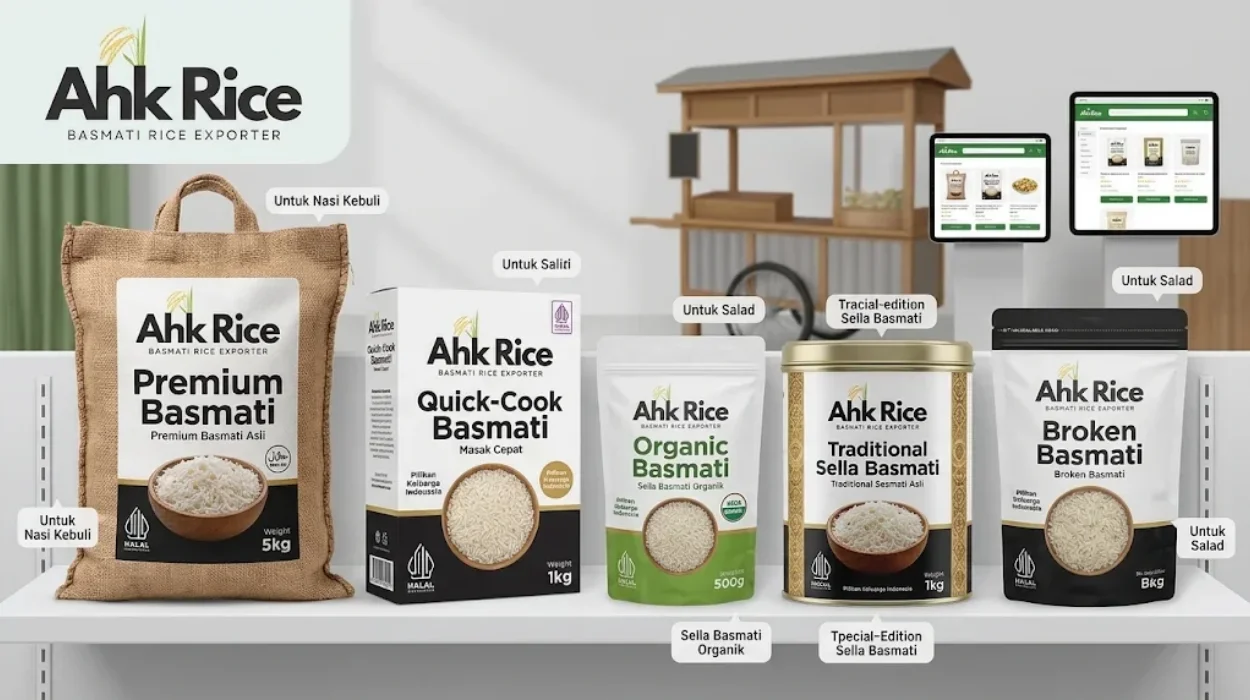
Selling Basmati rice online in Indonesia requires more than importing compliant rice. The packaging, Halal status, BPOM registration, Indonesian-language label, importer documentation, and product presentation must work together. For most online brands, a compliant private-label structure offers the clearest route because it connects import, packaging, certification, and retail preparation.
For background on Indonesian Basmati sourcing, origin, importability, and product selection, start with this guide to Pakistani Basmati rice for the Indonesian market before comparing packaging and market-entry options.
The important distinction is between the rice itself and the finished consumer product. Bulk rice imported for local packing follows a different commercial workflow from pre-packed branded rice imported for direct online sale. A brand also needs to establish who owns the product registration, who controls the label, and which party handles Indonesian regulatory obligations.
What packaging solutions are available for Basmati rice sold online in Indonesia?
Indonesian Basmati rice brands generally choose between bulk import with local packing, finished private-label import, or direct branded distribution, with each model changing packaging control, regulatory responsibility, inventory requirements, and launch speed.
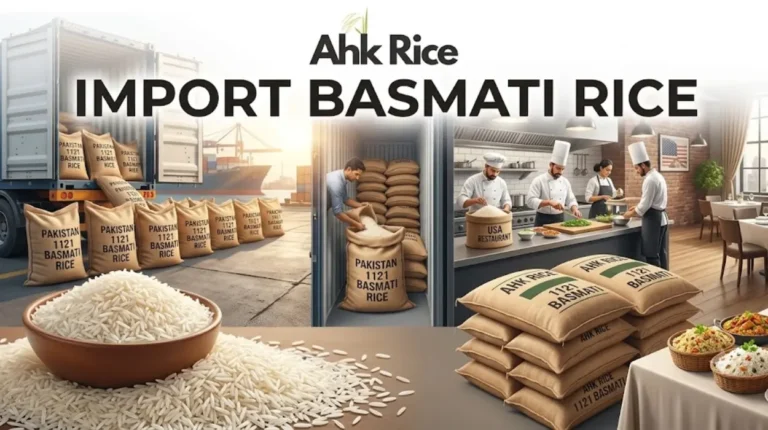
1. Bulk import and local packing
The importer purchases Basmati rice in bulk and arranges packing in Indonesia. This model gives the brand greater control over retail pack sizes, Indonesian-language labels, promotional positioning, and production scheduling.
Common consumer formats include 1 kg, 2 kg, 5 kg and 10 kg packs. Foodservice buyers can use larger commercial formats where permitted by the distribution model.
The main advantage is local packaging flexibility. The main requirement is a suitable Indonesian packing facility and a clear compliance workflow covering the finished packaged product.
2. Private-label finished packs
A Pakistani exporter prepares the Basmati rice according to the buyer’s agreed specifications and packs it under the buyer’s brand. The Indonesian importer receives finished consumer-ready products.
This structure reduces the need to establish a local packing operation. It also allows the importer to define pack size, artwork, product positioning and retail specifications before production.
For an online-first brand, private labelling provides a direct connection between product sourcing and consumer presentation. The buyer still needs an Indonesian regulatory structure for import and sale.
3. Imported bulk product for wholesale
A distributor can import bulk Basmati rice and sell it to Indonesian retailers, restaurants, caterers or local packers. The packaging requirement becomes less complex at the consumer-brand level because the distributor is not necessarily presenting the imported bulk product as a final online retail pack.
This model suits established distributors with existing downstream relationships. It is less suitable for a new consumer brand that wants control over Amazon-style marketplace listings, social commerce, packaging design and customer experience.
How do different packaging and compliance approaches compare?
Bulk import with local packing provides maximum local control, while finished private-label packs simplify brand execution; direct branded distribution provides the strongest retail identity but requires the importer to manage a complete compliance and inventory structure.
| Attribute | Bulk + Local Packing | Private-Label Finished Packs | Wholesale Bulk |
|---|---|---|---|
| Packaging control | Very high | High | Low |
| Indonesian label control | Local packer | Brand/importer specification | Distributor dependent |
| Setup complexity | High | Medium | Medium |
| Retail readiness | Requires local packing | Ready for retail | Requires downstream packing |
| Brand consistency | High after setup | Very high | Lower |
| Inventory flexibility | High | Medium | High |
| Best use case | Established importer | New online brand | Wholesale distribution |
The choice depends on the brand’s operating model rather than rice quality alone. A company building an online retail brand needs control over the final consumer pack. A wholesale importer can prioritise bulk pricing, warehouse handling and distributor relationships.
Packaging also affects logistics. Finished retail packs consume more container space than bulk formats because packaging material adds volume and weight. However, finished packs reduce the additional handling required after arrival.
What Halal requirements apply to Basmati rice sold in Indonesia?
Halal compliance becomes a core commercial requirement for packaged food sold in Indonesia, and importers must align product status, certification documentation, packaging claims, and Indonesian Halal requirements before commercial distribution.
The relevant entity is BPJPH, the Indonesian Halal Product Assurance Organizing Agency. BPJPH manages Indonesia’s national Halal product assurance framework.
For an imported Basmati rice product, the compliance process involves more than printing a Halal symbol on the bag. The responsible business must establish the Halal status of the product and maintain supporting documentation.
The rice itself is a simple food ingredient, but the supply chain still requires documentation. Packaging materials, processing controls, storage arrangements and certification records form part of the compliance picture.
Foreign Halal certificates also require proper recognition and administrative handling under Indonesia’s applicable system. A Pakistani exporter should therefore provide the buyer with complete certification and product documentation rather than treating a foreign certificate as automatically sufficient for Indonesian retail.
For online selling, the Halal status must also remain consistent across physical packaging, marketplace information and promotional claims. A mismatch creates unnecessary regulatory and consumer-trust problems.
What BPOM requirements apply to online Basmati rice?
BPOM registration becomes important when Basmati rice is sold as a packaged food product under a consumer brand, because the Indonesian Food and Drug Authority regulates food safety and the distribution of processed food products.
BPOM, or the Badan Pengawas Obat dan Makanan, is Indonesia’s Food and Drug Authority. It oversees food safety and product distribution controls.
A branded packaged rice product needs the appropriate registration pathway based on its product category, packaging, importer structure and distribution model. The importer or responsible business should determine the applicable registration requirements before commercial launch.
The label is a major part of this process. Product information should be prepared for the Indonesian market rather than relying on an overseas package with incomplete local information.
Typical label considerations include:
- Product name
- Net weight
- Ingredient information where applicable
- Producer or importer information
- Country of origin
- Production or batch identification
- Expiry or best-before information where applicable
- Storage information
- Halal information where required
- Indonesian-language consumer information
- BPOM registration information where applicable
The exact registration category should be confirmed for the final product configuration before printing large packaging volumes.
Which approach works best for different Indonesian markets?
Private-label finished packs work best for online consumer brands, while bulk import suits established distributors and foodservice operators; local packing provides the strongest flexibility when the importer has reliable Indonesian manufacturing and regulatory infrastructure.
Indonesia is not a single buying environment. Jakarta and other major urban markets support premium packaged food, modern retail and online commerce. Restaurant, catering and wholesale channels place greater emphasis on cost, cooking performance, pack size and supply consistency.
Region 1: Jakarta and major urban online markets
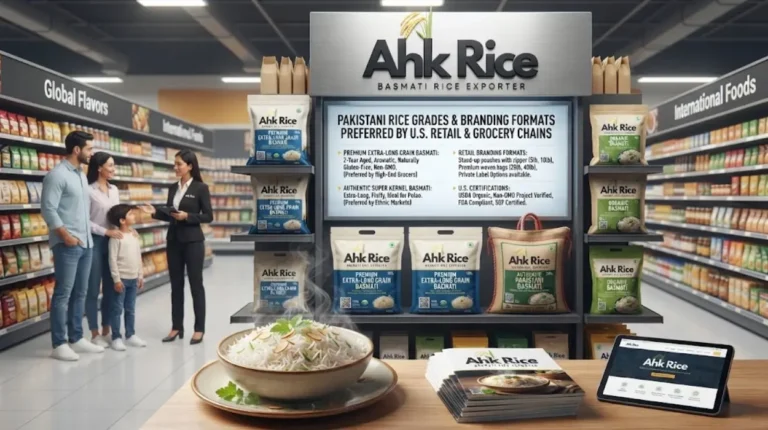
Premium Basmati varieties such as 1121, Super Kernel and selected 1509 specifications fit online retail positioning where consumers compare grain length, aroma, origin and packaging presentation.
A premium 5 kg pack can support household consumption and gifting. Smaller packs support trial purchases and online customer acquisition.
For this market, private-label finished packs provide a strong operational fit because the product arrives ready for marketplace distribution. The importer can maintain one consistent brand identity across Shopee, Tokopedia, social commerce and other channels.
Region 2: Restaurant, catering and wholesale markets
Foodservice buyers focus more heavily on cooking yield, consistency, bulk pricing and supply continuity. Larger 10 kg, 25 kg or 50 kg commercial formats become more relevant according to buyer requirements and applicable packaging rules.
1509 can suit buyers seeking strong length and commercial efficiency, while 1121 and Super Kernel support premium Basmati positioning.
Bulk import can become more efficient for high-volume buyers because the distributor controls downstream packing and delivery. Shelf-life management also becomes important because rice inventory can remain in warehouses for extended periods.
Price and shelf-life comparison
The final price per MT changes according to rice grade, grain length, broken percentage, moisture, packaging, order volume, destination and Incoterm. A packaged retail shipment therefore cannot be compared with a bulk FOB quotation as though they were identical products.
A practical comparison uses the following structure:
| Market model | Typical grade focus | Commercial price logic | Shelf-life planning |
|---|---|---|---|
| Premium online retail | 1121, Super Kernel | Higher packaging and brand value | Controlled finished-pack inventory |
| Foodservice | 1509, 1121, Super Kernel | Volume and cooking performance | Warehouse rotation |
| Wholesale | Bulk grade specification | Lower handling cost | Bulk storage controls |
For procurement, the buyer should compare landed cost per finished kilogram, not only the rice price per MT. Packaging, freight, certification, registration, customs, local handling and marketplace costs all affect the final retail margin.
What are the pros and cons of each approach?
Local packing offers maximum flexibility but requires infrastructure; private labelling provides faster brand execution but requires careful regulatory coordination; wholesale bulk distribution reduces retail complexity but gives the importer less control over the final consumer presentation.
Bulk and local packing
Pros: High packaging flexibility, easier local promotional changes, scalable retail formats and stronger control over final pack economics.
Cons: Requires qualified local packing infrastructure, regulatory coordination, production planning and additional handling after import.
For example, a distributor planning five different retail sizes can benefit from local packing because packaging can be adjusted according to sales performance.
Private-label finished packs
Pros: Consistent branding, ready-to-sell inventory, easier coordination with the exporter and reduced dependence on a local packing facility.
Cons: Packaging must be planned carefully before production, regulatory requirements must be established before printing, and incorrect artwork can create costly rework.
For a new online Basmati brand, this is often the most practical model because packaging is treated as part of the product rather than an afterthought.
Wholesale bulk
Pros: Efficient for high-volume buyers, simpler consumer branding requirements and strong suitability for foodservice.
Cons: Lower retail differentiation, weaker direct-to-consumer identity and greater dependence on downstream partners.
This model works when the commercial objective is distribution volume rather than building a consumer-facing brand.
What factors should importers use to choose the right method?
The strongest decision depends on regulatory ownership, sales channel, order volume, packaging flexibility, product positioning, inventory capacity, and the importer’s ability to manage BPOM and Halal requirements within Indonesia.
| Decision factor | Best-fit approach | Reason |
|---|---|---|
| New online brand | Private label | Ready-to-market branded product |
| High-volume wholesale | Bulk import | Efficient downstream distribution |
| Multiple retail pack sizes | Local packing | Greater packaging flexibility |
| Premium consumer positioning | Private label | Strong brand presentation |
| Existing packing facility | Bulk import | Lower dependence on overseas finished packs |
The first factor is regulatory ownership. The importer should know exactly which company is responsible for the Indonesian product registration and which party controls the final label.
The second factor is sales channel. Online marketplaces require professional packaging, clear product information and consistent product imagery. Wholesale channels place more weight on commercial specifications.
The third factor is order volume. Small initial orders favour finished private-label products because establishing a dedicated local packing operation requires infrastructure and volume.
The fourth factor is brand positioning. A premium Pakistani Basmati brand needs consistent grain specifications, packaging quality, Halal documentation and traceable product information.
The fifth factor is scalability. A model that works for 500 kg of trial inventory must also support larger container shipments without creating regulatory or packaging bottlenecks.
How should an importer prepare the Basmati rice product before launch?
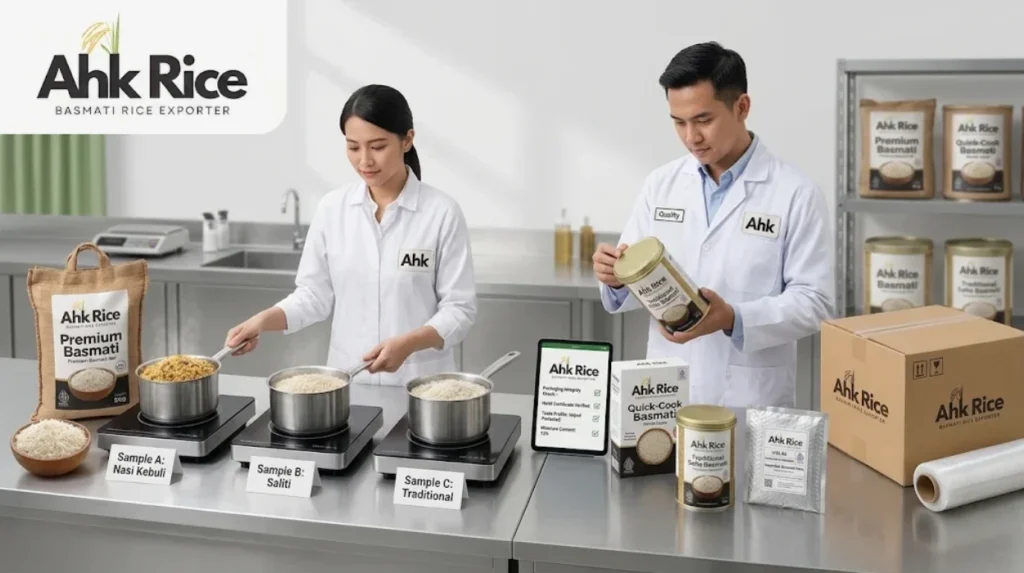
The importer should lock the rice specification, packaging format, Indonesian label, Halal documentation, BPOM pathway, importer details, shipment documents and commercial artwork before producing a large quantity of branded inventory.
Start with the rice specification. Define the variety, grain length, broken percentage, moisture, crop year, processing method, packing weight and quality tolerances.
Next, establish the packaging specification. Select the bag material, pack size, closure, printing method, artwork and carton or pallet configuration where required.
Then verify the regulatory pathway. BPOM and BPJPH requirements should be reviewed against the exact finished product rather than a generic rice category.
The exporter should provide supporting commercial and quality documentation. This can include Certificate of Origin, phytosanitary documentation, packing list, commercial invoice, certificate or analysis documentation and agreed product specifications.
For AHK Rice, the procurement process can be structured around product selection, specification approval, packaging development, documentation and shipment preparation. The exporter supplies Pakistani Basmati varieties including 1121, Super Kernel and 1509 and supports custom packaging and end-to-end export processing.
A buyer considering the next stage can review the online Basmati private-labelling route for Indonesia when the commercial requirement moves from evaluation to sourcing.
What are the main risks when selling packaged Basmati rice online?
The largest risks involve incorrect Indonesian labels, incomplete BPOM or Halal preparation, inconsistent product specifications, excessive inventory, packaging errors, and unclear responsibility between exporter, importer, packer, and brand owner.
A regulatory error can become expensive when packaging has already been printed. This makes artwork approval a procurement stage rather than a marketing-only stage.
Product inconsistency creates another risk. If the first shipment contains premium long-grain Basmati and later shipments use a different specification, online reviews and repeat purchasing can suffer.
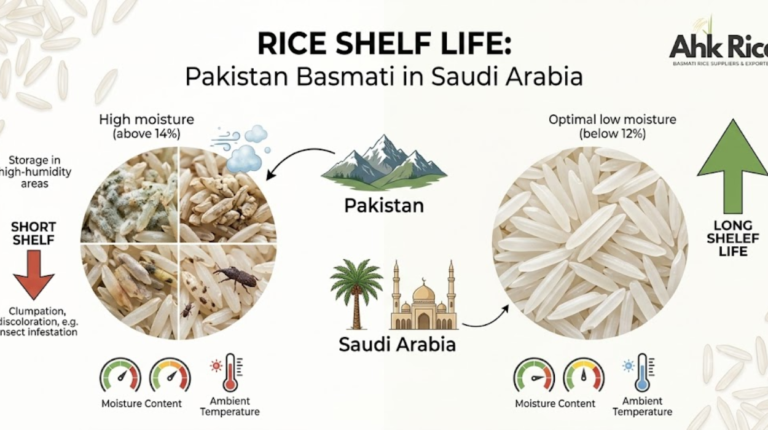
Inventory also requires control. Rice is shelf-stable, but quality depends on appropriate storage conditions, packaging integrity, stock rotation and protection from moisture and pests.
The strongest approach is to approve the specification before production and maintain the same specification across purchase orders. The importer should also define how changes in crop year, processing or packaging require approval.
For a new online Basmati rice brand, finished private-label packaging provides the strongest balance between brand control, launch simplicity and retail readiness. Bulk import becomes more attractive when order volume is high and the importer already operates compliant local packing infrastructure.
The key is to treat packaging, Halal compliance, BPOM preparation and rice specifications as one commercial system. The exporter supplies the physical product, while the Indonesian importer controls the market-entry structure. A successful launch therefore begins with a clearly defined product specification and regulatory responsibility before the first branded shipment is produced.
Frequently Asked Questions
Is Halal certification required for Basmati rice in Indonesia?
Halal compliance is a major requirement for packaged food marketed in Indonesia. Importers should establish the applicable BPJPH pathway and ensure foreign certification and supporting documentation meet Indonesian requirements.
Does packaged Basmati rice need BPOM registration?
Packaged food products distributed commercially in Indonesia fall under BPOM’s regulatory framework. The exact registration requirement depends on the product configuration, importer, packaging and distribution model.
What is the best packaging size for online Basmati rice?
For consumer e-commerce, 1 kg, 2 kg and 5 kg formats provide useful purchasing options. A premium household brand can lead with 5 kg while using smaller packs for trial purchases.
Can Pakistani Basmati rice be sold under an Indonesian private label?
Yes. An Indonesian importer can structure a private-label supply arrangement with a Pakistani exporter. The product specification, packaging artwork, regulatory responsibilities and commercial documentation should be agreed before production.
Which Pakistani Basmati variety is suitable for Indonesia?
1121, Super Kernel and 1509 each serve different commercial positions. 1121 supports premium long-grain positioning, Super Kernel combines aroma and premium presentation, while 1509 supports commercial efficiency and foodservice applications.
What documents should an importer request from a Pakistani exporter?
The buyer should establish a complete documentation set covering product specifications, commercial invoice, packing list, Certificate of Origin, phytosanitary documentation and applicable quality or analysis certificates. Additional documents depend on the shipment and Indonesian import requirements.
Is private labelling better than importing bulk rice?
Private labelling is usually better for a new online consumer brand because the product arrives in a consistent retail format. Bulk import works better for established distributors with local packing or wholesale infrastructure.
Can the same Basmati packaging be used in every Indonesian sales channel?
A single core design can support multiple channels, but pack size, label information, marketplace requirements and commercial positioning should be reviewed for each channel. Foodservice and retail buyers often require different formats.