Pakistan Rice Exports Rise Amid Growing Global Demand
What Is Pakistani Basmati Rice?
Pakistani Basmati Rice is a premium long-grain aromatic cereal crop grown exclusively in the fertile Indus River plains. The grain expands to twice its original length during cooking, delivering a distinct nutty fragrance and non-sticky texture preferred globally by consumers.
Pakistani Basmati rice is an agricultural product characterized by its long, slender grains and chemical composition. The distinct fragrance of this rice stems from a naturally occurring chemical compound named 2-acetyl-1-pyrroline. This compound is present in higher concentrations within grains grown under the specific climate parameters of the Indus basin than in alternative global farming zones. International trade standard regulations define Basmati rice based on genetic purity traits, average uncooked grain length, and elongation ratios after boiling.
Global demand for this premium cereal variety shows measurable growth due to evolving consumer nutritional trends. According to recent market trade data, Pakistan shipped over 5.5 million metric tons of rice to international hubs during the last fiscal cycle, generating substantial export values. Consumers select this grain over short-grain options due to its low glycemic index rating. This structural property prevents rapid spikes in blood glucose levels among individuals.
Where Is Premium Rice Grown in Pakistan?

Premium rice varieties grow in the fertile agricultural lands of the Punjab province fed by the historic Indus River basin. Specific districts including Gujranwala, Sialkot, and Sheikhupura provide the optimal clay-loam soils and climate conditions required for this unique cultivation.
The geographic cultivation zone of premium Pakistani rice concentrates primarily within the Kallar tract. This localized zone sits between the Ravi River and Chenab River inside the northeastern sector of Punjab. The unique geological footprint of this region consists of mineral-rich alluvial soil deposited over thousands of years by Himalayan river streams. The specific soil composition retains moisture efficiently without waterlogging the roots of the growing crop.
Climate parameters within Punjab match the physiological lifecycle of aromatic rice plants perfectly. Summer temperatures ranging from 35 degrees Celsius to 45 degrees Celsius accelerate vegetative growth phases. Evolving weather patterns during the autumn harvest season bring cooler nighttime temperatures down to 20 degrees Celsius. This precise temperature drop triggers the synthesis of aromatic compounds inside the developing kernels. Agricultural infrastructure across these districts utilizes a comprehensive canal system that delivers fresh mountain meltwater directly to the paddy fields.
How Does the Rice Processing Cycle Work?
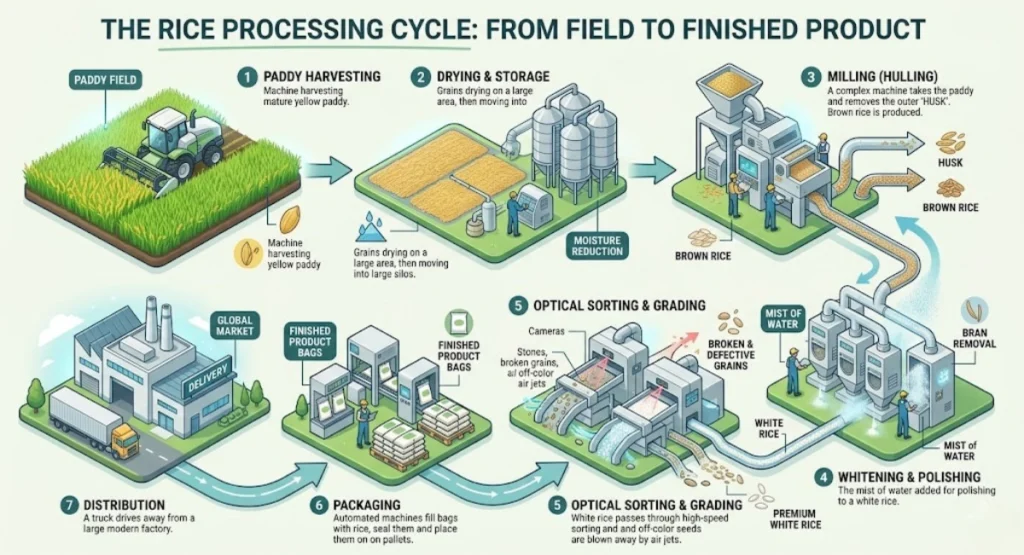
The rice processing cycle transforms raw paddy into export-ready grains through six specific mechanical steps including cleaning, de-husking, milling, polishing, sorting, and packaging. Advanced processing mills eliminate impurities and ensure uniform moisture levels across all batches before final overseas shipment.
1. Pre-Cleaning and Paddy Drying
The processing sequence begins immediately upon arrival of the harvested crop at processing facilities (such as modern milling complexes). Raw paddy carries a baseline moisture content of approximately 20 percent to 25 percent. Industrial mechanical dryers reduce this moisture percentage down to a stable baseline of 12 percent to 14 percent within a 24-hour window. This precise reduction prevents microbial infestation and prepares the grain husks for mechanical hulling. Pre-cleaning machines use vibrating sieves and air aspirators to extract foreign materials including straw, soil particles, stones, and weed seeds.
2. De-Husking and Hulling
The dried paddy passes directly into rubber-roller hulling machinery. These machines apply shear force to strip the outer protective husk from the paddy kernel. This mechanical separation yields brown rice grains and detached husks. Aspiration systems extract the lightweight husks from the processing stream for use as industrial fuel or insulation materials. The remaining brown rice passes through a paddy separator machine to segregate un-hulled paddy grains from brown grains. This machine recycles the un-hulled grains back into the huller for secondary processing.
3. Milling and Polishing
Brown rice moves into horizontal milling chambers to undergo the pearling process. Friction rollers remove the nutrient-rich outer bran layers from the grain kernel. This step transforms the brown grain into polished white rice. Automated water-polishing machinery injects a mist of purified water during the final friction cycle. This specific action removes residual bran dust and gives the rice grain a translucent, glossy appearance. Technicians monitor temperature levels inside the milling chambers closely because excessive heat accumulation causes grain fractures.
4. Color Sorting and Packaging
The polished white rice flows into optical color sorting machines at high velocities. High-resolution digital cameras inspect every single grain as it passes through a sensor field. Compressed air nozzles blast discolored grains, chalky kernels, and yellow defects out of the mainstream channel. The sorted rice passes to mechanical sieves that separate broken grains from full-length premium grains based on dimensional length metrics. Automated packaging systems scale the final product into predefined weights including 5-kilogram, 10-kilogram, and 25-kilogram woven polypropylene or cotton bags for export containers.
What Are the Key Components and Varieties of Exported Rice?
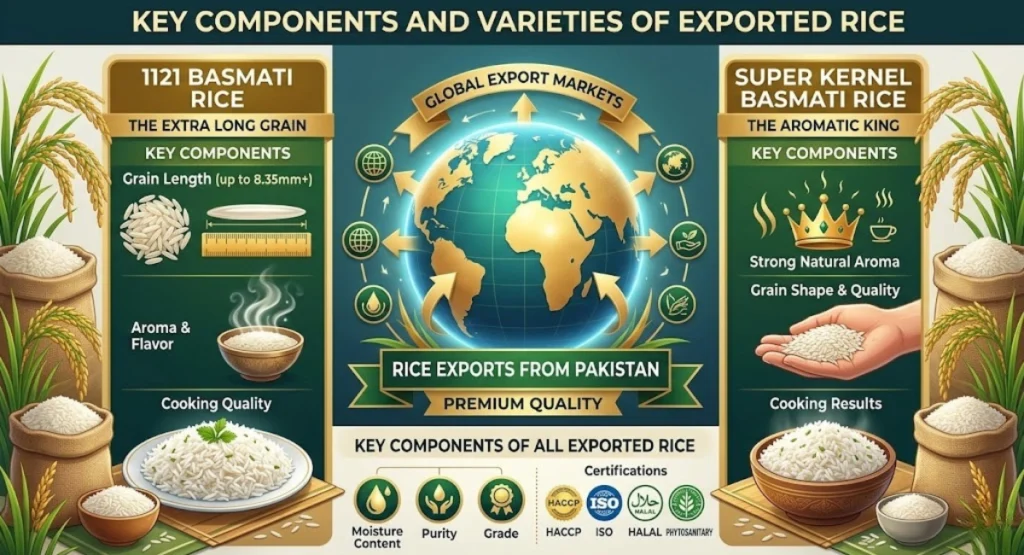
The key components of this export sector comprise specific long-grain varieties including 1121 Basmati, Super Kernel Basmati, and 1509 Basmati rice. Each variety maintains unique technical grain dimensions, distinct cooking elongation ratios, and varying aging requirements for discerning global buyers.
1121 Basmati Rice
The 1121 Basmati variety represents a dominant component of the premium rice market. This grain features an average uncooked grain length ranging from 8.35 millimeters to 8.40 millimeters. This dimension makes it one of the longest rice varieties in the international marketplace. During the cooking process, the grain achieves an elongation ratio of 2.2 times its original size. The physical grain structure exhibits exceptional tensile strength. This structural strength prevents breaking or clumping when chefs handle large volumes in commercial kitchens.
Super Kernel Basmati Rice
Super Kernel Basmati rice is a traditional variety recognized for its strong aroma profiles. The uncooked grain length averages 7.20 millimeters to 7.40 millimeters. This variety requires an extended natural aging period of 12 months to 24 months inside temperature-controlled warehouses. The natural aging process breaks down moisture molecules and concentrates organic compounds inside the endosperm. This step results in a fluffy texture when cooked, with individual grains separating from each other effortlessly.
1509 Basmati Rice
The 1509 Basmati variety is a newer early-maturing crop introduced to optimize agricultural water usage. It features an uncooked length of 8.20 millimeters. The crop reaches full maturity within a 120-day cycle, which is shorter than the 150-day cycle required by Super Kernel. This attribute allows farmers to plant secondary crops in the same field during a single calendar year. The grain delivers a competitive price point for price-sensitive international markets while maintaining premium long-grain attributes.
What Are the Global Benefits of Importing Pakistani Rice?
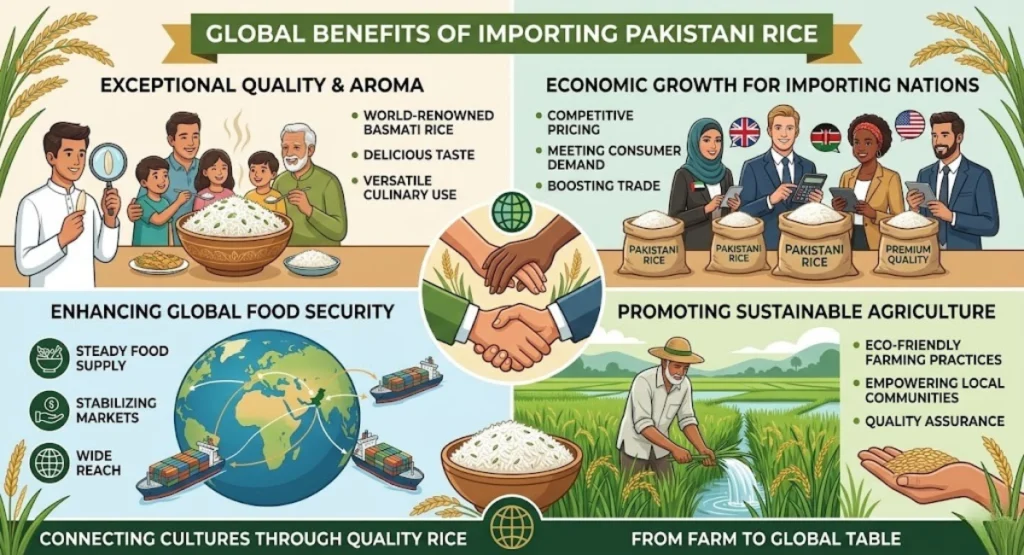
Importing Pakistani rice provides specific macro-economic benefits including high volumetric yield upon cooking, excellent shelf-life stability exceeding twenty-four months, and competitive pricing metrics. These structural advantages allow international distribution networks to optimize profit margins while ensuring high end-user consumer satisfaction.
International supply chain networks benefit directly from the physical expansion properties of Pakistani Basmati rice. One single kilogram of raw 1121 Basmati grain yields approximately 2.5 kilograms to 3.0 kilograms of cooked food product. This volumetric yield lowers the overall food cost per serving for institutional buyers including hotel chains, hospital kitchens, and cruise ship catering departments. The low moisture content of 12 percent prevents the growth of molds and aflatoxins during oceanic transit cycles inside shipping containers.
Price stability represents another structural benefit for international importers. Pakistan maintains competitive energy and labor costs within its processing zones, allowing exporters to offer favorable FOB prices. Trade data from global agricultural agencies shows that Pakistani Basmati pricing remains highly competitive compared to alternative regional options. This pricing flexibility enables retail distributors to establish strong retail markup percentages while offering affordable retail shelf prices to local consumers.
What Are the Primary Culinary Use Cases for Basmati Varieties?
The primary culinary use cases span commercial food service sectors including luxury restaurants, high-volume catering companies, and retail consumer markets. Institutional buyers utilize these grains for traditional recipes requiring structural integrity including Biryani, Pilau, and diverse Middle Eastern rice dishes.
Commercial Food Service Sectors
High-volume catering establishments rely on the structural resilience of 1121 Basmati rice during long steam-table holding periods. The grains do not burst open or exude excess starches under sustained heat application. This property keeps the food visually appealing for hours during buffet services. Chefs use this grain for complex layered dishes like Biryani, where the rice must absorb spices, fats, and meat juices without dissolving into a mushy consistency.
Retail Consumer Markets
In residential kitchens, households select Super Kernel Basmati rice for daily meal preparation due to its rapid cooking time and aromatic output. The grain requires 15 minutes to 20 minutes of boiling or steaming after an initial soaking period. The distinct aroma fills the cooking environment, which consumers associate with premium food quality. The non-sticky nature of the grain makes it suitable for individual pilaf preparations, stir-fries, and cold rice salads.
What Common Problems and Misconceptions Affect the Market?
Common market misconceptions include the false belief that all long-grain rice possesses aromatic properties and that freshly harvested paddy yields optimal cooking results. Industry data proves that unaged rice suffers from high breakage rates and sticky textures during food preparation.
A significant problem in the global supply chain is the confusion between generic long-grain white rice and authentic Basmati rice. Generic long-grain varieties lack the gene responsible for synthesizing the 2-acetyl-1-pyrroline aroma compound. They possess a higher amylopectin starch content, which causes individual grains to stick together during boiling. Importers must request laboratory grain elongation testing certificates to verify authentic genetic profiles before finalizing purchase contracts.
Another common misconception centers on the age of the crop. Consumers frequently assume that fresh harvest rice represents the highest quality tier. The opposite rule applies to Basmati rice. Freshly harvested rice contains unstable moisture pockets and active enzyme structures that break down grain walls during cooking. This process causes the grains to fracture and turn sticky. Premium exporters age their stock for a minimum of 365 days to stabilize these internal starches, ensuring uniform elongation and maximum grain separation.
Which International Markets Import Pakistani Rice and Which Certifications Apply?
International markets importing these shipments include fifteen global destinations spanning the United Arab Emirates, Saudi Arabia, and the European Union. Mandatory trade certifications ensuring market access encompass ISO 22000 food safety standards, HACCP risk assessments, and Halal operational compliance protocols.
Major Importing Jurisdictions
The Gulf Cooperation Council region constitutes a primary market destination for premium Pakistani rice shipments. The United Arab Emirates and Saudi Arabia import substantial volumes annually to meet the consumption demands of their local populations and hospitality networks. The European Union market imports high volumes of brown and white Basmati rice under specific import tariff quotas. European buyers enforce strict Maximum Residue Limits on chemical pesticides, requiring exporters to implement rigorous testing protocols during the farming phase.
Statutory Trade Certifications
International trade frameworks require specific quality certifications to clear customs barriers effectively. The table below outlines the core regulatory certifications governing Pakistani rice exports:
| Certification | Regulatory Focus | Target Market Benefit |
| ISO 22000 | Food Safety Management Systems | Validates processing plant hygiene standards globally |
| HACCP | Hazard Analysis Critical Control Point | Identifies and eliminates physical and chemical risks |
| Halal Compliance | Islamic Dietary Law Requirements | Guarantees permissible processing methods for Muslim nations |
| Phytosanitary Certificate | Plant Health and Quarantine Standards | Confirms freedom from active pests and fungal pathogens |
Exporters secure these credentials through annual third-party audits conducted by international verification bodies. These certificates accompany bill of lading documents, commercial invoices, and packing lists inside every export shipment to prevent customs delays at global discharge ports.