Pakistan UK Basmati Rice Trade Value and Market Size in 2026
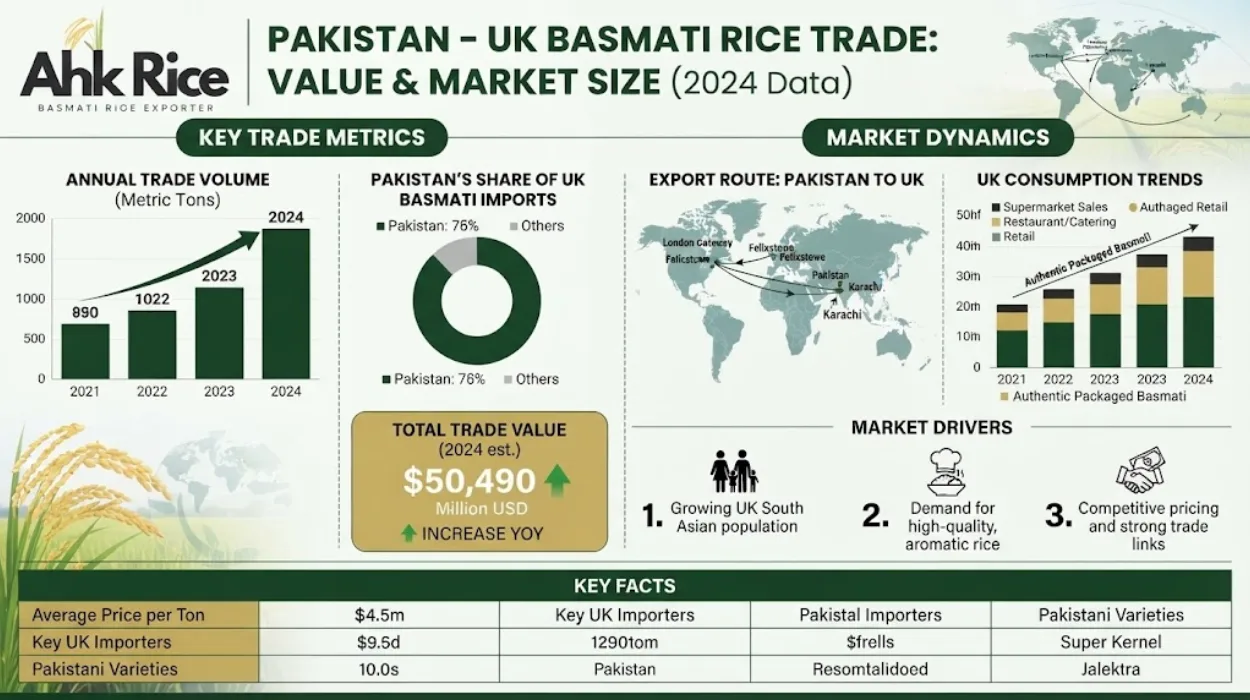
Pakistan’s UK rice trade is a premium Basmati market where 1121, Super Kernel, and selected parboiled grades serve different retail and wholesale requirements, with 2025 bilateral rice trade worth about US$67.5–78.5 million and 2026 FOB Basmati benchmarks around US$1,135–1,205 per MT. The difference between the two trade values reflects the reporting perspective: Pakistan’s exports to the UK were reported at US$67.48 million, while UK import records reported US$78.5 million for 2025.
For buyers entering the market, trade value alone does not explain procurement demand. 1121 Basmati is an extra-long premium variety, Super Kernel is a traditional aromatic Pakistani Basmati, and 1509 is an efficient long-grain option positioned around yield and procurement economics. Buyers comparing these grades should first understand how UK rice importers and Asian grocery chains source Pakistani rice rather than comparing price per tonne without specification context.
The UK market also has a strong Pakistani and wider South Asian consumer base. Census 2021 data shows that Pakistani residents were particularly concentrated in the West Midlands, Yorkshire and the Humber, North West, and London. These concentrations support distinct wholesale and retail distribution clusters, although official statistics do not publish Basmati-grade market share by UK region.
What is the Pakistan-UK Basmati rice trade market in 2026?
The Pakistan-UK Basmati market is a specification-driven import channel connecting Punjab-origin rice with British wholesalers, ethnic grocery chains, private-label retailers, restaurants, caterers, and foodservice distributors that require consistent quality and documented compliance.
Pakistan’s rice exports to the United Kingdom reached US$67.48 million in 2025 according to UN Comtrade data reported by Trading Economics. UK-side import statistics put the corresponding value at US$78.5 million. These figures should not be treated as contradictory market failures because exporter and importer records can differ through valuation, timing, freight treatment, and statistical coverage.
The 2025 value provides the most recent complete bilateral benchmark for a 2026 market-size discussion. It is more reliable than presenting partial 2026 shipments as a full-year market size.
Pakistan’s wider Basmati export position also remained active during 2026. In July 2026, Pakistan exported 67,857 tonnes of Basmati rice worth US$76.48 million, compared with 52,694 tonnes worth US$55.68 million in July 2025. The increase demonstrates stronger overall Basmati export value, although it does not represent UK-specific trade.
What are the available Pakistani Basmati solutions for UK buyers?
UK buyers can structure procurement around 1121 White, 1121 Steam or Sella, Super Kernel, and 1509, with the appropriate grade selected according to retail positioning, aroma expectations, cooking performance, storage cycle, and target procurement cost.
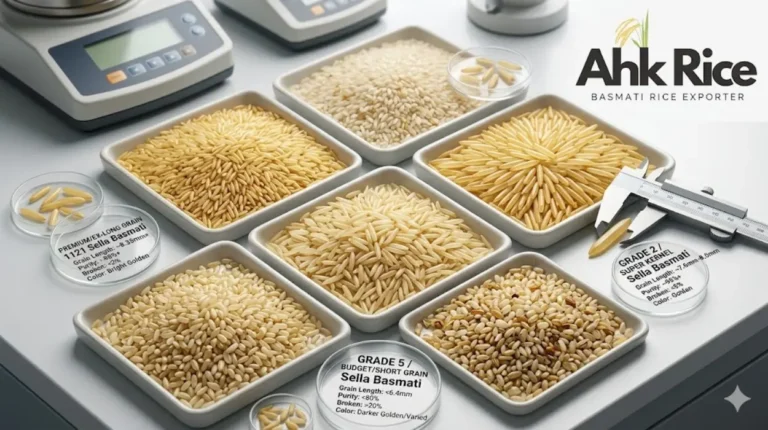
1121 Basmati provides the longest visual grain profile among the main Pakistani Basmati options. Current 2026 indicative FOB references place 1121 grades between about US$1,135 and US$1,205 per MT depending on processing. White, Steam, Golden Sella, and Sella versions serve different retail and foodservice applications.
Super Kernel Basmati represents the traditional aromatic segment. Its grain is shorter than 1121, but its strong aroma and familiar Pakistani Basmati character make it relevant for ethnic retail and traditional foodservice. Current indicative FOB references place premium Super Kernel around US$1,165–1,205 per MT.
1509 Basmati occupies a different commercial position. It provides long-grain cooking performance with a shorter cultivation cycle and is commonly considered when buyers need a balance between appearance, yield, and procurement cost. Its final UK price depends on grade, broken percentage, moisture, packing, quantity, freight, and Incoterm.
For UK procurement, the supplier should quote the same specification across competing offers. Comparing a premium 1121 White quote against a lower-specification 1509 quote only by price per tonne produces an inaccurate cost comparison.
How do Pakistani Basmati specifications compare?
The main differences between UK-oriented Pakistani Basmati grades are grain length, processing method, aroma, cooking expansion, broken percentage, moisture control, and storage planning, because these attributes directly affect retail appearance, foodservice performance, and inventory management.
| Attribute | 1121 White | 1121 Steam/Sella | Super Kernel | 1509 |
|---|---|---|---|---|
| Grain length | About 8.3 mm | About 8.3–8.5 mm | About 7.2–7.6 mm | About 8.1–8.4 mm |
| Processing | White milled | Steam or parboiled | White, Steam/Sella by specification | White, Steam/Sella |
| Aroma | Strong Basmati | Strong Basmati | Strong traditional aroma | Distinct Basmati aroma |
| Cooking expansion | About 2.0–2.3× | About 2.0–2.5× | About 1.8–2.0× | About 2.0–2.2× |
| Broken specification | Common premium target 0–2% | Common premium target 0–2% | Common premium target 0–3% | Common premium target 1–3% |
| Moisture | Controlled, commonly ≤12–13% | Controlled, commonly ≤12–13% | Controlled, commonly ≤12–13% | Controlled, commonly ≤12–13% |
| Shelf-life planning | About 12–18 months | About 18–24 months for Sella | About 12–18 months | About 12–18 months |
The figures represent commercial specification ranges rather than universal legal definitions. Final contract specifications should be written into the purchase agreement and verified through the approved pre-shipment sample and certificate of analysis.
Parboiled Sella processing generally provides stronger grain structure and longer storage planning than standard white rice. A commercial Sella specification can support up to about 24 months under controlled storage, while actual shelf life remains dependent on moisture, packaging, temperature, humidity, pest control, and the producer’s declared specification.
How do London and South East markets compare with Midlands and Northern markets?
London and the South East support premium retail and foodservice demand, while the Midlands and northern distribution clusters provide strong opportunities for traditional Basmati, ethnic wholesale, and value-conscious bulk procurement across established Pakistani and South Asian communities.
London is a major concentration point for Asian consumers, while the Pakistani population is also heavily represented across the West Midlands, North West, and Yorkshire and the Humber. Census 2021 data attributes 20.1% of England and Wales residents of Pakistani ethnicity to the West Midlands, 19.1% to the North West, 18.7% to Yorkshire and the Humber, and 18.3% to London.
A practical sourcing segmentation therefore looks like this:
| UK market region | Common commercial preference | Indicative FOB benchmark | Shelf-life planning |
|---|---|---|---|
| London & South East | 1121 White, 1121 Steam, premium Super Kernel | US$1,160–1,205/MT | 12–18 months |
| Midlands & North | Super Kernel, 1121 Sella/Steam, selected 1509 | US$1,135–1,205/MT | 12–24 months depending on processing |
The price figures are Pakistan-origin FOB Karachi benchmarks, not regional UK landed prices. Current September 2026 market references place 1121 White at about US$1,165–1,205/MT, 1121 Sella at US$1,135–1,175/MT, 1121 Steam at US$1,160–1,200/MT, and Super Kernel at US$1,165–1,205/MT.
The regional difference therefore comes more from product positioning and distribution strategy than from a separate regional export price. Freight, customs, port handling, packaging, duty treatment, inspection, and inland delivery must be added before comparing UK landed costs.
How do different Pakistani Basmati approaches compare?
A premium 1121 strategy prioritizes visual grain length, branded retail presentation, and premium positioning; Super Kernel emphasizes traditional aroma and recognition; 1509 emphasizes procurement efficiency and cooking performance for buyers managing larger volumes.
A 1121-focused strategy fits supermarkets, premium ethnic retailers, private-label brands, and foodservice buyers where long grain appearance is commercially visible. Its higher specification supports a higher procurement band.
A Super Kernel strategy fits traditional Pakistani and South Asian retail channels where aroma and familiar Basmati character carry significant value. It gives buyers a different proposition from extra-long 1121 without moving outside the premium Basmati category.
A 1509 strategy works where buyers need long-grain performance while controlling procurement economics. It is particularly relevant for high-volume foodservice, catering, restaurants, and distributors that calculate cost against cooked yield.
A mixed-grade strategy uses different SKUs for different customers. One distributor can carry 1121 White for premium retail, Super Kernel for traditional customers, and 1509 for price-sensitive foodservice. This avoids forcing one variety into every channel.
Which method works best for different UK buyer cases?
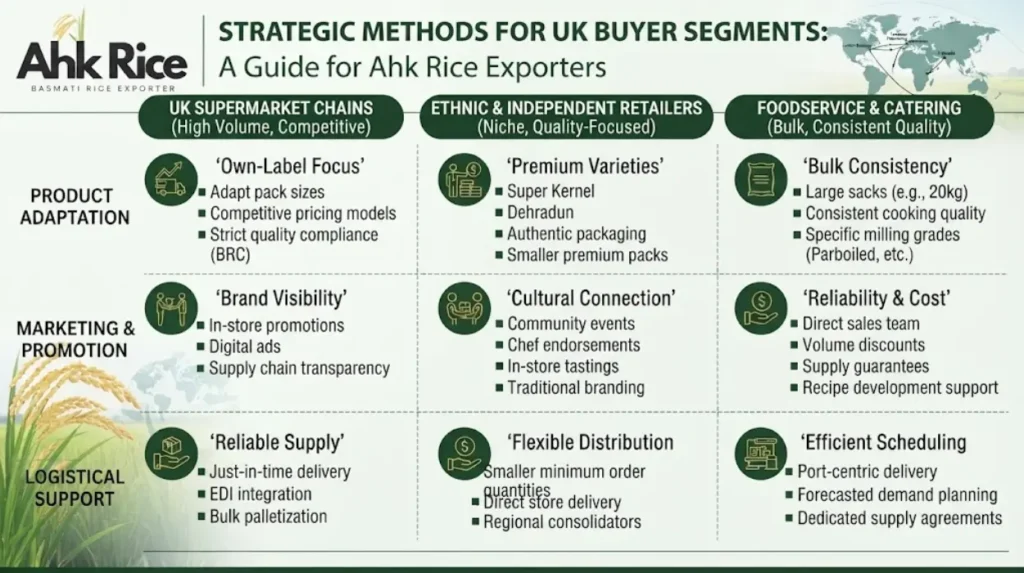
The appropriate method depends on the buyer’s customer segment, required cooking result, inventory cycle, target price, and packaging format, so UK importers should select a grade by commercial use rather than choosing the lowest FOB price available.
For premium supermarket retail, 1121 White or 1121 Steam provides a strong specification because long grain, clean appearance, aroma, and packaging presentation remain visible to consumers.
For traditional Asian grocery distribution, Super Kernel and 1121 provide two distinct commercial positions. Super Kernel supports aroma-led demand, while 1121 supports customers seeking an extra-long grain profile.
For restaurants and catering, 1121 Steam, Sella, and 1509 can be evaluated through cooked yield, grain separation, holding performance, and cost per prepared serving.
For longer warehouse cycles, Sella and Golden Sella provide stronger storage planning because parboiling strengthens the kernel. Commercial references commonly place Sella planning around 18–24 months under controlled conditions.
For private-label brands, specification consistency becomes more important than the variety name alone. The importer should define grain length, broken percentage, moisture, processing type, packaging, country of origin, lot identification, and required laboratory documentation.
What are the pros and cons of each sourcing approach?
1121 offers strong premium positioning but usually carries a higher procurement expectation; Super Kernel provides traditional aroma but shorter grain; 1509 improves cost efficiency but requires careful specification control to maintain the intended retail and cooking position.
| Approach | Advantages | Limitations | Example use |
|---|---|---|---|
| 1121 premium | Extra-long grain, strong visual presentation | Higher procurement band | Supermarket private label |
| 1121 Steam/Sella | Strong cooking performance and storage characteristics | Processing adds specification complexity | Catering and premium wholesale |
| Super Kernel | Traditional aroma and strong ethnic-market recognition | Shorter grain than 1121 | Asian grocery retail |
| 1509 | Cost and yield efficiency | Less premium visual positioning | High-volume foodservice |
| Mixed portfolio | Serves several buyer segments | More SKUs and inventory controls | National distributor |
The principal mistake is treating the variety name as the complete specification. Two shipments labelled as the same variety can differ in broken grains, moisture, milling quality, packaging, grain length, and inspection results.
What decision factors should UK rice importers use?
UK importers should evaluate product specification, market segment, price per MT, shelf-life requirement, and compliance documentation together because a low FOB price has limited value when the shipment fails the buyer’s quality, storage, or regulatory requirements.
| Decision factor | Buyer question | Practical implication |
|---|---|---|
| Product specification | What grain length, broken %, and moisture are required? | Fix the specification before comparing quotes |
| Market segment | Who will buy or consume the rice? | Match 1121, Super Kernel, or 1509 to the channel |
| Price per MT | Is the quote FOB, CFR, or CIF? | Compare equivalent Incoterms |
| Shelf life | How long will inventory remain in storage? | Select processing and packaging accordingly |
| Compliance | Are testing and documents complete? | Verify UK import requirements before shipment |
UK rice imports also operate within formal import-control and quota arrangements. The Rural Payments Agency issued multiple 2026 rice quota notices, including a September 2026 notice covering applications from 1 October to 7 October 2026.
The buyer therefore needs a procurement file that connects product specifications with origin, laboratory results, commercial documentation, packing details, and customs requirements. This approach reduces the risk of comparing technically different products as if they were identical commodities.
How should buyers evaluate a Pakistani Basmati supplier for the UK?
A reliable sourcing process begins with a written specification, sample approval, laboratory verification, packaging confirmation, pre-shipment inspection, export documentation, and shipment planning rather than selecting a supplier from price alone.
AHK Rice operates from Punjab and supplies 1121, Super Kernel, and 1509 Basmati rice to international buyers. Its export model covers processing, grading, packaging, documentation, and shipment coordination. For UK buyers, the relevant service page is the Pakistan Basmati rice export service to the UK.
The evaluation should begin with a sample that represents the proposed commercial grade. Buyers should check raw grain length, cooked appearance, aroma, broken percentage, moisture, foreign matter, colour, and cooking performance.
The same specification should then appear on the commercial quotation. The quotation should identify FOB or CIF/CFR terms, packing size, minimum quantity, destination port, inspection requirements, and documentation.
For larger retail or wholesale programmes, buyers should also compare batch consistency. One strong sample does not establish long-term supply reliability. The production and inspection process must reproduce the approved specification across commercial shipments.
What does the 2026 UK market size mean for Pakistani rice suppliers?
The latest bilateral trade value shows an established Pakistan-UK rice market, while the 2026 opportunity is best understood through grade segmentation, compliant supply, private-label demand, wholesale distribution, and specification-based procurement rather than one headline market-size number.
The 2025 Pakistan-to-UK rice export value of US$67.48 million and UK-reported import value of US$78.5 million establish a meaningful bilateral trade base entering 2026.
The market is not defined by one Basmati grade. Premium retail favours long-grain specifications and consistent presentation. Traditional wholesale channels value aroma and familiar Pakistani varieties. Foodservice buyers focus more heavily on cooked yield, holding performance, volume consistency, and procurement cost.
That creates a multi-grade market in which 1121, Super Kernel, and 1509 have different commercial roles. The supplier that can maintain specification discipline across these grades can serve more than one UK buyer segment without treating every customer requirement as identical.
For 2026 procurement, the central comparison is therefore not simply Pakistan rice price per MT versus another supplier’s price per MT. It is specification versus price, shelf life versus inventory cycle, processing versus cooking performance, and FOB cost versus final landed cost.
Frequently Asked Questions
What is the Pakistan-UK rice trade value in 2026?
The latest complete bilateral data available for the 2026 market benchmark records Pakistan’s 2025 rice exports to the UK at US$67.48 million. UK import data reports US$78.5 million, with differences arising from reporting methodology and valuation.
Which Pakistani Basmati varieties are relevant to UK buyers?
The main commercial options include 1121 Basmati, Super Kernel, and 1509. 1121 targets premium long-grain positioning, Super Kernel focuses on traditional aroma, and 1509 provides an efficient option for volume-oriented procurement.
What is the 2026 price of Pakistani Basmati rice per MT?
Indicative September 2026 FOB Karachi references place 1121 Basmati around US$1,135–1,205 per MT depending on processing, while Super Kernel is around US$1,165–1,205 per MT. Actual quotations depend on specification, quantity, packing, freight, inspection, and Incoterm.
Which grade has the longest shelf life?
Parboiled Sella and Golden Sella generally provide stronger storage planning than standard white or steam grades. Commercial planning commonly uses approximately 18–24 months under suitable storage, but the supplier’s declared shelf life and storage conditions remain controlling factors.
Is 1121 better than Super Kernel for UK retail?
The two varieties serve different commercial requirements. 1121 provides longer grain and stronger premium visual positioning, while Super Kernel provides traditional Pakistani Basmati aroma. The appropriate selection depends on the retailer’s customer segment and product positioning.
Is 1509 suitable for UK wholesale?
1509 is suitable for wholesale applications where buyers prioritize long-grain cooking performance and procurement efficiency. The final specification should define grain length, broken percentage, moisture, processing type, packaging, and cooking performance before purchase.
What should UK importers compare before accepting a rice quote?
Importers should compare the same variety, processing type, grain specification, broken percentage, moisture, packing, quantity, Incoterm, inspection standard, documentation, freight, and destination costs. A lower FOB price does not automatically produce a lower landed cost.