Understanding Freight, Insurance and FOB Pakistan to CIF UAE Pricing for 1509 White Basmati Rice
FOB Pakistan remains the most cost-efficient procurement method for experienced UAE importers, while CIF UAE provides greater budgeting certainty for buyers who prefer simplified logistics. Here is why: FOB gives direct control over freight negotiations and carrier selection, while CIF combines product cost, marine insurance, and shipping into a single landed quotation. .
1509 White Basmati Rice has become one of Pakistan’s fastest-growing export varieties because of its long grain structure, competitive pricing, and strong acceptance across Gulf retail and foodservice sectors. UAE buyers import substantial volumes from Pakistan due to short transit times and established trade routes (source: Pakistan Bureau of Statistics, FY2024-25). Importers evaluating procurement options should first understand how freight, insurance, and commercial responsibilities affect total landed cost. Buyers seeking foundational knowledge about rice export pricing models can also explore our guide on understanding international Basmati rice export pricing structures before comparing FOB and CIF approaches.
What Are FOB Pakistan and CIF UAE Pricing Methods?
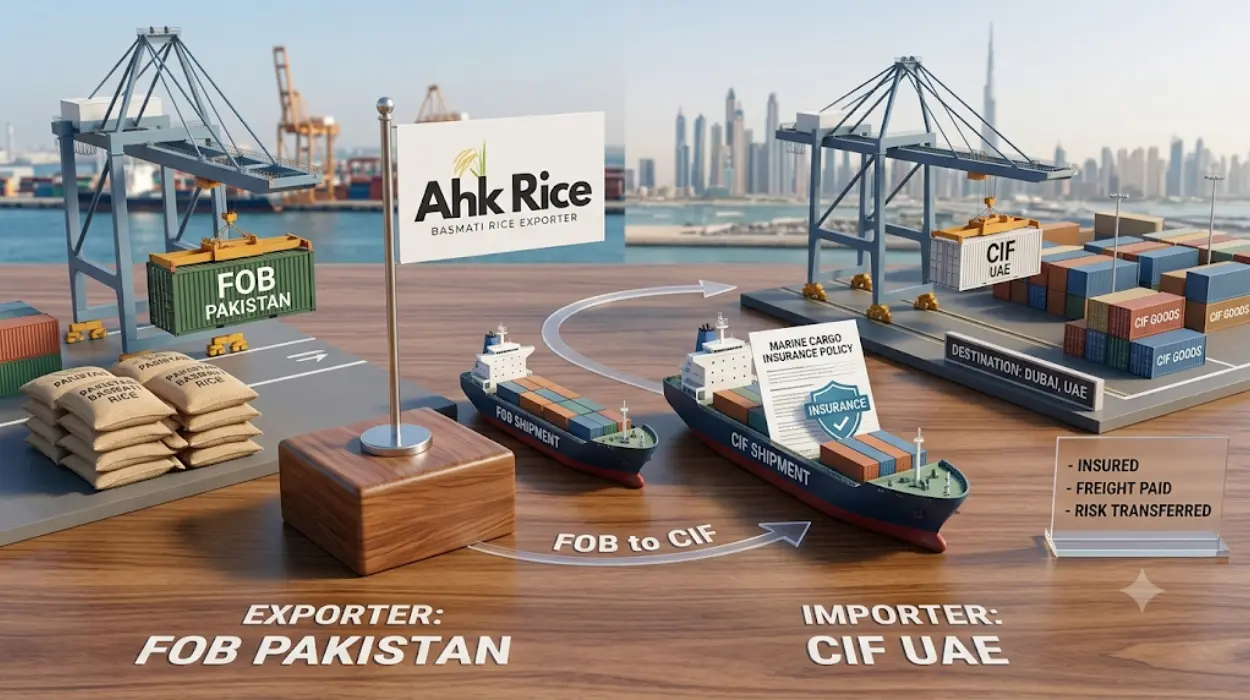
FOB places freight responsibility on the buyer, while CIF includes ocean freight and marine insurance within the supplier quotation, creating a complete delivered-cost structure for UAE importers.
FOB stands for Free on Board. The exporter loads cargo at the designated Pakistani port. Ownership risk transfers after loading. The buyer then arranges freight, insurance, destination clearance, and inland transportation.
CIF stands for Cost, Insurance, and Freight. The exporter arranges shipment and marine insurance up to the UAE destination port. The buyer receives a more predictable landed cost estimate before shipment dispatch.
FOB and CIF Specification Comparison
| Attribute | FOB Pakistan | CIF UAE |
|---|---|---|
| Freight Included | No | Yes |
| Marine Insurance | No | Yes |
| Freight Negotiation Control | Buyer | Seller |
| Price Transparency | High | Medium |
| Logistics Complexity | Higher | Lower |
| Initial Cost Visibility | Medium | High |
| Suitable Buyer Type | Experienced Importers | New Importers |
FOB provides maximum control. UAE importers can negotiate directly with shipping lines. Large distributors often reduce freight costs through volume agreements.
CIF simplifies procurement. Restaurant suppliers and retail importers often prefer a single quotation covering product and transport.
FOB transfers responsibility earlier. CIF transfers greater logistical responsibility to the exporter.
Understanding these structures creates the foundation for comparing actual pricing components.
How Are Freight and Insurance Costs Calculated for 1509 White Basmati Rice?
Freight usually represents 8–18% of landed cost, while marine insurance generally contributes less than 1% of shipment value on Pakistan-UAE trade routes.
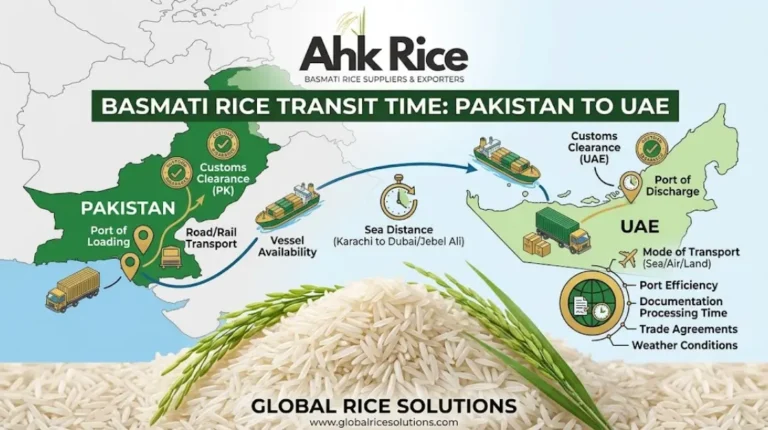
Freight cost depends on vessel availability, fuel prices, container demand, seasonal shipping patterns, and destination port congestion. UAE routes remain among Pakistan’s shortest export corridors.
A typical 20-foot container loads approximately 24–25 MT of 1509 White Basmati Rice. A 40-foot container loads approximately 26–28 MT depending on packaging specifications.
Marine insurance protects cargo against transit risks. Insurance providers calculate premiums using cargo value, route profile, and coverage conditions.
Main Freight Cost Components
| Cost Element | Description |
|---|---|
| Ocean Freight | Port-to-port shipping |
| Terminal Charges | Container handling |
| Documentation | Shipping paperwork |
| Container Fees | Equipment usage |
| Marine Insurance | Transit protection |
| Port Surcharges | Regulatory fees |
Freight rates fluctuate monthly. UAE routes typically remain more stable than African and European routes because of shorter sailing distances.
Insurance protects against container damage, cargo loss, fire incidents, and maritime accidents. Most CIF quotations include standard marine coverage.
With freight components established, the next question is how FOB and CIF prices compare in real procurement scenarios.
How Do FOB Pakistan and CIF UAE Prices Compare?
CIF pricing typically exceeds FOB pricing by the exact cost of freight, insurance, and export logistics services included within the shipment arrangement.
A buyer evaluating quotations should separate product value from logistics costs. This comparison reveals the true procurement difference.
Example Price Comparison Per Metric Ton
| Cost Component | FOB Pakistan | CIF UAE |
|---|---|---|
| Rice Product Cost | $930 | $930 |
| Ocean Freight | Buyer Pays | $55 |
| Marine Insurance | Buyer Pays | $5 |
| Export Logistics | Buyer Pays | Included |
| Estimated Total | $930 | $990 |
Values vary according to market conditions and shipping schedules.
FOB quotations often appear lower because freight remains excluded. CIF quotations appear higher because transportation services are already embedded.
Large UAE importers commonly prefer FOB because freight contracts reduce transportation expenses. Smaller buyers frequently prefer CIF because budgeting becomes easier.
Wholesale distributors importing ten containers monthly usually benefit from FOB purchasing. Restaurant supply businesses importing one container quarterly often prefer CIF simplicity.
Price comparison explains cost differences. Buyer suitability determines which model delivers greater value.
Which Method Works Best for Different UAE Importers?
Large Importers
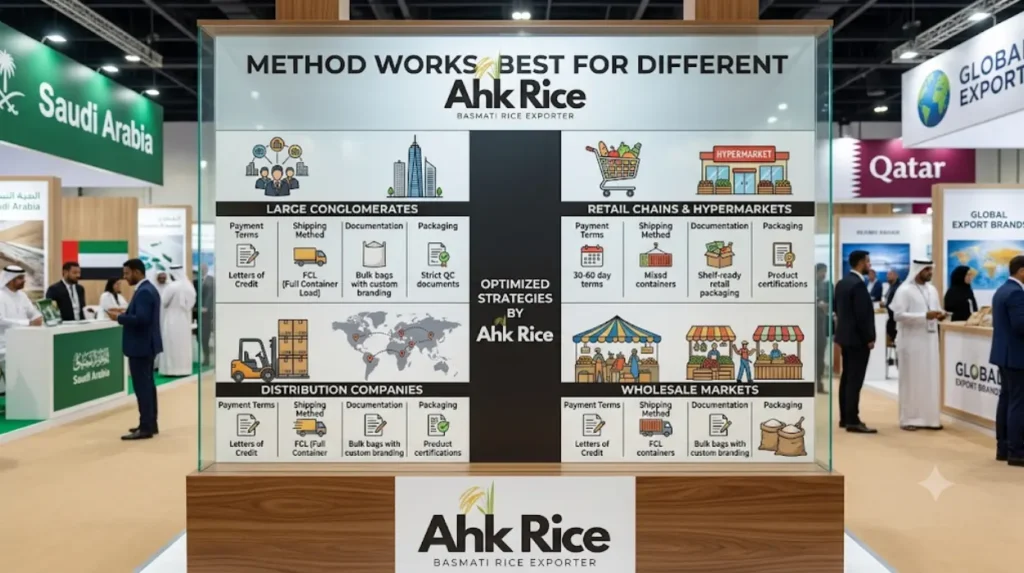
FOB works best for volume buyers, while CIF works best for importers prioritizing convenience, predictable budgeting, and simplified logistics management.
Large distributors benefit from FOB purchasing.
These companies often maintain relationships with freight forwarders. Volume contracts generate lower shipping costs. Procurement teams monitor freight markets continuously.
Retail Brands
Retail importers frequently choose CIF quotations.
Single-source coordination reduces administrative workload. Budget forecasting becomes easier. Product launch schedules become more predictable.
Foodservice Buyers
Restaurant suppliers often balance both approaches.
FOB performs better during stable freight markets. CIF performs better during volatile freight periods.
Government and Institutional Buyers
Public tenders frequently evaluate delivered cost.
CIF quotations simplify supplier comparison because freight and insurance remain standardized.
Regional Market Preferences
| Region | Preferred Method | Primary Reason |
|---|---|---|
| UAE Retail Sector | CIF | Budget certainty |
| UAE Wholesale Trade | FOB | Freight control |
Dubai-based wholesalers often prioritize FOB procurement. Abu Dhabi retail chains frequently request CIF quotations for easier budgeting.
Buyer suitability clarifies selection criteria. Next comes a practical evaluation of advantages and disadvantages.
What Are the Pros and Cons of FOB and CIF Pricing?
FOB offers greater control and potential savings, while CIF offers convenience and reduced operational complexity.
FOB Advantages
- Lower initial quoted price
- Direct freight negotiation
- Carrier selection flexibility
- Greater shipment visibility
- Better scalability
FOB Limitations
- More coordination required
- Freight market monitoring needed
- Separate insurance arrangements
- Additional documentation management
CIF Advantages
- Single supplier quotation
- Simplified logistics
- Insurance included
- Predictable budgeting
- Faster procurement decisions
CIF Limitations
- Reduced freight transparency
- Limited carrier selection
- Less control over shipment routing
- Potentially higher landed cost
Practical Example
A Dubai wholesaler importing twelve containers annually negotiates freight contracts directly. FOB purchasing often generates annual savings through lower logistics costs.
A Sharjah retail chain importing one container every quarter prioritizes administrative simplicity. CIF purchasing reduces internal workload and speeds procurement approvals.
Pros and cons establish operational trade-offs. Decision factors provide a final selection framework.
What Decision Factors Should Importers Evaluate Before Choosing FOB or CIF?
Shipment volume, logistics expertise, freight visibility, cash-flow planning, and operational resources determine the most suitable procurement method.
Decision Framework
| Decision Factor | FOB Advantage | CIF Advantage |
|---|---|---|
| Shipment Volume | High | Low |
| Logistics Knowledge | Required | Minimal |
| Freight Control | Full | Limited |
| Budget Predictability | Moderate | High |
| Administrative Work | Higher | Lower |
Importers handling multiple monthly shipments usually gain greater value through FOB contracts.
Importers lacking dedicated logistics teams often benefit from CIF solutions.
Cash-flow planning also influences selection. CIF quotations provide earlier visibility into total landed costs.
Market volatility creates another consideration. CIF protects buyers from sudden freight increases occurring after purchase confirmation.
Risk management remains equally important. Marine insurance within CIF quotations reduces administrative requirements while maintaining cargo protection.
Procurement strategy should align with operational capability rather than focusing exclusively on product price.
With procurement factors evaluated, buyers can confidently select the pricing structure matching their business model.
FOB Pakistan delivers maximum control and long-term cost efficiency, while CIF UAE delivers convenience, predictable budgeting, and streamlined logistics. UAE wholesalers, distributors, retailers, and foodservice operators should evaluate shipment frequency, freight expertise, administrative capacity, and risk management priorities before selecting a procurement model.
1509 White Basmati Rice remains one of the most competitive Pakistani export varieties because of its long grain appearance, strong cooking performance, and favorable freight access to Gulf markets. Buyers comparing quotations should always separate product value from logistics costs to identify the most efficient sourcing strategy. For buyers ready to evaluate supplier-specific pricing and shipment options, review our detailed guide on Get Direct Export Quotations for 1509 White Basmati Rice FOB Pakistan and CIF UAE Delivery obtaining direct export quotations and delivery options for UAE imports.
Frequently Asked Questions
What does FOB mean in rice exports?
FOB means Free on Board. The exporter loads the rice onto the vessel at the Pakistani port. The buyer arranges freight, insurance, and destination logistics.
What does CIF mean in rice exports?
CIF means Cost, Insurance, and Freight. The exporter includes shipping and marine insurance in the quoted price up to the destination port.
Is FOB cheaper than CIF?
FOB usually shows a lower quoted price because freight and insurance remain excluded. Total landed cost depends on freight arrangements.
Which method is preferred in the UAE?
Large wholesalers often prefer FOB. Retailers and smaller importers frequently prefer CIF for budgeting simplicity.
How much insurance is included in CIF pricing?
Most CIF quotations include standard marine cargo insurance covering common transportation risks during ocean transit.
Does freight significantly affect rice import costs?
Yes. Freight commonly represents a meaningful portion of total landed cost and directly influences importer profitability.