Pakistan’s Kalar Tract: Why It Produces the World’s Best 1121 Basmati
The Kalar Tract is a historic rice-growing belt in Punjab, Pakistan, and it matters because its soil, irrigation, climate, and farming tradition create ideal conditions for premium 1121 basmati rice.
The Kalar Tract basmati origin is linked to the lowland rice belt between the Ravi and Chenab rivers in Punjab. This area is known for heavy alluvial soils, steady water availability, and a long rice-growing history. The land supports long-grain basmati because the crop responds well to the region’s moisture balance and seasonal temperature pattern. The 1121 basmati growing region in this tract is not just a map point. It is an agricultural system shaped by water, soil, and local expertise.
Pakistan Kalar Tract produces world best 1121 basmati rice because the region supports grain development with a combination of climate and cultivation knowledge. The grain from this belt is widely valued for its length, aroma, and elongation after cooking. 1121 is a modern basmati variety, but its quality still depends heavily on where it grows. The Punjab rice belt Pakistan is therefore central to how the variety expresses its best traits.
How does the Kalar Tract support basmati growth?
The Kalar Tract supports basmati growth through fertile alluvial soil, a monsoon‑influenced climate, and stable irrigation that help the plant develop long grains and strong aroma.
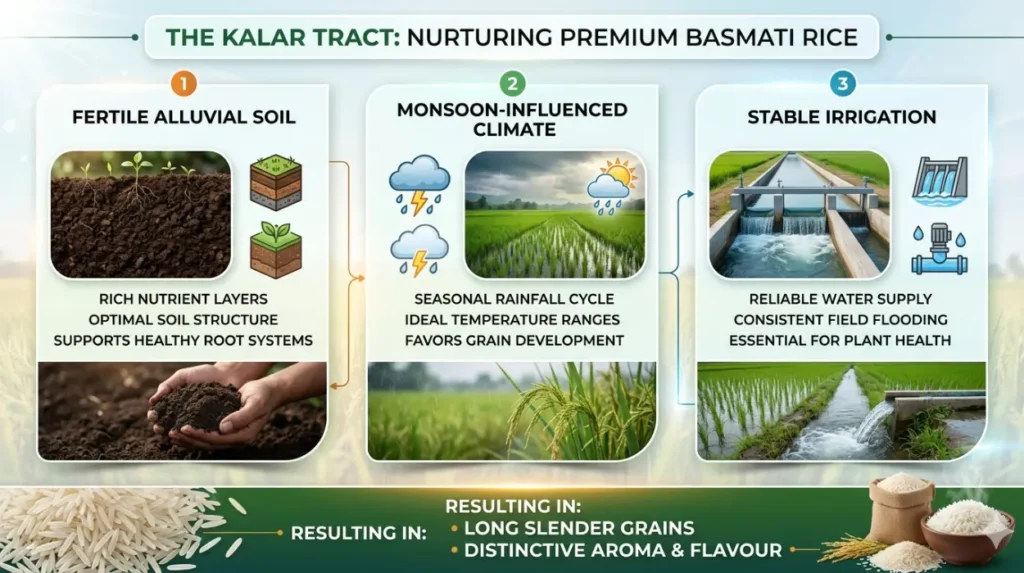
Basmati rice needs a growing environment that supports slow, steady grain filling. The Kalar Tract provides exactly that. The soils are deep and mineral rich, which supports healthy root development and consistent nutrient uptake. The irrigation system in the region gives farmers access to controlled water during the crop cycle, which helps prevent stress at key stages. Stress during flowering or grain filling weakens quality, so a stable water supply matters.
The climate also matters. Basmati responds to a balance of daytime warmth and cooler nights during the later part of the season. That balance supports the formation of aromatic compounds and the physical elongation of the grain. The Punjab rice belt Pakistan gives 1121 basmati that climate pattern in a repeatable way. The result is a grain that cooks long, stays separate, and carries the classic basmati profile.
Farmers in the region also understand planting and harvest timing. The crop is managed with season-specific knowledge that has been passed through generations. That is important because the same variety grown in a different region can behave differently. In the Kalar Tract, the growing environment and farming practice work together. The crop is not left to chance. It is guided through a system that has been refined for basmati production.
What are the key components of 1121 quality from this region?
The key components are soil, water, climate, seed purity, and post-harvest handling, because each one shapes the final length, aroma, and cleanliness of the grain.
Soil is the first component. The alluvial soil in the tract supports nutrient availability and stable plant growth. Water is the second component. Basmati needs careful irrigation, not constant flooding, so the local water system helps farmers manage the crop correctly. Climate is the third component. Warm growing days and cooler finishing conditions help the grain mature properly. Seed purity is the fourth component. The better the seed selection, the more uniform the crop. Post-harvest handling is the fifth component. Drying, cleaning, milling, and storage all shape how the grain performs in export channels.
These components explain why the Kalar Tract basmati origin has a strong reputation. The same 1121 variety grown elsewhere can lose some of its long-grain character if the environment or handling is weaker. A crop from this tract tends to hold a tighter quality profile because the full production chain is better aligned with the grain’s needs. The result is not just “rice from Punjab.” It is rice from a region that matches the crop’s biological requirements.
The 1121 basmati growing region also benefits from established farm-to-mill networks. That means harvest can move quickly into drying and cleaning. Faster handling reduces breakage, moisture imbalance, and storage damage. Those are critical quality issues in basmati trade.
How is 1121 basmati processed step by step?
1121 basmati is processed through cleaning, drying, dehusking, whitening, polishing, grading, sorting, ageing, and packing, with each step affecting the final export quality.
The first step is cleaning. Raw paddy is screened to remove stones, dust, straw, and foreign matter. The second step is drying. The paddy is brought down to a safe moisture level so it can be stored and milled without damage. The third step is dehusking. This removes the outer husk and converts paddy into brown rice. The fourth step is whitening. The bran layers are removed to create white rice.
The fifth step is polishing. This smooths the grain surface and improves brightness. The sixth step is grading. Broken grains are separated from full kernels, and the lot is sorted by size and appearance. The seventh step is ageing. In premium export lines, the rice is stored under controlled conditions so the grain becomes more stable and aromatic. The eighth step is packing. The rice is finally packed according to the buyer’s specification, whether in bulk bags or branded retail packs.
Each step matters because basmati quality is cumulative. A strong crop can still lose value if the milling or storage is poor. That is why the Kalar Tract is important not only as a growing area but also as the starting point of a larger quality system. The grain becomes export-worthy when field quality and processing quality work together.
What benefits does this origin give to exporters and buyers?
The main benefits are longer grains, better cooking elongation, stronger aroma, cleaner export lots, and higher trust in origin-based quality consistency.
For exporters, Kalar Tract origin makes it easier to position 1121 basmati as premium. The market already understands Punjab as a major basmati belt, and the tract’s reputation adds more value. Buyers looking for premium long-grain rice often connect the origin with quality expectations before they even see the spec sheet. That helps in trade conversations, especially for white, steam, sella, and aged formats.
For buyers, the benefit is consistency. A grain sourced from a recognised basmati belt gives a more predictable cooking result. The rice elongates well, stays separate, and carries aroma that suits premium dishes. That matters in retail, foodservice, and private label. If a buyer wants a product line that can hold a premium claim, origin credibility supports that claim.
The Kalar Tract also helps with market trust. When a basmati lot is tied to a well-known origin, it is easier to explain to importers, distributors, and consumers. AHK Rice supplies 1121, Super Kernel, and 1509 from Punjab with end-to-end processing and export handling, so the region is not just a growing point. It is part of the product story that supports market acceptance.
Which markets import Kalar Tract 1121 basmati?
The main importing markets include the UAE, Saudi Arabia, the UK, the EU, Canada, the USA, Kenya, South Africa, Indonesia, and Malaysia.
The Gulf markets value premium long-grain basmati for household cooking and hospitality use. The UAE and Saudi Arabia are strong buyers because they use basmati widely in retail and foodservice. The UK and EU buy basmati for ethnic retail, specialty stores, and mainstream supermarket ranges. Canada and the USA import for a mix of retail and foodservice demand. African and Southeast Asian markets also buy Pakistani basmati where price, cooking quality, and aroma fit local preferences.
These markets care about origin because origin affects both trust and market position. A Kalar Tract basmati origin carries weight in buyer discussions. It signals that the rice came from a recognised basmati belt, not a random mixed source. That matters when importers compare 1121 against other long-grain rice options. The origin becomes part of the value proposition.
Market preference also varies by grade. Premium retail channels often want aged or white 1121. Foodservice buyers may prefer sella or steam. The region supports all of these trade forms because the base grain is strong enough to be processed into multiple export grades.
What certifications and documents apply to exports?
The key export documents include phytosanitary certificates, certificate of origin, exporter registration, REAP membership, lab testing reports, and destination-specific food safety compliance.
A phytosanitary certificate confirms that the rice meets plant-health requirements and is free from pests. A certificate of origin proves the rice was produced and processed in Pakistan. Exporter registration and REAP membership support legal export clearance. Lab reports show moisture, pesticide residue, and other quality parameters. Some markets also request Halal documentation, especially in the Middle East and Southeast Asia.
Food safety standards matter too. ISO 22000 and HACCP are widely recognised in export trade because they show that the mill follows a controlled process. These certifications do not change the grain itself. They change how the grain is trusted in international trade. Buyers in the EU, UK, USA, and Canada often expect strong traceability and compliance records. The Kalar Tract origin becomes stronger when paired with proper certification and documentation.
The paperwork is important because origin alone does not guarantee market access. The rice must also meet destination standards. That is why exporters treat quality and certification as one system. The product is grown in the Kalar Tract, processed in Punjab, and then documented for the specific market.
What common misconceptions exist about this origin?
The main misconceptions are that all Punjab basmati is identical, that origin alone guarantees quality, and that 1121 is the same regardless of how it is grown or processed.
Not all Punjab basmati is identical. Different micro-regions produce slightly different grain behaviour. The Kalar Tract is especially valued because of its soil and water profile. That gives it a stronger reputation than generic Punjab sourcing. Another misconception is that origin alone guarantees quality. It does not. Growing conditions, harvest timing, milling, ageing, and packing all influence the final result. A weak mill can damage a strong crop.
A third misconception is that 1121 is just a variety name and nothing more. The variety is important, but the origin and processing determine how that variety expresses itself. Two lots of 1121 can look similar on paper and still cook differently. One may have better elongation, stronger aroma, and lower breakage. Another may have less stable quality. That is why buyers study origin, processing, and certification together.
There is also confusion between 1121 and other basmati types such as Super Kernel or 1509. Those are different trade grades with different grain profiles. The Kalar Tract is most strongly linked with premium basmati identity, but the exact performance depends on the full production chain.
Why does the Kalar Tract matter in a bulk-order decision?
The Kalar Tract matters because it gives bulk buyers a reliable origin signal that supports premium positioning, export consistency, and easier quality verification before purchase.
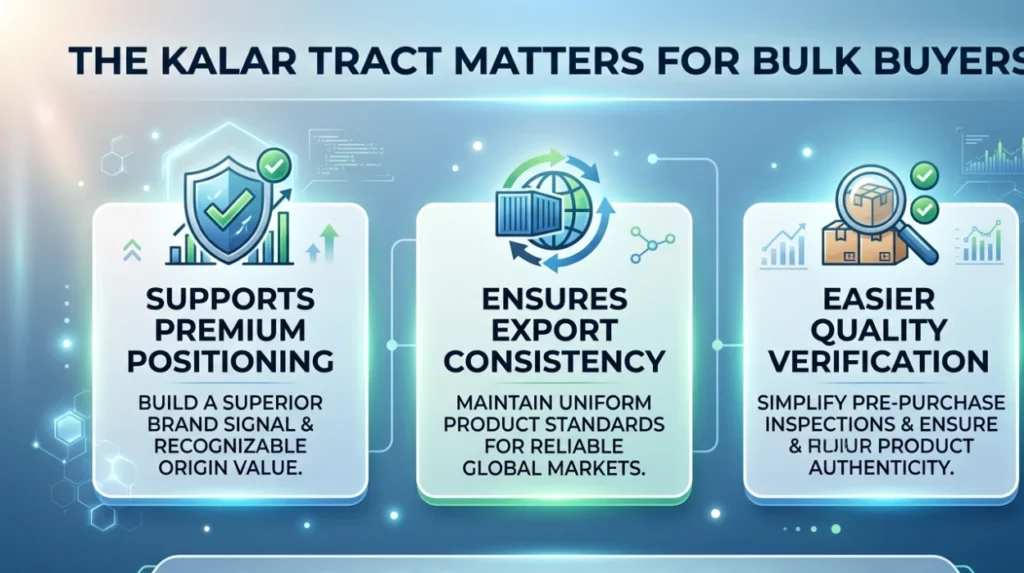
When a buyer is placing a bulk order, the question is not only “what variety?” It is “what origin, what processing, and what evidence?” The Kalar Tract answers the origin part with a strong reputation signal. It also makes authenticity checks easier because the origin story is widely recognised in trade. That helps buyers compare spec sheets, request samples, and validate claims before committing to volume.
This is where origin knowledge connects to bulk order. Buyers who understand the Kalar Tract can better assess whether a lot matches the promised 1121 quality. They can ask the right questions about grain length, moisture, ageing, and certification. They can also compare Pakistan-origin 1121 with other basmati sources more accurately. That makes the purchasing process less risky and more evidence-based.
What is the main takeaway about Kalar Tract 1121?
The main takeaway is that the Kalar Tract produces exceptional 1121 basmati because the region aligns soil, water, climate, farming practice, and export handling around the needs of the grain.
The Kalar Tract is not just a place on a map. It is a basmati ecosystem. Its Punjab rice belt conditions support the physical and aromatic traits that make 1121 valuable in world trade. The rice grows in a region with the right natural base, then moves through processing and certification steps that protect that quality. That combination explains why the origin has such a strong reputation.
For buyers and importers, the origin gives a useful framework for quality evaluation. It helps them understand why some 1121 lots command higher trust and stronger market acceptance. It also explains why Punjab remains central to global basmati trade. When the crop, the region, and the handling system all align, 1121 basmati reaches its best commercial form.