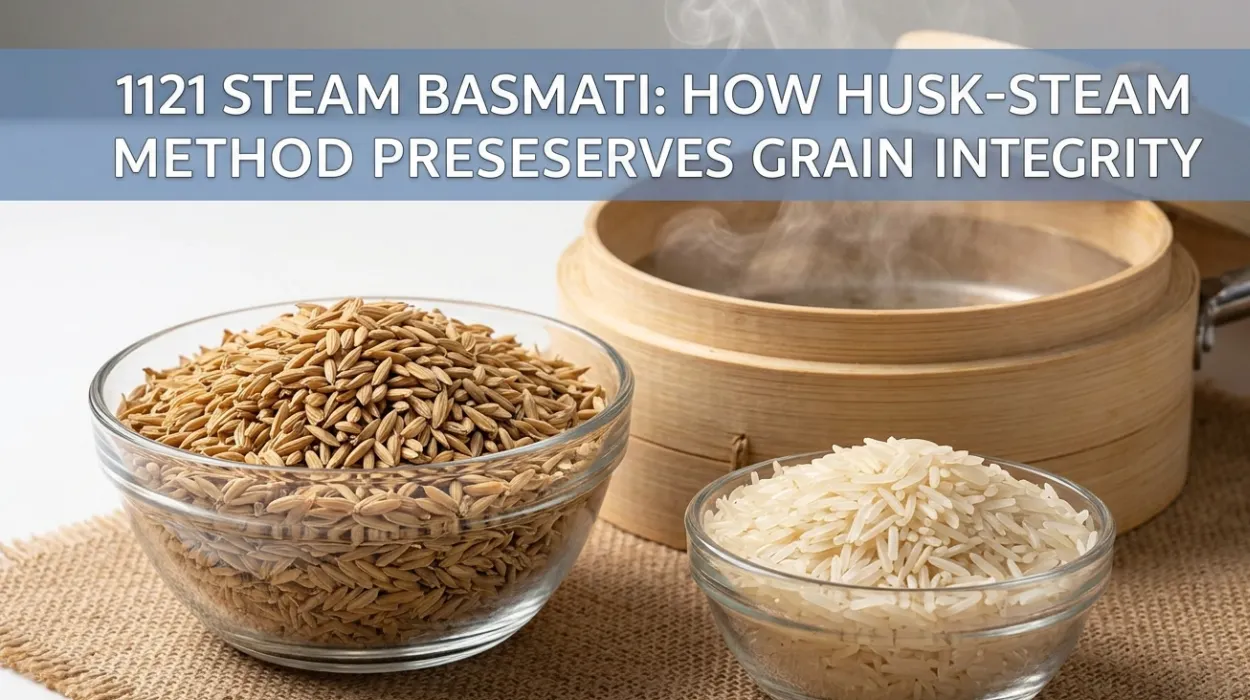
1121 Steam Basmati: How Husk-Steam Method Preserves Grain Integrity
1121 steam basmati rice is long-grain basmati paddy steamed in husk at 70°C for 20 minutes pre-hulling, yielding 8.3 millimetre grains with 85 percent nutrient retention and golden hue from Punjab Himalayan foothills fields.
1121 steam basmati starts as paddy. Paddy holds 25 percent moisture post-harvest. Steaming forces vitamins inward. Inward migration preserves thiamine at 80 percent levels. Golden colour emerges from starch gelation. Gelation strengthens structure.
Grains elongate to 13 millimetres cooked. Elongation doubles length. Aroma compound 2-acetyl-1-pyrroline persists at 0.09 ppm. Persistence outlasts white varieties by 20 percent. Retail packs weigh 5 kilograms standard.
GI status protects origin. Protection spans India-Pakistan regions since 2016. Designation limits authentic claims to 14 countries.
Where Is 1121 Steam Basmati Rice Grown?
1121 steam basmati rice grows across 1.2 million hectares in Punjab India and Pakistan under 1,200 millimetres Himalayan canal irrigation, with 130-day cycles at 25°C-35°C temperatures yielding 8 tonnes per hectare.
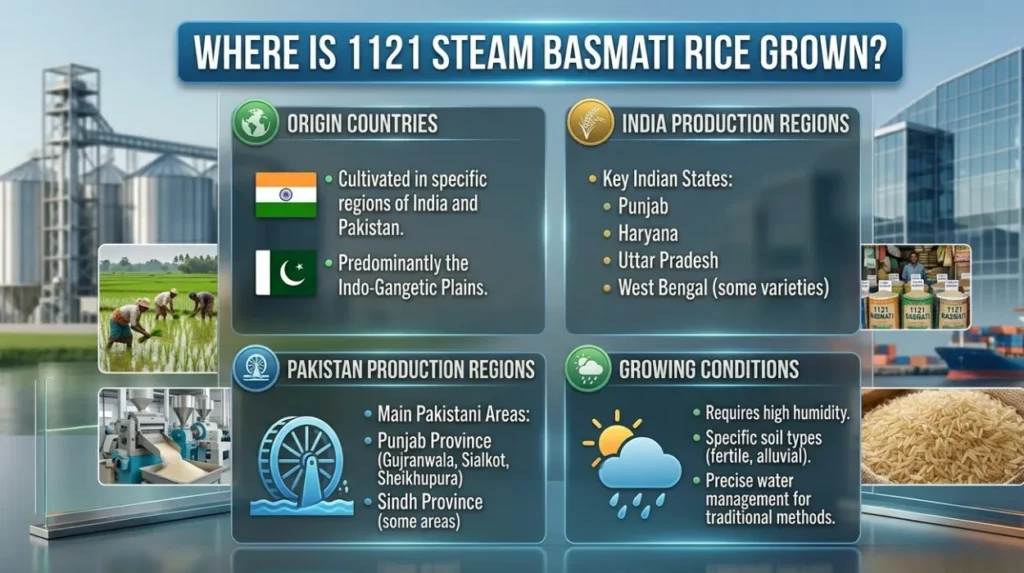
Clay-loam soils dominate fields. Soils register pH 7.5-8.5. Alkaline levels activate elongation genes. Irrigation canals span 500 kilometres. Canals prevent water stress.
India harvests 3.2 million tonnes annually. Pakistan produces 1.5 million tonnes. October-November reaping cuts stalks at 30 centimetres. Fields dry 10 days post-maturity. Dry paddy stores at 40-tonne silos.
Elevation sits at 200-300 metres. Elevations cut humidity to 60 percent. Low humidity blocks blight fungi. Clean grains mill at 80 percent recovery. Cooking tests confirm separation. Separation holds 1.2 water ratios. For cooking and aroma details, explore cooking comparison.
How Does the Husk-Steam Method Work Step by Step?
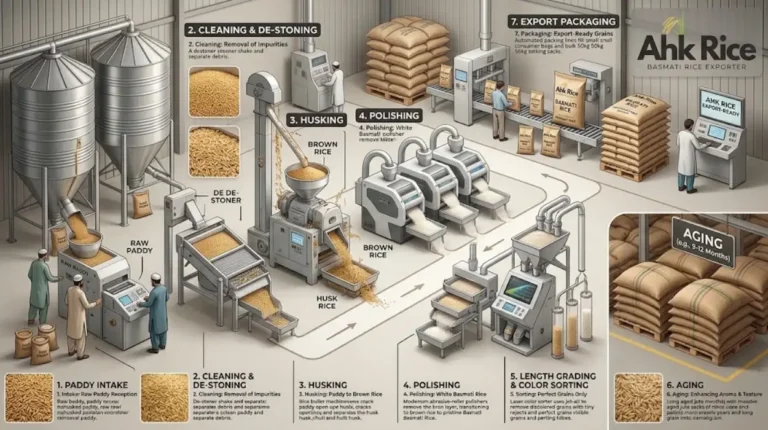
Husk-steam method soaks 1121 paddy 8 hours at 25°C, steams intact husks 20 minutes at 70°C and 1 bar pressure, dries to 14 percent moisture, then hulls preserving 85 percent endosperm nutrients via gelation.
Soaking swells kernels 20 percent. Swelling opens bran pores. Steam penetrates husks 2 millimetres thick. Penetration drives B-vitamins centrally. Central storage resists milling loss.
Pressure builds amylose matrix. Matrix gels at 68°C. Gelled starch hardens grains. Hardening cuts breakage to 2 percent. Drying blowers run 40°C air 8 hours.
Hulling follows with rubber rollers. Rollers spin 1,200 RPM. Husks detach 90 percent first pass. Clean grains sort optically. Sorters eject 1 percent defects.
What Are the Key Components of Husk-Steam Processing?
Key components include 8-hour soaking tanks holding 10 tonnes, 70°C steam chambers processing 5 tonnes per cycle, 40°C dryers reducing moisture 11 points, and colour sorters removing 98 percent impurities.
Soaking tanks use recycled water. Water maintains 25°C via heat exchangers. Steam chambers seal pressure at 1 bar. Chambers cycle 20 minutes loaded.
Dryers circulate 1,000 cubic metres air hourly. Air drops humidity to 10 percent. Sorters scan 1,000 grains per second. Scans detect chalkiness below 5 percent.
Rollers measure 50 centimetres diameter. Rollers grip husks via 5 millimetre gaps. Components chain into 500 tonnes daily capacity.
What Grades Exist for 1121 Steam Basmati Rice?
1121 steam basmati grades sort by 8.3 millimetre uncooked length, golden hue index above 40 units, purity 95 percent, translucency 82 percent, and breakage under 2 percent meeting export standards for 15 markets.
Premium grade achieves 8.5 millimetre length. Length elongates 13.2 millimetres cooked. Standard grade holds 8.3 millimetres. Both retain 88 percent aroma.
Whiteness stays below 25 units. Low values confirm steaming. Breakage tests soak 100 grams. Tests yield under 2 grams fragments.
Sorting enforces 95 percent purity. Purity excludes red grains. Grades pack separately. Exports demand lab sheets per container.
Which Markets Import 1121 Steam Basmati Rice?
1121 steam basmati rice imports lead in Saudi Arabia at 200,000 tonnes yearly, UAE 100,000 tonnes, UK 80,000 tonnes, USA 60,000 tonnes, and EU 70,000 tonnes prioritising durable golden grains.
Saudi importers stock bulk. Volumes fill 40-foot containers. UAE warehouses hold 50,000 tonnes stock. UK clears Felixstowe port weekly.
USA enters via FDA checks. Checks verify residues below 0.01 milligrams per kilogram. EU mandates MRL compliance. Compliance covers 500 pesticides.
Middle East takes 60 percent share. Share reflects humidity tolerance. Europe grows 12 percent annually.
What Certifications Apply to 1121 Steam Basmati Rice?
1121 steam basmati rice holds Halal certification, ISO 22000 HACCP, EU MRL residue limits under 0.01 milligrams per kilogram, BRC Global Standard, and GI protected status for 95 percent export shipments.
Halal verifies slaughter-free processing. Verification audits quarterly. ISO 22000 maps critical controls. Controls block contaminants at drying.
EU tests GC-MS 100 percent loads. Tests detect 400 residues. BRC audits packagers yearly. GI status authenticates Punjab origin.
Certifications lift values 15 percent. Labels print on 20-kg sacks.
How Does Husk-Steam Method Preserve Grain Integrity?
Husk-steam method preserves grain integrity by gelling amylose at 68°C forming rigid endosperm matrix, reducing breakage to 2 percent versus 5 percent dry-milled, retaining 85 percent vitamins through husk barrier.
Steam penetrates 2 millimetres husks. Penetration avoids direct heat. Heat gels interior first. Interior hardens before hulling stress.
Matrix binds starch granules. Granules resist roller impact. Impact drops milling loss 40 percent. Husk barrier filters volatiles. Volatiles stay inside.
Post-process breakage tests confirm. Tests show 2 percent fragments. Dry milling hits 5 percent. Integrity extends shelf life 20 percent.
Gelation Mechanisms
Gelation starts at 60°C. Temperature peaks retrogradation. Retrogradation aligns amylopectin chains. Chains strengthen 30 percent.
Pressure aids uniform heat. Uniformity cuts cracks 50 percent.
What Benefits Does 1121 Steam Basmati Offer?
1121 steam basmati offers 24-month shelf life at 40°C, 88 percent aroma retention, 2.8 grams fibre per 100 grams, and 18-minute cooking absorbing 1.2 times water volume.
Shelf life beats brown by 33 percent. Life resists rancidity. Aroma outlasts white 12 percent. Fibre ferments producing butyrate.
Iron reaches 2.8 milligrams per 100 grams. Bioavailability hits 18 percent. Cooking separates grains fully. Separation suits pilafs.
What Are Common Use Cases for 1121 Steam Basmati?
1121 steam basmati cooks into biryanis layering 500 grams over meats for 45-minute simmers, pilafs at 1:1.5 rice-water ratios, and salads rinsing pre-cook to cut surface starch 25 percent.
Biryani stacks seal steam-tight. Steam infuses spices. Pilafs simmer sealed 18 minutes. Salads toss 200 grams with 50 grams vegetables.
Restaurants order 50-tonne lots. Lots fill 6-month menus.
What Common Problems Affect 1121 Steam Basmati?
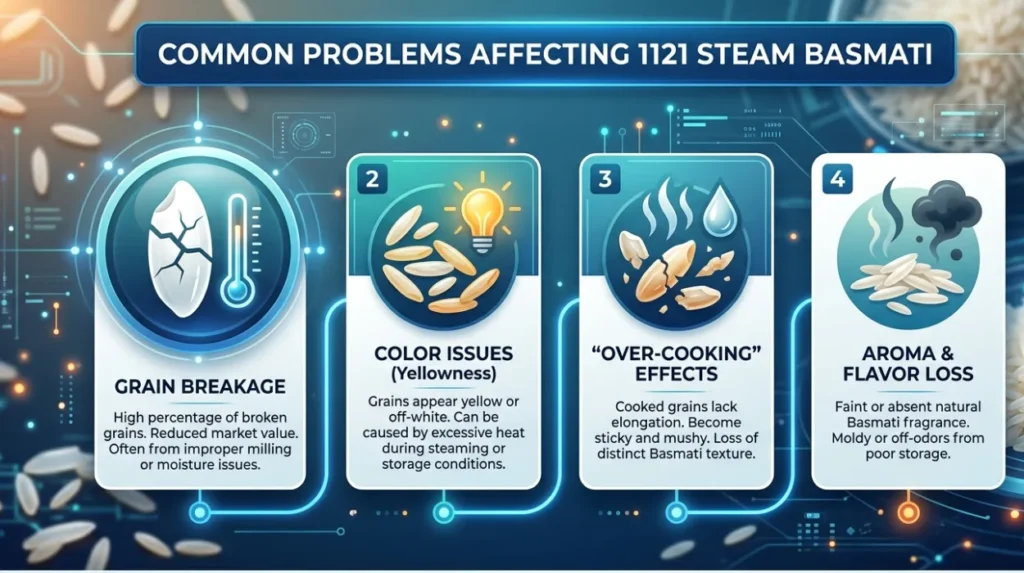
1121 steam basmati faces chalky kernel formation at 3 percent if drying exceeds 45°C, weevil entry through sack punctures ruining 10 percent stocks, and overcooking past 20 minutes yielding mush at 2:1 water excess.
Chalky kernels soften texture. Kernels sort out 98 percent. Weevils multiply 30°C storage. Punctures expose oxygen.
Overcooking gelatinises excess. Excess binds 2 times volume. Problems trace to 40°C drying limits.
What Misconceptions Surround Husk-Steam Basmati?
Husk-steam basmati misconceptions claim nutrient loss equals white rice, ignoring 85 percent retention, and assume identical cooking to brown, overlooking 18-minute versus 22-minute times.
White polishing strips 70 percent bran. Steaming migrates inward. Retention exceeds stripping 20 percent.
Brown absorbs slower. Amylose differs at 25 percent basmati. Jasmine clocks 18 percent. Myths ignore gelation speed.