Private Label Basmati Rice from Pakistan: What Importers Need to Know
Private label basmati rice from Pakistan gives importers full brand control with export-grade consistency. It delivers specification-based sourcing, controlled milling, and scalable packaging. Here is why: Pakistan produces long-grain basmati varieties like 1121, 1509, and Super Kernel under structured milling, grading, and export systems that support OEM branding for global retail and foodservice markets.
Private label basmati rice Pakistan importers rely on structured OEM systems that allow custom branding, packaging formats, and specification control. Learn the full sourcing framework and export process in our detailed TOFU guide: Private Label Rice Export Guide from Pakistan.
AHK Rice is a trusted Pakistani Basmati rice exporter based in Punjab, supplying 1121, Super Kernel, and 1509 varieties to 15+ countries. Its Private Label Services enable importers to build custom rice brands with controlled milling, grading, and export documentation.
What are the available solutions for private label basmati rice sourcing?
Private label basmati rice sourcing offers three structured solutions: OEM contract manufacturing, exporter-managed branding, and hybrid co-branding systems. Each model differs in control, cost structure, and scalability, allowing importers to choose based on market positioning, volume requirements, and retail or foodservice distribution strategy.
Private label sourcing in Pakistan is not a single model. It is a layered export system built around milling capacity, grading precision, and packaging flexibility.
OEM Contract Manufacturing
- Brand ownership control
- Packaging customization flexibility
- Specification-based procurement
OEM systems allow importers to define bag design, rice grade, and quality parameters. The exporter mills, grades, and packages under strict instruction sets.
Exporter-Managed Private Label
- Pre-approved packaging formats
- Standardized rice grades
- Lower setup cost structure
This model suits first-time importers who want faster market entry without heavy design or compliance overhead.
Hybrid Co-Branding Model
- Shared branding elements
- Flexible packaging tiers
- Gradual market testing approach
This model is used when importers test demand before scaling full OEM branding.
Private label basmati rice Pakistan importers often start with hybrid models before moving into full OEM systems due to lower initial risk exposure.
With sourcing models defined, the next step is understanding how these approaches perform under real export conditions.
How do different private label approaches compare in practice?
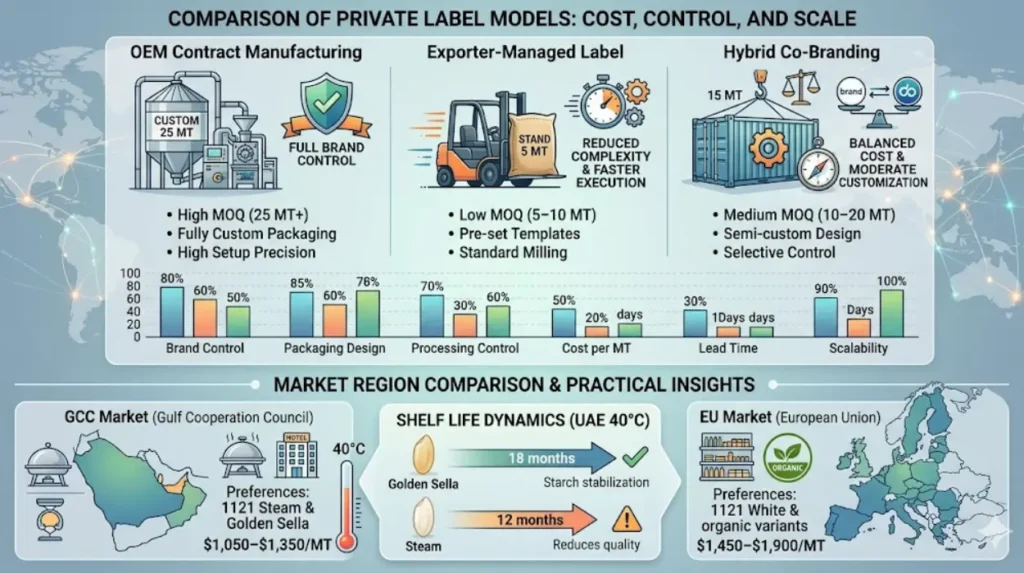
OEM contract manufacturing delivers maximum branding control with higher setup precision, exporter-managed systems reduce complexity with faster execution, and hybrid models balance cost efficiency with moderate customization, making them suitable for market testing, scaling, and long-term brand development strategies across global rice import markets.
Comparison of private label models depends on cost, control, and scalability metrics.
Specification Comparison Table (7 Attributes)
| Attribute | OEM Contract Manufacturing | Exporter-Managed Label | Hybrid Co-Branding |
|---|---|---|---|
| Brand Control | Full control | Limited control | Moderate control |
| Packaging Design | Fully custom | Pre-set templates | Semi-custom |
| MOQ Requirement | High (25 MT+) | Low (5–10 MT) | Medium (10–20 MT) |
| Processing Control | Full milling specification | Standard milling | Selective control |
| Cost per MT | Higher setup cost | Lower entry cost | Balanced cost structure |
| Lead Time | 20–30 days | 10–15 days | 15–25 days |
| Scalability | Very high | Moderate | High potential |
Market Region Comparison
Gulf Cooperation Council (GCC)
- Preference: 1121 Steam & Golden Sella
- Price per MT: USD $1,050–$1,350
- Shelf Life: 12–18 months depending on parboiling
- Demand Driver: Catering and hospitality supply chains
European Union
- Preference: 1121 White & organic basmati variants
- Price per MT: USD $1,450–$1,900
- Shelf Life: 10–14 months under controlled storage
- Demand Driver: Retail branding and premium positioning
Golden Sella basmati lasts longer than Steam basmati because parboiling stabilizes grain starch. In UAE warehouses at 40°C, Golden Sella maintains structure for 18 months, while Steam reduces quality after 12 months.
With comparison models defined, the next step is identifying which approach fits specific import scenarios.
Which private label method works best for different import cases?
OEM contract manufacturing works best for established importers with retail distribution, exporter-managed labeling suits small distributors entering new markets, and hybrid co-branding fits importers testing demand before scaling production, especially in price-sensitive regions with evolving retail penetration strategies.
Each import case requires different supply chain maturity.
Retail Brand Builders
- OEM contract manufacturing
- Custom packaging identity
- Long-term shelf positioning
Retailers need strong branding control. OEM systems support consistent SKU development.
New Market Entrants
- Exporter-managed labeling
- Low MOQ flexibility
- Fast shipment cycles
New importers prioritize speed and reduced operational complexity.
Market Testers
- Hybrid co-branding model
- Controlled cost exposure
- Incremental scaling ability
Testing markets reduces financial risk before full brand rollout.
Private label basmati rice Pakistan importers typically evolve from exporter-managed systems toward OEM once demand stabilizes.
With method selection clarified, the next step is understanding operational strengths and limitations.
What are the pros and cons of private label basmati rice systems?
Private label basmati rice systems provide strong branding control, scalable export operations, and flexible packaging formats, but they also require higher compliance management, longer lead times, and precise specification control, especially when dealing with multiple grades, export certifications, and international retail requirements.
Private label systems create structured trade advantages and operational constraints.
Advantages
- Brand ownership control across markets
- Packaging flexibility for retail formats
- Export scalability across multiple regions
- Specification consistency in milling output
Disadvantages
- Higher MOQ requirements in OEM systems
- Longer production lead times
- Strict quality control dependency
- Packaging compliance complexity
Example Use Case
A GCC importer using OEM branding gains premium shelf identity. However, lead time increases to 25 days due to packaging alignment and grading verification.
A European importer using exporter-managed labeling reduces lead time to 12 days but loses differentiation in retail positioning.
With pros and cons evaluated, the next focus is structured decision-making.
What are the key decision factors for private label basmati rice importers?
Key decision factors include target market positioning, MOQ capacity, pricing tolerance, packaging strategy, shelf life requirements, certification needs, and distribution channel structure, all of which determine whether OEM, exporter-managed, or hybrid private label models are operationally viable.
Import decisions depend on measurable trade variables.
Decision Framework Table (5 Rows)
| Factor | OEM Model | Exporter Model | Hybrid Model |
|---|---|---|---|
| Market Position | Premium retail brands | Entry-level distributors | Test-market brands |
| MOQ Capacity | High volume readiness | Low volume flexibility | Mid-range scaling |
| Price Sensitivity | Low sensitivity | High sensitivity | Balanced sensitivity |
| Branding Needs | Fully custom identity | Standard branding | Partial customization |
| Risk Level | Medium risk | Low risk | Balanced risk |
Packaging Decision Factor
- Retail packs (1kg–5kg) suit EU supermarkets
- Bulk packs (25kg–50kg) suit GCC catering buyers
- Mixed SKUs support hybrid distribution models
Certification Requirement Factor
- EU markets require phytosanitary compliance
- GCC markets require Halal certification
- US markets require FDA registration
Private label basmati rice Pakistan importers select models based on alignment between logistics capability and market regulation.
With decision factors defined, the final stage is linking strategy to execution.
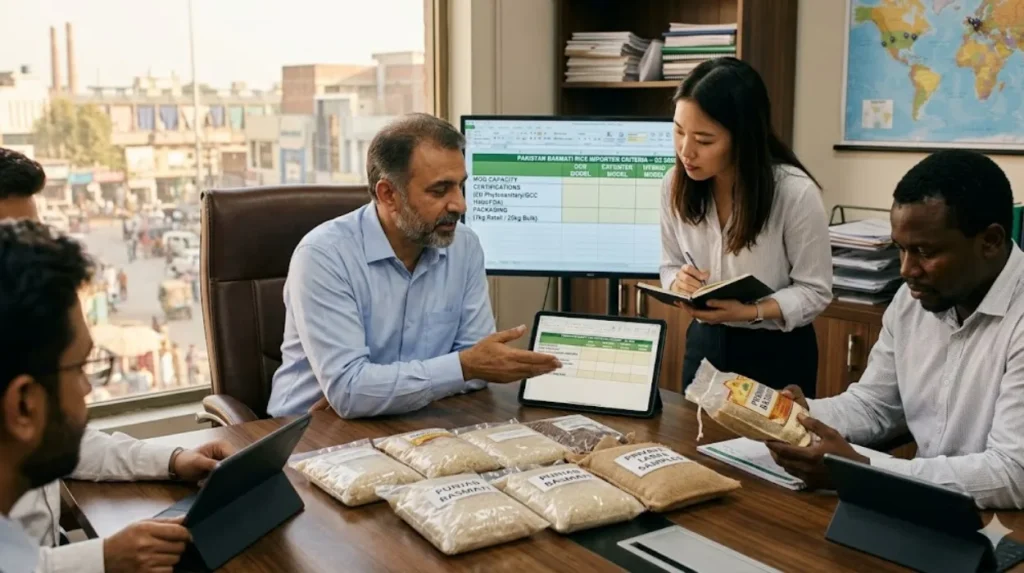
Final Strategic Outlook for Private Label Basmati Rice Importers
Private label basmati rice sourcing from Pakistan creates structured control over branding, pricing, and export execution. OEM systems maximize branding power. Exporter-managed systems reduce operational complexity. Hybrid models support controlled market entry.
Private label rice Pakistan strategies depend on aligning milling precision, packaging systems, and export documentation with buyer market expectations.
Custom rice brand development is no longer just procurement. It is a supply chain design decision that defines long-term market positioning.
Basmati OEM export models continue to expand as importers prioritize consistency, traceability, and controlled specification sourcing across retail and foodservice channels.
Frequently Asked Questions
What is private label basmati rice?
Private label basmati rice is rice that is produced by an exporter but sold under an importer’s own brand name. Importers can customize packaging, branding, and sometimes product specifications while the exporter handles milling, processing, and export.
What are the main private label sourcing models in Pakistan?
The main sourcing models are OEM contract manufacturing, exporter-managed labeling, and hybrid co-branding. Each model offers different levels of control, cost, and flexibility depending on the importer’s business goals and market strategy.
Which basmati rice varieties are commonly used for private label exports?
The most commonly used varieties include 1121 Basmati, 1509 Basmati, and Super Kernel. These are selected for their long grain, aroma, and suitability for both retail and foodservice export markets.
What is the minimum order quantity for private label rice?
Minimum order quantity depends on the sourcing model. OEM systems usually start from around 25 metric tons, while exporter-managed private label options can start as low as 5–10 metric tons.
Which markets have the highest demand for Pakistani basmati rice?
The GCC region and European Union are major markets. GCC countries prefer steam and parboiled rice for catering, while EU markets focus more on premium packaged retail basmati rice with certifications.