1509 Parboiled vs 1509 Golden Sella: Shelf Life and Cooking Performance
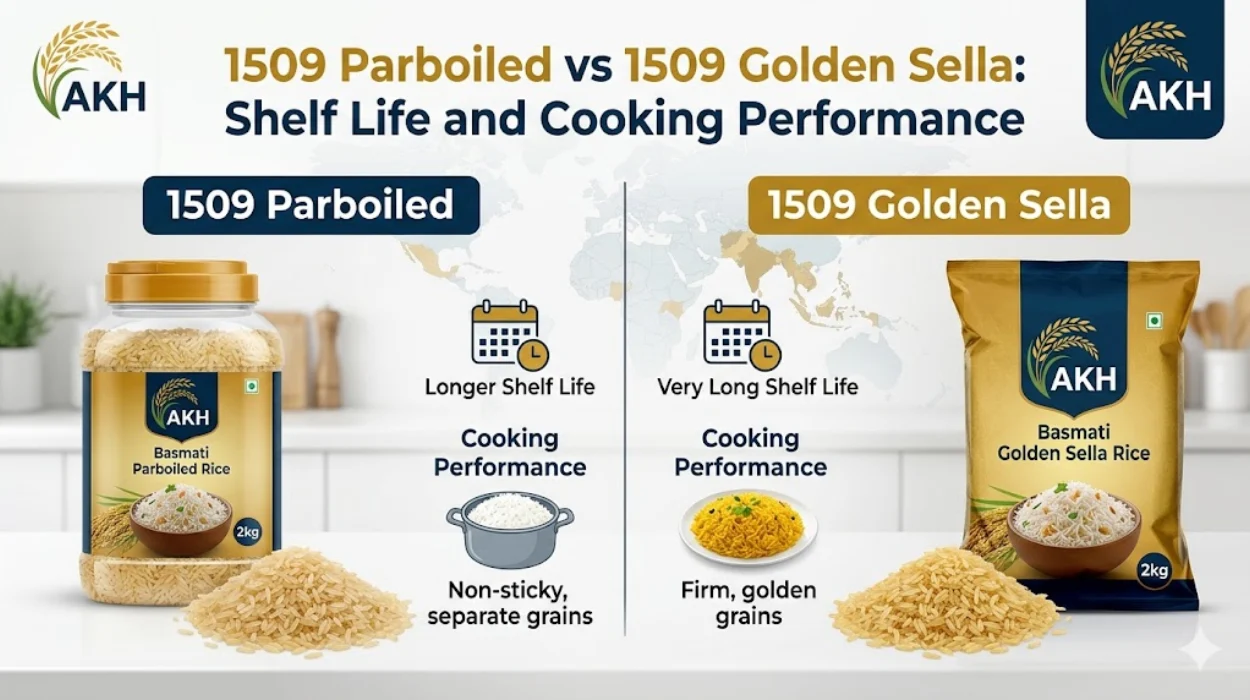
1509 Golden Sella lasts longer and performs better in bulk cooking, while 1509 Parboiled offers faster hydration and softer texture for quick-service kitchens. Here is why: Golden Sella undergoes controlled parboiling and drying, which hardens the grain structure and extends shelf life, while Parboiled retains more internal moisture, improving cooking speed but reducing long-term durability.
1509 Basmati rice varieties dominate export markets because they balance grain length, aroma, and processing flexibility. Buyers evaluate two core variants: Parboiled and Golden Sella. Both originate from the same 1509 paddy, but processing defines their final performance. Understanding this distinction allows importers to match specifications with storage conditions and cooking needs.
Processing begins after farmers harvest 1509 paddy in Punjab. Millers clean, dehusk, polish, grade, and sort the grain. Parboiling introduces heat and moisture before drying. Golden Sella applies a deeper parboiling stage with extended steaming. This difference creates measurable variation in durability, cooking behavior, and export suitability. For a foundational understanding of Basmati processing, refer to this contextual guide on how rice processing methods shape grain performance.
The product comparison directly impacts procurement decisions. AHK Rice supplies both variants with controlled processing, enabling consistent export quality across markets.
What are the available solutions in 1509 processing?
1509 Parboiled and 1509 Golden Sella are the two primary solutions, each defined by specific parboiling intensity, drying method, and grain stabilization, delivering different shelf life durations and cooking outcomes for commercial and retail buyers globally across markets.
1509 Parboiled Basmati
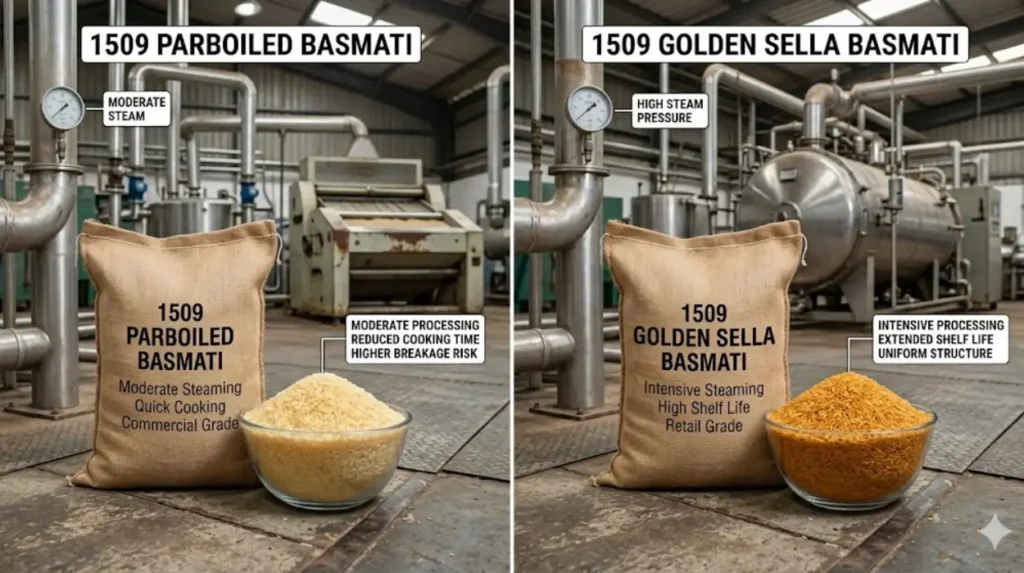
1509 Parboiled rice undergoes moderate soaking and steaming. The process gelatinizes starch partially. This improves cooking speed and reduces grain breakage.
Processing steps:
- Clean the paddy
- Soak the grain
- Steam under pressure
- Dry to safe moisture levels
- Dehusk and polish
- Grade by length
- Sort by color
Parboiled rice absorbs water quickly during cooking. Kitchens reduce cooking time by 10–15%. Restaurants benefit from faster turnover. However, moderate processing leaves residual moisture variation, reducing long-term storage stability.
1509 Golden Sella Basmati
1509 Golden Sella undergoes intensive parboiling with higher temperature steaming. This hardens the grain and gives a golden hue.
Processing steps:
- Clean the paddy
- Soak under controlled temperature
- Steam at higher pressure
- Dry slowly for uniform moisture
- Dehusk and polish
- Grade precisely
- Sort using color sorters
Golden Sella develops stronger grain structure. This increases shelf life and reduces spoilage risk. Exporters prefer this grade for long-distance shipping.
With both solutions defined, the next step is a direct specification comparison.
How do 1509 Parboiled and Golden Sella compare technically?
Golden Sella shows superior durability and longer storage stability, while Parboiled delivers faster cooking and softer texture, with measurable differences in moisture tolerance, grain hardness, and breakage resistance across commercial supply chains and end-use cooking environments globally.
Specification Comparison Table
| Attribute | 1509 Parboiled | 1509 Golden Sella |
|---|---|---|
| Grain Length | 8.2–8.4 mm | 8.3–8.5 mm |
| Color | Light cream | Golden yellow |
| Moisture Content | 13–14% | 12–13% |
| Shelf Life | 12–14 months | 18–24 months |
| Cooking Time | 12–15 minutes | 15–18 minutes |
| Grain Strength | Medium | High |
| Breakage Resistance | Moderate | Low breakage |
Golden Sella lasts longer than Parboiled because deeper parboiling stabilizes internal starch. In a 40°C UAE warehouse, Golden Sella maintains quality for 18–24 months. Parboiled requires consumption within 12–14 months.
Golden Sella resists breakage better during bulk handling. In African bulk shipments, Golden Sella retains whole grain integrity. Parboiled shows higher breakage in non-controlled logistics environments.
Parboiled cooks faster than Golden Sella. In quick-service kitchens, Parboiled reduces cooking cycles. Golden Sella requires longer soaking and cooking but delivers firmer grains.
This comparison leads directly to market-specific preferences.
Which markets prefer Parboiled vs Golden Sella?
Middle Eastern and African markets prefer Golden Sella for durability and long storage, while European and quick-service Asian markets prefer Parboiled for faster cooking and softer texture, driven by climate conditions, logistics constraints, and end-user cooking requirements.
Middle East and Africa
Golden Sella dominates imports in the Gulf and Africa. High temperatures and long storage cycles require durable grains.
Market characteristics:
- High ambient temperature storage
- Bulk catering consumption
- Long shipping cycles
Golden Sella performs better because it resists spoilage and maintains structure. In Saudi Arabia and UAE warehouses, Golden Sella maintains aroma and grain integrity longer.
Europe and Asia
Parboiled rice gains preference in Europe and Southeast Asia. Buyers prioritize cooking convenience and consistent texture.
Market characteristics:
- Controlled storage conditions
- Retail packaging demand
- Faster cooking requirements
Parboiled works better because it cooks faster and delivers softer texture. In European retail, consumers prefer quicker meal preparation.
Price per Metric Ton Comparison
- Parboiled: $850–$950/MT
- Golden Sella: $900–$1100/MT
Golden Sella costs more because extended processing increases energy and time inputs. Export demand also raises its price.
With market preferences clear, the next step is evaluating cooking performance.
How does cooking performance differ between the two?
Parboiled rice cooks faster and produces softer grains, while Golden Sella delivers firmer, separate grains with better elongation, making it ideal for biryani and bulk catering applications requiring visual appeal and grain integrity consistency.
Cooking Behavior
Parboiled absorbs water quickly. Kitchens reduce soaking time. This improves operational efficiency in restaurants.
Golden Sella requires longer soaking. However, it elongates more during cooking. The grains remain separate and non-sticky.
Real Use Cases
Golden Sella performs better in biryani preparation. The grains remain firm and separate even after extended cooking.
Parboiled performs better in daily meals. The softer texture suits rice bowls and quick dishes.
Golden Sella maintains structure in reheating cycles. Catering services benefit from this stability. Parboiled softens further when reheated, reducing texture quality.
With cooking performance understood, the next step is evaluating pros and cons.
What are the pros and cons of each option?
Golden Sella offers longer shelf life and stronger grains, while Parboiled provides faster cooking and softer texture, with trade-offs in durability, cost, and cooking control depending on the buyer’s operational and storage requirements.
Golden Sella Pros
- Longer shelf life
- Strong grain structure
- Better for bulk storage
- Ideal for biryani
Golden Sella Cons
- Higher cost
- Longer cooking time
- Requires soaking
Parboiled Pros
- Faster cooking
- Lower cost
- Softer texture
- Suitable for quick meals
Parboiled Cons
- Shorter shelf life
- Higher breakage risk
- Less durable in heat
Golden Sella lasts longer than Parboiled. In African import markets, Golden Sella reduces losses during storage. Parboiled requires faster turnover.
Parboiled cooks faster than Golden Sella. In restaurant kitchens, Parboiled improves efficiency. Golden Sella prioritizes presentation over speed.
With pros and cons clear, the next step is decision-making.
Which method works best for different use cases?
Golden Sella works better in bulk catering. The grain structure supports large-scale cooking, which is why many buyers review detailed supply specifications before sourcing for hotels and restaurants, such as in this guide on 1509 parboiled basmati for hospitality procurement.
Decision Framework Table
| Use Case | Recommended Option |
|---|---|
| Long-term storage | Golden Sella |
| High-temperature markets | Golden Sella |
| Quick-service restaurants | Parboiled |
| Retail packaging | Parboiled |
| Biryani catering | Golden Sella |
Golden Sella works better in export chains exceeding 30 days. The grain remains stable during shipping.
Parboiled works better in fast-moving retail markets. The shorter shelf life does not impact turnover.
Golden Sella works better in bulk catering. The grain structure supports large-scale cooking.
With use cases mapped, the final step is evaluating decision factors.
What factors should buyers consider before choosing?
Buyers should evaluate storage duration, climate conditions, cooking method, and cost sensitivity, as these factors directly determine whether Golden Sella or Parboiled delivers better performance and long-term value in the supply chain.
Key Decision Factors
- Storage duration
- Climate exposure
- Cooking application
- Price sensitivity
- Logistics timeline
Storage duration determines the primary choice. Golden Sella supports longer storage cycles. Parboiled suits short-term consumption.
Climate conditions impact grain stability. High humidity and heat require Golden Sella. Controlled environments allow Parboiled.
Cooking method defines user experience. Biryani requires Golden Sella. Daily meals suit Parboiled.
Cost sensitivity influences procurement. Parboiled offers lower upfront cost. Golden Sella reduces long-term losses.
Logistics timeline matters. Longer shipping routes favor Golden Sella. Short routes allow Parboiled.
Conclusion: Selecting the Right 1509 Variant
Golden Sella delivers durability and premium cooking presentation, while Parboiled provides efficiency and cost advantage, making the correct choice dependent on storage conditions, cooking needs, and supply chain length.
1509 Golden Sella dominates bulk export and catering markets. Its durability ensures consistent performance. 1509 Parboiled supports fast-moving retail and restaurant operations.
AHK Rice processes both variants with controlled specifications. Buyers align product choice with operational requirements to maximize value and reduce losses.
Frequently Asked Questions
What is the main difference between 1509 Parboiled and 1509 Golden Sella?
1509 Golden Sella offers longer shelf life and stronger grains, while 1509 Parboiled provides faster cooking and softer texture. Golden Sella undergoes deeper parboiling, which hardens the grain and improves durability. Parboiled rice retains more moisture, which reduces cooking time but shortens storage life.
Which rice has a longer shelf life: Parboiled or Golden Sella?
1509 Golden Sella lasts up to 24 months, while Parboiled typically lasts 12–14 months under standard storage conditions. Golden Sella performs better in hot and humid climates because its lower moisture content reduces spoilage risk during long storage and shipping cycles.
Which type cooks faster in commercial kitchens?
1509 Parboiled cooks faster than Golden Sella, usually within 12–15 minutes. Parboiled rice absorbs water more quickly due to moderate processing. Golden Sella requires longer soaking and cooking time because of its harder grain structure.
Which option is better for biryani and catering use?
1509 Golden Sella is better for biryani and catering because it produces long, separate, and firm grains. The grain structure remains intact during extended cooking and reheating, making it suitable for large-scale food preparation.
How does price differ between 1509 Parboiled and Golden Sella?
1509 Golden Sella is typically $50–$150 per metric ton more expensive than Parboiled. The higher cost reflects extended processing, better durability, and stronger demand in export markets with long storage requirements.