Rice Import Regulations and ONSSA Requirements in Morocco for 2026 | AHK Rice Export Compliance Guide
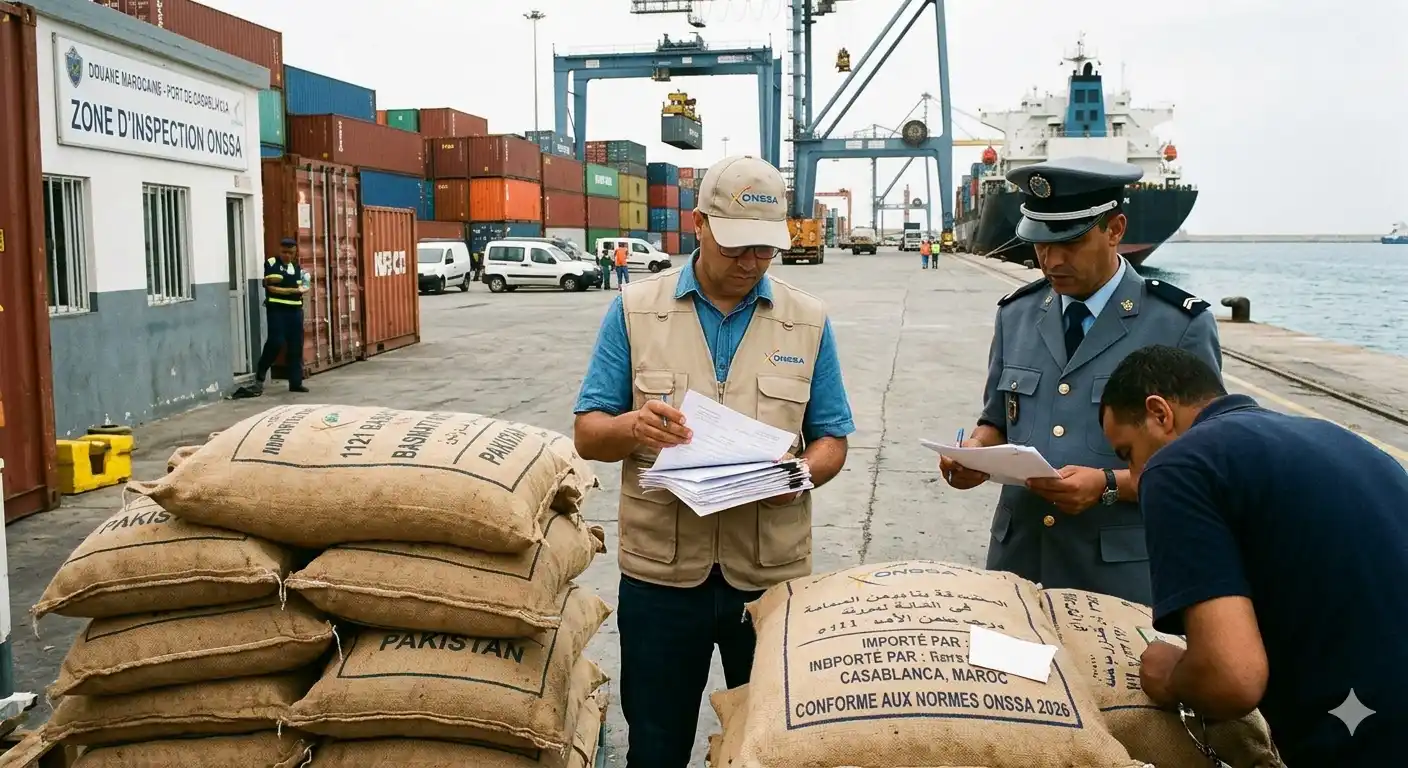
Rice import regulations Morocco 2026 define the legal framework, inspection system, customs requirements, and food safety controls applied to all rice shipments entering Morocco, including phytosanitary certification, tariff classification, labeling rules, and ONSSA clearance procedures at ports such as Casablanca.
Rice import regulations Morocco 2026 refer to a structured set of rules enforced by Moroccan authorities to control rice entry into the country. These regulations ensure food safety, traceability, and compliance with international trade standards.
The system is built around customs law and food safety governance. It applies to all rice varieties such as long grain rice, parboiled rice, and aromatic rice like Basmati 1121, Super Kernel, and 1509 exported from countries such as Pakistan, India, and Thailand.
The regulatory framework connects three major institutions. The Moroccan Customs Administration manages tariff classification and duty collection. The Office National de Sécurité Sanitaire des Produits Alimentaires (ONSSA) manages phytosanitary and food safety clearance. The Ministry of Industry and Trade controls import licensing rules.
Rice shipments must pass documentation checks before physical inspection. The process ensures that imported rice meets hygiene standards and is free from pests, contaminants, and unauthorized chemical residues.
How do rice import regulations in Morocco work under ONSSA system?
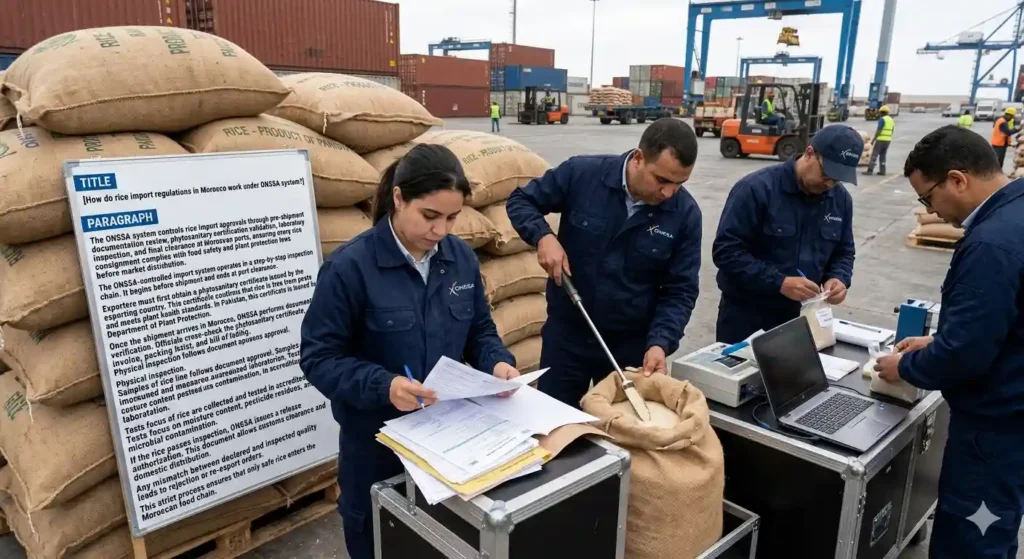
The ONSSA system controls rice import approvals through pre-shipment documentation review, phytosanitary certification validation, laboratory inspection, and final clearance at Moroccan ports, ensuring every rice consignment complies with food safety and plant protection laws before market distribution.
The ONSSA-controlled import system operates in a step-by-step inspection chain. It begins before shipment and ends at port clearance.
Exporters must first obtain a phytosanitary certificate issued by the exporting country. This certificate confirms that rice is free from pests and meets plant health standards. In Pakistan, this certificate is issued by the Department of Plant Protection.
Once the shipment arrives in Morocco, ONSSA performs document verification. Officials cross-check the phytosanitary certificate, invoice, packing list, and bill of lading.
Physical inspection follows document approval. Samples of rice are collected and tested in accredited laboratories. Tests focus on moisture content, pesticide residues, and microbial contamination.
If the rice passes inspection, ONSSA issues a release authorization. This document allows customs clearance and domestic distribution.
Any mismatch between declared and inspected quality leads to rejection or re-export orders. This strict process ensures that only safe rice enters the Moroccan food chain.
What are key regulatory components for rice import into Morocco?
Key regulatory components include phytosanitary certification, customs classification codes, labeling requirements, quality standards, and import documentation rules that together define the compliance structure for all rice imports entering Morocco through official ports.
Rice import regulations Morocco 2026 are built on five core compliance pillars. Each pillar controls a different stage of import approval.
The first component is phytosanitary compliance. It ensures rice is free from pests such as weevils and fungal contamination. This requirement is enforced under ONSSA standards.
The second component is customs classification. Rice is assigned HS codes under international trade classification systems. These codes determine tariff rates and statistical tracking.
The third component is labeling compliance. Imported rice must display origin, variety, net weight, production date, and storage instructions in French or Arabic.
The fourth component is quality specification. Broken percentage, grain length, and moisture levels must match declared export documents.
The fifth component is import documentation. Required documents include commercial invoice, packing list, certificate of origin, bill of lading, and phytosanitary certificate.
Together, these components ensure full traceability of rice shipments from origin countries like Pakistan’s Punjab region to Moroccan retail markets.
What are Morocco rice customs duties and tariff structure?
Morocco rice customs duty structure applies tariff rates based on rice classification, origin country agreements, and import policy frameworks, with additional VAT and administrative fees collected during clearance at Moroccan ports such as Casablanca port.
Morocco applies a structured tariff system to rice imports. Duties depend on rice type, processing level, and trade agreements.
White rice and parboiled rice are classified under separate HS codes. Each code carries a defined customs duty percentage. The duty rate varies depending on whether the exporting country has preferential trade agreements with Morocco.
In addition to customs duty, Morocco applies Value Added Tax (VAT) on imported rice. This tax is calculated on CIF value, which includes cost, insurance, and freight.
Customs clearance is handled by Moroccan Customs Administration. Importers must submit full documentation before tariff assessment.
The Casablanca port is the primary entry point for rice shipments. It handles bulk grain imports, container inspection, and customs processing.
Delays occur when declared HS codes do not match physical inspection results. Accurate classification reduces storage charges and demurrage costs significantly.
What is ONSSA phytosanitary requirement for rice imports?
ONSSA phytosanitary requirements mandate that imported rice must be certified pest-free, chemically safe, and compliant with plant health standards through official inspection certificates issued before shipment and validated upon arrival in Morocco.
Phytosanitary control is the most critical requirement in rice import regulations Morocco 2026. It focuses on protecting Morocco’s agricultural ecosystem from invasive species.
The system requires an official phytosanitary certificate issued by the exporting country. This document confirms that rice has undergone inspection and meets international plant protection standards.
For exports from Pakistan, rice grown in Punjab undergoes pre-shipment cleaning, fumigation, and quality grading before certification.
At Moroccan entry points, ONSSA verifies certificate authenticity and performs random sampling.
Laboratory tests measure pesticide residue levels and detect fungal contamination. Moisture levels above regulatory thresholds trigger rejection or reconditioning requirements.
Container sealing integrity is also inspected. Broken seals indicate tampering and lead to automatic quarantine.
This system ensures that rice entering Morocco maintains agricultural safety and consumer health protection standards.
What role does Halal rice certificate play in Morocco imports?
Halal rice certification confirms compliance with Islamic dietary standards, ensuring rice processing, storage, and packaging meet halal requirements, which supports consumer trust and facilitates smoother market acceptance in Morocco’s predominantly Muslim population.
Halal certification is not always a legal import requirement, but it is a market-driven compliance factor in Morocco.
It ensures that rice processing does not involve non-halal contamination sources during milling, storage, or packaging.
Certification bodies inspect production facilities, cleaning systems, and packaging lines. They verify that no prohibited substances are used in processing aids or storage chemicals.
For imported rice, halal certificates are often required by distributors and retailers before market entry approval.
Pakistani Basmati rice varieties such as 1121 and Super Kernel frequently carry halal certification due to export standards in Punjab processing mills.
In Morocco, halal compliance improves retail acceptance and supports distribution in both urban and wholesale markets.
While ONSSA does not issue halal certification, it ensures that food safety standards align with consumer protection laws.
How does Casablanca port handle rice import clearance?
Casablanca port handles rice import clearance through coordinated customs inspection, ONSSA food safety checks, container scanning, and warehouse release procedures that regulate storage, testing, and final distribution authorization for imported rice shipments.
The Casablanca port is Morocco’s primary logistics hub for grain imports.
Rice containers arrive and are registered in the customs digital system. Each shipment is assigned a tracking reference for inspection coordination.
Customs officers verify commercial documents and HS codes. After this step, ONSSA officials take control for food safety inspection.
Containers are moved to inspection warehouses for sampling. If laboratory results confirm compliance, clearance documents are issued.
Port storage charges apply during inspection delays. Efficient documentation reduces dwell time significantly.
Once cleared, rice is transferred to inland distribution networks serving wholesale markets and retail supply chains across Morocco.
The integration between customs and ONSSA systems ensures controlled and traceable import flow.
What are benefits of compliant import process?
A compliant import process ensures faster customs clearance, reduced shipment delays, lower financial penalties, improved food safety assurance, and stable access to Moroccan rice distribution networks for international exporters.
Compliance with rice import regulations Morocco 2026 provides operational and financial advantages for importers and exporters.
Faster clearance reduces port storage fees. This is critical at high-traffic entry points such as Casablanca port.
Accurate documentation reduces the risk of shipment rejection. Rejected shipments create high reverse logistics costs.
Compliance also improves buyer trust in retail and wholesale markets. Food safety certification assures distributors of product reliability.
Alignment with ONSSA requirements ensures uninterrupted market access.
For exporters from Pakistan, consistent compliance improves long-term trade relationships with Moroccan importers.
Standardized documentation also simplifies repeat shipments. Importers reuse approved documentation templates for faster processing cycles.

What are common problems in rice import regulations Morocco 2026?
Common problems include documentation mismatches, delayed phytosanitary certification, incorrect HS classification, inspection bottlenecks at ports, and non-compliance with ONSSA testing standards, leading to shipment delays or rejection.
The most frequent issue is inconsistent documentation. Differences between invoice, packing list, and certificate of origin trigger inspection delays.
Phytosanitary delays also occur when exporting countries do not issue certificates in standardized formats required by ONSSA.
HS code misclassification leads to incorrect tariff application and customs hold.
Port congestion at Casablanca increases inspection waiting time during peak import seasons.
Laboratory testing failures usually result from pesticide residue levels exceeding permitted thresholds.
Another issue is improper container sealing, which triggers quarantine procedures.
These problems are reduced through accurate pre-shipment inspection, standardized documentation, and strict quality control at the milling stage in origin countries such as Pakistan’s Punjab rice processing zones.