What Grain Length Specifications Do Saudi Arabian Buyers Require from Pakistan Basmati Rice Exporters?
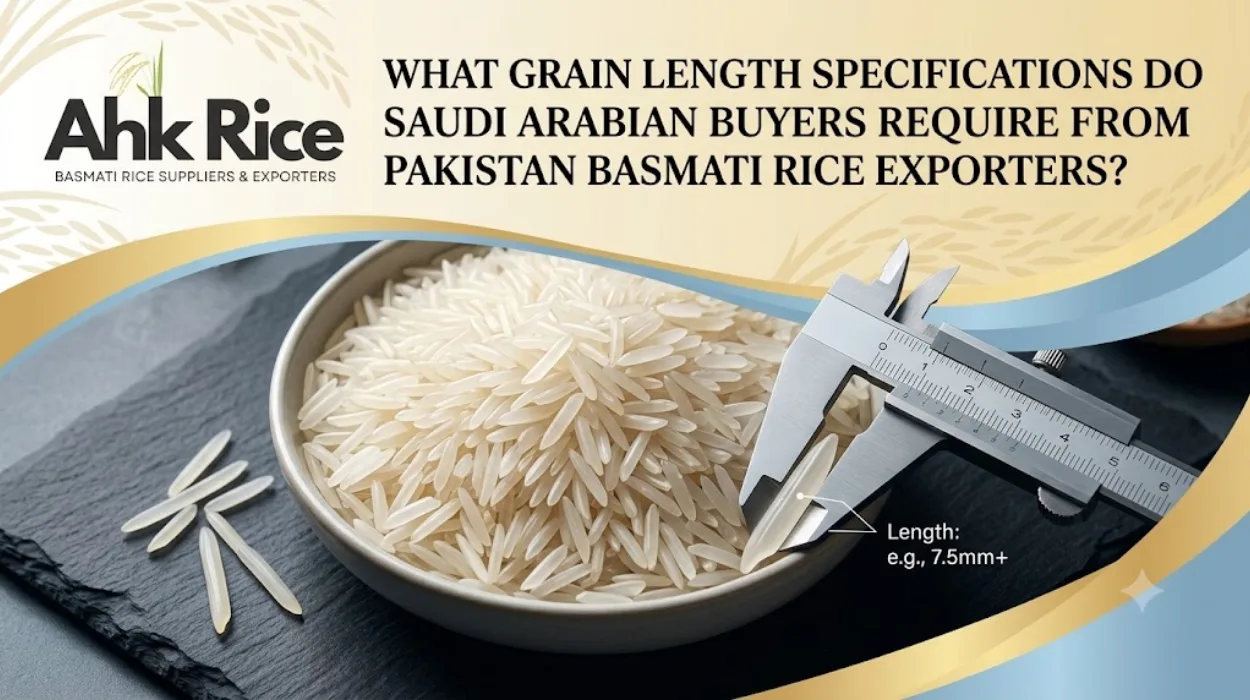
Saudi Arabian buyers require average grain lengths of 8.20 mm to 8.50 mm before cooking and elongation ratios of 1.8 to 2.3 times after cooking for premium Pakistan Basmati rice imports. Here is why: Saudi importers prioritize long grain appearance, low broken percentages, uniform grading, and high cooking expansion for retail, food service, and hospitality sectors. Saudi Arabia remains one of the largest destinations for Pakistani Basmati rice exports, with 1121 Basmati dominating demand due to its exceptional grain length and cooking performance (source: REAP export data, December 2025).
Pakistan Basmati rice serves a market where visual quality influences purchasing decisions. Saudi consumers evaluate grain length before purchase and elongation after cooking. Grain specifications therefore determine product acceptance, pricing, and importer contracts.
Understanding these specifications requires examining grain measurement standards, processing methods, grading systems, certifications, and import requirements.
What Grain Length Specifications Do Saudi Arabian Buyers Require?
Saudi Arabian buyers prefer rice with average grain lengths of 8.20–8.50 mm, broken grain levels below 2–5%, purity above 95%, and strong elongation performance after cooking.
Saudi importers purchase rice according to measurable specifications rather than variety names alone. Grain length remains one of the most important quality indicators. Importers inspect laboratory reports before approving shipments.
Pakistani exporters classify Basmati rice according to grain length, broken percentage, moisture content, and purity level. Saudi buyers typically request detailed specifications within sales contracts.
1121 Basmati Rice Specifications
1121 Basmati rice represents the benchmark grade for Saudi Arabian imports.
| Specification | Typical Saudi Requirement |
|---|---|
| Average Grain Length | 8.20–8.50 mm |
| Broken Rice | 0–5% |
| Moisture Content | 12–14% |
| Purity | 95–100% |
| Foreign Matter | 0.1% maximum |
| Damaged Grains | 0.5% maximum |
| Elongation Ratio | 1.8–2.3x |
1121 Basmati rice achieves one of the longest grain lengths among commercial rice varieties. Saudi retailers frequently position this rice in premium supermarket categories because consumers associate longer grains with superior quality.
Super Kernel Basmati Specifications
Super Kernel Basmati serves a different market segment.
| Specification | Typical Range |
|---|---|
| Average Grain Length | 7.20–7.80 mm |
| Broken Rice | 0–5% |
| Moisture Content | 12–14% |
| Purity | 95–100% |
Super Kernel Basmati remains popular among traditional consumers who prioritize aroma and heritage characteristics over maximum grain length.
Saudi grain length preferences establish the foundation for understanding why specific varieties dominate imports.
What Is Pakistan Basmati Rice and Why Does Saudi Arabia Import It?
Pakistan Basmati rice is an aromatic long-grain rice cultivated in Punjab and selected by Saudi importers for its fragrance, grain length, cooking expansion, and premium presentation.
Basmati rice refers to aromatic rice varieties cultivated within specific geographical regions of Pakistan and India. Pakistan’s Punjab province produces the majority of exported Basmati rice.
Punjab provides fertile alluvial soil, irrigation infrastructure, and climate conditions suitable for long-grain rice cultivation. Farmers cultivate Basmati during the Kharif season and harvest mature crops between October and November.
Saudi Arabia imports large rice volumes because domestic rice cultivation remains limited by water availability and climatic conditions. Imported rice supports household consumption, hospitality businesses, catering companies, restaurants, and religious tourism sectors.
Saudi consumers frequently use Basmati rice in kabsa, mandi, biryani, and traditional Gulf rice dishes. Long grains create the visual presentation preferred in these meals.
Major Pakistani Basmati Varieties Exported to Saudi Arabia
Several varieties serve Saudi import demand.
- 1121 Steam Basmati Rice
- 1121 Golden Sella Basmati Rice
- 1121 White Basmati Rice
- Super Kernel Basmati Rice
- PK 386 Long Grain Rice
- 1509 Basmati Rice
1121 Basmati rice accounts for the largest premium segment because its grain length exceeds most competing varieties.
With the role of Basmati rice established, the next question is how exporters achieve these grain specifications.
How Do Pakistan Basmati Rice Exporters Achieve Required Grain Length Standards?
Rice exporters maintain grain length standards through controlled cultivation, precise harvesting, advanced milling, grading systems, and laboratory testing procedures.
Grain length originates in the field but remains dependent on processing quality. Improper handling reduces average grain size through breakage.
Rice processors follow a structured workflow to preserve grain integrity.
Rice Processing Steps
- Harvest mature paddy at optimal moisture levels.
- Clean paddy to remove impurities.
- Dry paddy to target moisture content.
- Store paddy under controlled conditions.
- De-husk rice grains.
- Polish rice according to product specification.
- Grade rice by length and quality.
- Sort grains using optical sorting systems.
- Inspect finished lots through laboratory testing.
Modern rice mills use length graders to separate grains into commercial categories. Length grading ensures buyers receive consistent specifications across each shipment.
Quality Testing Procedures
Laboratories verify export quality before dispatch.
- Grain length measurement
- Broken percentage analysis
- Moisture testing
- Purity verification
- Chalkiness inspection
- Foreign matter testing
- Cooking quality assessment
Saudi buyers frequently request pre-shipment inspection reports from recognized inspection agencies before shipment approval.
Processing precision directly influences grading systems, making rice grades the next important topic.
What Grades of Pakistan Basmati Rice Meet Saudi Import Standards?
1121 Steam, 1121 Golden Sella, 1121 White, and selected Super Kernel grades meet Saudi import standards when grain length, purity, and moisture specifications match contract requirements.
Rice grades define commercial quality levels. Different buyers select different grades according to target markets.
1121 Steam Basmati Rice
1121 Steam rice undergoes steaming before milling.
Key characteristics include:
- 8.20–8.50 mm grain length
- Bright appearance
- Soft texture
- Strong elongation
Saudi retail brands frequently choose Steam rice because consumers prefer its appearance and cooking characteristics.
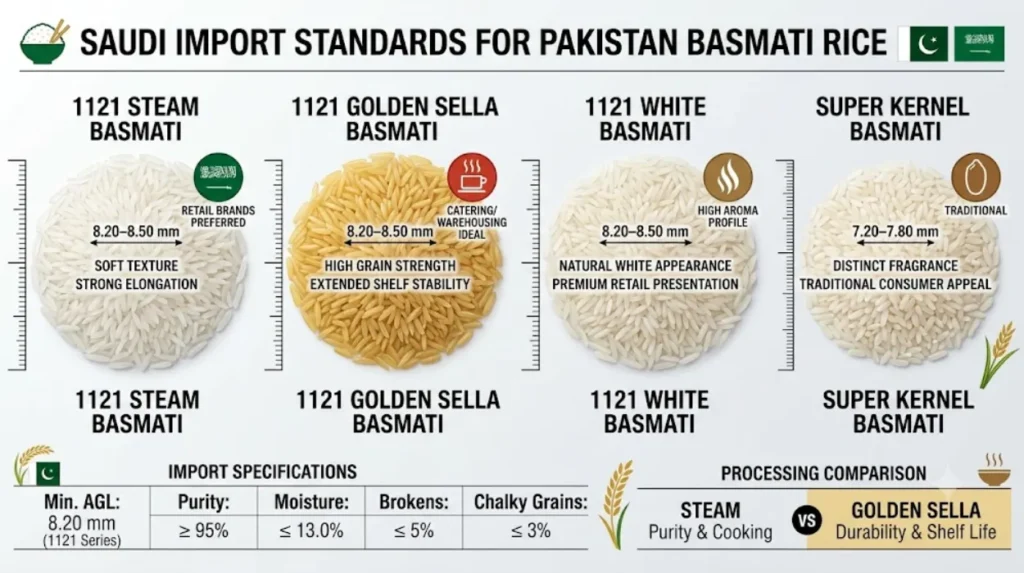
1121 Golden Sella Basmati Rice
1121 Golden Sella rice undergoes parboiling before milling.
Key characteristics include:
- 8.20–8.50 mm grain length
- Golden color
- Strong grain strength
- Extended shelf stability
Golden Sella lasts longer than Steam rice. In hot Gulf storage environments, Golden Sella maintains grain integrity during extended warehousing periods. Large catering operators often select Golden Sella for this reason.
1121 White Basmati Rice
1121 White rice receives standard milling without steaming or parboiling.
Key characteristics include:
- Natural white appearance
- Premium retail presentation
- Strong aroma profile
White rice remains popular in premium supermarket channels.
Super Kernel Basmati Rice
Super Kernel Basmati offers traditional aroma characteristics.
Key characteristics include:
- 7.20–7.80 mm grain length
- Distinct fragrance
- Traditional consumer appeal
For a detailed explanation of how specific 1121 grades align with Saudi import specifications, readers can explore the comparison between steam, white, and sella processing methods in our guide about grain-length-based grade selection for Saudi buyers.
With grade classifications explained, the next question concerns the certifications that support Saudi imports.
What Certifications Apply to Pakistan Basmati Rice Exports for Saudi Arabia?
Saudi importers typically require food safety, quality management, phytosanitary, and conformity certifications before accepting rice shipments.
Certification verifies product safety and regulatory compliance.
Saudi authorities inspect documentation before allowing commercial imports.
Common Export Certifications
- ISO 22000 Food Safety Management
- HACCP Certification
- Phytosanitary Certificate
- Certificate of Origin
- Health Certificate
- SGS Inspection Reports
- SASO-related compliance documentation
Food safety certifications demonstrate controlled processing systems. Importers use these certifications to reduce supply chain risks.
Government and Industry Oversight
Pakistani rice exports operate under regulatory frameworks involving multiple organizations.
- Rice Exporters Association of Pakistan (REAP)
- Trade Development Authority of Pakistan (TDAP)
- Department of Plant Protection (DPP)
- Pakistan Standards and Quality Control Authority (PSQCA)
Export certification supports quality assurance, but buyers also evaluate practical business benefits.
What Benefits Do Saudi Buyers Gain from Longer Grain Basmati Rice?
Longer grain Basmati rice delivers stronger visual appeal, higher perceived quality, improved cooking presentation, and greater consumer acceptance.
Grain length influences purchasing behavior across retail and food service markets.
Saudi consumers frequently associate longer rice grains with premium quality.
Benefits for Retail Importers
Retail importers gain several advantages.
- Premium shelf positioning
- Higher consumer preference
- Stronger brand differentiation
- Better packaging presentation
Long grains remain visually attractive through transparent packaging.
Benefits for Food Service Operators
Hotels, restaurants, and catering companies prioritize cooking performance.
Benefits include:
- Better plate presentation
- Higher volume after cooking
- Improved grain separation
- Reduced breakage during preparation
Long grains create a premium appearance in kabsa and mandi dishes. Hospitality operators therefore prefer high-elongation Basmati grades.
Benefits explain demand growth, but misconceptions still influence purchasing decisions.
What Common Misconceptions Exist About Saudi Arabian Grain Length Requirements?
Many buyers assume all long-grain rice meets Saudi standards, but grain length alone does not determine import acceptance.
Grain length represents one quality factor among several measurable specifications.
Misconception: Longer Grain Always Means Better Quality
Length alone does not guarantee premium quality.
Rice with 8.50 mm grain length but high broken content performs worse than rice with 8.30 mm grain length and excellent purity.
Importers evaluate multiple factors simultaneously.
Misconception: All 1121 Rice Grades Are Identical
Processing methods create significant differences.
Steam rice offers a different texture than Golden Sella rice. White rice provides a different appearance than both. Saudi buyers select specifications according to market segment requirements.
Misconception: Grain Length Determines Cooking Performance
Cooking performance depends on multiple variables.
- Grain length
- Moisture content
- Variety genetics
- Milling quality
- Storage conditions
Laboratory cooking tests remain essential because visual inspection alone cannot predict final cooking quality.
Understanding these misconceptions helps buyers evaluate rice according to measurable standards rather than assumptions.
Why Does Grain Length Remain a Critical Specification in Saudi Arabia?
Grain lengths of 8.20–8.50 mm remain the preferred benchmark because Saudi consumers associate long grains with premium quality, superior presentation, and authentic Basmati characteristics.
Saudi Arabia continues to rank among the most important destinations for Pakistani Basmati rice exports (source: Pakistan Bureau of Statistics, FY2024-25). Consumer preferences consistently favor long grains, strong elongation, low breakage, and uniform appearance.
1121 Basmati rice satisfies these expectations through exceptional grain length and cooking expansion. Exporters maintain compliance through controlled cultivation, advanced milling, grading systems, and laboratory verification.
Grain length therefore functions as both a quality indicator and a commercial requirement within the Saudi rice market.
Frequently Asked Questions
What grain length is considered premium for Saudi Arabian Basmati rice imports?
Saudi Arabian buyers generally consider Basmati rice with an average grain length of 8.20 mm to 8.50 mm as premium quality. This specification is most commonly associated with Pakistan 1121 Basmati rice. Longer grains provide better visual appeal, stronger cooking elongation, and higher consumer acceptance in retail and food service markets.
Which Pakistani Basmati rice variety is most popular in Saudi Arabia?
Pakistan 1121 Basmati rice is the most popular variety in Saudi Arabia. Importers prefer it because of its extra-long grain length, strong aroma, high elongation ratio, and attractive appearance after cooking. It is widely used in kabsa, mandi, biryani, and hospitality sector applications.
Does grain length affect the cooking quality of Basmati rice?
Yes, grain length influences cooking performance, but it is not the only factor. Cooking quality also depends on moisture content, milling quality, rice variety, and storage conditions. High-quality 1121 Basmati rice combines long grains with strong elongation and excellent grain separation after cooking.
What certifications are required for exporting Basmati rice to Saudi Arabia?
Saudi Arabian importers typically require a Phytosanitary Certificate, Certificate of Origin, Health Certificate, and food safety certifications such as ISO 22000 and HACCP. Many buyers also request third-party inspection reports to verify quality specifications before shipment.
Why do Saudi buyers prefer 1121 Golden Sella Basmati rice?
Saudi buyers prefer 1121 Golden Sella Basmati rice because it offers strong grain strength, long shelf life, and excellent cooking performance. The parboiling process helps preserve grain integrity during storage and transportation, making it suitable for large-scale catering, hospitality, and wholesale distribution.