Select a Pakistan Basmati Rice Supplier That Meets Saudi Arabian Moisture Requirements
Saudi Arabian rice buyers reduce quality risks by selecting suppliers that consistently meet moisture specifications before shipment. If your procurement process depends on reliable cooking performance, long shelf life, and lower claims after delivery, choosing an exporter with verified moisture control is more important than selecting the lowest price. Before comparing suppliers, it is useful to understand:
How Saudi importers assess moisture levels in Pakistan Basmati rice through standardized inspection methods, then compare:
The moisture specifications that separate premium and standard export grades. These evaluation steps help buyers make confident purchasing decisions before signing export contracts.
Saudi Arabia remains one of the largest destinations for premium Pakistani Basmati rice in 2026. Importers expect every shipment to comply with contractual moisture limits because excessive moisture increases the risk of mold, discoloration, insect activity, reduced shelf life, and customer complaints. A supplier that manages moisture from procurement to container loading protects product quality throughout the export process.
For buyers seeking dependable exports to Saudi Arabia, AHK Rice provides controlled processing, laboratory testing, export documentation, customized packaging, and shipping support that align with Saudi import requirements. AHK Rice works with importers, wholesalers, distributors, retail brands, and food-service companies that require consistent quality throughout every shipment.
What is the best solution for selecting a Pakistan Basmati rice supplier for Saudi Arabia?
The best solution is choosing a supplier that controls moisture throughout procurement, milling, grading, storage, packaging, inspection, and container loading while supporting every shipment with laboratory reports, internationally accepted certifications, and complete export documentation that satisfies Saudi Arabian buyer specifications and minimizes commercial risks.
Many exporters can supply rice. Fewer can consistently maintain moisture specifications from harvest until the container reaches the destination port. Moisture management is not a single inspection performed before shipment. It is a controlled process covering every production stage.
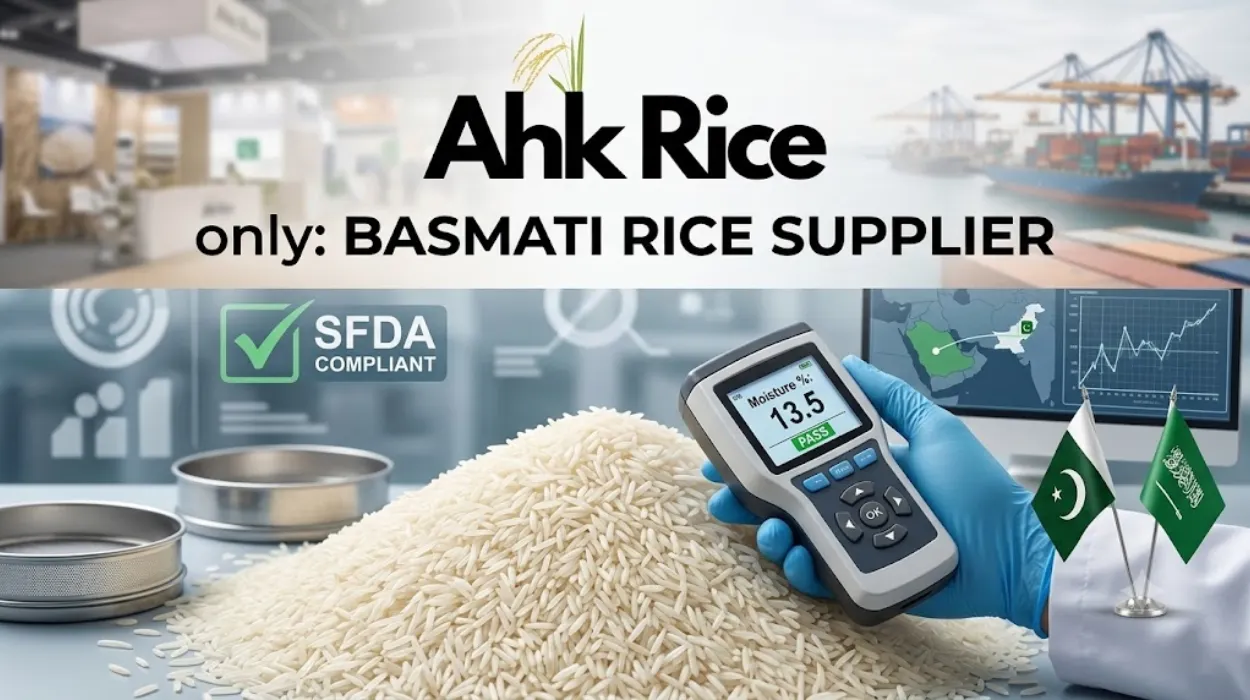
AHK Rice applies moisture monitoring during paddy selection, drying, milling, polishing, grading, packaging, warehouse storage, and final loading. Every batch is tested before dispatch to confirm compliance with the agreed contract specification.
The first mention of Pakistan Basmati rice should also include access to the dedicated Saudi Arabia service, where buyers can review export capabilities and available packaging options before requesting a quotation.
A qualified supplier should provide:
- Moisture testing reports
- Fumigation certificates where required
- Phytosanitary documentation
- Certificate of Origin
- Commercial invoice
- Packing list
- Bill of Lading
- Quality inspection reports
- SGS or equivalent third-party inspection when requested
These documents reduce customs delays and help Saudi importers verify product conformity before cargo arrives.
Why choose Saudi Arabia export services from AHK Rice?
Choosing a supplier with specialised Saudi Arabia export experience improves shipment consistency, simplifies documentation, reduces moisture-related quality risks, supports faster customs clearance, and provides buyers with predictable product quality across repeat orders, contract renewals, and long-term commercial supply agreements.
Saudi Arabia has strict commercial expectations for imported Basmati rice. Buyers frequently specify maximum acceptable moisture levels, broken percentages, grain length, purity, packaging materials, labeling requirements, and inspection procedures.
AHK Rice supplies several export grades including:
- 1121 Steam Basmati Rice
- 1121 Sella Basmati Rice
- 1121 White Basmati Rice
- Super Kernel Basmati Rice
- 1509 Steam Basmati Rice
- 1509 Sella Basmati Rice
Each product can be packed according to buyer requirements, including:
- 1 kg
- 2 kg
- 5 kg
- 10 kg
- 20 kg
- 25 kg
- 40 kg
- 50 kg
Private labeling and OEM packaging are also available for distributors building retail brands in Saudi Arabia.
Because Saudi importers often operate long-term distribution contracts, shipment consistency matters more than isolated low pricing. AHK Rice focuses on maintaining repeatable quality standards across multiple containers rather than treating every order as an independent shipment.
What shipping times should Saudi Arabian buyers expect?
Shipping schedules depend on production readiness, inspection requirements, vessel availability, and destination port, but experienced exporters provide transparent production timelines and realistic transit estimates instead of promising delivery dates they cannot consistently achieve.
Typical production and export timelines during 2026 are shown below.
| Export Stage | Typical Time |
|---|---|
| Contract confirmation | 1 day |
| Advance payment confirmation | 1–2 days |
| Production scheduling | 1 day |
| Milling and grading | 3–5 days |
| Packaging | 2–3 days |
| Laboratory inspection | 1 day |
| Container loading | 1 day |
| Export documentation | 1–2 days |
Approximate sea transit times from Pakistan ports include:
| Saudi Destination | Estimated Transit |
|---|---|
| Jeddah Islamic Port | 10–14 days |
| King Abdulaziz Port, Dammam | 12–16 days |
| Jubail Commercial Port | 13–17 days |
| Yanbu Commercial Port | 12–16 days |
Actual transit depends on vessel schedules, weather conditions, customs processing, and shipping line operations.
Providing realistic shipping expectations helps buyers coordinate inventory planning and warehouse management more effectively.
What results can buyers expect from working with AHK Rice?
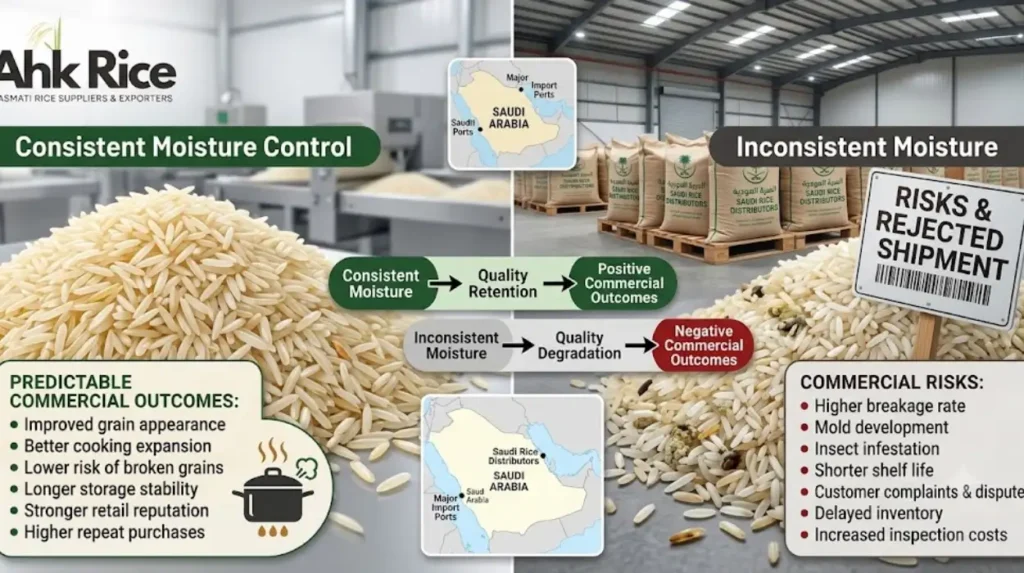
A supplier that consistently controls moisture and quality throughout production delivers better cooking performance, longer storage stability, fewer customer complaints, stronger retail reputation, and more predictable commercial outcomes for Saudi Arabian distributors, wholesalers, and food-service companies.
Consistent moisture control directly influences product performance after arrival.
Expected commercial outcomes include:
- Improved grain appearance
- Better cooking expansion
- Lower risk of broken grains during handling
- Longer shelf life under suitable storage
- Reduced mold risk
- Lower insect infestation risk
- Better customer satisfaction
- Fewer shipment disputes
- Higher repeat purchase rates
Consider a Saudi supermarket chain importing twenty containers annually.
If inconsistent moisture causes only one rejected shipment, the importer may experience delayed inventory, additional inspection costs, storage charges, customer dissatisfaction, and replacement negotiations.
A supplier that maintains stable moisture specifications helps reduce those commercial risks.
This reliability explains why many buyers prefer long-term supply agreements rather than switching exporters every season.
AHK Rice supports repeat contracts through standardized production procedures instead of relying solely on final inspection.
How much does moisture-controlled Pakistan Basmati rice cost?
Export pricing depends on rice variety, crop season, grain quality, packaging configuration, order quantity, inspection requirements, shipping destination, freight rates, and contract volume rather than moisture control alone because quality assurance forms part of the complete export process.
Several commercial factors influence pricing.
Product specification
Premium export grades generally command higher prices because they require stricter sorting, grading, and quality control.
Packaging
Retail bags cost more than bulk woven sacks because of printing, packaging materials, and handling requirements.
Quantity
Container-load purchases usually receive better pricing than partial container shipments.
Shipping market
Ocean freight changes throughout the year according to shipping demand and vessel availability.
Inspection
Third-party inspections increase overall shipment costs but improve buyer confidence.
Certifications
Additional documentation requested by certain buyers may affect final pricing.
Rather than selecting the lowest quotation, procurement managers should compare the complete commercial offer, including:
- Moisture specification
- Quality guarantee
- Packaging quality
- Inspection process
- Export documentation
- Production capability
- Shipment consistency
- Customer support
Lower prices can become more expensive if quality claims occur after delivery.
What is the complete sample process before placing a bulk order?
A structured sampling process allows buyers to verify moisture, grain appearance, cooking quality, aroma, purity, packaging, and laboratory compliance before approving commercial production, reducing procurement uncertainty and supporting confident purchasing decisions for larger export contracts.
Professional exporters normally follow a structured sampling workflow.
Step 1: Product consultation
The buyer specifies:
- Rice variety
- Grade
- Moisture requirement
- Packaging
- Target quantity
- Destination port
Step 2: Sample preparation
Representative samples are selected from export-ready production rather than specially prepared batches.
Step 3: Laboratory testing
Testing may include:
- Moisture percentage
- Broken percentage
- Chalkiness
- Purity
- Grain length
- Foreign matter
Step 4: Sample dispatch
Courier services generally deliver samples internationally within several business days depending on destination.
Step 5: Buyer evaluation
The importer performs:
- Visual inspection
- Cooking tests
- Aroma evaluation
- Laboratory confirmation where required
Step 6: Commercial approval
After approval, production begins according to the agreed specifications.
Typical sample-related costs in 2026 include:
| Item | Typical Cost Range |
|---|---|
| Sample quantity | Usually 500 g–2 kg |
| Sample preparation | Often complimentary |
| Laboratory testing | Approximately USD 20–80 depending on requested analyses |
| International courier | Approximately USD 40–120 depending on destination and weight |
| Third-party inspection sample | Additional inspection fees may apply |
Many exporters deduct certain sampling expenses from confirmed commercial orders, although policies differ by supplier.
AHK Rice assists buyers throughout this evaluation process to ensure that approved samples accurately represent commercial production.
How can buyers get started with AHK Rice?
The purchasing process begins by defining product specifications, confirming commercial requirements, reviewing samples, approving quality standards, agreeing shipment schedules, and completing documentation before production starts, ensuring both buyer and supplier share identical expectations before export begins.
A successful procurement project follows a structured sequence.
First, identify the required rice variety and intended application.
Second, define moisture specifications, grain quality, broken percentage, packaging, labeling, and quantity.
Third, request representative samples for technical evaluation.
Fourth, compare commercial offers based on total value rather than price alone.
Fifth, confirm production schedules and shipment timelines.
Finally, proceed with commercial documentation and export planning.
Throughout every stage, AHK Rice works with buyers to provide clear communication, production transparency, quality verification, and documentation support that align with Saudi Arabian import expectations.
Selecting a supplier should always focus on long-term reliability instead of one shipment. Moisture control, standardized production, transparent inspection, accurate documentation, and predictable logistics together determine whether a supplier can consistently satisfy commercial requirements.
For Saudi Arabian importers seeking dependable Pakistan Basmati rice exports, evaluating these factors before signing a contract helps reduce procurement risk and supports stable supply throughout the year. When you are ready to discuss your specifications, request samples, or receive a tailored quotation, visit request a quote as your final step.
Frequently Asked Questions
How do Saudi Arabian buyers verify moisture compliance before purchasing?
Saudi Arabian buyers verify moisture compliance through laboratory reports, third-party inspections when required, quality certificates, and representative product samples tested against agreed contract specifications.
Why is moisture content important for Pakistan Basmati rice exports?
Moisture content directly affects shelf life, grain appearance, cooking quality, mold resistance, and the overall commercial value of Pakistan Basmati rice during storage and transportation.
How long does it take to ship Pakistan Basmati rice to Saudi Arabia?
Production generally takes 7–10 days after order confirmation, while sea freight to major Saudi ports typically ranges from 10–16 days depending on the destination and shipping schedule.
What documents should a Pakistan rice supplier provide for Saudi Arabia?
A reliable supplier should provide a commercial invoice, packing list, Certificate of Origin, phytosanitary certificate, Bill of Lading, quality report, and inspection certificates when requested.
How is the export sample process completed?
The process includes product selection, sample preparation, laboratory testing, courier dispatch, buyer evaluation, and final approval before commercial production begins.
What factors affect the price of Pakistan Basmati rice exports?
Pricing depends on rice variety, grade, moisture specification, packaging type, order quantity, inspection requirements, freight charges, and seasonal market conditions.
Why should buyers choose AHK Rice for Saudi Arabia?
AHK Rice offers controlled moisture management, consistent quality, customized packaging, export documentation, and reliable shipment planning tailored to Saudi Arabian import requirements.
Can AHK Rice provide customized packaging for Saudi importers?
Yes. AHK Rice offers retail and bulk packaging options, private labeling, and custom branding to meet the requirements of distributors, wholesalers, retailers, and food-service businesses.
What moisture level is commonly specified for premium Pakistan Basmati rice?
Premium export contracts commonly specify moisture levels around 12–14%, depending on the rice variety and the buyer’s contractual quality requirements.
How can buyers start importing Pakistan Basmati rice from AHK Rice?
Buyers can begin by sharing their product specifications, requesting samples, confirming quality requirements, approving pricing, and finalizing the export agreement before production starts.