Secure Year-Round Basmati Supply for the UAE with AHK Rice’s Forward Contracts
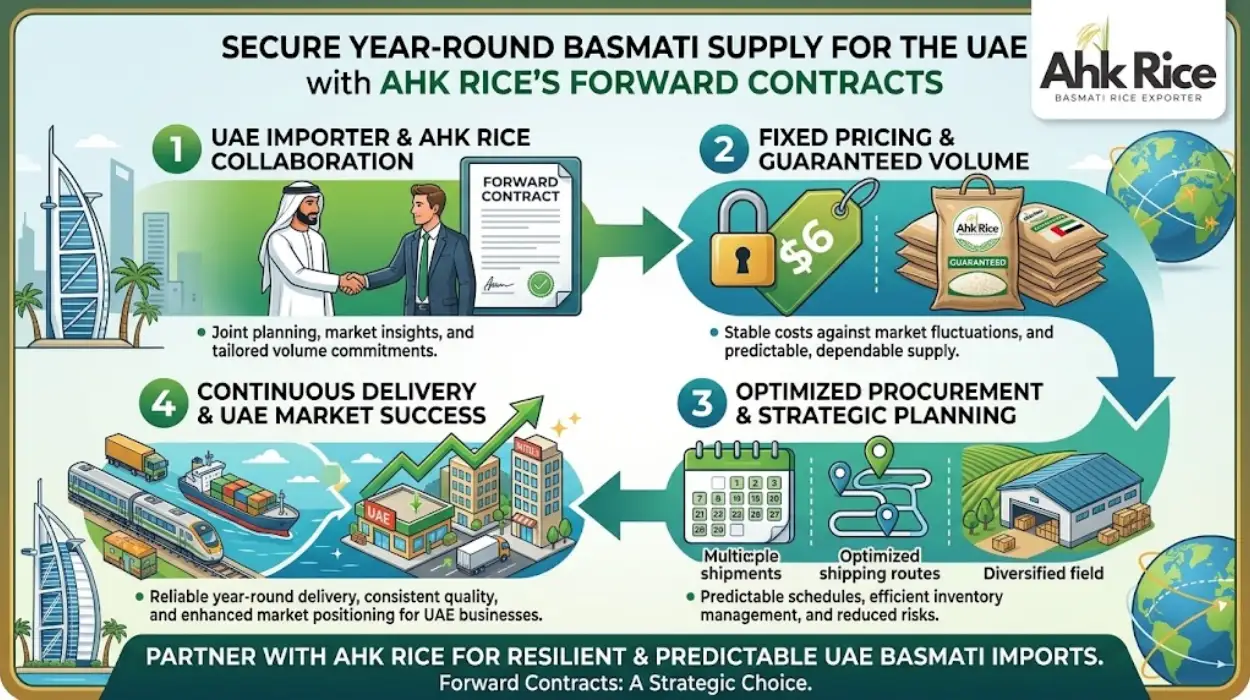
UAE rice importers, wholesalers, distributors, supermarkets and foodservice buyers need a dependable Basmati supply throughout the year. Seasonal purchasing, changing export prices, inconsistent grain specifications and shipping delays can disrupt stock availability and reduce profit margins. Forward contracts provide a structured way to plan procurement, agree commercial specifications and coordinate shipments against expected demand.
AHK Rice is a Pakistani Basmati rice exporter based in Punjab, supplying 1121, Super Kernel, and 1509 Basmati rice to international markets. Its export process covers rice processing, grading, custom packaging and shipment documentation. Buyers can evaluate the size and structure of the UAE Basmati rice market before planning their purchasing requirements and discussing a supply arrangement with AHK Rice.
What is the best solution for securing year-round Basmati rice supply in the UAE?
A forward supply agreement is an effective solution for UAE buyers who need predictable procurement, consistent specifications and planned deliveries. It establishes the commercial basis for repeat orders, while shipment schedules, pricing terms, quality parameters and documentation requirements must be agreed before the contract is confirmed.
Spot purchasing can suit importers who need an immediate shipment or want to benefit from a temporary market opportunity. However, relying exclusively on spot orders exposes buyers to changing quotations, fluctuating freight costs and uncertainty about future availability. These risks become more significant when a distributor supplies supermarkets, restaurants, catering companies or wholesale customers under ongoing commitments.
A forward contract creates a purchasing framework around anticipated demand. The buyer and exporter define the rice variety, grade, quantity, packing format, price mechanism, delivery schedule and applicable Incoterm. They also establish how quality will be checked and which documents must accompany the shipment.
For example, a Dubai distributor expecting monthly demand for 1121 Steam Basmati can plan several deliveries instead of sourcing every shipment independently. The contract may establish monthly quantities and a quotation validity period, with each shipment confirmed against agreed specifications and operational availability.
A forward contract does not automatically guarantee a fixed price, unlimited stock or an exact arrival date. Those commitments depend on the written terms, production capacity, payment arrangements, carrier schedules and agreed remedies for delays. Importers should distinguish between a fixed-price agreement and a formula-based contract that allows specified market adjustments.
Why should UAE importers choose AHK Rice for forward Basmati supply?
AHK Rice offers UAE buyers a single export-sourcing route for Pakistani Basmati varieties, processing, grading, packaging and shipment coordination. Importers can align their purchasing specifications with their target market, evaluate a commercial sample and establish documented quality requirements before approving a larger order.
AHK Rice supplies three commercially relevant options. Each serves a different purchasing objective, so buyers should select varieties according to cooking performance, retail positioning and landed-cost targets rather than grain length alone.
- 1121 Basmati: Suitable for premium retail, biryani-focused foodservice and customers who prioritize long grains and cooked elongation.
- Super Kernel Basmati: Suitable for traditional Basmati retail and wholesale distribution where aroma, cooking characteristics and competitive sourcing matter.
- 1509 Basmati: Suitable for buyers seeking a value-oriented option for bulk distribution, catering and price-sensitive customer segments.
The export arrangement can include raw, Steam or Sella specifications where available and commercially suitable. Buyers should identify the required processing type explicitly because Steam and Sella rice have different processing characteristics and may deliver different cooking results.
AHK Rice can also discuss packing formats such as 5 kg, 10 kg, 25 kg and 50 kg bags, subject to the agreed order and production capabilities. Retail buyers may require branded consumer packaging, while foodservice distributors often prioritize durable bulk bags, clear identification and efficient warehouse handling.
For UAE imports, the commercial specification should include variety, processing type, grain-length target, moisture limit, broken percentage, foreign-matter tolerance, bag weight, packaging material and marking requirements. Both parties should confirm the final specification in writing rather than relying on a product name or general quality description.
Importers reviewing changing market conditions can also compare demand patterns and seasonal purchasing considerations in Pakistani Basmati rice export trends to the UAE. This comparison helps buyers determine whether to prioritize premium 1121, traditional Super Kernel or more cost-conscious 1509 for their distribution channels.
What results can UAE buyers expect from a forward supply arrangement?
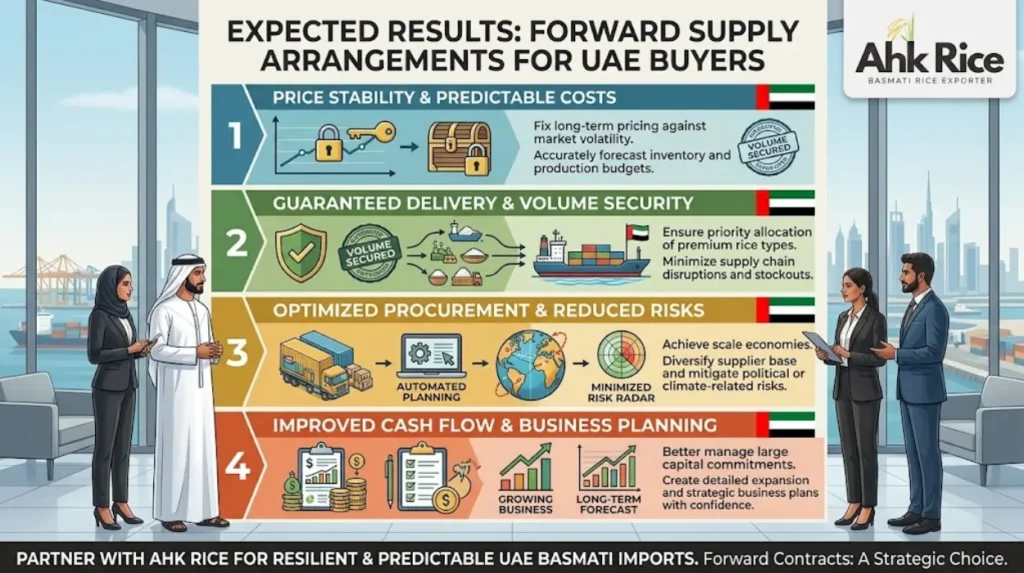
A well-defined supply agreement improves procurement visibility, supports inventory planning and reduces repeated negotiation over routine specifications. Its commercial value depends on accurate forecasts, enforceable terms, timely payments, agreed quality controls and realistic shipment schedules rather than on a guarantee of uninterrupted supply.
The first expected outcome is improved purchasing visibility. When an importer forecasts quarterly demand, the exporter can evaluate the proposed quantities and production requirements before shipment dates are finalized. The importer can then coordinate warehouse capacity, customer promotions and replenishment orders.
The second outcome is greater specification consistency. A documented contract establishes the agreed grade and quality parameters for each shipment. A pre-shipment sample, agreed inspection procedure and Certificate of Analysis (COA), where applicable, give both parties a reference for assessing conformity.
The third outcome is better budget management. Buyers can compare a fixed-price offer with a market-linked quotation and assess how freight, insurance, packaging, financing and customs-related charges affect the landed cost. The appropriate arrangement depends on price volatility, contract duration and the buyer’s tolerance for market movements.
Consider a UAE wholesaler planning three deliveries across a quarter. A supply schedule can identify target quantities, required arrival windows and minimum warehouse stock. If demand increases, the buyer can request an additional shipment, subject to availability and a written amendment.
These outcomes should be measured against actual performance. Useful indicators include on-time shipment, conformity with agreed specifications, landed cost per metric tonne, order fulfilment and stock availability. A forward agreement provides the framework for managing these indicators; it does not eliminate agricultural, logistical or market risks.
How many days does Basmati rice shipping from Pakistan to the UAE take?
Sea freight from Pakistan to the UAE often takes approximately 3–10 days of port-to-port transit, depending on the Pakistani departure port, UAE destination, service routing and vessel schedule. Allow additional time for processing, stuffing, port handling, customs clearance and final delivery.
The following planning ranges are indicative estimates, not guaranteed transit commitments. Actual schedules depend on the carrier, port congestion, vessel availability, routing and documentation readiness.
| UAE destination | Indicative sea transit | Main planning consideration |
|---|---|---|
| Jebel Ali, Dubai | 3–7 days | Vessel schedule and terminal handling |
| Khalifa Port, Abu Dhabi | 4–8 days | Service routing and port availability |
| Sharjah or Ajman delivery | 3–10 days to a relevant UAE port | Final inland transport and clearance |
These ranges are preliminary planning assumptions. Importers should obtain a current shipping schedule and a written estimated arrival date for the specific booking before making downstream commitments.
Total order lead time is longer than sea transit alone. Rice must be available or processed to specification, packed, inspected where required, documented, loaded and released for export. The importer must also complete the relevant UAE food-import procedures and arrange clearance and inland delivery.
A practical contract should distinguish the expected dispatch date, vessel departure, estimated arrival, customs clearance and warehouse delivery. It should also specify how the parties communicate schedule changes and which costs apply if delays occur.
What factors affect the price of a Basmati rice forward contract?
Forward-contract pricing depends on rice variety, processing type, quality grade, quantity, packaging, contract duration, payment terms, freight and the agreed Incoterm. Importers should compare the complete landed cost and the contract’s price-adjustment rules rather than choosing an exporter solely by the lowest quoted price.
The main pricing factors include:
- Variety and processing: Premium 1121, Super Kernel and 1509 have different market positions. Steam and Sella processing can also affect production costs and buyer preferences.
- Quality specification: Grain length, moisture, broken percentage, purity and inspection requirements influence the offer.
- Order quantity: Larger commitments may improve production and freight planning, but savings depend on the actual quotation and shipment economics.
- Packaging: Retail-ready printed bags generally require different preparation from standard bulk packaging. Artwork, printing quantities and bag materials affect costs.
- Delivery terms: FOB, CFR and CIF allocate freight, insurance and responsibilities differently. Buyers should compare equivalent delivery terms.
- Payment and duration: Advance payment, documentary arrangements, credit terms and the length of the price-validity period affect commercial risk.
- Market conditions: Paddy availability, milling costs, exchange rates, freight rates and seasonal demand can change the price between quotations.
A reliable quotation should identify the currency, price per metric tonne, quantity, packing, quality parameters, delivery term, payment conditions and validity date. If the contract covers multiple shipments, it should state whether the price remains fixed or is recalculated under a defined formula.
Importers should also calculate landed cost per tonne by including the applicable freight, insurance, destination handling, customs duties, taxes, inspection and local delivery charges. These costs depend on the shipment and the buyer’s circumstances, so they should be verified rather than assumed.
How does the AHK Rice sample approval process work, and what does it cost?
The sample process allows UAE buyers to assess grain appearance, aroma, cooking performance and conformity before committing to a commercial shipment. Sample rice may be offered up to 20 kg for evaluation, with the buyer covering courier shipping and applicable phytosanitary charges under the stated sample arrangement.
AHK Rice’s sample-to-order process should follow these steps:
Step 1: Submit the purchasing requirement. The buyer identifies the variety, processing type, intended use, approximate order volume, packaging needs and UAE delivery destination. This information helps establish whether the requested specification is commercially suitable.
Step 2: Confirm the sample specification. The exporter and buyer agree on the sample variety and grade. If the buyer is considering 1121 Steam and Super Kernel, separate samples may be necessary to evaluate each option accurately.
Step 3: Confirm sample costs. Under the stated offer, up to 20 kg of Super Kernel Basmati may be supplied free for sampling. The buyer pays the courier charges and any applicable phytosanitary fees. The total cost depends on the destination, parcel weight, courier service and documentation requirements. A current written estimate should be obtained before dispatch.
Step 4: Dispatch and evaluate. Once the sample and shipping arrangements are confirmed, the exporter prepares the parcel and applicable documents. The buyer evaluates raw grain characteristics and conducts a cooking test using its intended preparation method. Courier delivery time depends on the service and customs processing.
Step 5: Approve the commercial specification. The buyer records the accepted variety, processing type, quality parameters and packaging requirements. Any required COA parameters, third-party inspection arrangements and tolerances should be agreed before production or shipment.
Step 6: Confirm the order. The parties agree on quantity, price, payment, shipment schedule and Incoterm. The commercial contract should identify the approved specification and explain how any quality discrepancy will be handled.
A free sample is not a commitment to purchase, and sample approval does not replace applicable food-import checks or contractual quality controls. Importers should retain the approval record and ensure the commercial shipment conforms to the written specification.
How can UAE importers get started with year-round Basmati supply?
Start by sharing a realistic demand forecast, preferred rice variety, quality specification, packing format and target delivery schedule. AHK Rice can then assess the requirements, discuss sample evaluation and prepare a commercial proposal for a forward supply arrangement, subject to availability and agreed terms.
Before requesting a quotation, prepare the following information:
- Demand forecast: Monthly or quarterly volume in metric tonnes, including expected peak-season requirements.
- Product requirements: 1121, Super Kernel or 1509, with the required raw, Steam or Sella processing type.
- Quality criteria: Grain length, moisture, broken percentage, purity and any agreed inspection or COA requirements.
- Packaging: Bag sizes, packaging material, private-label artwork and destination-market marking requirements.
- Delivery plan: UAE port or warehouse destination, preferred arrival windows and requested Incoterm.
- Commercial terms: Target budget, payment method and whether the buyer prefers fixed pricing or a defined price-adjustment mechanism.
The parties should next confirm product availability, sample arrangements, quotation validity, contract quantity, shipment schedule and applicable export documentation. UAE importers must independently confirm current food-registration, labelling, customs and product-compliance requirements with their importer, broker and relevant authorities.
A forward contract works best when it connects purchasing forecasts with realistic production and shipping capacity. AHK Rice can serve as the sourcing partner for buyers seeking a documented approach to Pakistani Basmati procurement, with repeat orders governed by clear specifications and written commercial commitments.
For a tailored quotation covering variety, quantity, sample arrangements, packaging and UAE delivery terms, request a quote from AHK Rice.
Frequently Asked Questions
Can AHK Rice supply Basmati rice to UAE buyers throughout the year?
AHK Rice supplies Pakistani Basmati rice for international buyers, including 1121, Super Kernel and 1509 varieties. Year-round supply depends on stock, production capacity, confirmed orders and shipment planning. Buyers should agree on quantities and delivery schedules in writing.
Which Basmati variety is best for UAE wholesalers?
1121 suits premium retail and biryani-focused customers who value long grains. Super Kernel suits traditional Basmati distribution, while 1509 can support price-sensitive bulk demand. The right choice depends on cooking performance, target customers and landed cost.
How long does shipping from Pakistan to the UAE take?
Indicative sea transit can range from approximately 3–10 days, depending on the route and destination port. Total delivery time also includes processing, packing, port handling, customs clearance and inland transport. Confirm the current vessel schedule before contracting.
Are Basmati rice samples free for UAE importers?
The stated sample arrangement may provide up to 20 kg of Super Kernel Basmati free for evaluation. The buyer covers courier shipping and applicable phytosanitary charges. Confirm the current sample availability, shipping estimate and documentation requirements before dispatch.
Does a forward contract guarantee a fixed rice price?
A forward contract guarantees a fixed price only when its written terms explicitly establish that commitment. Other agreements use market-linked pricing or defined adjustment mechanisms. Buyers should confirm price validity, quantity, payment conditions and remedies for non-performance before signing.