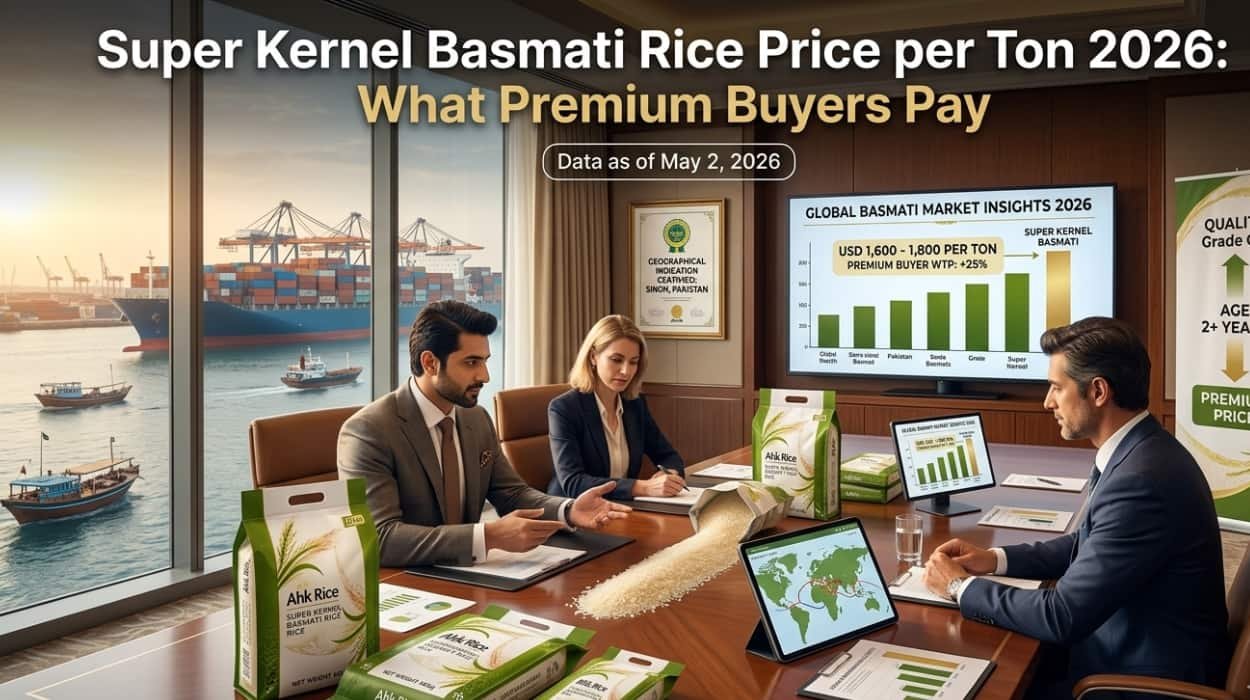
Super Kernel Basmati Rice Price per Ton 2026: What Premium Buyers Pay
Premium buyers of Super Kernel Basmati typically pay 965–1,005 USD per metric ton FOB Karachi in 2026, depending on grain‑length, chalk, and moisture‑specifications. This price band positions Super Kernel between 1121 (1095–1240 USD/MT) at the top‑premier‑segment and D98‑Basmati (980–1020 USD/MT) at the economy‑Basmati level, reflecting how markets value extra‑length, low‑chalk, and strong‑aroma Basmati.
What premium buyers actually pay for Super Kernel Basmati per ton in 2026?
Premium buyers generally pay 965–1,005 USD per metric ton FOB Karachi for Super Kernel Basmati in 2026, with higher‑length, lower‑broken‑content, and EU‑certified‑samples at the top of that band.
This band is based on 2025–26 indicative‑FOB‑lists from major Pakistani exporters and price‑aggregators, which show Super Kernel anchored at about 980 USD/MT for standard‑white‑50‑kg‑PP‑bag exports. The 965‑floor applies to longer‑contract‑volumes or blended‑loads, while spot‑orders with strict‑grade‑requirements often land near 1,005 USD/MT.
For example, shipments to the UAE and UK that demand 7.2–7.5 mm average‑length, ≤2% broken, and ≤12.5% moisture commonly sit at 990–1,005 USD/MT. In contrast, off‑grade‑Super‑Kernel with 3–4% broken can trade at 950–970 USD/MT, blurring the line into lower‑premier‑segments.
These figures compare to 1121‑Basmati at 1095–1240 USD/MT and D98‑Basmati at 980–1020 USD/MT, reinforcing that extra‑length and very low‑chalk command a 10–20% premium over mid‑Basmati grades.
How does Super Kernel Basmati compare to 1121 and D98 in terms of price and quality?
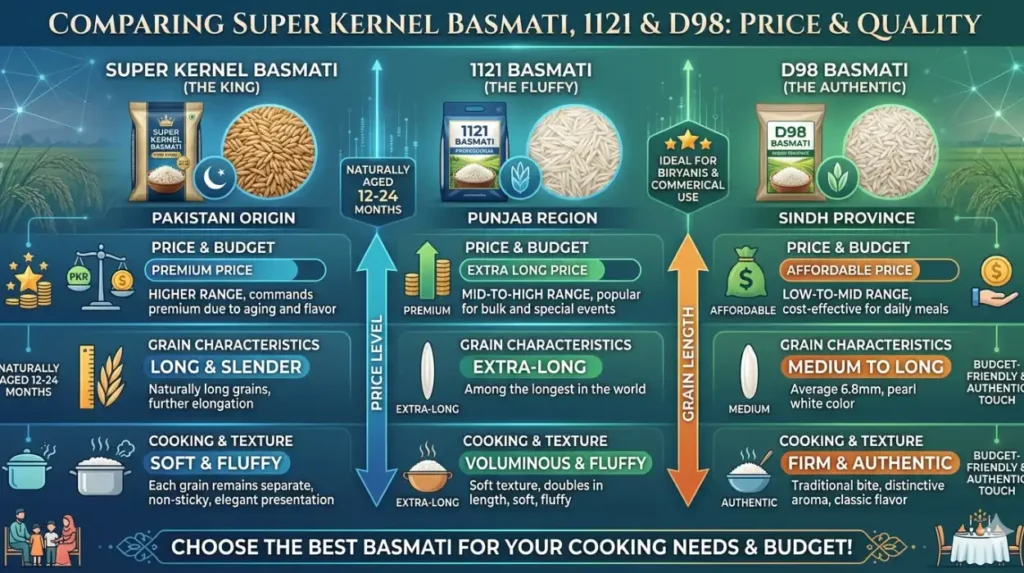
Super Kernel Basmati trades at a mid‑premier‑price point between 1121 (upper‑premier) and D98 (economy‑Basmati), reflecting its balance of length, aroma, and milling‑yield.
Consider seven‑key attributes:
| Feature | 1121 Basmati | Super Kernel Basmati | D98 Basmati |
|---|---|---|---|
| Average raw grain length (mm) | 8.2–8.3 | 7.2–7.5 | 6.8 |
| Typical FOB price 2026 (USD/MT) | 1095–1240 | 965–1005 | 980–1020 |
| Chalk limit (Max) | 2–3% | 2–5% | 5–8% |
| Moisture limit (Max) | 12–12.5% | 12.5% | 12.5–13% |
| Aroma intensity | High | High‑moderate | Moderate |
| Main processing forms | White, sel·la, steam | White | White |
| Ideal market segment | Top‑tier retail, premium HORECA | Mid‑premier retail, export‑branded | Value‑pack, budget‑segments |
Super Kernel sits 15–20% below 1121 but roughly 10% above D98, making it attractive for importers who need premium‑Basmati‑perception without the highest‑price‑point. Its 7.2–7.5 mm length elongates to about 18–19 mm when cooked, compared with 1121’s 22 mm+, which suits portion‑control‑sensitive menus and machinery.
D98, at 6.8 mm, offers a 10–15% price‑discount versus Super Kernel but with lower‑length, higher‑chalk, and lighter‑aroma, which limits its use in luxury‑retail‑segments.
Which markets are most active buyers of Super Kernel Basmati and at what price levels?
Super Kernel Basmati finds its strongest demand in the Middle East (UAE, Saudi Arabia) and Western Europe (UK, EU), where prices cluster at 980–1,005 USD/MT FOB Karachi, while African‑and‑CIS‑markets anchor closer to 965–980 USD/MT.
In the UAE and Saudi Arabia, Super Kernel is sold as a mid‑premium branded product in 1–5 kg retail packs and HORECA‑drums. Importers in these countries pay 990–1,005 USD/MT for EU‑compliant‑lots, because Saudi‑GSO and GCC‑standards align closely with EU‑limits on aflatoxins, heavy‑metals, and pesticide‑residues.
UK and EU buyers often source 980–1,000 USD/MT Super Kernel under FSSC‑22000 or ISO 22000‑certified‑exports, with added cost for inner‑liners, pallet‑codes, and HACCP‑documentation. These extras add 10–20 USD/MT but are essential for supermarket‑own‑label‑programs.
CIS‑and‑African‑importers tend to accept 965–980 USD/MT for 50 kg woven‑PP‑bags without retail‑packaging, because their focus is on volume and lower‑per‑unit‑cost. These buyers may blend Super Kernel with 1121 or D98 to hit mid‑price‑points that still feel “premium.”
How does Super Kernel shelf life and stability compare across import climates?
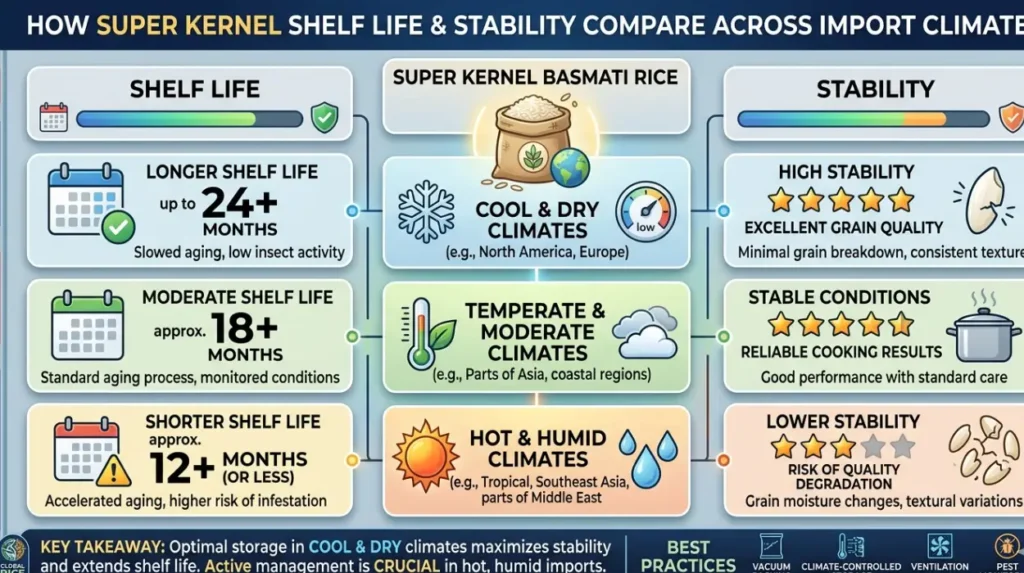
Super Kernel Basmati maintains 18–24 months of best‑quality‑life under cool‑dry‑storage, versus 12–18 months in hot‑humid‑environments, assuming 12–12.5% moisture and airtight‑packaging.
In the UK and EU, where ambient temperatures average 12–20 °C in warehouses, unopened 5‑kg Super Kernel‑packages remain within premium‑quality for 24–30 months. Studies show that moisture‑control and absence of light best preserve aroma, elongation, and low‑fissure‑rate.
In the Middle East, average warehouse‑temperatures of 30–40 °C can reduce best‑quality‑periods to 12–18 months, especially if relative humidity exceeds 65%. Packers mitigate this by using inner‑poly‑liners, nitrogen‑flushing, or oxygen‑absorbers, which can restore 18–24‑month‑performance.
In East Africa, where 25–35 °C and 70%+ humidity are common, best‑quality‑life drops to 6–12 months unless warehouses install dehumidifiers or sealed‑containers. Super Kernel‑exports to these regions often use 25–50 kg woven‑PP‑bags with double‑quality‑tags that track milling‑date and FOB‑date, improving transparency.
How do different import strategies affect the effective cost per ton of Super Kernel?
Different import strategies change the effective‑cost‑per‑ton of Super Kernel by 50–150 USD, depending on contract‑type, payment‑terms, shipping‑route, and packaging‑specifications.
A long‑term‑contract‑with‑a Pakistani‑exporter can lock in 965–980 USD/MT for 12–24‑month‑volumes, beating spot‑prices by 10–15 USD/MT. In contrast, last‑minute‑spot‑orders may land at 990–1,005 USD/MT, especially before Ramadan or Eid‑seasons.
Payment‑terms also move the net‑cost. T/T‑100%‑pre‑payment can secure 965–970 USD/MT, while 30–70 L/C‑or‑documentary‑credit‑structures often push prices up by 15–25 USD/MT due to bank‑fees and risk‑premiums.
Shipping‑choice adds 80–200 USD/MT in 2026‑rates:
- C&F desires to Jebel Ali: +80–100 USD/MT
- 20‑foot‑FCL‑direct‑to‑Rotterdam: +150–180 USD/MT
- DDP‑door‑to‑warehouse‑in‑UK: +180–200 USD/MT
Custom‑packaging, such as 1–2 kg consumer‑pouches, adds 30–50 USD/MT, whereas 50‑kg bulk‑bags minimize that overhead. Importers thus trade between physical‑cost, shipment‑risk, and flexibility.
What decision‑framework should buyers use when choosing between 1121, Super Kernel, and D98?
Buyers should use a five‑row‑decision‑framework that compares segment‑position, target‑markets, expected‑shelf‑life, compliance‑requirements, and budget‑band.
| Factor | 1121 Basmati | Super Kernel Basmati | D98 Basmati |
|---|---|---|---|
| Segment alignment | Top‑premium retail, luxury‑HORECA | Mid‑premium retail, branded‑export | Value‑segment, budget‑retail |
| Target markets (examples) | UAE, Saudi, UK, EU, US, Canada | UAE, Saudi, UK, EU, CIS | GCC‑value, Iran, CIS, East‑Africa |
| Expected shelf life (best quality) | 24–30 months (cool‑dry) | 18–24 months (cool‑dry) | 12–18 months (cool‑dry) |
| Compliance complexity | Strict EU, FDA, GCC‑standards | Moderate‑EU / GCC‑alignment | Lower‑barrier, but still SPS‑aligned |
| Budget band (USD/MT FOB) | 1095–1240 | 965–1005 | 980–1020 |
A buyer targeting supermarket‑own‑label‑Brands in the UK should lean toward 1121 or Super Kernel with EU‑certification, accepting 1095–1,005 USD/MT. A caterer‑using‑rice‑in‑school‑or‑university‑canteens may find D98‑at‑980–1020 USD/MT sufficient if the sensory‑differences are less visible in sauces.
For mixed‑portfolios, importers often blend 1121 with Super Kernel to create a 990–1,050 USD/MT “signature‑Basmati” that sits above D98 but below pure‑1121. This approach spreads risk across varieties and buffers against crop‑imbalances.