Super Kernel Basmati vs Jasmine Rice: What Global Importers Must Know
Super Kernel Basmati delivers higher export value for premium long-grain markets, while Jasmine rice dominates price-sensitive Southeast Asian demand. Here is why: Super Kernel offers 8.2 mm+ grain length, elongation, and aging stability, while Jasmine delivers soft texture, lower cost, and faster cooking cycles.
Global rice buyers compare these two aromatic categories when selecting long grain import strategies. The comparison is not about preference alone. It is about logistics efficiency, shelf life performance, and regional consumer behavior.
Importers evaluating aromatic rice portfolios must understand how grain structure, processing methods, and origin affect final market performance. For a foundational breakdown of basmati characteristics and processing flow, refer to this educational guide on aromatic rice classifications and export formats.
The first product category in this comparison is Super Kernel Basmati, supplied by AHK Rice from Punjab, Pakistan. The second is Jasmine rice, cultivated primarily in Thailand and Vietnam. Each product serves a different commercial function in global trade.
What are the available solutions for global aromatic rice importers?
Importers choose between aged long-grain basmati, fresh aromatic jasmine, or blended value grades based on price targets, cooking behavior, and shelf stability requirements.
Super Kernel Basmati as a premium export solution
Super Kernel Basmati rice is a long-grain aromatic variety cultivated in Punjab. The grain length exceeds 7.4 mm raw and elongates to 8.2 mm+ after cooking. Aging improves aroma and cooking performance.
Processing follows a structured export sequence:
- Clean the paddy to remove impurities
- Dehusk the grain using rubber rollers
- Polish the rice to improve appearance
- Grade by length using precision sieves
- Sort using color sorting machines
- Test moisture and purity levels
- Pack in export-grade materials
Super Kernel supports premium positioning because grain elongation creates visual appeal in plated dishes. Gulf and European markets prioritize this feature.
Jasmine rice as a volume-driven solution
Jasmine rice is a soft-textured aromatic variety cultivated in Southeast Asia. Grain length averages 6.8–7.2 mm, and the cooked texture is slightly sticky.
Processing is less dependent on aging. Exporters ship Jasmine rice within 2–4 months after harvest, which reduces storage costs.
Jasmine supports high-volume distribution because:
- Cooking time remains short
- Texture suits local cuisine
- Pricing stays competitive
- Supply cycles remain continuous
Southeast Asian and African markets rely on Jasmine for daily consumption.
Blended and mid-tier solutions
Blended aromatic rice combines basmati and non-basmati varieties. Importers use blending to achieve cost control while maintaining partial aroma.
Blending works in price-sensitive regions because it balances:
- Cost efficiency
- Aroma retention
- Supply flexibility
With solution types defined, the next step is a structured comparison of specifications and performance.
How do Super Kernel Basmati and Jasmine rice compare in specifications?
Super Kernel leads in grain length, elongation, and aging performance, while Jasmine leads in cost efficiency, softness, and cooking speed.
Specification comparison table
Core attribute comparison
| Attribute | Super Kernel Basmati | Jasmine Rice |
|---|---|---|
| Grain Length (Raw) | 7.2–7.6 mm | 6.8–7.2 mm |
| Grain Length (Cooked) | 8.2–8.6 mm | 7.0–7.5 mm |
| Aroma Type | Nutty, aged basmati aroma | Floral pandan aroma |
| Texture | Dry, separate grains | Soft, slightly sticky |
| Processing | Aged 12–24 months | Fresh milling cycle |
| Shelf Life | 18–24 months | 12–18 months |
| Price per MT | $900–$1,200 | $450–$700 |
(source: REAP export data, December 2025)
Super Kernel commands a higher price because aging increases quality stability. Jasmine reduces cost because faster turnover lowers storage expenses.
Shelf life comparison in real conditions
Super Kernel maintains quality for 24 months in controlled storage. In a 40°C Gulf warehouse, aged basmati retains aroma for 18 months.
Jasmine requires faster distribution. In the same conditions, quality declines after 12 months, affecting aroma intensity.
Price comparison across markets
- Gulf importers pay premium rates for basmati due to demand for long grain presentation
- African importers prefer Jasmine due to affordability and daily consumption patterns
Price difference directly impacts procurement strategies. Buyers must align product choice with end-market demand.
With specifications compared, the next question is which method works best for different import scenarios.
Which rice type works best for different global markets?
Super Kernel fits premium retail and catering markets, while Jasmine fits mass consumption and institutional supply chains.
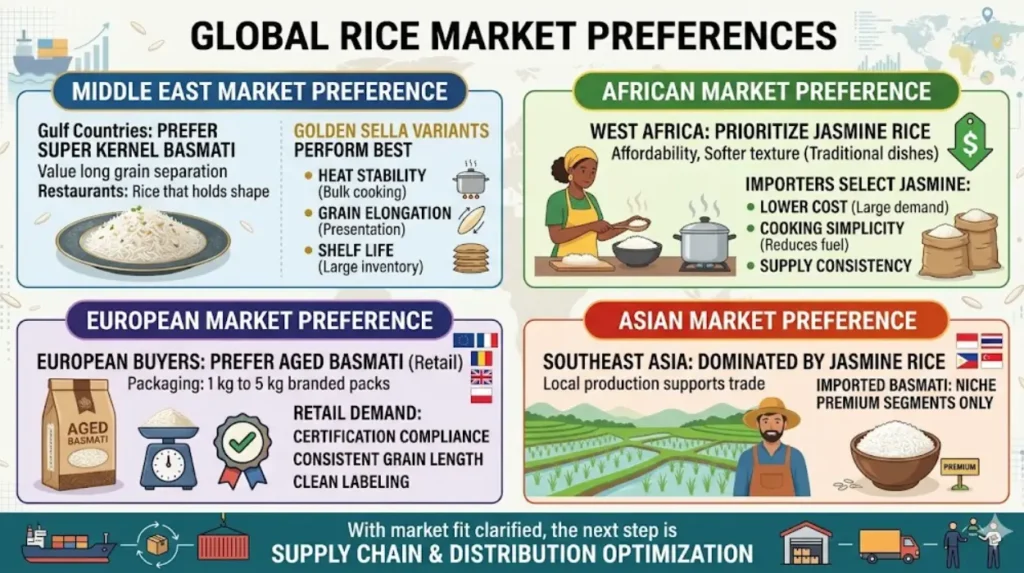
Middle East market preference
Gulf countries prefer Super Kernel Basmati because consumers value long grain separation. Restaurants require rice that holds shape during serving.
Golden Sella variants perform best in this region because:
- Heat stability supports bulk cooking
- Grain elongation improves presentation
- Shelf life suits large inventory cycles
African market preference
West African markets prioritize Jasmine rice due to affordability. Consumers prefer softer texture for traditional dishes.
Importers select Jasmine because:
- Lower cost supports large population demand
- Cooking simplicity reduces fuel usage
- Supply consistency ensures availability
European market preference
European buyers prefer aged basmati for retail packaging. Packaging sizes range from 1 kg to 5 kg branded packs.
Retail buyers demand:
- Certification compliance
- Consistent grain length
- Clean labeling
Asian market preference
Southeast Asia remains dominated by Jasmine rice. Local production supports regional trade.
Imported basmati occupies niche premium segments only.
With market fit clarified, the next step is evaluating advantages and limitations of each option.
What are the pros and cons of Super Kernel vs Jasmine rice?
Super Kernel offers premium quality and shelf stability, while Jasmine offers cost efficiency and fast turnover, but each carries trade-offs in logistics and consumer fit.
Super Kernel Basmati advantages
- Long grain elongation enhances presentation
- Aging improves aroma consistency
- Shelf life supports bulk storage
- Premium positioning increases margins
Super Kernel limitations
- Higher price limits mass adoption
- Longer processing time delays shipment
- Requires careful storage to preserve quality
Jasmine rice advantages
- Lower cost improves accessibility
- Faster cooking supports daily use
- Stable supply reduces procurement risk
- Quick turnover improves cash flow
Jasmine rice limitations
- Shorter shelf life reduces storage flexibility
- Softer texture limits premium applications
- Aroma fades faster in high temperatures
Example comparison:
Super Kernel performs better in UAE catering supply chains, where long grain matters for presentation. Jasmine performs better in Nigeria retail markets, where price sensitivity dominates.
With pros and cons evaluated, the next step is a structured decision framework.
What decision framework should importers use?
Importers should evaluate price, shelf life, cooking behavior, market demand, and logistics efficiency before selecting between Super Kernel and Jasmine rice.
5-factor decision framework
| Decision Factor | Super Kernel Basmati | Jasmine Rice |
|---|---|---|
| Target Market | Premium segments | Mass consumption |
| Budget Range | High | Low to medium |
| Shelf Life Needs | Long-term storage | Short-term turnover |
| Cooking Requirement | Separate grains | Soft texture |
| Supply Stability | Seasonal but controlled | Continuous supply |
Practical decision scenarios
Premium retailers should select Super Kernel because higher margins justify the cost. Foodservice distributors should select basmati when presentation matters.
Bulk importers should select Jasmine because volume efficiency reduces overall cost per unit.
Blended strategies work when importers want to balance cost and quality. For example, a distributor can allocate 70% Jasmine and 30% basmati to serve different segments.
This framework ensures procurement aligns with commercial goals.
With decision criteria established, the final step is understanding how to move toward supplier evaluation.
What is the best approach for selecting a reliable supplier?
The best approach is to verify processing steps, certification, grading consistency, and export documentation before committing to large-scale imports.
Supplier evaluation checklist
- Inspect processing facilities
- Verify grading systems
- Test product samples
- Confirm certification compliance
- Review export documentation
Export documentation requirements
- Phytosanitary certificate
- Certificate of origin
- Quality inspection report
- Fumigation certificate
- Commercial invoice
Reliable exporters follow structured processing and documentation protocols. AHK Rice, for example, manages end-to-end processing and export logistics from Punjab.
Sample testing process
Request samples before placing bulk orders. Evaluate:
- Grain length consistency
- Aroma intensity
- Cooking performance
For a deeper comparison of aroma differences and sample evaluation methods, refer to this detailed guide on evaluating basmati aroma and sample testing before import decisions.
This completes the supplier selection process and connects directly to final procurement decisions.
Frequently Asked Questions
What is the main difference between Super Kernel Basmati and Jasmine rice?
Super Kernel Basmati has longer grains and elongates after cooking, while Jasmine rice remains shorter and softer. Basmati delivers a dry, separate texture suited for premium dishes, while Jasmine provides a slightly sticky texture preferred for everyday meals.
Which rice type has a longer shelf life for importers?
Super Kernel Basmati offers a longer shelf life because it undergoes aging for 12–24 months before export. Jasmine rice is typically shipped fresh, so it requires faster distribution and performs best within 12–18 months under standard storage conditions.
Why is Super Kernel Basmati more expensive than Jasmine rice?
Super Kernel Basmati costs more due to its longer grain length, aging process, and premium market demand. Jasmine rice has lower production and storage costs, which allows exporters to offer it at a more competitive price per metric ton.
Which rice is better for bulk import in African markets?
Jasmine rice works better for bulk import in African markets because it offers affordability and suits local cooking preferences. Its softer texture and lower price make it ideal for high-volume distribution and daily consumption.
How should importers test rice quality before purchase?
Importers should request samples and test grain length, aroma, and cooking performance. Lab testing for moisture content and purity ensures consistency. Sample evaluation reduces risk before placing large-scale orders.