Why Super Kernel Basmati Has the Strongest Aroma Among All Rice Varieties
Super Kernel Basmati has the strongest aroma because it contains the highest concentration of 2-acetyl-1-pyrroline (2AP) at 0.09–0.12 ppm, developed through specific genetics, soil composition, and aging. Here is why: Himalayan foothill cultivation, controlled milling, and post-harvest aging amplify its fragrance intensity beyond all other rice varieties.
What is Super Kernel Basmati and why does it have the strongest aroma?
Super Kernel Basmati is a long-grain aromatic rice variety with grain length of 7.2–7.6 mm and elongation ratio of 2.0–2.3, containing the highest natural 2AP compound among rice types.
Super Kernel Basmati belongs to the basmati family cultivated in Punjab’s fertile plains. Basmati defines rice with natural fragrance, long grains, and post-cooking elongation. Super Kernel stands as a premium subtype due to its consistent aroma strength and export-grade uniformity.
The aroma originates from a chemical compound called 2-acetyl-1-pyrroline, also found in pandan leaves and baked bread crust. This compound forms naturally during grain development and intensifies during aging. Super Kernel accumulates higher levels due to genetic traits and environmental conditions.
Punjab’s alluvial soil contributes directly to aroma development. Soil minerals such as nitrogen and zinc influence enzymatic reactions that produce 2AP. Irrigation from glacial rivers ensures steady moisture levels during grain formation. Controlled harvesting at optimal maturity preserves volatile compounds.
Super Kernel undergoes aging for 9–18 months, which stabilizes moisture at 12–13%. Aging increases aroma concentration because water reduction enhances compound volatility. Fresh rice smells weaker compared to aged rice due to higher moisture dilution.
With the definition of Super Kernel established, the next question is how this aroma actually forms and intensifies during processing.
How does the aroma compound 2-acetyl-1-pyrroline develop in Super Kernel Basmati?
2-acetyl-1-pyrroline forms during grain maturation through enzymatic reactions triggered by nitrogen metabolism and controlled water stress during cultivation.
Rice plants synthesize aroma through biochemical pathways involving amino acids like proline. During late grain filling, enzymes convert these compounds into 2AP. Controlled irrigation cycles create mild stress that increases production.
Harvest timing plays a critical role. Harvesting at 20–22% moisture content ensures that aroma precursors remain intact. Early harvesting reduces aroma intensity because compounds remain underdeveloped. Late harvesting causes degradation due to oxidation.
Post-harvest processing further enhances aroma through structured steps:
- Clean the paddy to remove impurities
- Dehusk the grain to separate husk layers
- Dry the rice to reduce moisture to safe levels
- Age the grain under controlled storage
- Polish the rice to improve appearance
- Grade the grains by length and thickness
- Sort the grains using color sorting machines
- Test aroma intensity and moisture levels
- Pack the rice in moisture-resistant bags
Each step preserves volatile compounds. Excessive polishing reduces aroma because outer layers contain aromatic precursors. Controlled milling maintains balance between appearance and fragrance.
Storage conditions directly impact aroma retention. Maintain temperature at 15–25°C and humidity below 65% to prevent compound loss. Exposure to air accelerates aroma evaporation.
With the mechanism explained, the next question is which components influence aroma strength in measurable terms.
What are the key components that determine Super Kernel fragrance strength?
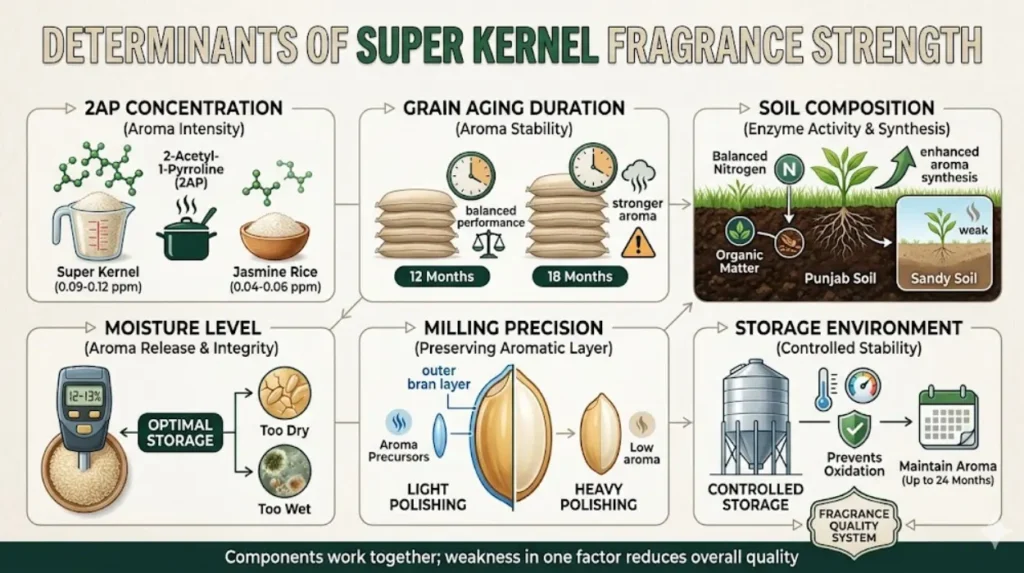
Super Kernel fragrance strength depends on 2AP concentration, grain aging duration, soil composition, moisture level, and milling precision.
2AP Concentration
2AP concentration defines aroma intensity. Super Kernel records 0.09–0.12 ppm, while Jasmine rice averages 0.04–0.06 ppm. Higher concentration produces stronger scent perception during cooking.
Grain Aging Duration
Aging increases aroma stability. Rice aged 12 months delivers balanced fragrance and cooking performance. Rice aged 18 months produces stronger aroma but requires precise cooking to prevent dryness.
Soil Composition
Soil minerals affect enzyme activity. Punjab soil contains balanced nitrogen and organic matter, which enhances aroma synthesis. Sandy soils produce weaker fragrance due to lower nutrient retention.
Moisture Level
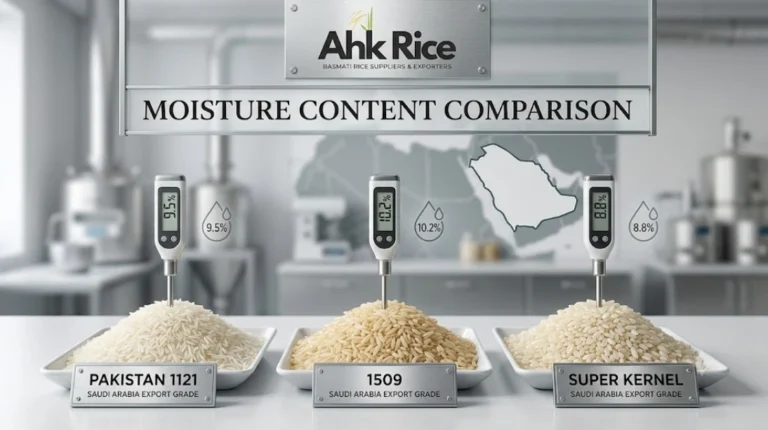
Moisture content controls aroma release. Maintain 12–13% moisture for optimal storage. Higher moisture dilutes aroma. Lower moisture causes grain brittleness.
Milling Precision
Milling determines how much aromatic layer remains. Light polishing preserves aroma. Heavy polishing removes outer bran layers where aroma precursors exist.
Storage Environment
Temperature and humidity influence compound stability. Controlled storage prevents oxidation and maintains aroma for up to 24 months.
These components work together as a system. Weakness in one factor reduces overall fragrance quality. With the components defined, the next question focuses on the measurable benefits of strong aroma.
What are the benefits of strong aroma in Super Kernel Basmati?
Strong aroma enhances sensory value, increases market price by 15–25%, improves consumer preference, and reduces seasoning requirements in cooking.
Aroma directly impacts perceived quality. Consumers associate fragrance with freshness and authenticity. Strong aroma creates a premium experience even before tasting.
Cooking efficiency improves with aromatic rice. Less seasoning is required because natural fragrance enhances flavor perception. Restaurants use aromatic rice to reduce ingredient costs while maintaining taste quality.
Export value increases due to demand in aroma-focused markets. Middle Eastern and European buyers prioritize fragrance as a key specification. Super Kernel commands higher prices compared to non-aromatic long grain rice.
Shelf differentiation becomes easier. Retail brands highlight aroma as a primary selling point. Packaging often includes descriptors such as “extra fragrant” or “aged basmati” to communicate quality.
Consumer satisfaction increases due to consistent cooking results. Aroma release during cooking signals proper preparation. Weak aroma creates perception of low quality even if texture remains acceptable.
With benefits established, the next question explores where this rice is used and which markets import it.
Where is Super Kernel Basmati used and which markets import it?
Super Kernel Basmati is used in biryani, pulao, and premium rice dishes, and is imported by Middle East, Europe, North America, and Africa.
Culinary Use Cases
Super Kernel performs best in dishes requiring long grain separation and aroma release. Examples include biryani, kabsa, mandi, and pulao. Each dish relies on grain elongation and fragrance during steaming.
Restaurants prefer Super Kernel for bulk cooking. The grain maintains structure under high heat. Home consumers use it for festive meals due to its sensory appeal.
Import Markets
Middle East remains the largest importer due to cultural preference for aromatic rice. Countries such as UAE and Saudi Arabia prioritize aged basmati for traditional dishes (source: REAP export data, December 2025).
Europe imports basmati for retail consumption. The UK leads in packaged basmati sales due to South Asian population demand (source: Pakistan Bureau of Statistics, FY2024-25).
North America imports premium basmati for health-conscious consumers. Organic and certified rice gains traction in this region.
Africa imports basmati for urban markets. High-income consumers prefer aromatic rice over standard long grain varieties.
Trade Comparison Context
Understanding how Super Kernel compares with other aromatic rice types improves buying decisions. A detailed comparison between basmati and jasmine rice explains differences in aroma intensity, grain structure, and global demand patterns.
With use cases and markets covered, the next question addresses common problems and misconceptions about aroma strength.
What are the common problems and misconceptions about Super Kernel aroma?
Common misconceptions include assuming all basmati has equal aroma, believing fresh rice smells stronger, and thinking polishing improves fragrance.
Misconception 1: All basmati has equal aroma
Different basmati varieties contain different 2AP levels. Super Kernel ranks higher than 1509 and IRRI-6. Uniform classification ignores measurable chemical differences.
Misconception 2: Fresh rice has stronger aroma
Fresh rice contains higher moisture, which suppresses aroma release. Aged rice delivers stronger fragrance because moisture reduction increases volatility.
Misconception 3: More polishing improves aroma
Excess polishing removes bran layers where aroma compounds reside. Light polishing preserves fragrance while maintaining visual quality.
Problem 1: Aroma loss during storage
Improper storage causes aroma evaporation. Store rice in airtight containers and maintain stable temperature to preserve fragrance.
Problem 2: Weak aroma after cooking
Incorrect cooking methods reduce aroma release. Use proper soaking time of 20–30 minutes and maintain water ratio of 1:1.75 for optimal results.
Problem 3: Adulteration with non-aromatic rice
Blending reduces aroma intensity. Verify grain length and fragrance before purchase to ensure authenticity.
These clarifications remove confusion and help maintain product quality. With misconceptions resolved, the full understanding of aroma strength is complete.
Frequently Asked Questions
Why does Super Kernel Basmati smell stronger than other rice?
Super Kernel Basmati smells stronger because it contains higher levels of 2-acetyl-1-pyrroline (2AP) compared to other rice varieties. This compound creates the characteristic nutty and popcorn-like aroma. Proper aging and controlled cultivation increase its concentration.
Does aging increase the aroma of basmati rice?
Aging increases aroma by reducing moisture content to 12–13%, which concentrates aromatic compounds. Rice aged for 9–18 months releases stronger fragrance during cooking compared to freshly harvested rice.
How can you identify authentic Super Kernel Basmati?
Authentic Super Kernel Basmati has grain length of 7.2–7.6 mm, uniform slender shape, and a noticeable natural fragrance even before cooking. When cooked, grains elongate up to 2 times without becoming sticky.
Does cooking method affect basmati aroma?
Cooking method directly affects aroma release. Soaking rice for 20–30 minutes and using a water ratio of 1:1.75 ensures proper gelatinization and maximum fragrance during steaming.
Which countries prefer Super Kernel Basmati the most?
Middle Eastern countries such as UAE and Saudi Arabia import the highest volumes due to traditional dishes like biryani and mandi. Europe and North America also import it for retail and premium food segments.