Super Kernel Parboiled vs Super Kernel Steam: Best Grade for Your Market?
Super Kernel Steam Basmati typically suits buyers who prioritise pure aroma and very soft‑fluffy texture, whereas Super Kernel Parboiled is better for channels that need firmer grains, lower breakage, and higher shelf‑life across long‑distribution chains. Deciding between parboiled and steam‑processed Super Kernel depends on regional‑taste‑preferences, logistics‑constraints, and whether the priority is grain‑elegance, yield‑efficiency, or operational‑stability.
What are the available solutions for Super Kernel Basmati rice?
The two main solutions for Super Kernel Basmati rice are Super Kernel Parboiled and Super Kernel Steam (raw‑milled), which differ in how the paddy is treated before milling and how the final rice behaves in cooking and storage.
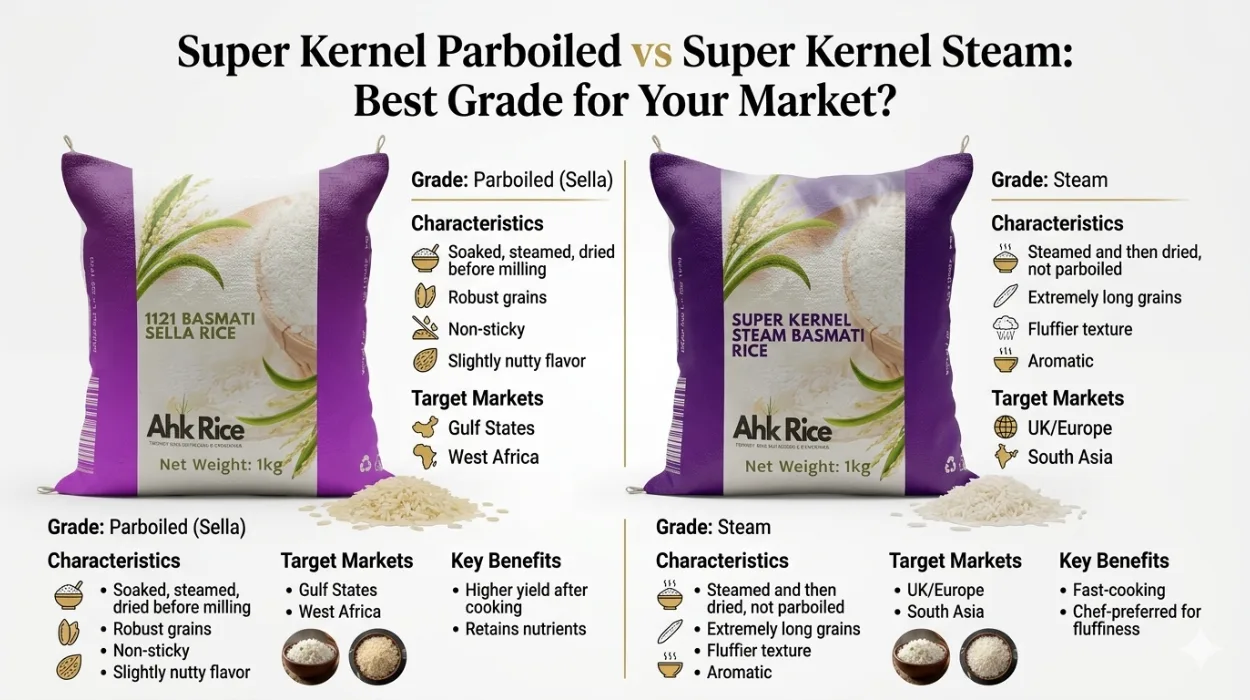
Super Kernel Parboiled Basmati refers to the grade where the husked paddy undergoes pre‑cooking (soaking, steaming, and drying) before de‑husking, which strengthens the starch, brightens the colour, and reduces grain‑breakage. This variant is often marketed as “aromatic parboiled” or “Super Kernel Sella,” and is widely used in hospitality, institutional‑catering, and value‑retail‑segments.
Super Kernel Steam (or Steam‑Basmati) is the raw‑milled form where the paddy is de‑husked without prior‑steaming, preserving a softer, more delicate texture and slightly higher aroma‑intensity compared with parboiled‑counterparts. It is common in premium‑retail packs and home‑cooking‑segments where fluffiness and fragrance are the primary‑decision‑factors.
Both Super Kernel grades are produced from Basmati‑paddy‑varieties such 1121, 1509, and Super Kernel‑specific‑lines, and are then sorted by length and breakage into Super Kernel‑level packs for export. Importers, distributors, and hotel‑procurement‑teams choose between these two processing‑methods based on how their end‑consumers expect Basmati to look and feel after cooking.
For buyers who want a clear introduction to the category, an overview of Super Kernel Parboiled Basmati rice and how its processing affects aroma, length, and cooking style can provide context before comparing parboiled and steam‑processed Super Kernel.
How do Super Kernel Parboiled and Super Kernel Steam compare across key attributes?
Super Kernel Parboiled and Super Kernel Steam differ in aroma intensity, grain texture, breakage behaviour, shelf‑life, and price, which makes parboiled‑Super‑Kernel‑parboiled vs steam‑Basmati‑best‑grade analysis essential for market‑fit.
To clarify the trade‑offs, the table below lists seven specification attributes for both forms of Super Kernel‑grade Basmati:
| Attribute | Super Kernel Parboiled Basmati | Super Kernel Steam Basmati (Raw‑Milled) |
|---|---|---|
| 1. Processing method | Paddy is soaked, steamed, and dried before milling | Paddy is milled without pre‑steaming |
| 2. Aroma intensity | Slightly less intense, but still aromatic | Very high‑aroma intensity, close to raw‑Basmati |
| 3. Grain texture after cooking | Firmer, slightly chewy, retains shape well | Soft, fluffy, more prone to clumping if overcooked |
| 4. Breakage during milling | 2–5% broken, very low with good processing | 5–10% broken, higher risk of fractures |
| 5. Shelf‑life (bagged, dry) | 18–24 months, lower moisture, more stable | 12–18 months, more moisture‑sensitive |
| 6. Suitability for large‑volume | Excellent for buffets, catering, and re‑heating | Best for home‑use, small‑batch‑cooking |
| 7. Typical price per MT (export‑level ranges) | Slightly lower or similar to steam‑Basmati, depending on brand‑tier | Often slightly higher in premium‑retail‑segments |
These factors determine whether a buyer’s priority is yield‑stability, re‑heating‑performance, or maximum‑aroma‑for‑end‑consumers.
Which method works best for different markets and use‑cases?
Super Kernel Parboiled works best in markets that demand firm‑grain performance, long‑distribution‑chains, and low‑breakage, while Super Kernel Steam is preferred in premium‑retail‑and‑home‑use‑segments that prioritise extreme‑fluffiness and aroma.
For Gulf Cooperation Council (GCC) hospitality and institutional‑catering buyers, Super Kernel Parboiled is usually the default‑choice because the firmer‑texture holds shape during buffet‑service, airline‑meals, and repeated‑re‑heating cycles. These channels often place Super Kernel‑style parboiled rice in bulk‑50‑kg‑bags for hotels, worker‑camps, and government‑contracts, where cost‑per‑serving‑and‑yield‑stability matter more than maximum‑fragrance.
For UK and European specialty‑food retailers, Super Kernel Steam (raw‑milled Super Kernel) is often preferred because consumers expect very soft, fluffy, and highly aromatic rice that looks aesthetically‑elegant on the plate. Supermarkets, health‑food‑chains, and online‑gourmet‑markets typically sell steam‑Basmati in 1–5 kg packs emphasising “pure‑Basmati,” “no‑pre‑cooking,” and “great‑for‑pilafs and curries.”
In Southeast Asia and parts of East Africa, buyers mix both approaches: Super Kernel Parboiled dominates value‑retail and industrial‑food‑processors, while Super Kernel Steam appears in mid‑to‑premium‑retail‑slots where consumers are willing to pay a small premium for better‑texture and aroma. Large‑importers in these regions sometimes blend a small share of steam‑Basmati with parboiled‑Super‑Kernel to balance price, aroma, and cooking‑performance.
For buyers focused on Super Kernel Parboiled Basmati bulk supply for hotels and hospitality‑chains, this detailed guide outlines how to structure large‑volume procurement.
What are the pros and cons of Super Kernel Parboiled and Super Kernel Steam?
Super Kernel Parboiled offers lower breakage and higher shelf‑life but relatively lower aroma, while Super Kernel Steam delivers superior aroma and softness at the cost of more fragility and shorter‑shelf‑life.
Pros of Super Kernel Parboiled include:
- Reduced breakage during milling and packaging, which lowers raw‑rice‑requirements per cooked‑serving and improves yield‑efficiency in large‑kitchens and industrial‑diners.
- Stronger‑shelf‑life, especially in hot‑climates, because the pre‑cooking‑process lowers moisture‑content and reduces the risk of mould‑or‑insect‑damage during multi‑month‑ships.
- Better‑performance in repeated‑re‑heating, where the grain remains separated and visually‑appealing, which is critical for hotel‑buffets, airline‑catering, and ready‑to‑eat‑meal‑lines.
Cons of Super Kernel Parboiled include:
- Slightly reduced‑aroma compared with steam‑Basmati, which can matter in markets where fragrance is the primary‑brand‑differentiator.
- Firmer‑texture that some consumers interpret as “less authentic” or “more industrial,” even though it is preferred by professional‑chefs for control‑and‑yield.
Pros of Super Kernel Steam include:
- Very high‑aroma‑and‑fluffiness, which makes it attractive for premium‑retail‑packs and for consumers who associate long‑grain Basmati with extremely soft, non‑sticky‑texture.
- Lighter‑colour and perceived‑“purity,” which supports branding that emphasises “natural,” “no‑pre‑cooking,” and “traditional‑Basmati‑methods.”
Cons of Super Kernel Steam include:
- Higher breakage during milling and transport, which can increase raw‑cost‑per‑serving and raise the risk of dust‑in‑packs if grading‑and‑handling‑are sub‑optimal.
- Shorter‑shelf‑life and higher‑sensitivity to moisture and temperature, which can be problematic for buyers in humid‑climates or with long‑warehouse‑holding periods.
How do price per MT, shelf‑life, and cost‑per‑serving differ between Super Kernel grades?
Price per MT of Super Kernel Parboiled is often similar to or slightly below Super Kernel Steam, but parboiled‑grade usually delivers lower cost‑per‑serving due to better yield and longer shelf‑life.
Export‑level price‑benchmarks show that Super Kernel‑grade Basmati, whether parboiled or steam‑processed, typically trades in overlapping‑bands, with small‑uplifts for steam‑Basmati when branded for premium‑retail. Exact‑per‑MT‑ranges depend on world‑Basmati‑prices, seasonality, and contract‑terms, but steam‑Basmati can command a 5–10% premium in select‑high‑value‑retail‑markets, whereas parboiled‑Super‑Kernel is competitively‑priced for institutional‑and‑value‑channels.
Shelf‑life advantages tilt the cost‑balance further: Super Kernel Parboiled’s 18–24‑month‑shelf‑life allows buyers to hold larger‑inventories without deterioration, reducing the number of reorder‑cycles and associated‑logistics‑costs. In contrast, Super Kernel Steam’s 12–18‑month‑window requires more frequent‑restocking and tighter‑stock‑control to avoid ageing‑losses.
From a cost‑per‑serving perspective, Super Kernel Parboiled often wins in large‑volume‑settings because its lower‑breakage and superior‑re‑heating‑performance reduce rice‑waste per plate. Hotels and caterers that buy Super Kernel‑level aromatic‑parboiled‑Basmati in bulk‑can calculate lower‑cost‑per‑serving than if they relied on steam‑Basmati with similar‑per‑MT‑pricing but higher‑breakage and more discards.
What decision factors should buyers use when choosing between Super Kernel Parboiled and Steam?
Buyers should choose Super Kernel Parboiled vs Steam based on region‑specific‑taste‑preferences, cooking‑method, storage‑duration, breakage‑tolerance, and target‑price‑point for the final‑pack‑or‑meal.
To systematise the decision, the following five‑row framework can guide category‑selection:
| Decision factor | Favour Super Kernel Parboiled when… | Favour Super Kernel Steam when… |
|---|
| Decision factor | Favour Super Kernel Parboiled when… | Favour Super Kernel Steam when… |
|---|---|---|
| 1. End‑use setting | Large‑hotels, canteens, airline‑catering, institutional‑kitchens | Home‑use, upscale‑restaurants, specialty‑retail‑packs |
| 2. Texture preference | Firmer, slightly‑chewy, holds‑shape after re‑heating | Very soft, fluffy, non‑sticky preferred |
| 3. Aroma vs yield priority | Yield‑efficiency and stability matter more than maximum‑fragrance | Aroma‑and‑texture are primary‑brand‑drivers |
| 4. Breakage and shelf‑life needs | Low‑breakage and 18–24‑month‑shelf‑life required | Shorter‑shelf‑life acceptable; aroma is worth higher‑breakage |
| 5. Logistics and climate conditions | Long‑transport, hot‑and‑humid‑warehousing, high‑breakage‑risk | Stable‑cold‑chains, shorter‑holding periods, premium‑handling |
Across these factors, importers and distributors can map Super Kernel‑level options to their specific‑market‑profiles instead of treating “Super Kernel” as a single‑monolithic‑grade.