Tricyclazole-Free Basmati from Pakistan: Which Grades Are EU Compliant?
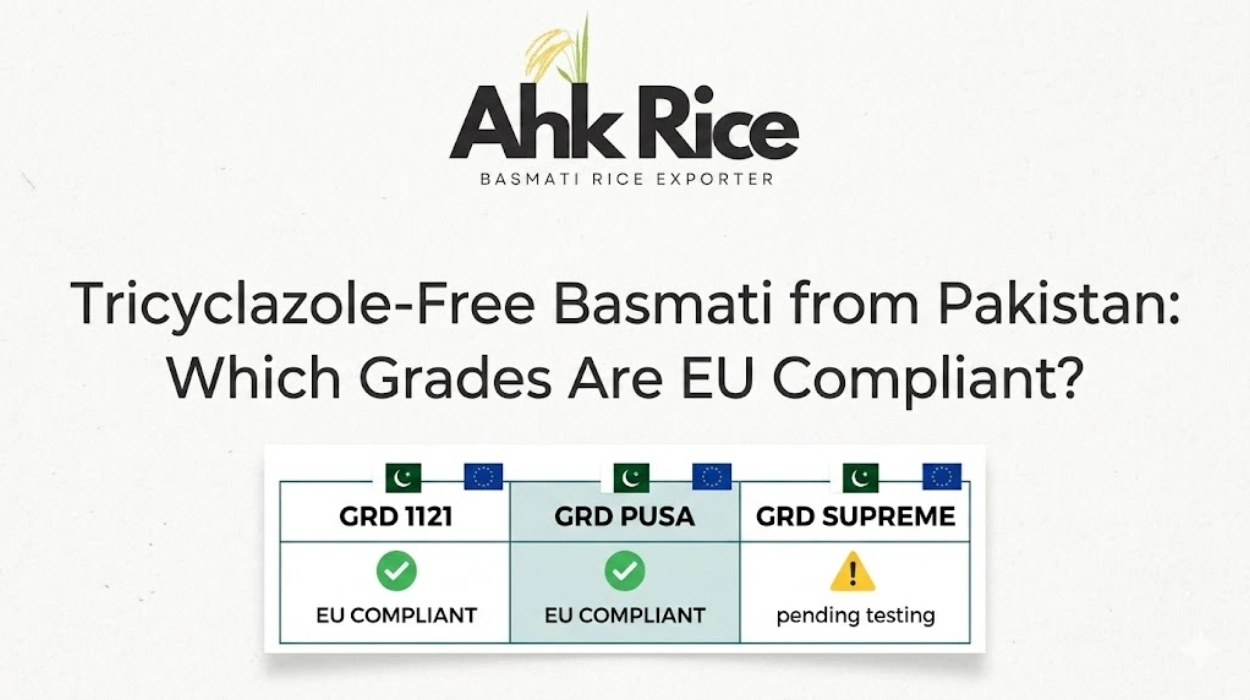
EU compliant tricyclazole-free basmati from Pakistan is achievable through controlled sourcing, lab-tested milling, and strict residue verification across 1121, 1509, and Super Kernel grades. Here is why: Evidence shows EU MRL enforcement rejects any detectable tricyclazole residue above 0.01 mg/kg, making compliant grading dependent on cultivation controls, certified testing, and segregated supply chains.
EU compliance in basmati rice is not a marketing label. It is a measurable chemical threshold system enforced at import inspection.
AHK Rice, a trusted Pakistani basmati exporter based in Punjab, applies end-to-end milling, grading, and certification systems to meet EU pesticide standards across multiple varieties AHK Rice.
Read the foundational production structure in this ToFu guide: tricyclazole-free rice cultivation and EU MRL standards explained.
The EU market defines compliance through residue detection, not origin claims. This makes grade selection a technical decision.
With compliance fundamentals established, the next step is identifying what solutions actually produce EU-approved basmati grades.
What are the available solutions for tricyclazole-free basmati Pakistan EU compliant grades?
EU compliant basmati production depends on five validated systems: residue-free cultivation zones, certified lab testing, segregated milling lines, varietal control of 1121/1509/Super Kernel, and export documentation aligned with EU MRL thresholds. Each system reduces pesticide risk at a different stage of cultivation, processing, or logistics control.
Tricyclazole-free basmati requires prevention, not correction.
Residue-free cultivation systems
Cultivation systems eliminate tricyclazole use at farm level. Farmers cultivate under monitored pesticide bans. Fields undergo seasonal inspection before harvest.
Contract farming structures
Contract farming enforces input control. Exporters supply seed, monitor irrigation, and restrict pesticide application schedules.
Laboratory testing systems
Inspect laboratories test paddy and milled rice for residue detection. EU threshold validation occurs before shipment loading.
Segregated milling operations
Milling operations dehusk, polish, and grade separately for EU batches. Cross-contamination is eliminated through line isolation.
Varietal compliance selection
Varietal selection includes 1121, 1509, and Super Kernel basmati types. Each variety responds differently to pesticide absorption risk.
EU compliance depends on system integration, not single interventions.
With solution structures defined, the next step is understanding how these approaches compare across measurable export criteria.
How do different approaches compare for EU compliant basmati production?
Residue-free cultivation delivers highest EU compliance certainty, while lab-only verification offers moderate risk control, and contract farming provides scalable balance. Integrated systems combining cultivation control, milling segregation, and certification testing outperform standalone methods across rejection rate, cost efficiency, and shipment consistency.
Comparison across systems reveals major operational differences.
Specification comparison table
| Attribute | Residue-Free Cultivation | Contract Farming | Lab-Only Verification | Segregated Milling | Hybrid Export System |
|---|---|---|---|---|---|
| Compliance reliability | High | Medium-High | Medium | Medium-High | Very High |
| Cost per MT | $820–$880 | $780–$850 | $760–$830 | $800–$870 | $840–$900 |
| Residue risk control | Maximum | Strong | Reactive | Strong | Maximum |
| Scalability | Low | High | Very High | Medium | High |
| EU rejection rate | <1% | 2–4% | 5–8% | 2–3% | <1% |
| Certification dependency | Low | Medium | High | Medium | Low |
| Traceability strength | Very High | High | Medium | High | Very High |
Hybrid systems combine cultivation control and laboratory verification, producing stable EU shipment approval rates.
AHK Rice applies hybrid EU-grade processing systems across basmati exports, including certified milling and segregated export batches AHK Rice.
BOFU decision support is detailed in: AHK Rice Germany certified EU compliant basmati free sample process.
With comparative systems established, the next step is identifying which method performs best across different import regions.
Which method works best for EU and GCC basmati rice markets?
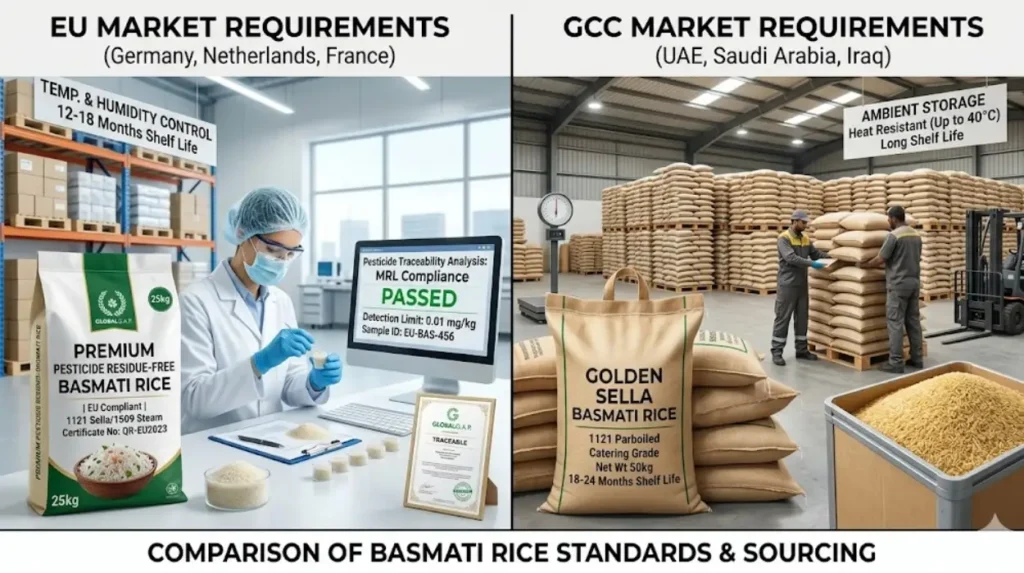
EU markets prioritize strict residue-free certification and traceability, while GCC markets prioritize long shelf life, price stability, and bulk packaging efficiency. EU buyers prefer hybrid or residue-free systems, whereas GCC importers favor contract farming with parboiled grades like Golden Sella and Steam basmati.
Market requirements diverge significantly between regions.
EU market requirements (Germany, Netherlands, France)
EU importers enforce strict MRL compliance at 0.01 mg/kg pesticide detection limits.
Preferred grades include 1121 Sella, 1509 Steam, and certified Super Kernel basmati.
Price per MT ranges between $820 and $900 depending on certification depth.
Shelf life for EU shipments is typically 12–18 months under controlled storage.
Golden Sella performs strongly in EU distribution due to stable kernel integrity.
GCC market requirements (UAE, Saudi Arabia, Iraq)
GCC buyers prioritize bulk catering stability and logistics durability.
Preferred grades include 1121 Golden Sella and parboiled 1509.
Price per MT ranges between $780 and $860 based on volume contracts.
Shelf life extends to 18–24 months for Golden Sella in ambient storage.
Steam basmati performs well in fast turnover retail channels.
Golden Sella lasts longer than Steam basmati. In UAE warehouses at 40°C, Golden Sella maintains structure for 18 months. Steam basmati requires 12 months consumption cycles.
Regional comparison summary
EU buyers prioritize compliance certainty and certification depth. GCC buyers prioritize shelf stability and price optimization.
With regional demand differences clear, the next step is evaluating operational pros and cons of each compliance method.
What are the pros and cons of EU compliant basmati production methods?
Residue-free cultivation ensures highest compliance certainty but increases cost and reduces scalability. Contract farming balances cost and control but introduces moderate risk. Lab-only verification reduces cost but increases rejection probability, while hybrid systems maximize compliance stability and export continuity.
Each method presents trade-offs across cost, risk, and scalability.
Residue-free cultivation
Pros include maximum EU compliance and zero pesticide residue risk.
Cons include higher production cost and limited farm scalability.
Example: premium 1121 basmati batches for German retail chains.
Contract farming systems
Pros include scalable production and controlled input management.
Cons include variable farmer compliance and moderate residue risk.
Example: 1509 basmati for GCC catering contracts.
Lab-only verification systems
Pros include low cost and fast export turnaround.
Cons include higher rejection probability at EU border checks.
Example: bulk shipments without pre-segregated sourcing.
Segregated milling systems
Pros include contamination control and batch-level traceability.
Cons include infrastructure cost and operational complexity.
Example: EU-certified Super Kernel export batches.
Hybrid systems combine advantages across all four models.
With pros and cons evaluated, decision-making depends on measurable operational and commercial factors.
What decision factors determine EU compliant basmati grade selection?
EU compliant basmati grade selection depends on pesticide residue risk tolerance, target market regulations, required shelf life, shipment volume, and certification cost structure. Buyers selecting 1121, 1509, or Super Kernel must align grade choice with EU MRL enforcement intensity and GCC storage expectations.
Decision-making requires structured evaluation.
Decision framework table
| Factor | EU Priority | GCC Priority | Impact on Grade Selection | Recommended Grade |
|---|---|---|---|---|
| Residue tolerance | Zero tolerance | Low tolerance | Determines cultivation system | 1121 / Super Kernel |
| Shelf life | 12–18 months | 18–24 months | Determines parboiling method | Golden Sella |
| Price sensitivity | Medium | High | Determines sourcing model | 1509 |
| Certification level | High | Medium | Determines export approval speed | All EU-certified grades |
| Volume demand | Medium | High | Determines contract farming use | 1121 Sella |
EU buyers prioritize certification depth and residue elimination systems.
GCC buyers prioritize storage stability and bulk logistics efficiency.
Golden Sella remains dominant in high-temperature storage environments due to parboiling stability.
With decision factors established, the full compliance framework becomes actionable across export markets.
Conclusion
EU compliant tricyclazole-free basmati from Pakistan depends on integrated cultivation, milling, and certification systems rather than single-point testing.
AHK Rice applies structured export processing, segregated milling, and EU-aligned verification across basmati varieties AHK Rice.
Final decision clarity comes from aligning grade selection with market-specific compliance pressure and shelf-life requirements.
Frequently Asked Questions
What does tricyclazole-free basmati mean for EU exports?
Tricyclazole-free basmati means the rice is cultivated and processed without the fungicide tricyclazole, which is strictly regulated in the EU. This ensures the final product meets EU MRL limits of near-zero detection, reducing shipment rejection risk during border inspections and certification checks.
Which basmati grades from Pakistan are EU compliant?
EU compliant basmati grades typically include 1121 Basmati, 1509 Basmati, and Super Kernel Basmati. These grades become compliant only when cultivated under residue-free systems, tested in certified labs, and processed in segregated milling lines to avoid contamination.
How is EU pesticide compliance tested in basmati rice?
EU compliance is tested through accredited laboratory residue analysis before shipment. Samples are taken from milled rice batches and checked against EU Maximum Residue Limits. If no detectable tricyclazole is found, the shipment is cleared for export approval.
Which grade is best for long shelf life in export markets?
Golden Sella Basmati offers the longest shelf life due to parboiling, which strengthens kernel structure and reduces moisture absorption. It performs best in GCC markets where storage conditions often exceed 40°C, maintaining quality for up to 18 months.
Why do EU buyers reject basmati rice shipments?
EU buyers reject shipments mainly due to pesticide residue detection, improper documentation, or cross-contamination during milling and storage. Even trace levels above EU thresholds can result in full container rejection, making strict process control essential.