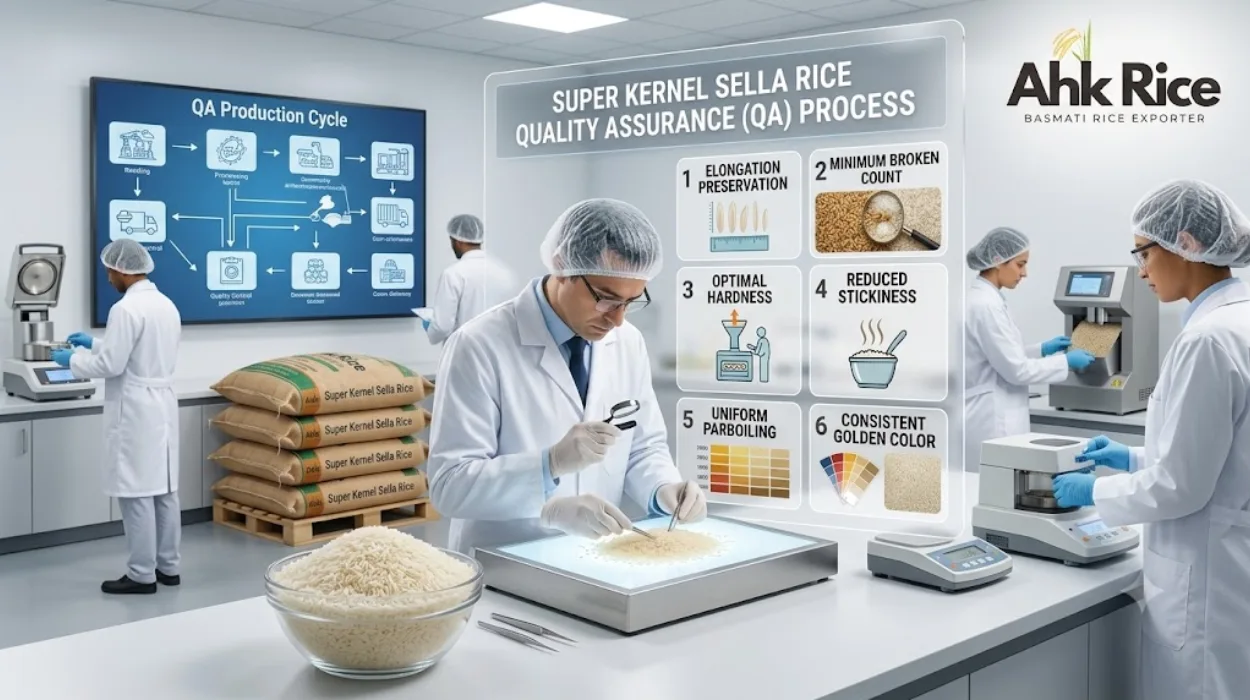
Super Kernel Sella Rice Quality Assurance Process Explained
Super Kernel Sella Rice quality assurance depends on multi-stage testing, controlled parboiling, moisture management, grading accuracy, and documented inspection records. Here is why: buyers face risks from broken grains, color variation, moisture instability, and shipment inconsistencies. A structured quality assurance process eliminates these risks through measurable specifications, laboratory testing, and export-grade controls.
Super Kernel Sella Rice remains one of the most demanded Pakistani Basmati products in the Middle East and Africa because it combines long grain appearance, cooking stability, and cost efficiency. Buyers evaluating suppliers often compare processing controls rather than price alone. Understanding the quality assurance process helps importers assess product consistency before placing container-scale orders.
Businesses seeking a deeper understanding of Super Kernel rice cultivation, processing, export markets, and certifications can also read our guide on how Pakistani Super Kernel rice moves from farm to export markets. The next step is understanding how quality assurance protects every shipment from field selection to container loading.
The first mention of Super Kernel Sella Rice should also be evaluated against supplier processing capabilities available through AHK Rice’s Super Kernel Sella Rice export services, where controlled processing and export documentation support international buyers.
What quality assurance challenges does Super Kernel Sella Rice solve?
Quality assurance prevents moisture variation, grain inconsistency, excessive breakage, color defects, contamination risks, and shipment disputes through measurable specifications and documented inspections at every processing stage.
Importers purchase rice months before consumption. Product stability becomes critical during storage, transportation, and distribution.
Super Kernel Sella Rice undergoes parboiling before milling. Parboiling strengthens grain structure and improves resistance to breakage during handling.
Quality assurance addresses five common buyer concerns:
- Moisture control
- Grain length consistency
- Broken percentage control
- Color uniformity
- Food safety compliance
Without inspection protocols, moisture variation can cause fungal growth during shipment. A container crossing the Arabian Gulf experiences significant temperature fluctuations.
Without grading controls, mixed grain sizes reduce cooking uniformity. Food service operators require consistent cooking results.
Third-party inspection agencies frequently verify export consignments before loading. These inspections reduce claims and improve buyer confidence.
With quality risks defined, the next question is understanding the available quality assurance solutions.
What are the available quality assurance solutions for Super Kernel Sella Rice?
The most effective solutions include farm-level selection, controlled parboiling, laboratory testing, optical sorting, grading systems, export inspections, and shipment verification procedures.
Farm-Level Quality Control
Farm-level quality begins with seed selection and cultivation practices.
Growers cultivate Super Kernel Basmati in Punjab’s rice-producing regions. Controlled irrigation improves grain development and maturity.
Harvest timing affects grain quality significantly. Mature paddy produces stronger kernels during processing.
Processing Quality Control
Processing quality relies on standardized manufacturing steps.
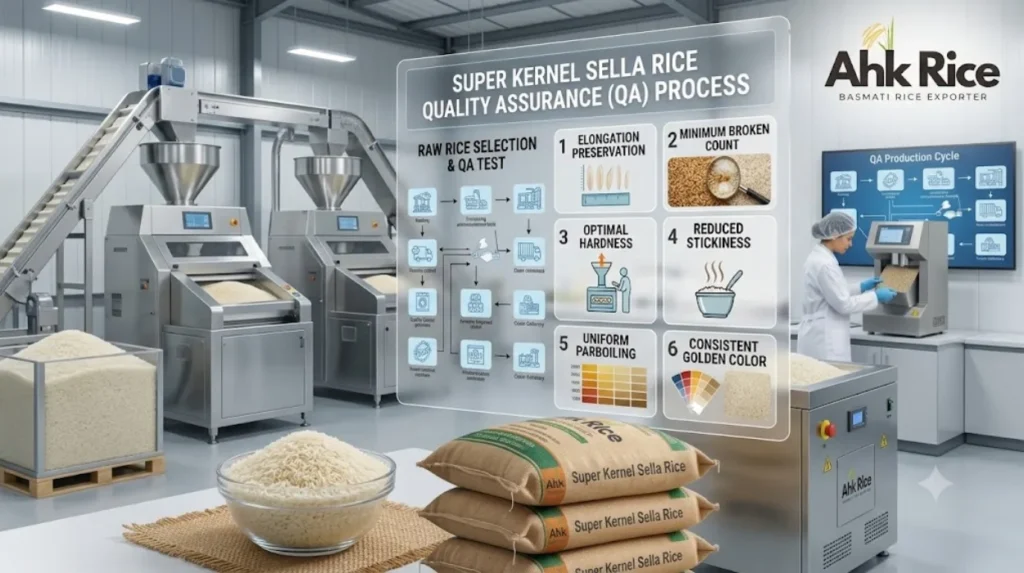
AHK Rice applies nine major processing stages:
- Clean the paddy
- Soak the grain
- Parboil the paddy
- Dry the grain
- De-husk the rice
- Polish the kernels
- Grade by size
- Sort by color
- Pack for export
Each stage reduces quality variation.
Laboratory Verification
Laboratory testing verifies product specifications before shipment.
Common tests include:
- Moisture analysis
- Grain length measurement
- Broken percentage verification
- Chalkiness evaluation
- Foreign matter testing
Export Inspection
Export inspection creates documented evidence.
Inspection agencies verify loading quality, packaging condition, and specification compliance before shipment dispatch.
With available solutions established, the next question is how these approaches compare.
How do different quality assurance approaches compare?
Laboratory testing delivers the highest measurement accuracy, optical sorting provides superior visual consistency, and multi-stage inspection offers the strongest overall quality protection.
Super Kernel Sella Rice Quality Assurance Comparison
Specification Comparison Table
| Attribute | Basic Inspection | Laboratory Testing | Optical Sorting | Multi-Stage QA System |
|---|---|---|---|---|
| Moisture Control | Limited | Excellent | Moderate | Excellent |
| Broken Control | Moderate | Excellent | Good | Excellent |
| Color Consistency | Limited | Moderate | Excellent | Excellent |
| Foreign Matter Detection | Moderate | Good | Excellent | Excellent |
| Documentation | Limited | Strong | Moderate | Strong |
| Shipment Reliability | Moderate | Good | Good | Excellent |
| Buyer Protection | Moderate | Good | Good | Excellent |
Laboratory testing quantifies quality through measurable values.
Optical sorting removes discolored kernels through camera-based technology.
Multi-stage systems combine laboratory testing, grading, sorting, and inspection.
This combination produces the most reliable export outcome.
With comparison methods explained, the next question becomes regional market preferences.
Which quality specifications do different export markets prefer?
Middle Eastern buyers prefer premium appearance grades, while African importers prioritize cooking stability, value, and lower landed cost structures.
Gulf Market Preferences
Countries including Saudi Arabia, UAE, Oman, Qatar, and Kuwait prioritize visual quality.
Preferred specifications include:
- 7.0 mm+ grain length
- 12–13% moisture
- 2–5% broken
- High color uniformity
Gulf hospitality buyers frequently select premium grades for restaurants and catering operations.
African Market Preferences
Countries including Kenya, Tanzania, South Africa, and Mozambique focus on value and performance.
Preferred specifications include:
- 5–15% broken
- Stable cooking yield
- Competitive container pricing
- Long storage capability
African wholesalers often prioritize affordability while maintaining acceptable appearance standards.
Price Per MT Comparison
| Market Region | Preferred Grade | Typical Price Position |
|---|---|---|
| UAE & GCC | Premium Super Kernel Sella | Higher |
| East Africa | Standard Export Grade | Moderate |
| Southern Africa | Value-Oriented Grade | Moderate |
| Hospitality Sector | Premium Grade | Highest |
Pakistan continues among the world’s leading rice exporters, supporting these markets through large-scale shipments (source: Pakistan Bureau of Statistics, FY2024-25).
With regional preferences clarified, the next question is determining which approach fits specific buyer requirements.
Which quality assurance method works best for different cases?
Premium hospitality buyers need multi-stage verification, wholesalers benefit from laboratory-certified grades, and price-sensitive importers often choose specification-based inspections.
Hospitality Buyers
Hotels require visual consistency.
Multi-stage quality systems provide superior appearance and cooking performance.
Retail Brands
Retail brands need reputation protection.
Laboratory-certified specifications support label claims and consumer confidence.
Government Tenders
Government procurement prioritizes documented compliance.
Third-party inspections create transparent verification.
Commodity Wholesalers
Wholesalers focus on balancing cost and quality.
Specification-based inspections reduce unnecessary processing costs.
Different buyer profiles require different solutions. The next question examines practical advantages and disadvantages.
What are the pros and cons of Super Kernel Sella Rice quality assurance systems?
Advanced quality assurance improves consistency, reduces disputes, increases buyer confidence, and supports repeat business, but it also increases processing and inspection costs.
Advantages
| Advantage | Example |
|---|---|
| Lower Claims | Reduced shipment disputes |
| Better Consistency | Uniform grain appearance |
| Stronger Reputation | Higher buyer retention |
| Export Compliance | Easier customs clearance |
| Longer Shelf Life | Better storage performance |
Disadvantages
| Limitation | Example |
|---|---|
| Higher Cost | Additional testing expenses |
| Longer Processing Time | Extra inspections |
| More Documentation | Greater administrative work |
| Equipment Investment | Optical sorting costs |
| Skilled Staff Requirement | Technical expertise needed |
Quality assurance creates measurable value despite additional costs.
Quality assurance also extends product stability during storage.
Shelf Life Comparison
| Product Condition | Expected Shelf Life |
|---|---|
| Standard White Rice | 12–18 Months |
| Super Kernel Sella Rice | 18–24 Months |
| Vacuum-Packed Product | Up to 24 Months |
In Gulf warehouses exceeding 40°C, Super Kernel Sella often maintains quality longer than white rice because parboiling strengthens kernel structure.
For importers maintaining strategic inventory, extended shelf life reduces stock rotation pressure.
With strengths and limitations evaluated, the final consideration involves selecting the correct supplier framework.
What decision factors should buyers evaluate before selecting a supplier?
Processing controls, testing frequency, documentation quality, inspection transparency, and shipment consistency determine long-term supplier performance.
Decision Framework Table
| Decision Factor | Importance | Evaluation Method |
|---|---|---|
| Processing Controls | High | Review factory procedures |
| Laboratory Testing | High | Request test reports |
| Inspection Records | High | Verify documentation |
| Packaging Standards | Medium | Examine samples |
| Shipment Consistency | High | Review previous orders |
Request specification sheets before finalizing contracts.
Review moisture reports before shipment approval.
Verify inspection records before container loading.
Assess packaging durability before market distribution.
Compare historical consistency before supplier selection.
Quality assurance ultimately protects margins, brand reputation, and customer satisfaction. The next step for buyers is evaluating suppliers that provide documented guarantees rather than verbal assurances.
Frequently Asked Questions
What moisture level is acceptable for Super Kernel Sella Rice?
12–13% moisture content is generally preferred for export shipments because it supports safe transportation and storage.
Why is parboiling important in quality assurance?
Parboiling strengthens grain structure and reduces breakage during milling, transportation, and handling.
How is grain length verified?
Laboratory measurement and grading systems verify grain length before packing and shipment dispatch.
Which market prefers premium Super Kernel Sella Rice grades?
GCC countries and hospitality buyers typically prefer premium appearance grades with low broken percentages.
What documents support quality assurance?
Inspection certificates, laboratory reports, packing lists, phytosanitary certificates, and certificates of origin commonly support export verification.
How often should export rice be tested?
Every production batch and every export shipment should undergo quality verification before loading.