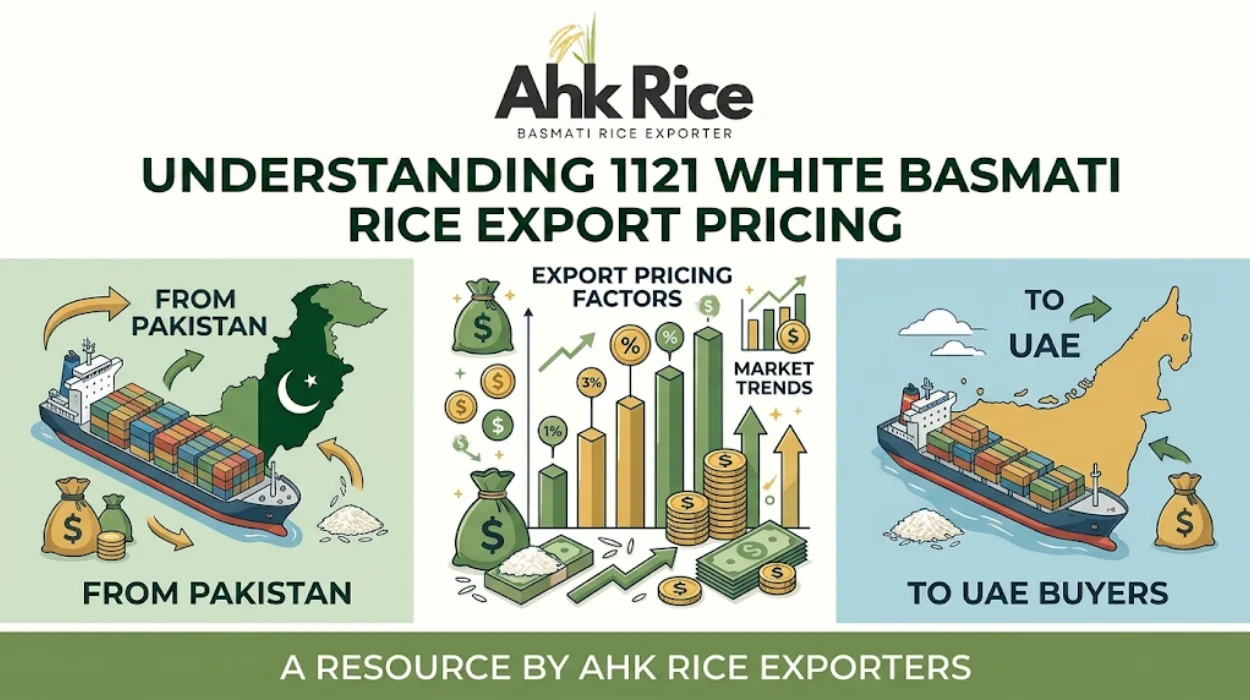
Understanding 1121 White Basmati Rice Export Pricing from Pakistan to UAE Buyers
1121 White Basmati rice export pricing depends on grain quality, milling specifications, export costs, freight charges, certifications, and market demand. Here is why: every stage, from cultivation in Pakistan to delivery in the UAE , adds measurable value that influences the final FOB and CIF price offered to importers.
Pakistan supplies a significant share of the world’s premium Basmati rice exports because Punjab produces long-grain aromatic varieties with high cooking performance (source: Pakistan Bureau of Statistics, FY2024–25). Among these varieties, 1121 White Basmati has become one of the most traded grades for supermarkets, wholesalers, distributors, and food service companies across the United Arab Emirates.
Understanding export pricing requires more than comparing quotations. Buyers need to understand how cultivation practices, processing quality, packaging specifications, logistics, inspection, and international shipping combine to determine the final export price. Knowing these factors helps importers compare quotations based on value instead of price alone.
This guide explains every component that influences 1121 White Basmati rice pricing from Pakistan to UAE buyers. It also prepares readers for a deeper discussion about FOB and CIF pricing structures, which is covered in our detailed guide on determining international rice quotations.
What Is 1121 White Basmati Rice?
1121 White Basmati rice is a premium aromatic long-grain rice cultivated in Pakistan and India. It delivers grain lengths exceeding 8.30 mm, cooks into extra-long separate grains, contains natural fragrance, and serves retail, hospitality, catering, and wholesale markets throughout the Middle East, Europe, North America, and Africa.
1121 White Basmati rice is a naturally aromatic variety belonging to the Basmati family. Farmers cultivate it primarily in Punjab, where fertile alluvial soil, controlled irrigation, and favorable climate produce consistent grain quality. The variety is known for its exceptionally long kernels, soft texture, and strong elongation after cooking.
Unlike parboiled rice, White Basmati undergoes complete milling without steam treatment. Rice mills remove the husk, polish the kernels, grade the rice by size, and sort defective grains before packaging. This process preserves the bright white appearance preferred by retail consumers across the UAE.
Where Is 1121 White Basmati Rice Grown?
Pakistan cultivates commercial quantities of 1121 White Basmati mainly in Punjab.
Major cultivation regions include:
- Hafizabad
- Gujranwala
- Sheikhupura
- Sialkot
- Narowal
- Mandi Bahauddin
These districts produce fertile soil conditions and adequate irrigation systems that support premium Basmati production.
How Is 1121 White Basmati Processed?
Export-quality rice follows a controlled production sequence.
- Clean the harvested paddy.
- Dry the grains to export moisture.
- De-husk the rice.
- Polish the kernels.
- Grade by grain length.
- Sort using colour sorters.
- Inspect laboratory samples.
- Pack according to buyer specifications.
- Load containers for export.
Each processing stage improves consistency, food safety, and commercial value.
Available Processing Grades
Exporters generally supply several processing grades, including:
| Grade | Typical Use |
|---|---|
| Premium Sortex | Premium retail brands |
| Double Sortex | Supermarkets |
| Single Sortex | Wholesale distribution |
| Silky Polish | Consumer packaging |
| Regular Polish | Food service |
| Head Rice | Premium cooking |
| Broken Rice | Industrial food production |
Every grade satisfies different quality specifications and pricing levels.
Typical Product Specifications
| Specification | Typical Value |
|---|---|
| Grain Length | 8.30 mm+ |
| Broken Grains | 0.5%–5% |
| Moisture | 12–13% |
| Purity | 95–99% |
| Crop | Current Harvest |
| Shelf Life | 24 Months |
These specifications directly influence export quotations because higher quality requires stricter grading and lower allowable defects.
UAE buyers frequently compare these quality parameters before evaluating export offers. Understanding the product itself creates the foundation for learning how export pricing actually works.
How Does 1121 White Basmati Rice Export Pricing Work?
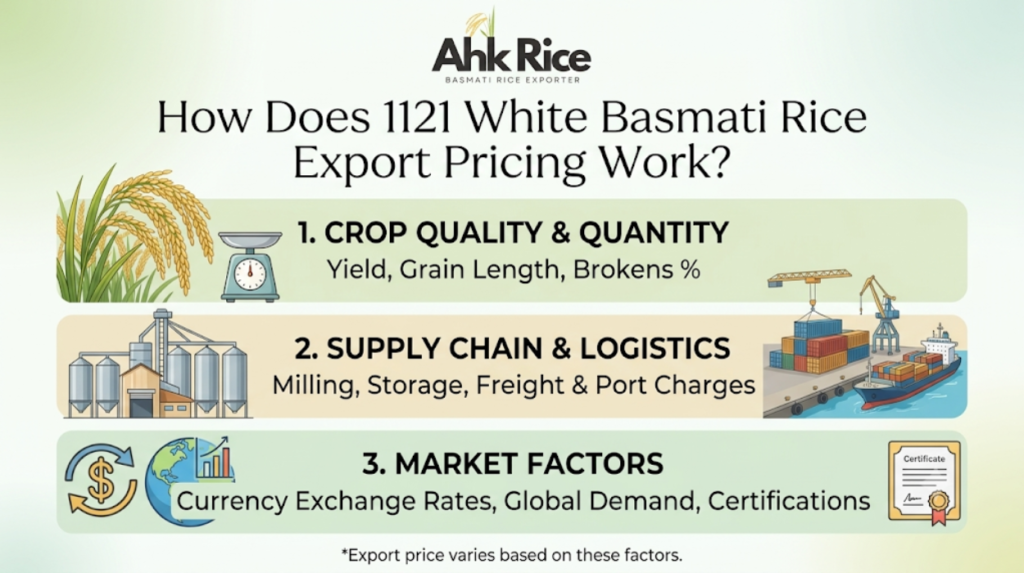
1121 White Basmati rice export pricing combines farm production costs, milling expenses, quality specifications, packaging, certifications, inland transport, port handling, ocean freight, insurance, and destination demand. Every cost component contributes to the final quotation, making export pricing a transparent calculation rather than an estimated figure.
Export pricing begins long before rice reaches the port. Farmers cultivate 1121 White Basmati during the Kharif season using irrigation, fertilizer management, and crop protection practices that determine yield and grain quality. Better cultivation produces longer grains, fewer broken kernels, and stronger aroma. These characteristics command higher export values.
Rice mills purchase harvested paddy and begin a controlled processing sequence. Each stage adds measurable value because the grain becomes cleaner, safer, and more uniform.
Which Cost Components Build the Export Price?
The export price consists of several identifiable components.
| Cost Component | Purpose |
|---|---|
| Paddy procurement | Raw material purchase |
| Milling | De-husking and polishing |
| Colour sorting | Remove defective grains |
| Grading | Separate grain sizes |
| Laboratory testing | Verify quality standards |
| Packaging | Protect rice during transport |
| Inland transportation | Deliver cargo to port |
| Customs clearance | Complete export formalities |
| Container loading | Prepare shipment |
| Ocean freight | Transport cargo to UAE |
| Marine insurance | Protect cargo value (CIF only) |
Each component contributes a fixed or variable amount to the final quotation.
What Is the Difference Between FOB and CIF Pricing?
International rice exporters commonly quote two pricing methods.
FOB (Free on Board) includes every cost until the loaded container is placed on the vessel at Karachi Port or Port Qasim. After loading, the buyer assumes responsibility for ocean freight and insurance.
CIF (Cost, Insurance, and Freight) includes all FOB costs plus marine insurance and freight charges to the destination port in the UAE. Buyers receive a delivered port price instead of arranging shipping independently.
Understanding these trade terms allows buyers to compare quotations correctly. The next step is identifying the specific factors that increase or decrease export prices.
What Factors Influence 1121 White Basmati Rice Export Pricing?
Export pricing changes according to grain quality, crop year, processing grade, packaging type, container availability, freight rates, exchange rates, certifications, and seasonal demand. Every factor has a measurable effect on the final export quotation offered to UAE buyers.
Grain Quality
Longer grains command higher prices because premium retail markets require uniform appearance and superior cooking performance.
Examples include:
- 8.40 mm+ premium grade
- 8.30 mm standard export grade
- 8.10 mm commercial grade
Higher grain length requires stricter grading, increasing production costs.
Processing Grade
Different milling standards produce different prices.
Premium Sortex rice undergoes multiple colour-sorting passes. Regular grades require fewer sorting cycles. Better processing reduces defects and improves visual quality.
Packaging Specifications
Packaging influences export costs through materials, printing, and handling.
Examples include:
- 1 kg retail bags
- 5 kg branded bags
- 10 kg family packs
- 25 kg PP bags
- 40 kg woven sacks
- 50 kg export bags
Retail packaging costs more because it includes laminated film, branding, and consumer labeling.
Certifications
Many UAE importers request internationally recognized certifications before placing orders.
Common certifications include:
- ISO 22000
- HACCP
- Halal Certification
- Phytosanitary Certificate
- Certificate of Origin
- Fumigation Certificate
Inspection and certification increase buyer confidence while adding defined compliance costs.
Freight Rates
Ocean freight changes throughout the year because shipping demand and container availability fluctuate (source: international container freight market reports, 2025). Freight increases directly affect CIF quotations while leaving FOB prices unchanged.
Exchange Rates
Rice exports are generally quoted in US dollars. Currency fluctuations influence exporter costs and purchasing power, affecting final quotations.
Every pricing factor explains why identical-looking rice can receive different quotations. Understanding these variables prepares buyers to evaluate the advantages of sourcing premium 1121 White Basmati rice from Pakistan rather than comparing prices alone.
What Are the Benefits of Understanding 1121 White Basmati Rice Export Pricing?
Understanding export pricing enables better supplier comparisons, accurate budgeting, stronger contract negotiations, improved quality evaluation, and reduced purchasing risks. Buyers who understand every pricing component select suppliers based on measurable value instead of choosing the lowest quotation.
Price alone does not determine the best purchase. Two quotations with a difference of USD 30 per metric ton often represent different quality specifications. One supplier may offer 99% purity, while another supplies 95% purity. One shipment may include 2% broken grains, while another allows 5% broken grains. Comparing only the price ignores these quality differences.
Understanding pricing also improves purchasing budgets. Importers can estimate the impact of freight changes, packaging upgrades, and certification requirements before requesting quotations. This approach reduces unexpected costs during procurement.
How Does Pricing Knowledge Help UAE Buyers?
Different buyer groups evaluate export prices differently because each market serves different customers.
| Buyer Type | Pricing Focus |
|---|---|
| Supermarkets | Premium appearance and branded packaging |
| Food distributors | Competitive wholesale pricing |
| Hotels | Uniform cooking performance |
| Restaurants | Long grain elongation |
| Catering companies | Value per serving |
| Retail importers | Consumer packaging and shelf appeal |
Each buyer benefits from understanding which pricing factors directly affect their business model.
Why Does Quality Matter More Than the Lowest Price?
Higher-quality rice produces better commercial results.
Premium 1121 White Basmati delivers longer cooked grains, fewer broken kernels, stronger aroma, and improved presentation. These characteristics increase consumer satisfaction and reduce product complaints.
Lower-priced rice often includes higher percentages of broken grains or mixed varieties. Such specifications reduce consistency and affect cooking performance.
How Does Pricing Transparency Improve Supplier Selection?
Transparent quotations simplify supplier comparisons.
Professional exporters identify each pricing element separately instead of presenting a single figure. Buyers understand how packaging, certifications, freight, and processing contribute to the final price.
Clear quotations also reduce misunderstandings during contract negotiations because both parties evaluate identical specifications.
Bridge: Understanding the benefits of pricing creates a foundation for examining the industries and applications that depend on premium 1121 White Basmati rice.
Where Is 1121 White Basmati Rice Commonly Used?
1121 White Basmati rice serves retail supermarkets, hotels, restaurants, catering companies, wholesalers, food distributors, and food processors. Every sector selects specific grades and packaging formats according to customer requirements, cooking methods, and commercial objectives.
Premium Basmati rice reaches many industries beyond household consumption. Its long grain, aroma, and cooking performance make it suitable for premium food applications across international markets.
Retail Supermarkets
Retail brands prefer polished, Sortex-cleaned rice packed in consumer-friendly sizes.
Common retail packs include:
- 1 kg
- 2 kg
- 5 kg
- 10 kg
These products emphasize shelf appearance, branding, and consistent quality.
Hotels and Restaurants
Hotels require uniform grain length because presentation influences customer experience.
Restaurants serving biryani, mandi, kabsa, and pulao select premium grades that maintain grain separation after cooking.
Catering Companies
Large catering businesses prioritize cooking yield and consistency.
Premium 1121 White Basmati expands significantly during cooking, allowing efficient portion control for large events and institutional kitchens.
Wholesale Distribution
Wholesale importers commonly purchase larger packaging.
Examples include:
- 20 kg PP bags
- 25 kg PP bags
- 40 kg woven bags
- 50 kg export bags
Large packaging reduces packing costs and simplifies warehouse handling.
International Markets
Pakistan exports 1121 White Basmati to numerous destinations.
Major importing regions include:
- United Arab Emirates
- Saudi Arabia
- Oman
- Qatar
- Kuwait
- Bahrain
- United Kingdom
- European Union
- Canada
- United States
- Australia
- East Africa
Growing demand in these markets supports continued international trade
What Are the Common Misconceptions About 1121 White Basmati Rice Export Pricing?
Several misconceptions create incorrect buying decisions. The lowest quotation does not guarantee the best value, FOB and CIF prices are not interchangeable, all 1121 White Basmati grades are not identical, and identical packaging does not indicate identical quality. Understanding these facts enables buyers to compare quotations accurately and purchase the correct specification.
Many first-time importers compare quotations using only the total price per metric ton. This approach ignores quality specifications, processing standards, certifications, and logistics costs. Export pricing represents the complete value of the product rather than a single number.
Misconception 1: The Lowest Price Is Always the Best Choice
Lower prices often reflect lower specifications.
Examples include:
- Higher broken grain percentage
- Lower grain length
- Reduced purity
- Basic polishing
- Fewer colour-sorting cycles
Premium rice requires stricter grading and additional inspection. These processes increase production costs while improving cooking performance and appearance.
Misconception 2: FOB and CIF Prices Mean the Same Thing
FOB and CIF quotations include different cost responsibilities.
FOB covers production, inland transportation, customs clearance, and vessel loading at the Pakistani port.
CIF includes every FOB expense plus marine insurance and ocean freight to the destination port in the UAE.
Comparing an FOB quotation with a CIF quotation produces incorrect purchasing decisions because the shipping costs differ.
Misconception 3: Every 1121 White Basmati Rice Grade Is Identical
Export grades vary significantly.
Differences include:
| Quality Factor | Premium Grade | Commercial Grade |
|---|---|---|
| Grain Length | 8.40 mm+ | 8.10–8.20 mm |
| Broken Grains | 0.5–1% | 5% |
| Purity | 99% | 95% |
| Colour Sorting | Multiple Passes | Standard Pass |
| Appearance | Bright White | Commercial White |
These differences directly influence both market acceptance and export pricing.
Misconception 4: Packaging Does Not Affect Export Costs
Packaging changes production and logistics costs.
Laminated retail bags require printing, sealing, and branding. Plain woven polypropylene bags cost less because they use simpler materials and faster packing processes.
Container loading efficiency also changes with different bag sizes. Efficient loading reduces handling costs during export operations.
Understanding 1121 White Basmati rice export pricing requires evaluating every stage of the supply chain. Cultivation, milling, grading, quality inspection, packaging, certifications, inland logistics, customs clearance, and ocean freight all contribute to the final quotation. Buyers who understand these components compare offers using measurable specifications instead of price alone.
Frequently Asked Questions
Why is 1121 White Basmati rice more expensive than ordinary long-grain rice?
1121 White Basmati rice commands a higher price because it offers extra-long grains, natural aroma, superior elongation after cooking, and stricter quality grading. Premium cultivation and processing increase production costs while delivering higher market value.
Which factors influence Pakistan’s export price of 1121 White Basmati rice?
Major pricing factors include crop quality, grain length, broken percentage, purity, milling quality, packaging, certifications, inland transportation, customs clearance, container availability, and ocean freight rates.
What is the difference between FOB and CIF pricing?
FOB (Free on Board) includes all costs until the rice is loaded onto the export vessel in Pakistan. CIF (Cost, Insurance, and Freight) includes FOB costs plus marine insurance and ocean freight to the destination port.
Why do different exporters offer different prices for similar rice?
Exporters apply different quality specifications, processing standards, packaging materials, certification levels, and logistics arrangements. Two quotations often represent different products despite sharing the same rice variety.
Which certifications are commonly required for exporting 1121 White Basmati rice?
Common export documents include ISO 22000, HACCP, Halal Certification, Phytosanitary Certificate, Certificate of Origin, Fumigation Certificate, and quality inspection reports, depending on the destination country’s import requirements.