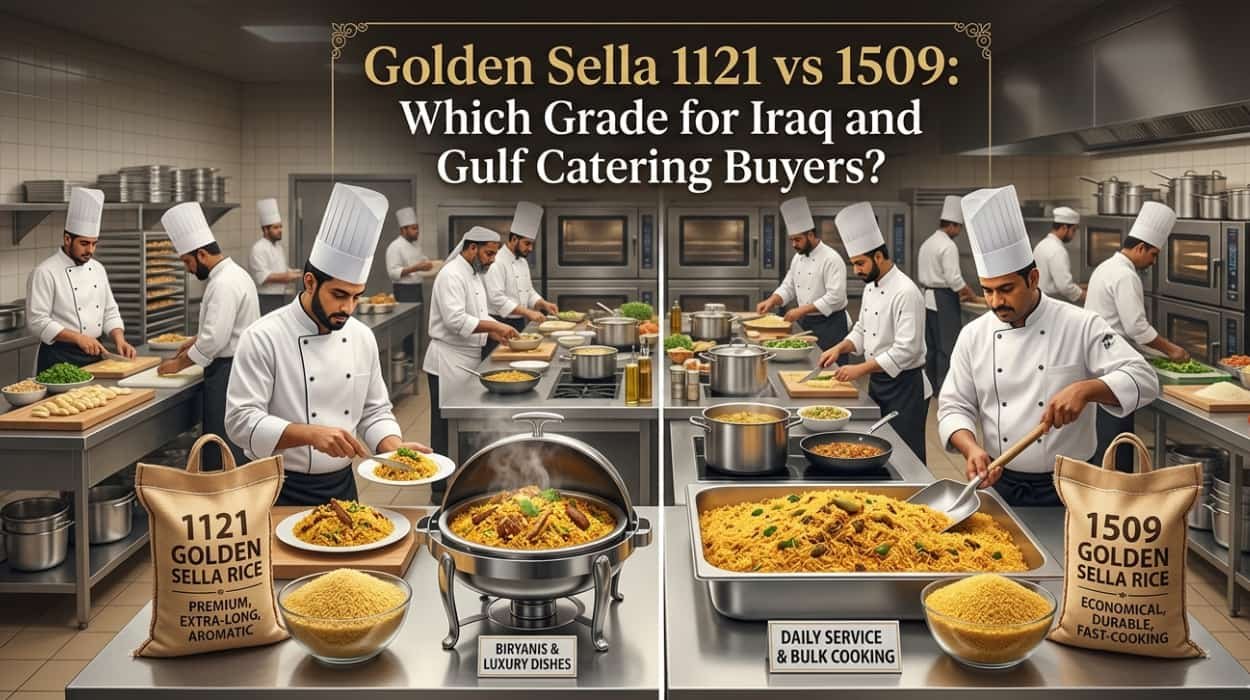
Golden Sella 1121 vs 1509: Which Grade for Iraq and Gulf Catering Buyers?
Golden Sella 1121 generally suits premium‑catering and high‑visibility‑banquet‑menus in the Iraq‑Gulf region, while Golden Sella 1509 works better for high‑volume‑institutional‑menus where cost‑per‑serving and stable‑yield matter more than extra‑length. Buyers who compare 1121 and 1509 by length, price, and shelf‑life can choose a Golden Sella grading‑mix that matches their catering‑volume, client‑tier, and working‑capital‑structure.
How do Golden Sella 1121 and 1509 differ in core specifications?
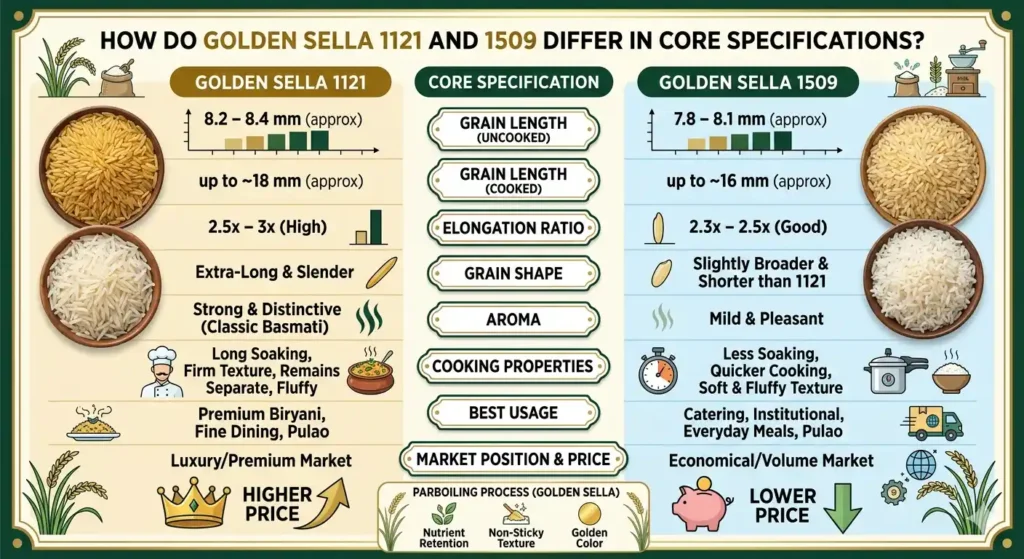
Golden Sella 1121 and 1509 differ in core specifications through grain‑length, expansion ratio, aroma‑intensity, colour‑consistency, and price‑band, which define their suitability for different catering tiers.
| Feature | 1121 Golden Sella | 1509 Golden Sella |
|---|---|---|
| Average raw grain length (mm) | 8.2–8.3 | 7.2–7.4 |
| Typical broken‑% (A‑grade) | 18–20% | 22–24% |
| Chalk limit (Max) | 1–2% | 2–3% |
| Moisture limit (Max) | 12.5% | 12.5% |
| Colour‑intensity | Bright, uniform‑golden‑yellow | Light‑golden to cream‑yellow |
| Aroma‑strength | High‑Basmati‑type | Moderate‑Basmati‑type |
| Primary use‑cases | Premium banquets, hotels, five‑star caterers | School‑canteens, hospitals, institutional‑feeding |
1121 Golden Sella stretches closer to 22 mm when cooked, making it visually‑impressive in plated‑dishes and high‑end‑buffets, while 1509 Golden Sella elongates less but offers a firmer‑texture and lower‑price‑per‑metric‑ton.
AHK Rice processes both grades through the same sella‑(parboiled)‑line, so they share the same‑steam‑and‑drying‑parameters but differ in raw‑varietal‑properties.
Buyers who want to understand how Golden Sella’s colour and nutrient‑profile arise from parboiling can review the earlier Golden Sella Basmati Rice: Nutrition Profile and Health Benefits Explained, which describes the soaking, steaming, and drying‑mechanisms behind Golden Sella.
How do Iraq and Gulf catering buyers price 1121 vs 1509 Golden Sella?
Iraq and Gulf catering buyers typically see 1121 Golden Sella priced 30–50 USD per metric ton above 1509 Golden Sella due to longer‑grain‑specifications, higher‑grade‑requirements, and stronger‑perception as a premium‑catering‑product.
AHK Rice quotes 1121 Golden Sella A‑grade in the 1,000–1,070 USD/MT FOB‑Karachi band for 18–20%‑broken, whereas 1509 Golden Sella A‑grade usually sits at 970–1,020 USD/MT for 22–24%‑broken. This 1121 vs 1509 gap can widen by 10–15 USD/MT when buyers demand tighter‑length‑tolerance, nitrogen‑flushing, or 1–5 kg‑retail‑packs for branded‑catering‑material.
In Iraq, 1121 Golden Sella commonly appears in:
- Government‑banquet‑contracts above 1,020 USD/MT CIF‑Basra.
- Private‑hotel‑and‑event‑catering at 990–1,040 USD/MT FOB‑Karachi.
In the Gulf (UAE, Saudi, Qatar), 1121 Golden Sella often sells at 1,010–1,080 USD/MT CIF‑Jebel‑Ali, while 1509 Golden Sella runs 980–1,030 USD/MT for the same‑volume‑band.
Catering buyers in the Iraq‑Gulf region therefore use 1121 Golden Sella for high‑visibility‑menus and 1509 Golden Sella for rotating‑institutional‑contracts, blending the two when they need to balance cost and colour.
How do shelf life and storage conditions compare between 1121 and 1509 Golden Sella?
Shelf life and storage conditions for 1121 and 1509 Golden Sella differ only slightly; both retain 18–24 months of best‑quality under cool‑dry‑conditions, with 1121 slightly more sensitive to colour‑fading if humidity exceeds 14%.
In cool‑dry warehouses (12–15°C, 50–60%‑relative‑humidity), unopened 50‑kg‑PP‑bags of 1121 Golden Sella and 1509 Golden Sella stay within premium‑quality for 18–24 months, with 1121 sometimes showing a 2–3‑month‑edge in colour‑retention because its longer‑grain‑structure resists moisture‑absorption better.
In hot‑humid‑warehouses (30–40°C, 65–70%‑humidity), 1121 Golden Sella‑packs often stay within premium‑quality for 12–18 months, whereas 1509 Golden Sella can lose some of its golden‑hue after 10–14 months, especially without inner‑poly‑liners or nitrogen‑flushing.
Catering buyers in Iraq and the Gulf who store Golden Sella in basic‑PP‑bags must monitor moisture‑levels closely, because exceeding 14% can trigger flavour‑loss and harder‑grains in both 1121 and 1509 Golden Sella.
How do 1121 and 1509 Golden Sella perform in different catering‑cases?
1121 and 1509 Golden Sella perform differently in Iraq‑Gulf‑catering cases, with 1121 preferred for high‑end‑banquets and 1509 favoured for high‑volume‑institutional‑feeds.
A 5‑row‑decision‑framework helps catering buyers choose which grade to stock more heavily:
| Factor | Strategy for 1121 Golden Sella | Strategy for 1509 Golden Sella |
|---|---|---|
| Target segment (examples) | Five‑star hotels, embassies, premium events, luxury cafés | Government schools, hospitals, military canteens, construction‑camps |
| Price sensitivity | Low‑to‑moderate, accepts 10–15% premium | High, pushes 5–10% price‑difference tolerance |
| Menu‑visibility | High‑visibility plated‑dishes, gallery‑buffets | Buffet‑trays, portion‑boxes, mass‑serving |
| Shelf‑life priority | 18–24 months, colour‑retention‑critical | 15–20 months, cost‑and‑texture‑dominant |
| Stock‑role | Image‑core, margin‑driver, branded‑catering | Rotation‑core, high‑volume, blended‑loads |
Buyers who cater to Iraq‑Gulf‑embassy‑events typically keep 60–70% of their Golden Sella inventory as 1121, using 30–40% 1509 Golden Sella for blending or value‑menus. Institutional‑caterers invert this, making 1509 Golden Sella the primary‑stock and 1121 Golden Sella a limited‑premium‑add‑on.
What are the pros and cons of 1121 Golden Sella vs 1509 for caterers?
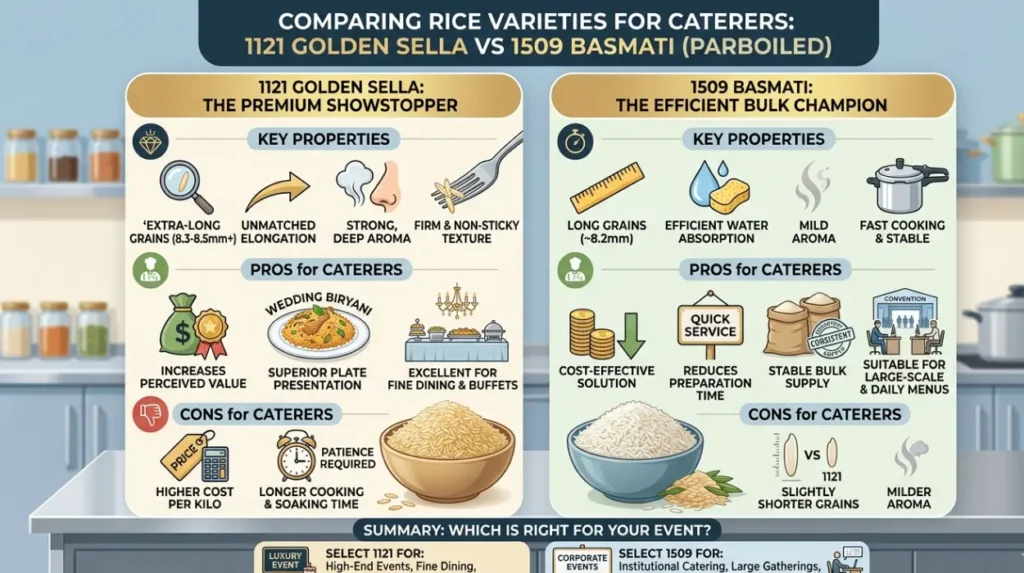
The pros and cons of 1121 Golden Sella vs 1509 for caterers revolve around image‑value, price‑per‑serving, texture, shelf‑life, and working‑capital‑exposure rather than any single‑technical‑failure‑point.
Pros of 1121 Golden Sella:
- Extra‑length and strong‑aroma suit high‑end‑banquets and visible‑buffet‑lines.
- Bright‑golden‑hue signals premium‑quality and festive‑occasion to guests.
- Slightly better moisture‑resistance helps preserve colour in long‑storage‑cycles.
Cons of 1121 Golden Sella:
- 30–50 USD/MT premium narrows gross‑margins in high‑volume‑contracts.
- Colour‑and‑length‑consistency expectations raise grading‑pressure and re‑inspection‑risk.
- Seasonal‑demand spikes can create short‑term‑overstocking situations.
Pros of 1509 Golden Sella:
- Lower‑cost‑base supports higher‑turnover‑and‑volume‑contracts in schools, hospitals, and construction‑sites.
- Slightly greater‑grain‑toughness reduces breakage in large‑portion‑holds and transport.
- Softer‑colour‑tone hides minor‑imperfections, easing buyer‑acceptance thresholds.
Cons of 1509 Golden Sella:
- Shorter‑grain‑length makes it less impressive in plated‑presentation‑dishes.
- More vulnerable to colour‑fading if stored in high‑humidity without proper packaging.
AHK Rice builds 1121 and 1509 Golden Sella on the same‑end‑to‑end‑processing line, so buyers can request custom‑blends, 50‑kg‑bulk‑bags, or 1–5 kg‑retail‑packs tailored to their Iraq‑Gulf‑catering‑mix.
What decision‑factors should Iraq and Gulf catering buyers consider?
Iraq and Gulf catering buyers should consider decision‑factors such as client‑tier, portion‑volume, margin‑target, shelf‑life‑expectation, and packaging‑level when choosing between 1121 Golden Sella and 1509 Golden Sella.
High‑end‑clients (five‑star hotels, embassies, corporate events) usually justify 1121 Golden Sella because the visual‑impact supports higher‑billing‑rates and brand‑image, whereas volume‑clients (schools, hospitals, military) often prefer 1509 Golden Sella to control COGS per‑serving.
Buyers who need to justify Golden Sella‑selection in tenders can reference 1121’s greater‑expansion‑ratio and colour‑consistency as qualitative‑advantages, while 1509’s lower‑price and higher‑toughness suit quantitative‑tender‑calculations.
For buyers who want to speed up 1121 Golden Sella‑procurement for urgent‑Iraq‑Gulf‑orders, the AHK Rice 1121 Golden Sella 24‑hour‑export‑quote‑importers explains how to request a rapid‑FOB‑or‑CIF‑offer that accounts for bag‑specifications, volume‑band, and shipping‑route.