Understanding Rice Processing and Container Loading Timelines Before Export
Rice processing and container loading timelines directly affect export quality, shipment schedules, and buyer inventory planning. Here is why: every processing stage, inspection requirement, packaging specification, and container loading activity adds measurable time before export. Buyers who understand these timelines reduce delays, improve procurement planning, and secure consistent rice quality.
International rice buyers evaluate more than price. Buyers assess milling schedules, grading standards, fumigation requirements, quality inspections, packaging lead times, and vessel booking availability. Pakistani Basmati exporters process rice through multiple controlled stages before loading containers for shipment. Understanding each stage helps importers select the correct sourcing strategy and avoid supply chain disruptions.
AHK Rice provides complete rice processing and export services for 1121, Super Kernel, and 1509 Basmati varieties. Buyers researching export preparation can first review our educational guide on how premium Pakistani Basmati moves from harvested paddy through modern milling stages before comparing export timelines.
What happens between rice processing and container loading?
The complete export preparation process normally requires 10–25 days, depending on grade selection, packaging requirements, quality testing, and vessel schedules.
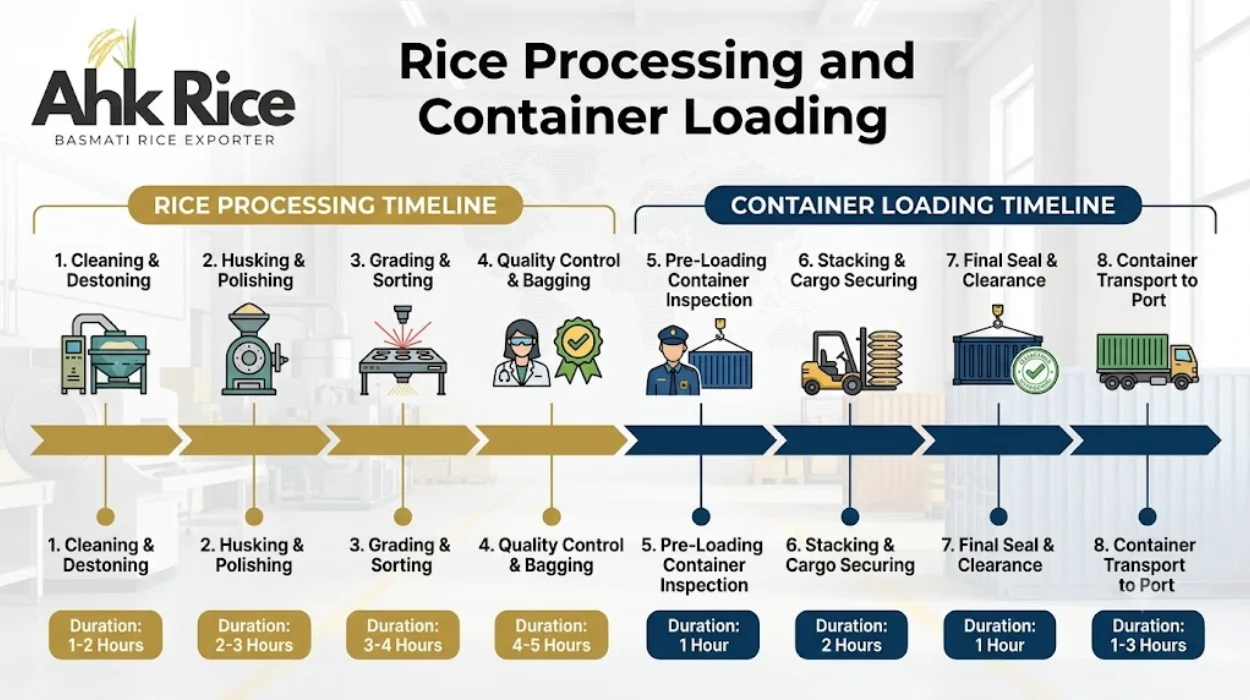
Rice processing begins after paddy procurement and quality verification. Export-grade rice passes through several controlled operations before container loading.
What are the 9 processing steps before export?
- Clean the paddy.
- De-husk the grain.
- Separate immature kernels.
- Polish the rice.
- Grade by length.
- Sort by color.
- Test moisture levels.
- Inspect export specifications.
- Pack and palletize bags.
Each stage serves a specific quality objective. Cleaning removes foreign matter. Length grading separates premium kernels. Color sorting removes defective grains. Moisture testing protects shelf life.
Exporters inspect rice repeatedly because international buyers require specification consistency. Gulf retailers, European distributors, and African wholesalers often maintain different acceptance standards.
Processing time varies by product type. Steam rice requires fewer production stages. Golden Sella rice requires soaking, parboiling, drying, milling, and grading. This additional processing increases preparation time.
With processing stages established, the next question becomes which export preparation solution best matches buyer requirements.
What are the available solutions for rice processing and export preparation?
The three main solutions are White Rice, Steam Rice, and Golden Sella Rice processing, with preparation periods ranging from 7 to 25 days.
Buyers select processing methods according to market demand, storage conditions, and pricing objectives.
Processing Solution Comparison
| Attribute | White Rice | Steam Rice | Golden Sella Rice |
|---|---|---|---|
| Processing Time | 7–12 Days | 10–18 Days | 15–25 Days |
| Colour | White | Creamy White | Golden Yellow |
| Moisture Target | 12–14% | 12–14% | 12–14% |
| Shelf Life | 12 Months | 12–18 Months | 18–24 Months |
| Cooking Expansion | 2.0x | 2.5x | 3.0x |
| Processing Complexity | Low | Medium | High |
| Export Demand | Europe | Middle East | Africa & Gulf |
White Rice Processing
White rice undergoes cleaning, de-husking, polishing, grading, and packaging. Buyers seeking rapid shipment schedules frequently select white rice because processing requirements remain straightforward.
European supermarkets commonly procure white Basmati for retail shelves. Importers often prioritize appearance and shorter lead times.
Steam Rice Processing
Steam rice receives controlled steaming before milling. The process improves grain strength and reduces breakage during transport.
Middle Eastern importers frequently select steam rice because restaurants require long grains with strong cooking performance.
Golden Sella Processing
Golden Sella rice undergoes soaking, parboiling, drying, milling, grading, and sorting. This method strengthens kernels and improves storage stability.
African wholesalers often choose Golden Sella because warehouses experience higher temperatures. Gulf catering suppliers also prefer Golden Sella for bulk food service applications.
With available processing solutions explained, the next step is comparing timeline performance across export scenarios.
How do different processing and loading approaches compare?
Golden Sella requires the longest preparation period, while White Rice offers the fastest route to container loading.
Processing timelines influence procurement decisions as much as price.
Timeline Comparison by Export Activity
| Export Activity | White Rice | Steam Rice | Golden Sella |
|---|---|---|---|
| Raw Material Procurement | 1–3 Days | 1–3 Days | 1–3 Days |
| Processing | 3–5 Days | 5–8 Days | 8–12 Days |
| Quality Inspection | 1–2 Days | 1–2 Days | 1–2 Days |
| Packaging | 1–3 Days | 1–3 Days | 1–3 Days |
| Container Loading | 1–2 Days | 1–2 Days | 1–2 Days |
| Total Timeline | 7–12 Days | 10–18 Days | 15–25 Days |
Golden Sella lasts longer than Steam Rice. In Gulf warehouses operating near 40°C, Golden Sella maintains quality for up to 24 months. Steam rice performs best within 18 months. White rice performs best within 12 months.
Steam rice delivers stronger grains than white rice. Restaurant operators benefit from reduced breakage during cooking. Catering suppliers gain improved consistency during bulk preparation.
White rice reaches loading readiness faster than both alternatives. Retail importers operating on seasonal promotions often prioritize shorter lead times.
Processing strategy influences loading schedules, which leads directly to regional market preferences.
Which processing method works best for different export markets?
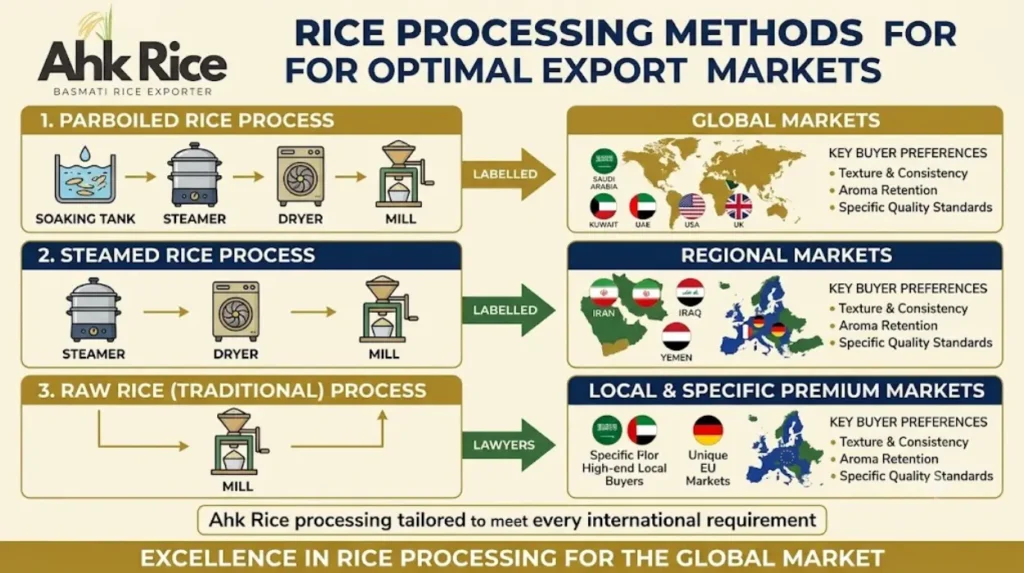
Middle Eastern buyers generally prefer Steam Rice, while African markets often select Golden Sella grades for storage durability and cooking expansion.
Regional preferences influence both processing choices and shipment planning.
Middle East Market Preferences
Countries including Saudi Arabia, UAE, Qatar, Oman, and Kuwait import substantial quantities of premium Basmati rice (source: REAP export data, December 2025).
Preferred grades include:
- 1121 Steam Basmati
- Super Kernel Steam Basmati
- 1121 White Basmati
Importers prioritize grain appearance, cooking length, and restaurant performance.
Typical export prices:
| Grade | Average Price Per MT |
|---|---|
| 1121 White | $900–1,100 |
| 1121 Steam | $1,000–1,250 |
| Super Kernel Steam | $900–1,150 |
African Market Preferences
Countries including Kenya, South Africa, Senegal, and Nigeria import large volumes of parboiled rice (source: Pakistan Bureau of Statistics, FY2024-25).
Preferred grades include:
- 1121 Golden Sella
- 1509 Golden Sella
- IRRI-based parboiled grades
Importers prioritize storage life, transport durability, and value pricing.
Typical export prices:
| Grade | Average Price Per MT |
|---|---|
| 1509 Golden Sella | $850–1,050 |
| 1121 Golden Sella | $950–1,250 |
| Super Kernel Golden Sella | $900–1,150 |
Market preferences explain product selection. The next consideration is evaluating advantages and limitations.
What are the pros and cons of each export preparation approach?
White Rice delivers speed, Steam Rice balances quality and efficiency, and Golden Sella maximizes durability and storage performance.
White Rice
Advantages
- Faster production schedules
- Lower processing costs
- Premium retail appearance
Disadvantages
- Shorter shelf life
- Higher breakage risk
- Greater sensitivity to storage conditions
Steam Rice
Advantages
- Stronger kernels
- Better cooking consistency
- Balanced production timeline
Disadvantages
- Higher processing cost
- Longer preparation period
Golden Sella Rice
Advantages
- Extended shelf life
- Superior storage performance
- Strong grain structure
Disadvantages
- Longest processing cycle
- Additional energy requirements
- Higher inventory planning needs
These strengths and limitations create a practical framework for selecting the correct export solution.
Which decision factors should buyers evaluate before ordering?
The most important factors are lead time, destination market, storage conditions, packaging requirements, and budget targets.
Buyer Decision Framework
| Decision Factor | White Rice | Steam Rice | Golden Sella |
|---|---|---|---|
| Fast Shipment Needed | Excellent | Good | Moderate |
| Retail Appearance Priority | Excellent | Good | Moderate |
| Long Storage Requirement | Moderate | Good | Excellent |
| Catering Use | Good | Excellent | Excellent |
| High-Temperature Warehousing | Moderate | Good | Excellent |
Lead time affects purchasing schedules. Buyers with urgent inventory requirements usually choose white rice.
Storage conditions influence grade selection. Importers using non-climate-controlled warehouses generally achieve better results with Golden Sella.
Packaging requirements affect loading preparation. Custom retail packaging increases preparation time compared with standard PP bags.
Budget objectives influence grade selection. Steam rice often balances quality and cost more effectively than premium Golden Sella.
With decision factors defined, buyers can evaluate export schedules more accurately before placing orders.
Rice processing and container loading timelines determine export readiness, shipment reliability, and inventory planning accuracy. White Rice offers the fastest preparation route. Steam Rice provides a balance between efficiency and performance. Golden Sella delivers the strongest storage and logistics advantages. Buyers who understand processing timelines make more accurate purchasing decisions and reduce supply chain disruptions.
Frequently Asked Questions
How long does rice processing take before export?
Rice processing generally requires 7–25 days. White Rice processes fastest. Golden Sella requires the longest preparation period because of parboiling and drying stages.
How long does container loading require?
Container loading normally requires 1–2 days. Inspection schedules, fumigation requirements, and port procedures influence loading duration.
Which rice grade has the longest shelf life?
Golden Sella rice provides the longest shelf life. Properly stored Golden Sella remains stable for up to 24 months.
Which markets prefer Steam Rice?
Saudi Arabia, UAE, Qatar, Kuwait, and Oman commonly import Steam Basmati rice for retail and food service sectors.
Why do export timelines vary?
Processing methods, packaging specifications, laboratory testing, fumigation requirements, and vessel booking schedules influence total export timelines.